Direct Characterization of Halogen-Based Microplastics via Single-Event ICP-Mass Spectrometry in Negative-Ion Mode
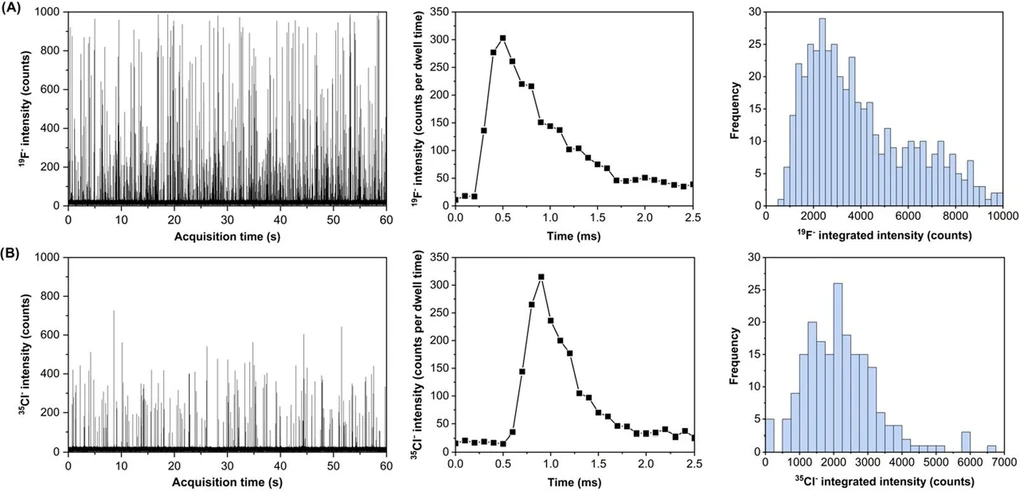
Anal. Chem. (2026) 98 (31): 22977–22987: Figure 3. Single-event nICP-MS time-resolved signal, average duration of the individual events, and frequency versus integrated intensity distribution for a 3 μm PTFE (A) and 3 μm PVC particles (B).
This study introduces negative-ion single-event ICP-MS as a direct method for particle-resolved characterization of halogen-containing microplastics. By monitoring F⁻ and Cl⁻ ions on a quadrupole ICP-MS, the approach enables selective detection of PTFE and PVC particles without plasma modifiers or proxy-ion chemistry.
After optimization, reliable transient detection was achieved with a 100 μs dwell time. Size detection limits reached 0.68 μm for PTFE and 0.45 μm for PVC using high-efficiency sample introduction, demonstrating that negative-ion ICP-MS can expand direct microplastic analysis beyond conventional carbon-based or indirect fluorine detection strategies.
The original article
Direct Characterization of Halogen-Based Microplastics via Single-Event ICP-Mass Spectrometry in Negative-Ion Mode
Antonio Bazo; Eduardo Bolea-Fernandez; Ana Rua-Ibarz; Martín Resano; Hamid Badiei; David Clases; Andrea Raab; Jörg Feldmann; Raquel Gonzalez de Vega *
Anal. Chem. (2026) 98 (31): 22977–22987.
licensed under CC-BY 4.0
Selected sections from the article follow. Formats and hyperlinks were adapted from the original.
Microplastics are ubiquitous across natural and engineered systems, but their direct chemical characterization at the level of individual particles remains a major unresolved analytical challenge. (1−3) Existing spectroscopic approaches can provide polymer-specific information, yet they often trade chemical specificity for throughput, struggle with smaller particle sizes, or are not readily suited to the direct analysis of heterogeneous particle suspensions. (4−6) As a result, a critical capability remains missing: the rapid, event-resolved chemical discrimination of large numbers of individual microplastic particles in dispersed samples. Time-resolved mass spectrometric particle detection offers a promising route to close this gap as it enables high-throughput interrogation of individual particles while preserving chemically informative elemental signatures. (7)
In this context, single-event inductively coupled plasma-mass spectrometry (single-event ICP-MS) provides a powerful analytical tool in which discrete transient signals originating from individual particles can be used to derive particle number concentrations, size-related information, and chemical differentiation. (8−11) Most ICP-MS-based strategies for microplastic analysis rely on carbon as a broadly applicable polymer marker; (12−14) however, substantially greater chemical selectivity can be achieved by targeting heteroatoms intrinsic to specific polymer types. In this context, heteroatom- and label-based approaches have already demonstrated the value of single-event ICP-MS for particle counting and discrimination, (15, 16) yet its extension toward direct halogen-resolved characterization remains incomplete.
For fluorinated polymers in particular, this gap reflects a fundamental analytical limitation. Fluorine is difficult to determine by conventional positive-ion ICP-MS because its first ionization potential (17.42 eV) exceeds that of argon (15.76 eV), resulting in low ionization efficiency. As a consequence, fluorine analysis in ICP-MS has commonly relied on indirect strategies, most notably the detection of reaction products or proxy ions such as BaF+. (17−21) These approaches have enabled important advances, but they also introduce an additional layer of chemistry between analyte and measurement and are not equivalent to direct event-resolved fluorine detection of individual particles. Establishing a direct route to fluorine-selective single-particle analysis would therefore address a long-standing measurement challenge and expand the analytical scope of single-event ICP-MS.
Chlorine-containing polymers represent a related but distinct case. Chlorine has already been explored as an informative target in ICP-MS-based microplastic analysis, (22) and prior work has shown that chlorine signals can support selective polymer differentiation. (23) Even so, a unified analytical strategy capable of directly targeting both fluorine- and chlorine-containing particles in an event-resolved manner would substantially broaden the chemical scope of elemental particle analysis. Such a strategy would be especially valuable since it would extend direct ICP-MS-based particle analysis to polymer types that remain difficult to access within existing workflows.
Negative-ion ICP-MS offers such an opportunity. (24−26) Elements that readily form anions can, in principle, be monitored directly in negative mode, opening an alternative analytical window for selective particle characterization. Despite this conceptual promise, no studies have previously reported the use of negative-ion detection for single-event analysis, including applications to microplastic characterization. The central analytical question is therefore not only whether negative-ion mode detection is feasible, but whether it can provide sufficiently selective, sensitive, and quantitatively interpretable event signals for chemically distinct halogen-containing polymer particles.
In this work, we address this gap by establishing single-event negative-ion mode ICP-MS (single-event nICP-MS) for direct characterization of halogen-based microplastics. By targeting F– and Cl– signals, the method enables event-resolved detection of PTFE and PVC particles without relying on proxy-ion chemistry. Beyond demonstrating feasibility, we evaluate instrumental conditions that govern signal generation and transport, compare sample introduction strategies, and assess multiple quantification routes for converting transient event signal intensities into particle information. The aim is to define the analytical figures of merit, constraints, and opportunities of this measurement concept.
To establish the method under controlled conditions, commercially available PTFE and PVC particle standards were first characterized independently and then used as model systems for single-event nICP-MS. This design allows direct assessment of signal behavior, size-dependent response, and quantification performance for two analytically relevant halogen-containing polymer types. More broadly, the study positions negative-ion mode single-event ICP-MS as a new route for direct, chemically selective particle analysis and expands the range of accessible elements in particle-resolved ICP-MS.
Experimental Section
Instrumentation
All measurements were carried out using a NexION 2000 ICP-MS (PerkinElmer Inc., USA) configured for operation in negative-ion mode. To enable negative-ion mode detection, the detector and its associated power supply boards were replaced as described previously. (26) The remaining ion-optical and mass-filter components, such as the quadrupole drivers and electrostatic lenses, are inherently bipolar and therefore can operate under both positive or negative voltages as needed. To minimize the contribution of fluorine-based contamination to the background signal, internal fluoropolymer material (e.g., tubing, seals, vacuum grease) was replaced with other material to the extent possible. The instrument interface was equipped with standard nickel skimmer and hyperskimmer cone (skimmer with a 0.6 mm aperture ID, and 1 mm for the hyperskimmer). To enhance sensitivity for fluorine and chlorine, a custom-modified sampler cone featuring a tapered tubular geometry was used. This design was improved by recent mechanistic evidence indicating that negative ion formation via electron capture or Penning ionization occurs predominantly postsupersonic expansion behind the sampler aperture. To optimize this process, the cone was engineered to maximize electron cosampling and extend analyte-electron residence times within the interface while maintaining a stable gas load. Specifically, the modified sampler was fabricated with a 4 mm long tapered tubular internal channel, featuring an entrance diameter of 2 mm and an exit diameter of 1 mm. This configuration preserves standard vacuum integrity while significantly improving ionization efficiency compared to conventional commercial geometries. A standard Fassel-type torch with a 1.5 mm injector ID was used. Two sample introduction configurations were evaluated: a traditional cyclonic spray chamber and a high-efficiency sample introduction system (Glass Expansion, Australia). Instrument settings and operating conditions are summarized in Table S1. For the characterization of the PTFE particles, SEM images were obtained using an Inspect F50 (FEI Company).
Results and Discussion
Figures of Merit
Following optimization of the instrument settings and operating conditions for single-event nICP-MS analysis, Figure 3 shows the time-resolved signals, the frequency versus integrated intensity distributions, and the average signal events for 3 μm PTFE (Figure 3A) and 3 μm PVC (Figure 3B) particles. As shown, single-event nICP-MS produces the expected time-resolved signal comprising discrete particle events distributed across the acquisition period, which in turn generates the corresponding frequency–integrated intensity distribution. These results demonstrate that negative-ion mode can be effectively implemented for single-event ICP-MS at microsecond dwell times, (36) enabling the characterization of elements prone to anion formation or that exhibit difficulties forming positive ions. In this context, it may represent a significant advancement for the selective analysis of micrometer-sized halogen-based polymeric particles (i.e., microplastics), allowing both detection and size characterization through direct monitoring of F– and Cl– anions.
Anal. Chem. (2026) 98 (31): 22977–22987: Figure 3. Single-event nICP-MS time-resolved signal, average duration of the individual events, and frequency versus integrated intensity distribution for a 3 μm PTFE (A) and 3 μm PVC particles (B).
The average peak profiles of the individual events appear broader, with an asymmetric right-hand tail, than those typically observed in positive mode (average duration for individual events = 1680 ± 547 μs and 1540 ± 351 μs for 3 μm PTFE and 3 μm PVC particles, respectively). The broader and asymmetric single-event peak profiles observed in negative-ion mode likely reflect fundamental differences in anion formation compared to conventional positive-ion ICP-MS. While positive ions are generated directly within the high-temperature plasma, negative ions are predominantly formed via postplasma electron attachment, occurring within the expanding interface region and early ion optics. As this process is spatially distributed rather than confined to a localized plasma zone, anion formation is expected to proceed over an extended region, leading to increased temporal dispersion of the resulting ion cloud. In addition, electron attachment inherently involves collisional processes, which have previously been shown to induce peak broadening in single-event ICP-MS under collision/reaction conditions. (28) Together, these effects provide a plausible explanation for the longer event durations and asymmetric peak shapes (possibly a Boltzmann distribution) observed in negative-ion single-event measurements. (37)
Characterization of F- and Cl-Containing Polymer-Based Microparticles
To convert the integrated intensity of each event into the corresponding analyte mass per particle and subsequently calculate the particle size and size distribution of a particle population, appropriate calibration strategies must be established. Single-event pICP-MS often relies on metallic nanoparticle (NP) standards, such as AuNPs, to determine a correction factor, often referred to as TEionic, that enables calibration with ionic standards of the target analyte. (42) However, these NP standards do not form anions suitable for detection in single-event nICP-MS, thus necessitating alternative calibration strategies compatible with negative-mode operation.
In this context, existing strategies developed for single-event pICP-MS were evaluated for their potential adaptation to negative-ion mode, using PTFE and PVC particles as model F- and Cl-containing particles. The approaches assessed include methods that are independent of TE determination (i.e., external calibration) as well as those that depend on TE (i.e., particle size, particle frequency, and waste collection). (43) The results obtained for each strategy using both types of sample introduction systems are summarized in Figure 4.
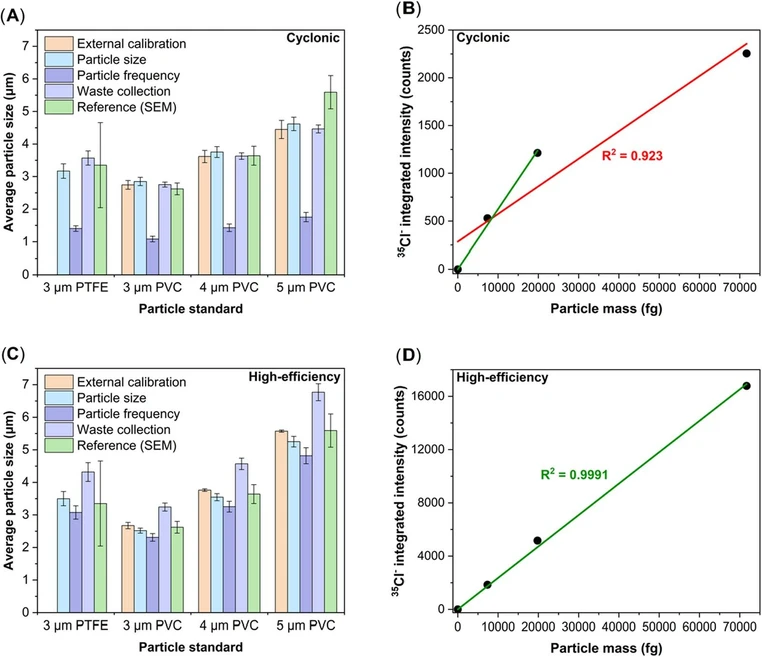 Anal. Chem. (2026) 98 (31): 22977–22987: Figure 4. Comparison of the results obtained for the characterization of PTFE and PVC particle standards using different quantification strategies (A, C) and their corresponding calibration curves (B, D) obtained with the cyclonic spray chamber and the high-efficiency spray chamber for sample introduction, respectively. The error bars of the sizes determined by single-event nICP-MS represent the combined uncertainty, calculated as discussed elsewhere. (43) The uncertainty in the SEM results corresponds to the standard deviation (n ≈ 200). The green solid lines represent the linear range of the external calibration, while the red solid line illustrates the loss of linearity for the cyclonic spray chamber when fitting the calibration curve including the 5 μm PVC particle standard.
In this work, while appropriate PVC particle standards were available for Cl, F determination relied only on the 3 μm (3.35 ± 1.31 μm; Figure 5C) PTFE standard, which could be used for external calibration of other samples but is not meaningful for calibrating itself. The 0.2 μm (0.21 ± 0.05 μm; Figure 5A) and 1 μm (0.24 ± 0.07 μm; Figure 5B) PTFE standards fell below the detection limit (0.68 μm). In addition, the 8 μm PTFE material consisted of large fibers that clogged the nebulizer (Figure 5D). As a result, external calibration could only be applied to the size determination of PVC particles, yielding highly accurate and precise results for all standards except the 5 μm PVC particles introduced using a cyclonic spray chamber (Figure 4A). This bias in the sizing of these particles can be attributed to the discrimination of the larger particle fraction occurring in low-efficiency sample introduction systems, which are not suitable for introducing micrometer-scale particles. Under these conditions, only the smaller fraction of the particle population was efficiently transported, resulting in fewer recorded events, an underestimation of the integrated intensities, and therefore an underestimation of mass and size. This effect is clearly reflected in the loss of linearity shown in Figure 4B (R2 = 0.923 when the data point for the larger 5 μm PVC particles is included, and 0.997 when it is excluded). In contrast, the use of the high-efficiency sample introduction system (Figure 4C) maximized transport for this particle-size range (3–5 μm; R2 = 0.9991), extending the linear range and improving method accuracy, as demonstrated in Figure 4D.
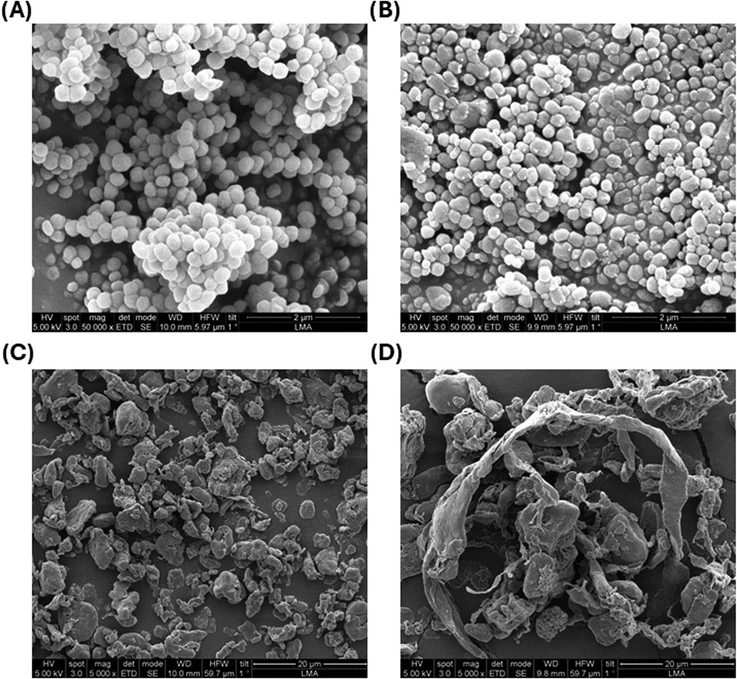 Anal. Chem. (2026) 98 (31): 22977–22987: Figure 5. Representative SEM images of the 0.2 (A), 1 (B), 3 (C), and 8 (D) μm PTFE particles analyzed in this work
Conclusions and Future Perspectives
In this work, we demonstrate, for the first time, the feasibility and analytical potential of negative-ion mode single-event ICP-MS for the characterization of halogen-based polymeric particles (microplastics). Following the adaptation of the ICP-MS platform for negative-ion mode, optimized conditions enabled the acquisition of time-resolved signals suitable for single-entity analysis, allowing the use of ionic standards rather than discrete entities for optimization. Halogen-based polymeric particles, which are traditionally challenging to analyze directly in positive-ion mode, were successfully characterized, with particular emphasis on the size determination of PTFE particles through direct monitoring of F– ions, thereby avoiding the need to rely on F-based molecular ions as indirect proxies. Although the peak durations of individual events were found to be longer than those typically observed in positive-ion mode, implementation of a high-efficiency sample introduction system provided size detection limits of 0.68 μm for PTFE and 0.45 μm for PVC. These results significantly improved those previously obtained by positive-ion mode operation and highlight the potential of negative-ion mode single-event ICP-MS for sizing and characterization of microparticulate material containing elements prone to anion formation. Calibration and quantification strategies established for positive-ion mode single-event ICP-MS were also applicable under negative-ion mode operation. However, the lack of sufficiently monodisperse, well-characterized particle standards in terms of both size and number concentration remains a limiting factor and can compromise measurement accuracy.
Overall, negative-ion mode single-event ICP-MS provides a direct route for halogen-specific particle characterization, including fluorine-resolved microplastic analysis without proxy-ion strategies. While positive-ion mode ICP-MS is widely established, negative-ion mode is still in an early stage of development. However, the prototype nature of the instrumentation leaves room for further improvements in sensitivity and F background reduction, which would substantially enhance detection limits. In this regard, the determination of per- and polyfluoroalkyl substances (PFAS), for which compound-specific regulations are becoming increasingly stringent, may also benefit from negative-ion mode operation, opening new avenues for ICP-MS analysis. Furthermore, an interchangeable ICP-MS platform capable of operating in both positive and negative modes would provide a more versatile route to exploit complementary cation and anion monitoring, further expanding the analytical scope of single-event ICP-MS.