Optical Extraction of Single Microplastics Followed by Online Molecular and Elemental Characterization
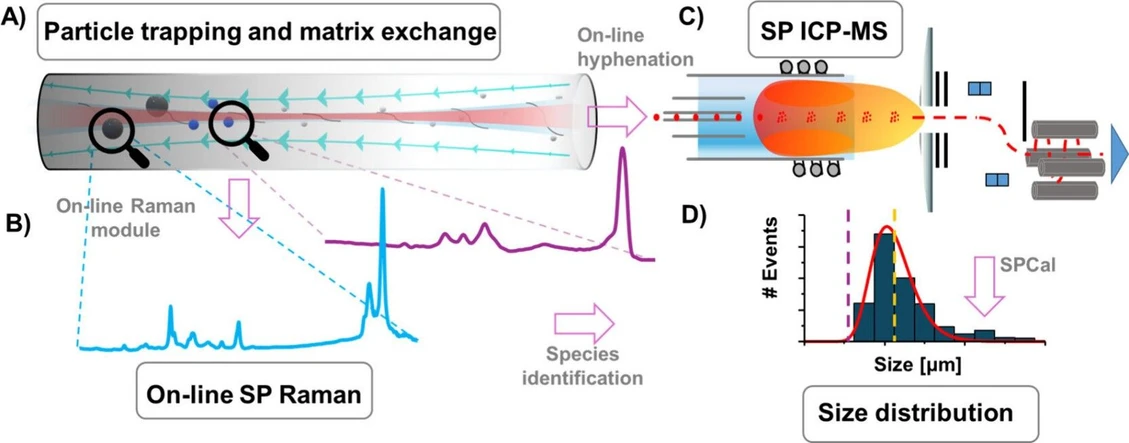
Anal. Chem. 2026, 98, 5, 3614–3620: Figure 1. Trimodal instrumental set up. (A) OF2i using a 2D optical trap and a weakly focused vortex beam with angular momentum. (B) Inelastically scattered laser light of trapped particles was analyzed via Raman spectroscopy. (C) SP ICP-MS was coupled online after the trap and, following the release of particles, used to detect MPs via the 12C signal. (D) SP signals were processed with SPCal to estimate size distributions of detectable MPs.
This study introduces a trimodal analytical platform integrating optofluidic optical trapping, single-particle Raman spectroscopy, and SP ICP-MS for advanced microplastic characterization. Optical extraction enables isolation of individual particles, allowing polymer identification via Raman spectroscopy and improved elemental analysis by reducing background interference.
The approach significantly enhances detection sensitivity and size limits, enabling analysis of smaller microplastics in complex matrices such as high-carbon solutions and soil. This proof-of-concept demonstrates a powerful strategy for combined molecular and elemental characterization of microplastics at the single-particle level, with potential extension to inorganic particles.
The original article
Optical Extraction of Single Microplastics Followed by Online Molecular and Elemental Characterization
Matthias Elinkmann, Christian Neuper, Manuel Candussi, Raquel Gonzalez de Vega, Svenja B. Seiffert, Patrizia M. Schmidt, Harald Fitzek, Christian Hill, and David Clases*
Anal. Chem. 2026, 98, 5, 3614–3620
https://doi.org/10.1021/acs.analchem.5c05030
licensed under CC-BY 4.0
Selected sections from the article follow. Formats and hyperlinks were adapted from the original.
Microplastics (MPs) have emerged as pervasive environmental pollutants and can be found ubiquitously in both terrestrial and aquatic systems. (1,2) They are typically defined as solid polymer particles smaller than 5 mm in size and are either manufactured at these sizes for specific applications (primary MPs) or originate from the breakdown of macroplastic (secondary MPs). (3−5) Their impact on both ecosystems and health has raised major concerns, which sparked analytical endeavors to develop dedicated methods for tracing and thoroughly characterizing these particles. (6,7) However, MPs consist of varying polymer types, have broad size distributions, and are contained in complex environmental or biological matrices alongside a plethora of natural colloidal structures. Currently, there is a significant analytical gap, and adequate technology and methodology providing high selectivity and sensitivity are required. (8−11)
Many established methods offer ensemble analysis without granting access to single particles and/or are not capable of counting small MPs at environmental/biological concentrations sufficiently fast to gain a statistically meaningful perspective on different polymer species. For example, methods like dynamic light scattering do not offer sufficient selectivity to distinguish MPs from natural colloids and cannot identify different polymer types. (6) Visual analysis with techniques such as electron microscopy enable the analysis of individual particles but are not applicable to pinpoint MPs at natural levels, to identify their polymer type, and to detect them in natural matrices. Consequently, they are often unable to collect meaningful data on the mixing states of MPs in the environment. (13,14) However, FTIR and Raman microscopy (12) may be applicable to identify polymer species in isolated MPs but can be time-consuming and limited in their ability to count sufficient particles in complex matrices -especially at low PNCs and with low diameters. (6)
A relatively new method for the analysis of MPs is inductively coupled plasma–mass spectrometry (ICP-MS) which can be operated in “single particle” (SP) mode to detect particles individually. ICP-MS instrumentation can be equipped with different mass analyzers: While quadrupoles offer high sensitivity for only one selected m/z in single particle mode, TOF analyzers can analyze virtually all elements in a particle and further enable non-target particle screenings. (15,16) When targeting C, both ICP-TOFMS as well as ICP-QMS are applicable to the analysis of single MPs even in complex matrices. (17,18) However, it is worth noting that all species/molecular information contained in MPs (e.g., polymer type) is lost during the hard atomization and ionization process in the ICP. As such, it is not possible to discriminate specific particulate C species and the analysis of samples containing for example different MPs, particulate organic matter, cells, bacteria and/or black carbon is very limited. (19) Furthermore, the detection limit for SP analysis of MPs is capped by the C background from dissolved species. The mean background intensity determines a critical limit-based threshold over which a signal is identified as a SP. At high background, detection limits therefore increase. Finally, characterizing important SP parameters such as particle transport efficiency becomes increasingly difficult when analyzing particles at the microscale, and it appears that large particles are underestimated when assessing both number concentrations and size distributions. (20)
Advancing MP analysis is possible when introducing and hyphenating complementary techniques, which can decipher polymer identity while providing complementary pathways to study size and number. These complementary techniques must be compatible with SP ICP-MS and offer non-destructive characterization capabilities to study particles before they are annihilated in the ICP. In a recent study, (19) we have demonstrated the possibility of coupling a two-dimensional optical trap to SP ICP-MS. This allowed advanced characterizations of both inorganic particles and MPs. In that study, the two-dimensional trap using optofluidic force induction (OF2i) was used in a new mode, which enabled static trapping of particles in a weakly focused vortex laser beam. The interested reader will find further information on OF2i elsewhere. (21−23) The combination of optical and fluidic forces enabled the trapping of up to 30–50 particles at size- and refractive index-dependent positions, and consequently, if the refractive index is known or determined, sizes can be calibrated using Mie theory. We could further show that appending OF2i with an SP Raman module enabled the identification of the polymer type at single MP resolution. (19) The hyphenation of optical traps and mass spectrometric techniques has a high potential to advance MP analysis by combining their advantages and avoiding some of their limitations.
In this study, we advance from previously demonstrated dual couplings to the first functional realization of an online trimodal platform that unifies OF2i, SP Raman, and SP ICP-MS. The newly developed prototype enables optical trapping, molecular identification, and elemental analysis within a single analytical workflow. Using the OF2i static trapping mode, we employ an optical extraction mechanism to isolate suspended particles from complex matrices, thereby reducing the background and enabling species-specific analysis. Moving beyond model standards, we demonstrate how the developed platform addresses realistic analytical challenges, bypassing colloidal and dissolved interferences and characterizing industrial primary MP feedstock polymers within complex environmental matrices.
Materials and Methods
Instrumentation
A Brave B-Curious OF2i instrument using a cylindrically shaped microfluidic flow channel (1.3 mm) was used and operated with a 532 nm CW DPSS laser with a max power of 2 W (Laser Quantum, GEM532). Beam alignment was performed using two mirrors and a 5× beam expander. Using a zero-order vortex half-wave plate (q = 1), an azimuthally polarized Laguerre–Gaussian laser mode with a topological charge of m = 2 was generated and focused within the flow cell. Light scattered by particles was magnified and recorded with an ultramicroscope setup. The Raman signal of single particles was resolved using a prism and recorded at a 90° angle using a CMOS camera. The frequency shift was calibrated into wavenumbers by using an internal calibration approach in which the Raman signals of water stemming from the aqueous media were used as anchor points. The spectra of detected MPs were compared to reference spectra of common polymers. While there was a high correlation between the Raman signal of MPs and reference spectra, some intensity differences were apparent for different bands. These differences were the result of the wavelength of the applied laser, which was significantly lower than the wavelength used in established Raman spectrometers and used for reference spectra recording.
An Agilent 7900 series (Agilent Technologies) ICP-MS instrument was used in SP mode using a dwell time of 0.1 ms and acquiring the 12C signal for 2 min intervals. H2 was used as reaction/collision gas at between 2 and 3 mL/min as discussed in a previous study. (18) A total consumption nebulizer and spray chamber (CytoNeb, CytoSpray, Elemental Scientific, Omaha, US) were used to increase aerosol transport efficiency, which was determined to be between 60 and 80% by analyzing 100 nm and a 10 ng/g Au standard while maintaining a flow rate of 8 μL/min using a peristaltic pump. The same flow rate was used when coupling OF2i, SP Raman spectroscopy, and SP ICP-MS.
Results and Discussion
Hyphenation of OF2i, SP Raman, and SP ICP-MS
In a previous proof-of-concept, (19) we suggested a new hyphenated technique, which combined SP ICP-TOFMS with OF2i to trap and characterize particles optically before atomization in the ICP. We further demonstrated that OF2i can be coupled with an SP Raman module gaining chemical selectivity to identify MP types at single particle resolution. In this study, we advance on the previous set-ups and hyphenate all three techniques online. This combined certain advantages while eliminating some of the limitations. The resulting trimodal platform combining OF2i, SP Raman, and SP ICP-MS (see Figure 1) provided new analytical avenues to manipulate and characterize MPs in complex environments. Figure 1A shows a scheme of the optical trap, which uses a laser vortex beam to trap several particles according to their size and refractive index via OF2i. Harnessing both optical and fluidic forces in a 2D optical trap provides critical advantages when compared to other optical trapping systems. Compared to a Gaussian beam setup, several particles can be trapped statically in a size and refractive index-orientated order. Furthermore, the vortex beam presents a “donut” shape, which allows trapping of particles within the same size and refractive index range next to each other while minimizing particle–particle interactions within the trap.
Anal. Chem. 2026, 98, 5, 3614–3620: Figure 1. Trimodal instrumental set up. (A) OF2i using a 2D optical trap and a weakly focused vortex beam with angular momentum. (B) Inelastically scattered laser light of trapped particles was analyzed via Raman spectroscopy. (C) SP ICP-MS was coupled online after the trap and, following the release of particles, used to detect MPs via the 12C signal. (D) SP signals were processed with SPCal to estimate size distributions of detectable MPs.
Analysis of Microplastics in Spiked and Extracted Soil
Following the first proof-of-concept with a PS standard, a soil sample spiked with irregular PA microplastics was analyzed for a second proof-of-concept simulating a more environmentally orientated scenario, in which MPs showed a larger polydispersity as well as a range of different shapes. During sample preparation, MPs were recovered using a resuspension and density separation protocol by Pfohl et al. (24) This produced a suspension that also contained other colloidal matter and presented a scenario that is expected for most environmental samples, in which MPs represent only a small number-based fraction of the overall particulate matter. For these environmental scenarios, pinpointing and characterizing single MPs is challenging. Following dilution (1:10) of this suspension, PA-6 MPs were trapped optically, while other (smaller) colloidal matter was discarded. In this case, only PA-6 MPs were trapped, which facilitated further analysis via SP ICP-MS. In cases where other particulates are trapped next to MPs, OF2i-SP Raman characterization is still possible, but recovering the distinct particle species in SP ICP-MS is challenging. Figure 4A shows the Raman channel, in which the signal of four trapped PA-6 MPs can be seen. The Raman signals of water are located above 3000 cm–1, around 1640 cm–1, and below 250 cm–1, which was useful for internal calibrations of wavenumbers. The horizontal dimension represents the lateral position in the optical trap, and the intense scattering signal at the bottom was the Rayleigh scattering from MPs. The frequency shift caused by inelastic scattering of trapped PA-6 MPs can be seen along the vertical axis (e.g., yellow area). In the area (turquoise area in Figure 4A) behind the laser focus (red dashed line), no static trapping of MPs was possible, and the Raman signal was only caused by the aqueous media. This area was recorded to investigate the matrix composition during matrix exchange, and spectra recorded across three different times during the matrix exchange process are shown in Figure 4B. A signal at 950 cm–1 was caused by the matrix and was monitored as the indicator for when the matrix was exchanged, which was after approximately 10 min. After this time, the laser power was reduced to release the optically extracted particles from the trap. Figure 4C shows the calibrated Raman channel of one trapped particle, and the distinct Raman signal between 1100 and 1650 cm–1 was used to identify the MP polymer as PA-6. Following optical extraction, only PA-6 Raman signals were observed, and no other C particulates were retained. An unspiked soil was prepared accordingly as blank and no MPs were detected. Particles were subsequently recovered and analyzed by SP ICP-MS and the trapping, extraction, and release procedure explained for PS was repeated to estimate size distributions via SP ICP-MS as shown in Figure 5B. The mean size of detectable PA-6 MPs was 2.6 μm, and the size detection limit was determined to be 1.2 μm.
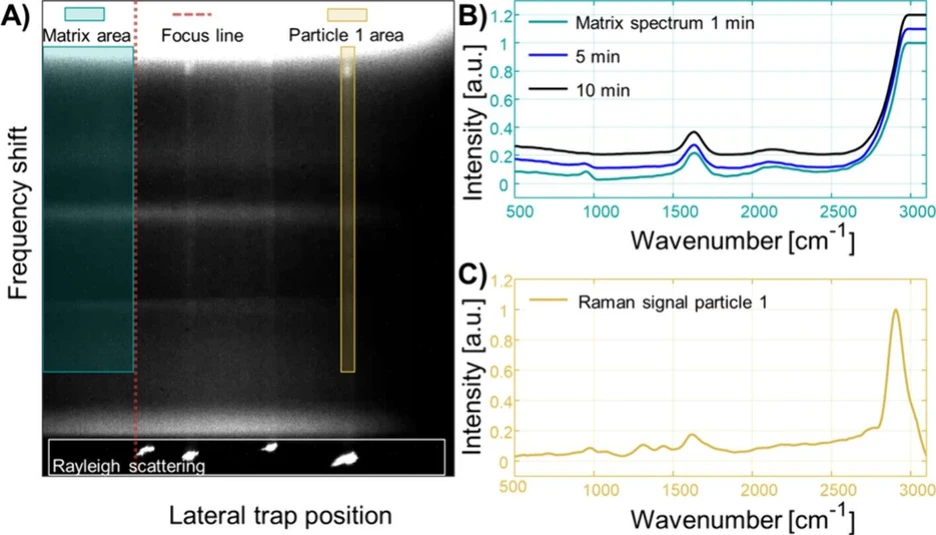 Anal. Chem. 2026, 98, 5, 3614–3620: Figure 4. (A) Cutout of the Raman channel. The horizontal axis shows the lateral position of particles in the optical trap, and the four intense dots (bottom) correspond to the Rayleigh scattering of four trapped MPs. Along the vertical axis, the frequency shift due to inelastic scattering is shown, which was calibrated into a Raman spectrum. (B) Raman spectrum of the matrix sampled behind the focus line at three different time points after the matrix exchange process. The band at 950 cm–1 was caused by the matrix and was used as an indicator when the matrix exchange process was complete. The other bands corresponded to the Raman signal of water. (C) Raman spectrum of a single particle, which was corrected for the signal contribution of the water matrix. The three bands between 1100 and 1650 cm–1 are typical for PA-6 MPs.
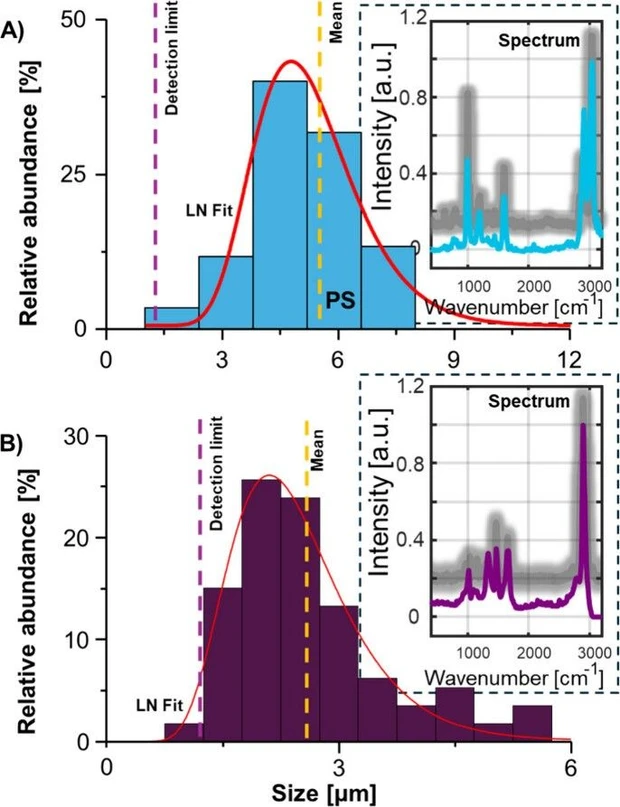 Anal. Chem. 2026, 98, 5, 3614–3620: Figure 5. (A) The size distribution of detected PS MPs was estimated with SP ICP-MS. A selected Raman spectrum of a single PS MP is shown in the inset, and a PS reference spectrum is shown in gray. (B) The size distribution of extracted and detected PA-6 MPs was estimated with SP ICP-MS. A selected Raman spectrum of a single PA-6 MP is shown in the inset, and a PA-6 reference spectrum is shown in gray.
Conclusion
The analysis of MPs challenges analytical techniques as they are required to address various chemical and physical facets, such as the chemical composition and sizes of particles in complex matrices. SP techniques are taking an important place to address the heterogeneity of particles and to describe both the internal and external mixing state of particles, while counting and characterizing MPs. However, current SP techniques alone provide only limited access to complex particulates, and new perspectives can be gained when combining different SP detection paradigms. In this study, a trimodal hyphenated SP platform consisting of OF2i, SP Raman, and SP ICP-MS has been developed for the first time to enable a multimodal analysis of individual MPs. A focus was directed to test the concept of optical extraction, which enabled the isolation, manipulation and characterization of MPs. This optical extraction mitigated matrix effects, enabled MP identification, and enhanced detection limits for MPs in SP ICP-MS as demonstrated in two proof-of-concepts.
While packages of particles can be trapped, released, and recovered by SP ICP-MS, it was not possible to trace the same particles between OF2i-Raman and SP ICP-MS. These limitations may complicate analyses when more than one MP polymer or other C particulates are present as their trapping order is not conserved when reaching the ICP. As such, it is not yet possible to gain both chemical and elemental information on the very same particles. However, using more efficient microfluidic transfer systems and for example an optical chromatography setup, which gradually reduces laser power to release single particles one-by-one, may render this possible in the future. Furthermore, Mie theory can be used in the future to provide complementary insights into size distributions, and OF2i may be used to count MPs and determine number concentrations. This provides opportunities not only for intrinsic validation of particle sizes but also to expand the analyzable size window and improve particle number calibrations.
Overall, this study moves beyond earlier dual-coupling feasibility tests to deliver the first operational online OF2i–SP Raman–SP ICP-MS platform. The system combines optical trapping, chemical characterization, and elemental analysis within a single workflow and provides opportunities for new extraction methods for particles. This made it possible to target relevant industrial microplastic particles in environmentally relevant matrices. However, it is worth noting that OF2i–SP Raman–SP ICP-MS is not limited to the analysis of MPs but may further be applied to the analysis of a range of inorganic (e.g., mineral) particles across the nano- and lower microscale, promising opportunities to gain new perspectives on relevant mineral-based particulates.