How to Simplify ICP-OES Analysis: Method Development, High Matrix Samples, and Daily Operation
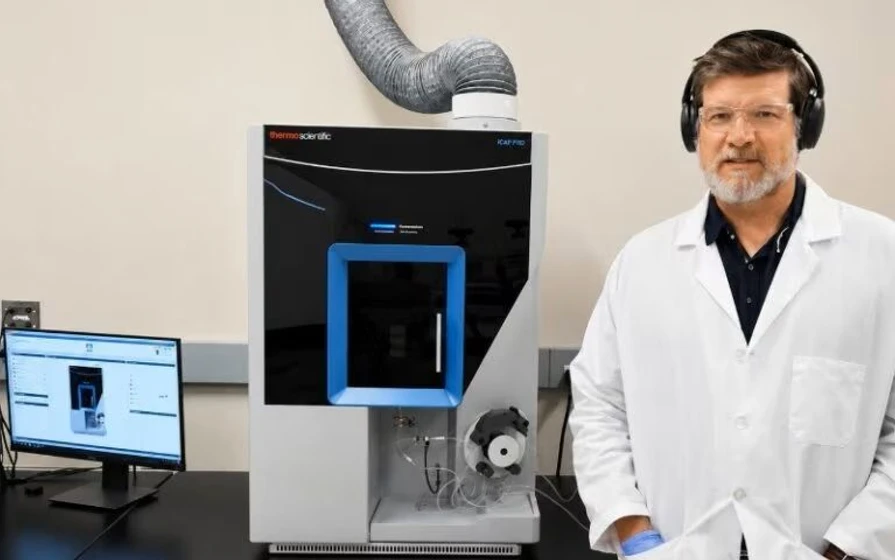
- Photo: Thermo Fisher Scientific: How to Simplify ICP-OES Analysis: Method Development, High Matrix Samples, and Daily Operation
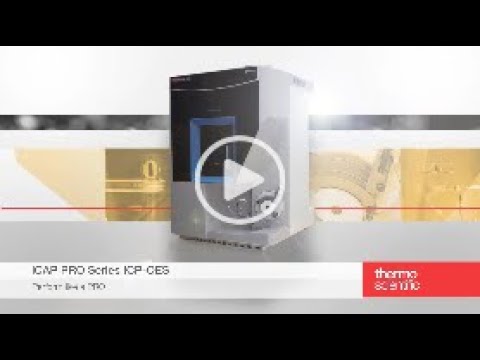
- Video: Thermo Scientific: iCAP PRO Series ICP OES
Discover how the iCAP PRO ICP-OES helps reduce method complexity, maintain stability with challenging matrices, and gain faster sample insight using AI-powered SemiQuant
For decades, ICP-OES has been a trusted workhorse for laboratories analyzing everything from clean water to complex brine, alloys, organics, and other challenging matrices. But today’s laboratories are being asked to do more: meet stricter regulatory and industry requirements, process more samples, reduce turnaround time, develop methods for complex samples, and improve workflow efficiency.
 Thermo Fisher Scientific: How to Simplify ICP-OES Analysis: Method Development, High Matrix Samples, and Daily Operation
That is where next-generation ICP-OES technology can make a meaningful difference.
The Thermo Scientific iCAP PRO Series ICP-OES is designed to help laboratories improve productivity, robustness, sensitivity, and ease of use — while introducing intelligent, AI-powered tools that give analysts faster insight into their samples.
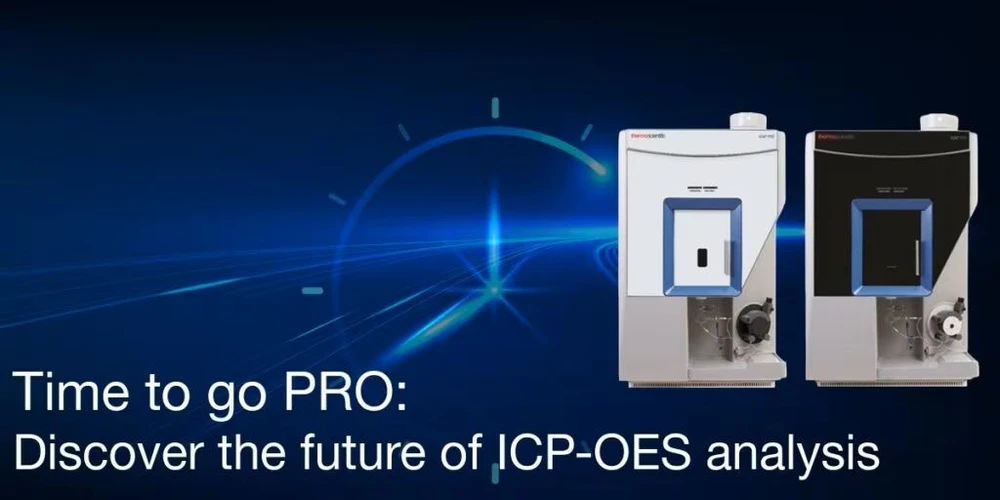
In the on-demand webinar, “Time to Go PRO: Discover the future of ICP-OES analysis,” Thermo Fisher Scientific experts take ICP users inside the iCAP PRO ICP-OES platform for a practical virtual demonstration of the hardware, software, and differentiating technologies that support modern trace elemental analysis.
Small footprint, big laboratory benefits
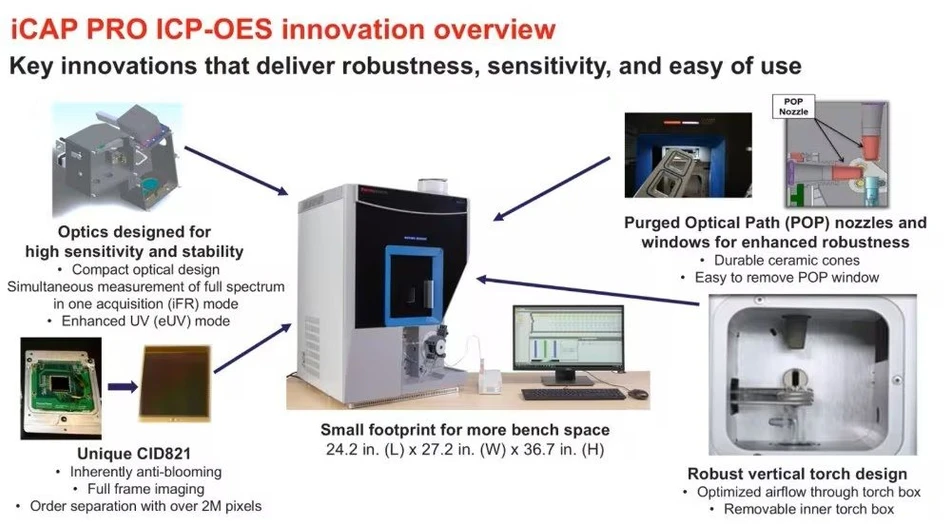
Laboratory space is valuable, and ICP-OES instruments need to fit efficiently into busy workflows. The iCAP PRO ICP-OES features a compact vertical design that helps conserve bench space while keeping maintenance and service areas easy to access.
Key benefits include:
- Space-saving vertical footprint that allows the instrument to sit flush against the wall.
- Front and side access to routine maintenance points and service connections.
- Simplified installation, service, and maintenance.
- Streamlined sample introduction system with familiar, quick-connect components.
- A smoother transition for laboratories currently using previous iCAP systems.
For ICP analysts, the result is a system designed not only for performance but also for everyday usability.
 Thermo Fisher Scientific: How to Simplify ICP-OES Analysis: Method Development, High Matrix Samples, and Daily Operation
Robust performance for high-matrix samples
High-matrix samples and high-throughput workloads are common in industrial, environmental, materials, and contract testing laboratories. To keep up, an ICP-OES system must maintain plasma stability, reduce drift, and minimize downtime.
The iCAP PRO ICP-OES is built with design features that support robust, reliable operation across demanding sample types.
Optimized vertical torch designed for extended stability and uptime
The iCAP PRO ICP-OES vertical torch design optimizes airflow within the torch box to support a stable, matrix-tolerant plasma. This helps reduce deposition on the torch and injector, which can support longer, more stable analytical runs.
For ICP analysts, the benefits are clear:
- Reduced signal drift
- Fewer sample failures and reruns
- Less matrix buildup on key components
- Reduced maintenance-related downtime
- Long-term stability and reliability when analyzing challenging samples
If cleaning is needed, the passivated aluminum torch box can be removed with just three screws, making maintenance more straightforward.
Purged Optical Path for efficient UV transmission
The iCAP PRO ICP-OES also uses a Purged Optical Path, or POP, interface to help maintain efficient light transmission from the plasma to the spectrometer. Low-flow argon purge gas exits through ceramic axial and radial POP nozzles, creating a protected optical path that helps reduce UV absorption by air and helps prevent plasma byproducts, dust, soot, and sample material from reaching the optical system.
This is especially important for ICP-OES analysis because many critical emission lines are in the UV range.
Key benefits include:
- Improved UV sensitivity.
- Lower detection limits for important elements such as arsenic, selenium, and lead.
- Reduced contamination of the optical interface.
- No need for a separate shear gas supply or air compressor.
- Simplified operation and lower running complexity.
Mirror protection for long-term optical performance
The intense ultraviolet light produced by the plasma can gradually degrade optical mirrors over time. To help protect the optical system, the iCAP PRO ICP-OES uses an automated beam blocker that shields mirrors from unnecessary UV exposure when measurements are not being taken.
This helps support:
- Long-term optical stability.
- Reduced mirror wear.
- Lower maintenance requirements.
High-efficiency optics and detection for confident results
The iCAP PRO Series ICP-OES combines a compact, high-efficiency optical design with proprietary Charge Injection Device, or CID, detector technology to help maximize sensitivity, speed, and confidence in results.
The optimized optical path helps transmit more light from the plasma to the detector, while the 5th generation CID821 detector captures high-quality spectral information across the wavelength range with more than 2 million pixels and smaller pixel size than in the previous iCAP platform.
Together, these technologies support:
- Efficient light transmission
- Improved sensitivity
- Better spectral resolution
- Faster analysis
- More confident results in complex matrices
The CID detector advantage: more spectral detail, less compromise
In real-world ICP-OES analysis, a single sample can contain trace-level analytes that produce weak signals and major matrix elements that produce very intense emission lines. The detector must manage both at the same time.
That is where CID detector technology provides a significant advantage.
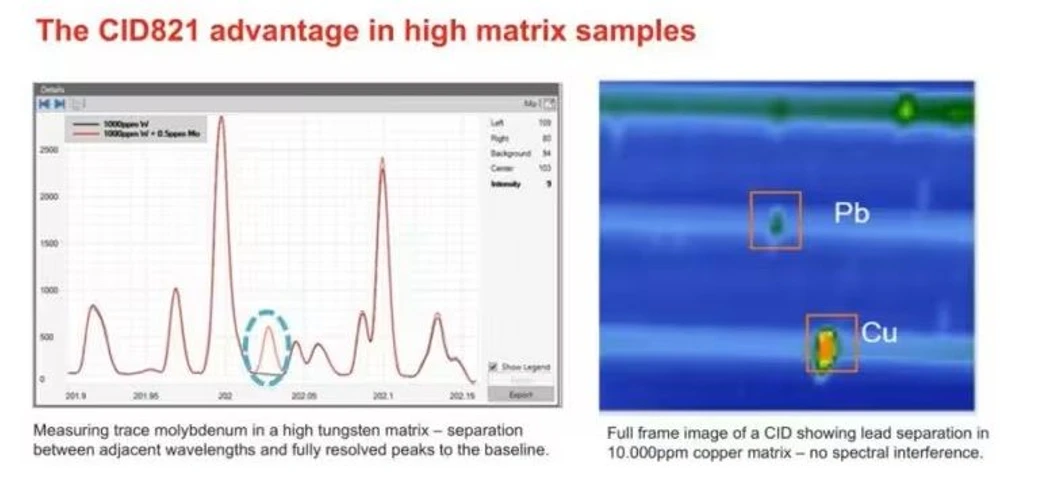
The iCAP PRO ICP-OES CID821 smaller pixel size and high pixel density help improve physical separation between adjacent wavelengths, giving analysts more flexibility when choosing emission lines and background correction points. This also makes it easier to resolve trace analytes from nearby matrix lines, such as trace molybdenum in a tungsten matrix or trace lead in high-concentration copper.
For the ICP-OES user, this means:
- Better peak separation
- Easier background correction
- Reduced spectral overlap
- Less reliance on correction strategies and mathematical equations
- Greater confidence in complex sample analysis.
 Thermo Fisher Scientific: How to Simplify ICP-OES Analysis: Method Development, High Matrix Samples, and Daily Operation
Why anti-blooming matters in ICP-OES
Instruments have advanced significantly from classical Paschen-Runge, or Rowland Circle, spectrometers that used individual photomultiplier tubes, or PMTs, positioned at fixed wavelengths. While effective, these systems required larger optical layouts and offered less flexibility because each PMT was dedicated to a specific emission line. The transition to solid-state chip detectors, known as Charge Transfer Devices, or CTDs, helped make ICP-OES instruments more compact, flexible, and information-rich by enabling many wavelengths to be captured across a detector array. This shift supported faster multi-element analysis, easier wavelength selection, improved method development, and access to full-spectrum data from a smaller instrument platform. The two primary CTD technologies used in ICP-OES are the Charge-Coupled Device, or CCD, and the CID.
In CTD detector-based ICP-OES, photons from emission lines are converted into electrical charge within individual pixels. When an intense emission line saturates a detector region, excess charge can spread into neighboring pixels, an effect known as blooming. In CCD detectors, where charge is shifted pixel by pixel across the chip during readout, blooming can distort nearby weaker signals and lead to overestimation of their intensity.
The CID detector within the iCAP PRO ICP-OES works differently. In a CID, each pixel is an independent site with its own set of electrodes. The electrical charge generated by incoming light is collected and stored directly inside that specific pixel. If a pixel fills to capacity, the excess charge drains into the underlying silicon substrate rather than spilling into neighboring pixels. Pixels are addressed individually and read without shifting charge across the array, helping contain intense signals. In this way, CID detectors are inherently anti-blooming.
For analysts, anti-blooming helps protect trace-level analyte peaks near strong matrix emission lines. This can reduce the need to choose less sensitive wavelengths, add extra dilutions, or rely on additional correction strategies that may increase method complexity.
Additionally, because the charge doesn’t have to move across the chip to be read (unlike a CCD), a CID can perform Non-Destructive Readout (NDRO) where the CID detector can measure the charge in an individual pixel without emptying it. For ICP-OES analysis, this provides two important benefits.
- First, weak emission lines can be integrated for a longer time to collect more signal.
- Second, bright emission lines can be monitored during the exposure and read before they approach saturation.
In practical terms, NDRO helps the CID detector capture weak trace-level signals more effectively while managing intense matrix lines — improving signal-to-noise ratio resulting to better sensitivity, extending dynamic range, and leading to more confident trace-level results.
The blooming effect experienced in CCD detectors can be minimized by setting integration times, segmenting the detector, or by adding anti-blooming or overflow drains. These approaches can help reduce the impact of very intense emission lines on weaker trace-level signals and reduce blooming, but they are mitigation strategies rather than the inherent pixel-level readout advantage of CID technology.
Intelligent Full Range and enhanced UV modes
The larger CID detector also enables Intelligent Full Range, or iFR, mode, which captures the full elemental spectrum in one simultaneous acquisition. This reduces analysis time by eliminating sequential low- and high-wavelength exposures.
For applications requiring improved UV performance, enhanced UV, or eUV, mode provides added sensitivity for key elements with emission lines in the low UV range.
Key takeaways from the optical and detector design
The practical benefits of the iCAP PRO ICP-OES compact optical design combined with the unique and proprietary CID technology are clear:
- High sensitivity,
- Faster analysis,
- Reduced spectral interferences,
- Better performance in high-matrix samples, and
- Greater confidence in the analysis of complex sample matrices.
The same rich, simultaneous spectral data captured by the CID detector also helps power advanced software capabilities such as the innovative AI-driven SemiQuant, giving analysts rapid insight into unknown samples without having to build a calibration curve.
AI-powered SemiQuant: instant sample insight
One of the most compelling parts of the on-demand webinar is the software demonstration, including a deep dive into the new AI-powered SemiQuant feature within the Thermo Scientific Qtegra Intelligent Scientific Data Solution (ISDS) software.
Traditional ICP-OES method development often starts with several questions: Which elements are present? What concentration ranges should be expected? Which wavelengths should be selected? What interferences might occur? Which samples need dilution?
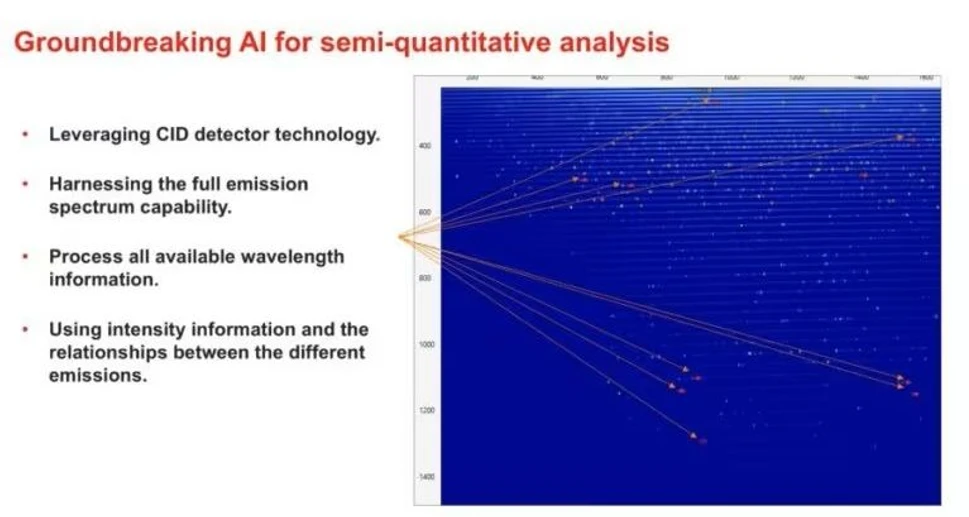
AI-powered SemiQuant helps answer those questions faster. Using the rich, simultaneous spectral information captured by the CID detector, SemiQuant evaluates many wavelengths for each element rather than relying on a single emission line. The AI model interprets these spectral patterns to provide rapid, semi-quantitative concentration estimates without requiring instrument calibration.
 Thermo Fisher Scientific: How to Simplify ICP-OES Analysis: Method Development, High Matrix Samples, and Daily Operation
For ICP users, this provides immediate insight into unknown samples.
The SemiQuant feature can help analysts quickly assess:
- What elements are present.
- Which elements are high or low in concentration.
- What calibration ranges to build.
- Which matrix components may cause spectral interferences.
- Which samples may need dilution before quantitative analysis.
- How to streamline method development and sample preparation.
This makes AI-powered SemiQuant especially valuable for sample screening, unknown identification, method development, contamination investigations, and troubleshooting before committing to a full quantitative workflow
Watch the on-demand iCAP PRO ICP-OES technical showcase
The on-demand virtual technical showcase gives ICP users an insider’s look at the iCAP PRO ICP-OES from both the hardware and software perspective.
In the hardware demonstration, you will see:
- The compact vertical instrument design
- The vertical torch and torch box access
- The simplified sample introduction system
- Maintenance and user-friendly design features
- How analysts interact with the instrument during routine operation
 Thermo Fisher Scientific: How to Simplify ICP-OES Analysis: Method Development, High Matrix Samples, and Daily Operation
In the Qtegra ISDS software demonstration, you will see:
- How to develop a method
- Wavelength selection
- Acquisition settings
- Interference correction tools
- Sample list setup
- AI-powered SemiQuant analysis
- A deep dive into how SemiQuant provides fast insight into unknown samples
Whether you are running environmental samples, industrial materials, or high-salt brines, the iCAP PRO Series ICP-OES is designed to help your laboratory move from sample to reliable result with greater speed, confidence, and ease.
Register now to watch the on-demand virtual technical showcase, “Time to Go PRO: Discover the future of ICP-OES analysis,” and get firsthand insight from our application experts into the innovations that make the iCAP PRO ICP-OES our most powerful, user-friendly instrument yet. To learn more, visit the iCAP PRO Series ICP-OES instruments.
Visit us on LinkedIn: #ICP-OES #ElementalAnalysis #MetalsAnalysis #AtomicSpectroscopy