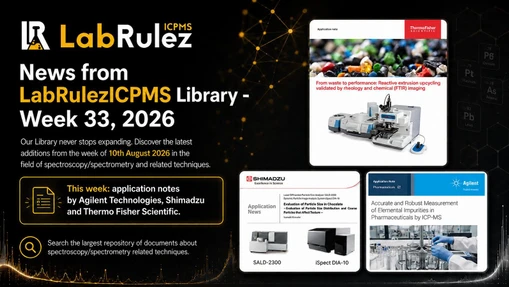
News from LabRulezICPMS Library - Week 30, 2026

LabRulez / AI: News from LabRulezICPMS Library - Week 30, 2026
Our Library never stops expanding. What are the most recent contributions to LabRulezICPMS Library in the week of 20th July 2026? Check out new documents from the field of spectroscopy/spectrometry and related techniques!
👉 SEARCH THE LARGEST REPOSITORY OF DOCUMENTS ABOUT SPECTROSCOPY/SPECTROMETRY RELATED TECHNIQUES
👉 Need info about different analytical techniques? Peek into LabRulezLCMS or LabRulezGCMS libraries.
This week we bring you application notes by Agilent Technologies, Shimadzu and Thermo Fisher Scientific!
1. Agilent Technologies: Analysis of Elemental Impurities in GLP-1 Receptor Agonist Oral Tablets by ICP-MS
- Application note
- Full PDF for download
Glucagon-like peptide-1 (GLP-1) receptor agonists represent a rapidly expanding class of therapeutics for the management of type 2 diabetes and chronic weight management. While many approved GLP-1 receptor agonists are administered by subcutaneous injections, oral formulations are generating significant clinical and commercial interest. However, formulating peptide-based therapeutics as oral solid dosage forms introduces additional manufacturing complexity, including the need for permeation enhancers, excipients, and coating materials. Each of these components presents a potential source of elemental impurity contamination. International or national-based regulatory authorities are responsible for ensuring that pharmaceutical products are both effective and safe for use. Control of elemental impurities in drug products is governed by the International Council for Harmonisation (ICH) Guideline for Elemental Impurities, Revision 2 (Q3D(R2))1 and United States Pharmacopeia (USP) <232>/<233> (Elemental Impurities — Limits and Procedures)2,3 using ICP-OES- or ICP-MS-based instrumental methods.
The USP chapters classify 24 elemental impurities in three classes based on toxicity and probability of occurrence, with permitted daily exposure (PDE) limits defined by route of administration. Analytical method validation follows ICH Q2(R2) (Validation of Analytical Procedures, 2023)4 and the harmonized USP <1225> (Validation of Compendial Procedures)5 , with system suitability criteria defined in USP <233>.3 ICH Q2(R2) provides updated guidance on the validation of analytical procedures that is applicable to biological- and biotechnology-derived products. The revised guideline offers clearer guidance on complex therapeutics, such as peptide-based biotherapeutics, including GLP-1 receptor agonists—an area not specifically addressed in the earlier Q2(R1) framework.
In this study, an analytical method was developed and validated in accordance with USP <232>/<233> and ICH Q3D(R2)/Q2(R2). The method enables quantitative determination of all 24 regulated elemental impurities in an oral tablet of a GLP-1 receptor agonist using an Agilent 7850 ICP-MS. The instrument features an integrated fourthgeneration Octopole Reaction System (ORS4) collision cell, which was operated in helium (He) mode to provide robust suppression of matrix-derived polyatomic interferences affecting the analytes. Data were acquired to evaluate drift/ stability, detectability, precision (repeatability and intermediate precision), specificity, accuracy, and linearity.
Results and discussion
Before being used for limit or quantitative procedures, the analytical instrument and method must meet performance criteria defined in ICH Q2(R2) and USP <233>. System suitability—verified by confirming that results remain stable (drift ≤ 20%) throughout the analytical run—must be demonstrated on the day of analysis. Separately, USP <233> requires procedure validation to demonstrate fitness for purpose: detectability, precision, and specificity for Limit Procedures; and accuracy, precision/repeatability, intermediate precision (ruggedness), specificity, limit of quantitation, linearity and range (demonstrated across 0.5–1.5 J) for Quantitative Procedures.
Speciation considerations for As and Hg
For some elements, toxicity is highly dependent on their chemical form. Of the analytes listed in the ICH/USP regulations, As and Hg are of particular concern. The PDE limit for both elements refers to their inorganic forms because inorganic As is the most toxic, and inorganic Hg is considered the most likely form to be present in pharmaceutical materials.
If the measured total As concentration exceeds the target concentration, USP <232> suggests that a speciation analysis is performed using LC-ICP-MS to allow independent quantification of inorganic As. If inorganic As is found to be below the limit, the material would be considered compliant even if total As exceeds the limit. The speciation of Hg should be established if the test material is likely to contain the more toxic methyl Hg species (for example, ingredients sourced from marine-derived materials). Otherwise, compliance is established by determining total Hg.
In this study, only trace-level Li (0.23 ppb) and Ni (0.07 ppb) were detected in the sample blank. All other elements were below the IDLs. Therefore, speciation analysis on As and Hg was not required. However, the 7850 ICP-MS can be easily integrated with an Agilent LC system for routine speciation analysis if needed.7
Conclusion
This study demonstrates the suitability of the Agilent 7850 ICP-MS for the identification and quantification of 24 regulated elemental impurities in a GLP-1 receptor agonist oral tablet formulation, prepared by microwave digestion. The instrument’s ORS4 collision cell was operated in helium mode, providing robust, non-specific attenuation of matrixderived polyatomic interferences. The method successfully met the limit and accuracy requirements specified in USP <232>/<233> and ICH Q3D(R2)/Q2(R2) guidelines, ensuring reliable multi-element quantification of GLP-1 tablets without the need for element-specific method optimization. F
or pharmaceutical QC laboratories, the Agilent ICP-MS MassHunter instrument control software assisted in developing the workflow, reducing the time and effort required to establish a compliant analytical method. The preset ICH/USP method template, automated J-value calculation, and built-in system suitability reporting eliminated manual configuration steps, making it easier for different analysts to use the instrument. The software also enables method transfer across sites. The demonstrated eight-hour signal stability performance of the 7850 ICP-MS further supports high-throughput batch testing in routine manufacturing QC environments.
As ICH Q2(R2) provides improved clarity for validating analytical procedures used with peptide based therapeutics, including GLP 1 receptor agonists, this application note provides a regulation-ready reference method. The workflow can be directly adopted or adapted for oral solid dosage forms containing active peptide ingredients, supporting faster regulatory submissions and reducing analytical development timelines.
2. Shimadzu: State Analysis of Iron Oxides in Sintered Ore for Steel Manufacturing after Hydrogen Reduction
- Application note
- Full PDF for download
User Benefits
- The mineral structure of sintered ore can be investigated by quantitative mapping of Al, Mg, Si, Ca, and Fe.
- EPMA analysis is a useful technique in research on the composition of the calcium ferrite phase due to differences in the reduction reaction depending on the furnace temperature.
- Investigation of the oxidation state of iron is useful in study of the production conditions for sintered ore, such as oxidation and reduction.
Foreign matter in CMP* slurrReduction of carbon dioxide (CO2) emissions is being promoted with the aim of achieving carbon neutrality in 2050. In the hydrogen reduction ironmaking process, iron ore is reduced with hydrogen (H2) in place of coke (C), forming water (H2O) instead of CO2, thereby reducing CO2 emissions. Targeting a reduction of 10 % or more in CO2 emissions, research on a hydrogen reduction technology using hydrogen in the blast furnace is now underway in the Japanese national project COURSE50, focusing on reduction of the heat requirement and optimization of the reaction conditions of the raw materials, together with circulating use of gas with a regenerated reduction capacity, by promoting hydrogen reduction, which is a smaller endothermic reaction than direct reduction by coke. Development of a Super COURSE50 technology has also begun, and will make it possible to inject a larger amount of hydrogen into the blast furnace. This article introduces a state analysis of the iron oxides in sintered ore, which was carried out by measuring the detailed spectra of micro-regions in sintered iron ore after hydrogen reduction using an EPMA electron probe microanalyzer (EPMA8050G).
Phase Analysis of Sintered Ore after Hydrogen Reduction
To identify differences in the oxidation valence, the element distribution images in Fig. 3 show oxygen (O) and iron (Fe) by the mass percentage concentration (wt%) of the simple elements. Fig. 4 (a) and (c) are Fe-O scatter diagrams showing the positions of the compounds by the theoretical concentration of iron oxide under low temperature and high temperature reduction, respectively. In Fig. 4 (a), the symbols 〇 and ▼ represent hematite (Fe2O3) and magnetite (Fe3O4), respectively, while in Fig. 4 (c), clusters (point-sets) can be seen in regions showing ☒ wustite (FeO) and compounds of iron (Fe). Fig. 4 (b) and (d) are phase diagrams in which filters were set by the Fe-O scatter diagrams (see Related Applications 3). In the phase diagrams, the purple regions are hematite, red regions are magnetite, green regions are wustite, dark blue regions are iron, yellow regions are magnesia ferrite, blue regions are calcium ferrite, and yellowgreen regions are slag. The sintered ore contains hematite and magnetite before reduction, but in the reduction reactions at the different furnace temperatures, the species of iron oxides are different depending on the furnace temperature. From the element distribution images and phase diagrams, it can be understood that metallic iron (Fe) has formed in the sintered ore subjected to hydrogen reduction at the high temperature of 1000 ˚C. The light blue region in Fig. 4 (d) is considered to be slag.
Conclusion
Quantitative mapping analysis and phase analysis of sintered ores after hydrogen reduction can be used not only in identification of iron oxide species and calcium ferrite, but also in structural analysis and research and development of the reduction process by utilizing state analysis from the detailed spectra of micro-regions.
3. Thermo Fisher Scientific: Accurate analysis of major components and trace level impurities in cathode active materials used in lithium ion battery production
- Application note
- Full PDF for download
Lithium-ion batteries (LIBs) provide a compact and versatile solution for energy storage, powering everything from consumer electronics to electric vehicles (EVs) and large-scale energy systems. Currently, they are the most important power storage materials for EVs due to their power density and life cycle performance. The performance, longevity, and safety of a battery heavily depends on the purity and the composition of the components, especially the cathode material.
To meet the required performance criteria (i.e., long battery lifetime and maximum achievable charge capacity), it is important to monitor not only the concentration ratio of the main components (typically nickel, manganese, cobalt, and lithium in nickel manganese cobalt (NMC) batteries), but also trace impurities in both the precursor materials and the finished products. In general, inductively coupled plasma mass spectrometry (ICP-MS) is the preferred analytical technique for the analysis of metals and related contaminants at low levels (sub μg·L-1). However, the analysis of samples containing higher levels of total dissolved solids (TDS, typically above 0.5% weight/volume (w/v)) is a known challenge in ICP-MS. The complexity of the sample matrix can significantly affect the sensitivity of the instrument, cause intensity fluctuation (suppression and drift), and lead to increased system maintenance with unwanted downtime due to clogging of the interface cone orifices, torch injector, or nebulizer. Diluting high matrix samples with argon gas allows direct placement on the autosampler, eliminating the need for manual, time-consuming, off-line dilution.
A further challenge for the analysis of battery materials such as cathodes when using conventional, single quadrupole ICP-MS is the presence of polyatomic interferences generated by the principal components of the samples. For example, in addition to the well-known argon-based interferences, arsenic can be affected by a cobalt-based interference (59Co16O+). Since arsenic is monoisotopic at m/z 75, removal of this interference is crucial for accurate data. Furthermore, nickel oxide-based interferences can impact the determination of selenium using a single quadrupole ICP-MS system.
This application note describes an optimized analytical method for the analysis of nickel, manganese, and cobalt (NMC) based cathode materials. To overcome the analytical challenges described above, a triple quadrupole ICP-MS instrument, the Thermo Scientific™ iCAP™ MTX ICP-MS, was employed for the analysis. Use of triple quadrupole technology offered superior interference removal, and operation using Argon Gas Dilution (AGD) facilitated direct analysis of the samples derived from the digestion process. Adverse effects caused by the introduction of high matrix containing samples, such as more frequent maintenance, can also be reduced, thanks to the use of AGD. This enables more efficient laboratory workflow.
Conclusion
The iCAP MTX ICP-MS enables analysts to perform accurate and reliable elemental analysis in challenging samples such as digested cathode active materials. The proposed analytical method was evaluated for performance, and the results obtained clearly demonstrate the following analytical advantages for battery cathode sample analysis:
- The use of argon gas dilution (AGD) allows the direct analysis of acid digested samples so that labor-intensive manual sample dilutions can be omitted. At the same time, there is no increased need for system maintenance.
- Using oxygen as a reactive gas in TQ-O₂ mode enabled sensitive, interference-free analysis of all analytes, including challenging ones like sulfur and arsenic.
- Excellent CCV recovery and spike recovery results, as well as stable and consistent internal standards response, were obtained, demonstrating the reliability of the methodThe authors wish to express their heartfelt gratitude to Prof. Taichi Murakami of Tohoku University Graduate School of Environmental Studies (GSES) for his generous cooperation in providing the samples and instructions regarding the data analysis in the preparation of this Application News article.