News from LabRulezICPMS Library - Week 24, 2026
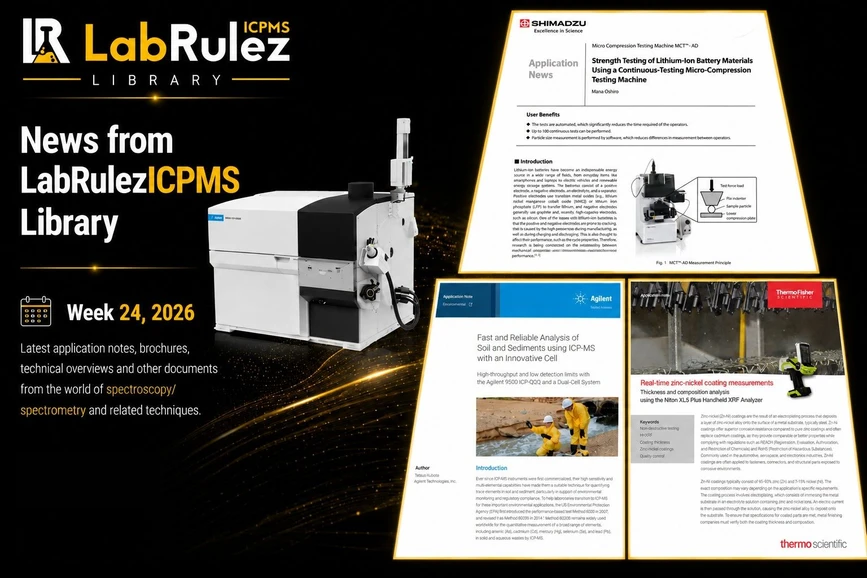
LabRulez / AI: News from LabRulezICPMS Library - Week 24, 2026
Our Library never stops expanding. What are the most recent contributions to LabRulezICPMS Library in the week of 8th June 2026? Check out new documents from the field of spectroscopy/spectrometry and related techniques!
👉 SEARCH THE LARGEST REPOSITORY OF DOCUMENTS ABOUT SPECTROSCOPY/SPECTROMETRY RELATED TECHNIQUES
👉 Need info about different analytical techniques? Peek into LabRulezLCMS or LabRulezGCMS libraries.
This week we bring you application notes by Agilent Technologies, Shimadzu and Thermo Fisher Scientific!
1. Agilent Technologies: Fast and Reliable Analysis of Soil and Sediments using ICP-MS with an Innovative Cell
High-throughput and low detection limits with the Agilent 9500 ICP-QQQ and a Dual-Cell System
- Application note
- Full PDF for download
Ever since ICP-MS instruments were first commercialized, their high sensitivity and multi-elemental capabilities have made them a suitable technique for quantifying trace elements in soil and sediment, particularly in support of environmental monitoring and regulatory compliance. To help laboratories transition to ICP-MS for these important environmental applications, the US Environmental Protection Agency (EPA) first introduced the performance-based test Method 6020 in 2007, and revised it as Method 6020B in 2014.1 Method 6020B remains widely used worldwide for the quantitative measurement of a broad range of elements, including arsenic (As), cadmium (Cd), mercury (Hg), selenium (Se), and lead (Pb), in solid and aqueous wastes by ICP-MS.
Traditionally, single-quadrupole ICP-MS (SQ ICP-MS) instruments equipped with collision/reaction cells (CRCs) have been used to meet the requirements of Method 6020B for sample analysis. Laboratories have typically used a combination of acquisition strategies to control interferences, including no gas mode for interference-free analytes and low mass analytes, helium (He) collision mode for analytes affected by polyatomic ion interferences, and half-mass mode to correct doubly charged ion (M2+) interferences. This multi-mode approach has enabled laboratories to meet Method 6020B performance and quality control (QC) criteria over many years.
Now, for the first time, the Agilent 9500 Triple Quadrupole ICP-MS featuring the Dual-Cell System (DCS) cell introduces two innovative cell gas modes, Advanced Helium Mode (AHM) and Air cell mode.2,3 These modes simplify interference removal approaches, enhance analytical performance, and accelerate analysis times
In this study, a range of environmentally certified reference materials (CRMs) was selected to represent sample types routinely analyzed in high-throughput environmental testing laboratories. As these laboratories prioritize productivity across all aspects of their operations to remain competitive, the 9500 ICP-QQQ configuration and analytical method were optimized to maximize sample throughput. The performance of the method was evaluated according to criteria set out in Method 6020B.
Conclusion
The study has shown that the Agilent 9500 ICP-QQQ, equipped with the unique Dual-Cell System (DCS) and the optional AVS MS discrete sampling system, is ideal for high-throughput, multi-element analysis of soil and sediment samples.
The use of the EPA 6020B Preset Method and selection of UHMI-4 plasma conditions in the Agilent OpenLab ICP-MS software enabled rapid setup of the instrument’s operating parameters, ensuring consistent performance across operators.
The instrument’s matrix-tolerant plasma (low CeO/Ce ratio), UHMI, and DCS effectively addressed the challenges of analyzing high-matrix samples, including signal drift, ion suppression, and spectral interferences, thereby delivering an optimized analytical workflow.
The method’s productivity was enhanced by operating the DCS in Advanced Helium Mode (AHM) and Air cell mode and by using short integration times, saving 5 to 10 s per sample. AHM replaces conventional no gas, helium (He) collision, and high energy He (HEHe) in a single mode, while Air cell mode uses oxygen from the laboratory, alleviating the need for gas cylinders. The 9500 maintains exceptionally high sensitivity in AHM and Air cell mode, minimizing background signals.
Overall, the 9500 ICP-QQQ with DCS achieved excellent analytical data:
- Low detection limits in the low ng/L (ppt) range for most analytes.
- Removal of M2+ interferences on Ca, As, and Se generated by Sr and rare earth elements (REEs) in the soil samples using Air cell mode.
- Recoveries of all certified elements in the five environmental CRMs or matrix spike samples within 100 ± 10%, confirming the effective control of interferences using AHM and Air cell mode.
- Method robustness and reproducibility over more than eight hours of continuous measurements, as demonstrated by the recoveries of ISTDs and CCVs within the limits specified in EPA Method 6020.
The 9500 ICP-QQQ with DCS and an integrated AVS MS enables high-throughput, routine analysis of complex environmental matrices. The EPA Method 6020-compliant method provided accurate data by effectively handling polyatomic ion and M2+ interferences using AHM and Air cell mode.
2. Shimadzu: Strength Testing of Lithium-Ion Battery Materials Using a Continuous-Testing Micro-Compression Testing Machine
- Application note
- Full PDF for download
User Benefits
- The tests are automated, which significantly reduces the time required of the operators.
- Up to 100 continuous tests can be performed.
- Particle size measurement is performed by software, which reduces differences in measurement between operators
Lithium-ion batteries have become an indispensable energy source in a wide range of fields, from everyday items like smartphones and laptops to electric vehicles and renewable energy storage systems. The batteries consist of a positive electrode, a negative electrode, an electrolyte, and a separator. Positive electrodes use transition metal oxides (e.g., lithium nickel manganese cobalt oxide [NMC]) or lithium iron phosphate (LFP) to transfer lithium, and negative electrodes generally use graphite and, recently, high-capacity materials, such as silicon. One of the issues with lithium-ion batteries is that the positive and negative electrodes are prone to cracking. This is caused by the high pressures during manufacturing, as well as during charging and discharging. This is also thought to affect their performance, such as the cycle properties. Therefore, research is being conducted on the relationship between mechanical properties and the electrochemical performance. 1), 2) This Application News presents compression tests on various battery materials as examples of quantitative evaluations of their mechanical properties. The MCT series of microcompression testing machines can perform compression testing of minute single particles. In addition, the MCT-AD model can automatically perform extraction of measurement particles, length measurements, and test operations. This results in significant time savings and enables evaluations with a larger number of measurements.
MCT-AD Micro Compression Testing Machine
Fig. 1 shows the MCT-AD and the measurement principle. The MCT compressed single particles placed on a lower compression plate using a flat indenter. Then, using data on diameters of the particles obtained in advance, a test forcedisplacement graph was created that measured various types of strength of the particles. The MCT-AD automatically performs selection of the measurement particles, length measurements, and cleaning of the indenter, which in the past had to be performed manually by the operator after each measurement. This enables continuous testing up to 100 times while consolidating the operation time by the operator and reducing labor.
Conclusion
This Application News presents a mechanical evaluation by the MCT-AD of materials used in the electrodes of lithium-ion batteries. Traditionally, this measurement process imposes a heavy workload on operators. But since the MCT-AD automatically performs extraction of measurement particles, length measurements, and test operations, there are significant labor savings, and the need for highly skilled operators is also eliminated. The MCT-AD can also handle compression testing of samples with minute particle shapes, not just battery materials, so it is useful not only for product development but also for quality control.
3. Thermo Fisher Scientific: Real-time zinc-nickel coating measurements.
Thickness and composition analysis using the Niton XL5 Plus Handheld XRF Analyzer
- Application note
- Full PDF for download
Zinc-nickel (Zn-Ni) coatings are the result of an electroplating process that deposits a layer of zinc-nickel alloy onto the surface of a metal substrate, typically steel. Zn-Ni coatings offer superior corrosion resistance compared to pure zinc coatings and often replace cadmium coatings, as they provide comparable or better properties while complying with regulations such as REACH (Registration, Evaluation, Authorization, and Restriction of Chemicals) and RoHS (Restriction of Hazardous Substances). Commonly used in the automotive, aerospace, and electronics industries, Zn-Ni coatings are often applied to fasteners, connectors, and structural parts exposed to corrosive environments.
Zn-Ni coatings typically consist of 85-93% zinc (Zn) and 7-15% nickel (Ni). The exact composition may vary depending on the application’s specific requirements. The coating process involves electroplating, which consists of immersing the metal substrate in an electrolyte solution containing zinc and nickel ions. An electric current is then passed through the solution, causing the zinc-nickel alloy to deposit onto the substrate. To ensure that specifications for coated parts are met, metal finishing companies must verify both the coating thickness and composition.
Instrumentation
X-ray fluorescence spectrometry (XRF) is the technology of choice for quality control of Zn-Ni plating, as it is the only analytical method that can determine the thickness and composition of the coating layer non-destructively. The use of handheld X-ray fluorescence spectrometry (HHXRF) instruments enables near-line analyses of finished products, which can be analyzed directly without being cut and brought to a separate chamber with benchtop instruments.
In previous work [1], the Thermo Scientific™ Niton™ XL5 Plus Handheld XRF Analyzer was demonstrated to be capable of measuring the coating weight or coating thickness of up to 4 layers of metal coatings on a substrate, using a proprietary standardless “fundamental parameters” algorithm. The layers and the substrate can be pure elements or alloys. Although the fundamental parameters algorithm can determine the thickness of Zn-Ni plating standardless, it delivers partial information, as the composition of the layer is not measured. To measure the composition and the thickness of the coatings simultaneously, another approach using empirical calibration can be deployed. The Niton XL5 Plus User Mode enables the operators to create their own calibration curves based on the measurements carried out on reference materials of Zn-Ni plated samples with known coating thickness and composition.
Conclusion
Performing quality control of Zn-Ni coatings is essential for metal finishers to ensure the corrosion resistance of critical parts used in the automotive and aerospace industries. The Niton XL5 Plus analyzer calibrated with user mode for this application has demonstrated its ability to deliver accurate results and numerous benefits to the metal finishing industry, including but not limited to these:
- Increased productivity thanks to real-time, near-line results for faster process control and reduced rework.
- Preservation of high-value parts due to non-destructive testing that requires no cutting or damage.
- A lower operational burden with easy deployment and low total cost of ownership.