News from LabRulezICPMS Library - Week 22, 2026
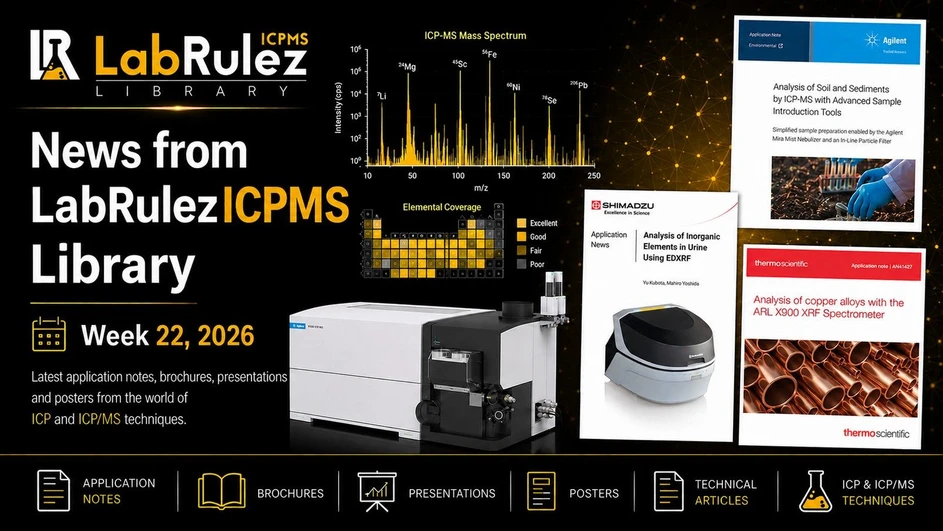
LabRulez / AI: News from LabRulezICPMS Library - Week 22, 2026
Our Library never stops expanding. What are the most recent contributions to LabRulezICPMS Library in the week of 25th May 2026? Check out new documents from the field of spectroscopy/spectrometry and related techniques!
👉 SEARCH THE LARGEST REPOSITORY OF DOCUMENTS ABOUT SPECTROSCOPY/SPECTROMETRY RELATED TECHNIQUES
👉 Need info about different analytical techniques? Peek into LabRulezLCMS or LabRulezGCMS libraries.
This week we bring you application notes by Agilent Technologies, Shimadzu and Thermo Fisher Scientific!
1. Agilent Technologies: Analysis of Soil and Sediments by ICP-MS with Advanced Sample Introduction Tools
Simplified sample preparation enabled by the Agilent Mira Mist Nebulizer and an In-Line Particle Filter
- Application note
- Full PDF for download
ICP-MS is widely employed for monitoring inorganic elements in soil and sediments, with established methods such as US EPA 6020B providing a validated framework for the accurate, multi‑element analysis of environmental samples.1 In a separate study, we demonstrated the outstanding performance capabilities of the Agilent 9500 Triple Quadrupole ICP-MS (ICP-QQQ) in compliance with EPA 6020B requirements.2 The instrument, which includes the Ultra High Matrix Introduction (UHMI) system for enhanced plasma stability and robustness, employed Advanced Helium Mode (AHM) and Air cell mode to achieve lower limits of detection (LODs) compared to conventional cell gas approaches.3,4
The two collision/reaction cell (CRC) modes of operation were enabled by the Agilent Dual-Cell System (DCS) —a unique CRC that provides the following performance advantages when operated in AHM and Air cell mode: – AHM – This innovative He-based gas collision-cell mode significantly enhances sensitivity for low-mass analytes while providing robust interference removal across the entire mass range. – This single gas mode eliminates the need for multiple modes, replacing no gas, conventional He, and high energy (HE) He mode. – Air cell mode – Using oxygen (O2 ) from air and an integrated air filter for the 9500 ICP-QQQ, Air cell mode leverages reactions between O2 and analytes to improve detection limits (DLs) for oxygen-reactive species. – Air cell mode effectively eliminates interferences, including M++ that are challenging to resolve using He-based gas methods.5 – With an unlimited supply of O2 in air, Air cell mode eliminates the need for O2 gas cylinders, reducing operating costs and simplifying workflows.
Of all the ICP-MS nebulizers, the Agilent Mira Mist nebulizer offers the best resistance to concentrated acids and organic solvents. Its parallel path design ensures good tolerance to high levels of particulates and total dissolved solids (TDS), providing excellent resistance to clogging. In this study, the 9500 ICP-QQQ equipped with an in-line particle filter and Mira Mist nebulizer was used to determine trace and major elements in five environmental certified reference materials (CRMs) and a real sediment sample. The performance of the method was evaluated according to criteria set out in EPA Method 6020B.
Experimental
Instrumentation
All measurements were performed using an Agilent 9500 ICP-QQQ that includes the following standard components: nickel (Ni) interface cones and newly designed DCS cell. The design features and functionality of the 9500 and DCS are explained elsewhere.3,4 The 9500 was also equipped with the optional Agilent Advanced Valve System (AVS MS) discrete sampling system for improved productivity. The AVS MS system’s high-speed piston pump works seamlessly with the Agilent SPS 4 and SPS 6 autosamplers for sample delivery, ensuring the high sample throughput necessary to meet the operational needs of most environmental testing laboratories.
To optimize signal stability with the Mira Mist nebulizer, the nebulizer pump speed was adjusted and a makeup gas was introduced (Table 1). In the 9500 ICP-QQQ, both the makeup gas and dilution gas can be added, enabling finer control of the plasma gas flow rates to optimize signal %RSD within the target sensitivity zone. The lens parameters were set automatically using the Autotune function in the software. The in-line filter’s internal volume is sufficiently small that its presence does not influence AVS MS sample introduction timing or method parameters. As a result, the same settings were used with and without the filter installed (Table 2).
Conclusion
In this study, sediment samples were analyzed in accordance with EPA Method 6020B using the Agilent 9500 ICP‑QQQ with UHMI and the optional AVS MS. The system was equipped with advanced sample introduction components, including the Mira Mist nebulizer and an in‑line particle filter.
The combination of the Mira Mist nebulizer and in-line filter enabled the analysis of sediment digests without a dedicated filtration step, reducing sample preparation time and consumable costs. At the same time, the configuration minimized the risk of sample introduction blockages, supporting robust and reliable long-term ICP-QQQ operation for complex environmental matrices.
Overall, the 9500 ICP-QQQ with the Mira Mist nebulizer and the in-line particle filter achieved excellent analytical data:
- Low detection limits in the low ng/L (ppt) range for most analytes
- The same or similar washout efficiency of sticky elements as a standard sample introduction configuration
- The same sample introduction timing, regardless of whether the filter was installed or not
- Method robustness and reproducibility over more than eight hours of continuous measurements, as demonstrated by the recoveries of ISTDs and CCVs within the limits specified in EPA Method 6020B
- Recoveries of all certified elements in the five environmental CRMs, matrix spike sample, and spiked real sediment sample within ±10%, confirming the effective control of interferences using AHM and Air cell mode
The study has highlighted how the 9500 ICP-QQQ with the Mira Mist nebulizer and in‑line particle filter enhances sample preparation efficiency and analytical performance for the analysis of complex sediment digests.
2. Shimadzu: Analysis of Inorganic Elements in Urine Using EDXRF
- Application note
- Full PDF for download
User Benefits
- Inorganic elements in urine can be quantified at the ppm level without any complicated sample pretreatment.
- Qual-quantitative analysis is possible using the FP (Fundamental Parameter) method, which does not require standards.
- Qual-quantitative results are obtained within 10 minutes per sample.
Inorganic element poisoning, including heavy metals, is caused by accidents or criminal incidents, and the causative elements are diverse. Although some of these elements are highly toxic, there are cases in which it is difficult to distinguish them at an early stage because they lack specific symptoms of poisoning. Therefore, analytical methods for rapid screening of these elements are required in forensic research.
Inorganic elements are generally analyzed by ICP-AES or ICP-MS. Although these techniques allow trace-level quantitation, they require chemical pretreatment such as dilution and deproteinization, and the samples are limited to liquid specimens. In contrast, energy dispersive X-ray fluorescence spectrometer (EDXRF - EDX-7200) offers sufficient sensitivity in the concentration range associated with poisoning and enables simple, non-destructive analysis in a short time.
This application describesthe results of quantitative analysis of 15 elements in urine by the calibration curve method, and qualquantitative analysis by the FP (Fundamental Parameter) method based on sensitivity coefficients installed in the instrument. The errors in the quantitative values obtained by the FP-based qualquantitative analysis method were approximately ±20 %, indicating that sufficient quantitative accuracy was achieved. Screening can be performed within 10 minutes persample.
Conclusion
The FP method demonstrated high accuracy for quantitation without calibration curves. Furthermore, urine samples do not require complicated pretreatment such as protein removal, and the analysis time is as short as approximately 10 minutes per sample. This method is well suited for poisoning screening in forensic research.
3. Thermo Fisher Scientific: Analysis of copper alloys with the ARL X900 XRF Spectrometer
- Application note
- Full PDF for download
Copper alloys
are very important products because they are used for many applications and many manufacturing processes as described in the next few paragraphs. It is important to accurately analyze these materials to confirm compliance of their chemical specifications that imply physical properties, like conductivity, compressive strength, hardness, resistance to traction and to abrasion. High product quality and efficient production can be ensured with accurate analysis results. Copper alloys Pure copper is mixed with other elements to produce a wide range of alloys: Brasses (Cu-Zn), bronzes (Cu-Sn), gun metal (Cu-Sn-Zn) used for casting due to its excellent fluidity, for valves, taps and water fittings. Manganese bronzes (Cu-Zn-Mn) are not true bronzes as Sn is not the essential constituent. Used for rudders, propellers, and ship fittings. Cupro-nickel (Cu-Ni) used for coins, tubes, wires, electrical resistances, and thermocouples. Nickel silver (Cu-Ni-Zn) used for marine applications, car radiators and fittings.
Brass
One of the most important non-ferrous engineering alloys. It covers a large range of physical properties with multiple applications. Copper can hold about 39% of zinc in solid solution. Alloys containing less than 39% Zn are known as α-brasses. This brass (70/30) is very widely employed for cartridge, cases, condenser tubes, etc. From 39% to 46% of Zn, a β-solid solution gives αβ-brass. This alloy (60/40) is found in extensive engineering applications with enhanced corrosion resistance used in marine applications. Alloys containing more than 49% Zn are very hard and only used for brazing brasses.
Instrument parameters and conditions
The ARL X900 XRF Spectrometer can accommodate up to 24 fixed monochromator channels alongside the goniometer or up to 32 fixed monochromator channels when no goniometer is fitted. New high counting fixed channel monochromators using an SCX detector are available to further improve the precision of analysis, especially for elements like Cu, Zn and Ni.
Our unique proprietary Moiré fringe goniometer ensures speed, flexibility and reliability of analysis thanks to the clever frictionfree positioning system. Up to nine crystals and four collimators can be fitted. With the two detectors (flow proportional and scintillation counters), precise elemental analysis from Boron to Californium is possible.
The ARL X900 XRF spectrometer can be calibrated using commercially available certified reference materials (CRM) or well analyzed samples from the user. Calibrations can be delivered from the factory, hence reducing the commissioning time at the customer’s site.
It should be stressed that an XRF spectrometer is a very accurate comparator, but the accuracy of the final analysis is entirely dependent on the quality of the standards used for calibration and on the care and reproducibility of sample preparation which must be identical for CRMs and for routine samples as well.
This application note only includes data obtained mostly on fixed channels and on some goniometer channels. For more results using goniometer channels please refer to AN41426.
Conclusion
Analysis of all sorts of copper alloys can be performed with ease using the ARL X900 Simultaneous-Sequential XRF Spectrometer. The performance of the Moiré fringe goniometer is such that it can be used for analysis of any elements that are not fitted as fixed channels. The analysis on the goniometer is done while the fixed channels are measuring. In addition, it can be used as a backup in case of failure of any of the fixed channels.
Appropriate calibrations for copper alloys can be delivered turnkey from the Thermo Fisher Scientific factory. In this case the commissioning time of the spectrometer is reduced to a minimum.
The precision is excellent in these matrix types for routine or R&D analysis, especially when the new high counting fixed channel monochromator is used for elements like Cu, Zn, and Ni.
Furthermore, operation is made easy through the innovative Thermo Scientific™ OXSAS™ Software that operates with the latest Microsoft Windows® package.
Thermo Fisher Scientific’s long experience in metals analysis comes from an installed base of over 2,000 XRF spectrometers worldwide. The ARL X900 spectrometer is the answer to your metallurgical analysis needs, whether they involve incoming material control, metal QC, or production analysis. Working 24 hours a day and 7 days a week, the ARL X900 spectrometer delivers dependable performance year after year. The high performance of the ARL X900 XRF Spectrometer will meet your analytical needs today and in the future