News from LabRulezICPMS Library - Week 06, 2026
LabRulez: News from LabRulezICPMS Library - Week 06, 2026
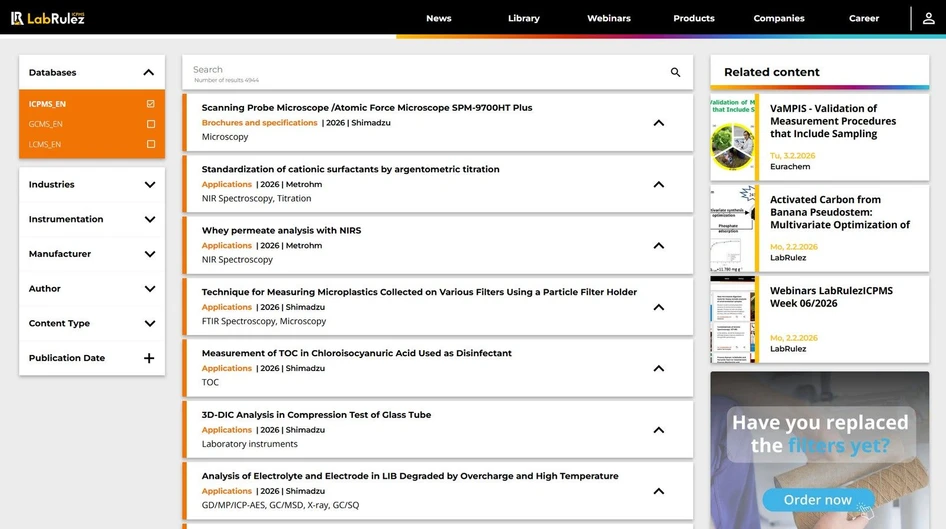
Our Library never stops expanding. What are the most recent contributions to LabRulezICPMS Library in the week of 2nd February 2026? Check out new documents from the field of spectroscopy/spectrometry and related techniques!
👉 SEARCH THE LARGEST REPOSITORY OF DOCUMENTS ABOUT SPECTROSCOPY/SPECTROMETRY RELATED TECHNIQUES
👉 Need info about different analytical techniques? Peek into LabRulezLCMS or LabRulezGCMS libraries.
This week we bring you application notes by Agilent Technologies, Metrohm, Shimadzu and Thermo Fisher Scientific!
1. Agilent Technologies: High Precision Analysis of Major Components in Precious Metals by ICP-OES
Determination of major components in jewelry alloys by ICP-OES and standard bracketing per ISO methods
- Application note
- Full PDF for download
Accurate quantification of major components in precious metal alloys can be challenging due to high precision and accuracy requirements, often to stringent industry-specific standards. This challenge is particularly relevant for the precious metals industry, where the stoichiometric composition and purity of metal alloys define both product quality and commercial value. A technique for high-precision measurements developed specifically for the precious metals industry is standard bracketing. As described in ISO methods 11494 and 11495 for ICP-OES analysis,1,2 this technique employs standard–sample–standard sequencing, which improves control over instrumental fluctuations and matrix effects, ensuring high levels of accuracy and precision.
Inductively Coupled Plasma-Optical Emission Spectroscopy (ICP-OES) is a powerful technique that is often used to analyze trace impurities in a broad range of samples. Both the Agilent 5800 and 5900 ICP-OES instruments are inherently precise, as discussed elsewhere.3 However, precision is further improved when the instruments are operated with the ISO-compliant standard bracketing feature within the Agilent ICP Expert Pro software version 7.8 onwards. The software provides additional useful features for jewelry assaying, catalyst refining, and material recycling. These functions include built-in automated result summarization, reporting in fineness (‰), karat (k), or concentration units, and processing tools specifically for determining major components and purity analysis. Standard bracketing is also applicable to other demanding applications, such as semiconductors, fertilizers, and the emerging battery materials sector.
In this study, the Agilent 5800 Vertical Dual View (VDV) ICP-OES with Agilent SPS 4 autosampler and ICP Expert 7.8 Pro software4 was used to determine the purity of gold (Au), palladium (Pd), and platinum (Pt) in three precious metal alloys. The analytical procedure was in accordance with ISO methods 11494 and 11495.
Experimental
Instrumentation
The Agilent 5800 VDV ICP-OES was configured with the Agilent SPS 4 autosampler, which provided automated sample delivery to the instrument (Figure 1). The 5800 ICP-OES was equipped with a SeaSpray nebulizer, double-pass cyclonic spray chamber, and Agilent one-piece VDV torch with a 1.8 mm internal diameter (id) injector. All components were controlled by Agilent ICP Expert Pro* 7.8 software. Instrument operating parameters are listed in Table 1.
Conclusion
This application demonstrates the effectiveness of highprecision standard bracketing calibration for the quantification of major components in gold, palladium, and platinum alloys using the Agilent 5800 VDV ICP-OES.
By employing gravimetrically prepared standards and integrating internal standard correction, the method improves analytical precision (RSD) more than threefold compared to conventional external calibration. It also reduces sample-tosample fluctuations, resulting in a 400× improvement in RPD values between duplicate measurements.
The high precision and reproducibility of the standard bracketing method enable accurate assaying of precious‑metal samples, making it ideal for quality control of high‑value materials where composition control is often required within ±0.1%.
The latest version of Agilent ICP Expert Pro software facilitates the standard bracketing method and includes tools for in-worksheet calculations and custom result displays. This approach simplifies metal-alloy purity testing, enables direct interpretation of sample purity in industry-standard terms, and provides confident, traceable quantification in accordance with ISO methods.
The method is useful in other applications that require tight composition control, such as battery materials, catalysts, semiconductors, and fertilizers.
2. Metrohm: Biodiesel content in diesel with nearinfrared spectroscopy
Monitor the fuel blending process within seconds
- Application note
- Full PDF for download
The properties of biodiesel fuel, which is produced from vegetable oils or animal fat, are very similar to petroleum-derived diesel, but biodiesel pollutes less. In most countries the common biodiesel blend is B20, which ranges from 6% to 20% biodiesel content. Measuring the biodiesel content in diesel is important, as higher levels can cause deposits in older diesel engines, clogging the fuel filters and pumps. Fuels with high levels of biodiesel also tend to absorb more moisture compared to petroleum-derived fuels. With near-infrared spectroscopy (NIRS), the biodiesel content is determined in seconds without any sample preparation. Compared to other test methods like those used in ASTM D7467, biodiesel content analysis with NIR spectroscopy saves time and enables the implementation of online process monitoring with fiber optics.
EXPERIMENTAL EQUIPMENT
Twenty-one diesel samples with varying biodiesel content from 0% to 20% were measured on the OMNIS NIR Analyzer Liquid (Figure 1) in transmission mode (1000–2250 nm) using 8 mm disposable vials. The vial temperature was set and monitored at 30 °C with the built-in vial sensor to ensure consistent measurement performance. OMNIS Software was used for all data acquisition and prediction model development.
CONCLUSION
This Application Note shows the results of a biodiesel content analysis test without the need for any sample preparation, using near-infrared spectroscopy in place of other more time-intensive analytical techniques. This ultimately leads to a reduction in workload and the related costs. Alongside the biodiesel content test, additional fuel quality parameters like cetane number, moisture, or flash point can be determined with NIRS.
3. Shimadzu: Quantitative Analysis of Lead (Pb) and Arsenic (As) in Cosmetic Raw Material Powders
- Application note
- Full PDF for download
User Benefits
- With simple sample preparation, lead and arsenic in cosmetic raw material powder can be quantified simultaneously.
- Increased X-ray tube output and optimized optical design have improved sensitivity for heavy elements.
- Continuous analysis of up to 48 samples is possible, improving analysis throughput.
The management of lead and arsenic contained in cosmetics raw materials is important for protecting people's health. Although colorimetric methods have been used for these analyses, there is a growing need for trace control due to tighter regulations in recent years, leading to a consideration of a shift to instrumental methods that enable quantification. Candidates for instrumental methods include ICP optical emission spectrometry/mass spectrometry and X-ray fluorescence spectrometry. While the former method is highly sensitive, powder and solid samples need to be dissolved in an acid such as nitric acid or hydrochloric acid. In contrast, X-ray fluorescence analysis is convenient because it can be analyzed without dissolving the sample.
This application news introduces the analysis of two inorganic oxide powders (talc and titanium oxide) using the energydispersive X-ray fluorescence Spectrometer ALTRACE (Fig. 1).
Conclusion
This application news reports on the quantitative analysis of lead (Pb) and arsenic (As) in two types of inorganic oxide powders: talc and titanium oxide. The analysis was performed using the energy-dispersive X-ray fluorescence spectrometer ALTRACE, which allows for the analysis of powders without dissolving them. ALTRACE enables simultaneous analysis of Pb and As, unlike traditional colorimetric methods that test them separately. Additionally, ALTRACE can analyze 48 samples continuously, significantly improving the efficiency of the testing process.
4. Thermo Fisher Scientific: Advantages of coincident XPS-Raman in the analysis of mineral oxide species
- Application note
- Full PDF for download
XPS is an extremely versatile technique that has found widespread use in a myriad of application areas, from contact lenses to aerospace materials. XPS is unique in that it can quantify the elemental and chemical composition of a material’s surface with extreme selectivity, since the typical information depth of XPS being less than 10 nanometers.
Raman spectroscopy is utilized in many similar application areas as it requires little sample preparation, is nondestructive, provides information on molecular structure, and enables users to identify materials quickly, thanks to extensive spectral libraries.
The implementation of XPS and Raman with other analysis techniques is well established; XPS has a long history of complementary use with related ultra-high vacuum (UHV) analysis techniques, such as UV photoelectron spectroscopy, Auger electron spectroscopy, and ion scattering spectroscopy. In these cases, additional equipment is added to the spectrometer to give coincident, complementary information.
To overcome these problems, the Thermo Scientific™ Theta Probe Angle-Resolved X-ray Photoelectron Spectrometer (ARXPS) System has been integrated with the Thermo Scientific iXR™ DXR3 Flex Raman Spectrometer to provide a multimodal analysis platform. The system aligns the XPS analysis position exactly with the Raman analysis position, ensuring that the data is collected from the same position.
The coincident XPS-Raman removes any requirement to transfer the sample from one instrument to the next between analyses, minimizing additional sample handling and exposure to different conditions that can lead to sample contamination or degradation.
Summary
In conclusion, XPS is used for quantitative determination of both elemental and chemical composition for any solid material compatible with UHV analysis, whereas Raman spectroscopy is used for identification of referenced compounds by careful spectral matching that searches algorithms and spectral databases. The combination of XPS and Raman spectroscopy on the DXR3 Flex Raman Spectrometer integrated with the Theta Probe ARXPS System, allows more powerful analysis of a material than either technique in isolation, with the cleanliness, purity and stoichiometry of a sample determined using XPS, and identification and quantification of molecular structures determined using Raman spectroscopy. As both techniques are aligned to the same position within the vacuum system, all the time-consuming aspects of locating the same analysis point when transferring between instruments is removed, giving absolutely certainty that all the information acquired has come from the same region of sample, which is particularly useful when studying nonuniform samples.