A Simple Online Internal Standard Calibration Strategy for Single-Particle Inductively Coupled Plasma Mass Spectrometry Based on Multielement Analysis
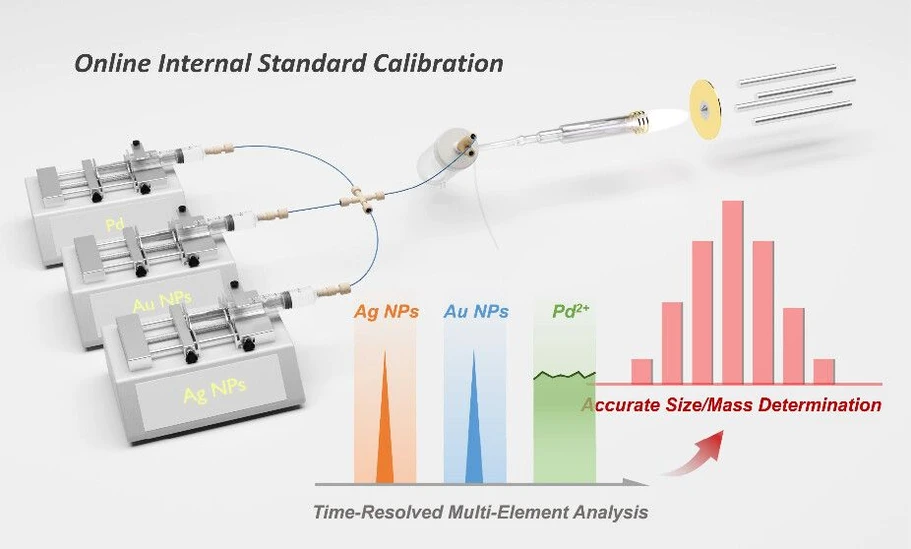
Anal. Chem. 2025, 97, 51, 28139–28147: Graphical abstract
Matrix effects significantly limit accurate nanoparticle sizing in single-particle ICP-MS, often causing signal attenuation and size underestimation. This study systematically evaluates matrix-induced biases and reports up to 10 nm underestimation of Ag nanoparticle sizes due to 30–50% signal loss.
To overcome these challenges, a novel online internal standard calibration strategy was developed using multielement detection and nonanalyte elements (Pd, Au) as internal standards. Simultaneous measurement of analyte and standards enabled correction of signal response and nebulization efficiency within a single run. The optimized approach provided accurate particle size determination in simulated and real matrices, extending SP-ICP-MS applicability to complex environmental and biological samples.
The original article
A Simple Online Internal Standard Calibration Strategy for Single-Particle Inductively Coupled Plasma Mass Spectrometry Based on Multielement Analysis
Xiangwei Tian, Ying Wang, Peijie Yang, Dingyi Wang, Yanwei Liu, Yingying Guo, Yuning Hu*, Xiaoyan Zhang*, Ligang Hu, Yongguang Yin*, Yong Cai, and Guibin Jiang
Anal. Chem. 2025, 97, 51, 28139–28147
https://doi.org/10.1021/acs.analchem.5c06975
licensed under CC-BY 4.0
Selected sections from the article follow. Formats and hyperlinks were adapted from the original.
Nanoparticles (NPs) are ubiquitous in environmental and biological systems. (1) In the environment, billions of tons of natural NPs are formed annually through biogeochemical processes. (1) Engineered NPs are widely utilized in industrial, medical, and consumer products and inevitably released into the environment. (2) In biological systems, NPs can be endogenously formed (3) or acquired from environmental exposure. (4) Functional NPs can also be intentionally delivered into biological systems as probes or drugs. (5−7) Variations in physicochemical properties of NPs, such as size and elemental composition, can influence their distribution patterns and effects within environmental and biological systems. (8,9) Therefore, it is of great significance to resolve particle heterogeneity at the single-particle level. Single particle inductively coupled plasma mass spectrometry (SP-ICP-MS), with its high-throughput and sensitive capabilities for elemental and isotopic analysis, plays a key role in single-particle analysis. (10,11)
Environmental particles always exist in complex or unknown matrices, such as ice cores, (12) wastewater, (13) and seawater. (14) Biological matrices are even more intricate, typically containing high concentrations of inorganic salts and organic matter. Matrix effects pose significant challenges for SP-ICP-MS analysis of environmental and biological samples. (15) Matrix effects on ICP-MS are generally categorized into spectral and nonspectral interferences. (15) Spectral interferences arise from isobaric overlaps or polyatomic ions (e.g., ArCl+ from Cl– interfering with 75As detection), which can often be eliminated using collision/reaction cell technique. (16) Nonspectral interferences refer to matrix-induced changes in signal intensity. (17) For instance, NaCl can suppress signal intensity, whereas low concentrations of methanol may lead to signal enhancement. Changes in signal intensity further contribute to errors in mass/size measurement. It was reported that a 4.5 g L–1 NaCl matrix caused underestimation of As(0) NP and Ag NP sizes by 28% and 41%, respectively, while a 2% methanol matrix resulted in overestimations of approximately 6% and 20%. (17) Common strategies to address nonspectral interferences include sample dilution and matrix matching. (15) However, dilution pretreatments would greatly reduce the analytical throughput, and changes in matrix concentration may affect the properties or state of the analyte. In real-world samples, the matrices are always complex, making it difficult to prepare solutions with exactly the same composition for matrix matching. Isotope dilution analysis (IDA), which involves enriched isotopes of the analyte element for signal response correction, is another established approach. (18−20) Nevertheless, due to strict requirements on matrix types, isotope properties, and analyte concentrations, IDA has limited applicability to real-world sample measurements. Furthermore, among the previously reported methods, the potential influence of the matrix on particle nebulization efficiency has not been fully considered, (18,21,22) leaving quantitative uncertainties. (17) The online droplet calibration method based on the microdroplet generator and ICP-time-of-flight (TOF)-MS considers matrix effects on both signal response and nebulization efficiency; (15,23) however, the technical barriers and high cost largely limit its broader adoption. Till now, due to the lack of practical calibration methods, the characterization of NPs in real matrices typically involves laborious extraction procedures. (24,25) A need exists to develop a simple and reliable calibration strategy suitable for the measurement in the original matrix.
In this study, we first systematically investigated the specific matrix effects on SP-ICP-MS and the underlying mechanisms based on the fundamentals of ICP-MS. The influence of time resolution on multielement detection was explored from multiple analytical perspectives. To address limitations of previous methods, we proposed a simple and reliable online internal standard calibration method, which largely eliminates matrix effects on size/mass determination by SP-ICP-MS. By utilizing the multielement detection mode, the signals of the analyte element(s) and internal standard elements can be monitored within the same analytical run, allowing for simultaneous correction of the response factor, nebulization efficiency, and time-dependent signal fluctuations. Notably, the novel calibration strategy involving the use a nonanalyte element as the internal standard for signal response calibration was developed and validated. The proposed method demonstrated high feasibility and reliability when applied to simulated real-world samples. It is also applicable to single-particle analysis using other types of ICP-MS (e.g., ICP-TOF-MS) and shows promise for application in single-cell ICP-MS analysis.
Experimental Section
SP-ICP-MS Analysis
Agilent 7900 ICP-MS (Agilent Technologies; Santa Clara, CA, USA) equipped with a quadrupole mass analyzer was used for SP-ICP-MS analysis. Instrument parameters are given in Table S2. The sample introduction system was composed of syringe pumps (Leifu Fluid; Baoding, China), a Mira Mist nebulizer (Burgener; Mississauga, Ontario, Canada), and a quartz dual-channel spray chamber (Agilent Technologies; Santa Clara, CA, USA) (Figure 1). The total sample flow rates were 300 μL min–1 for all the experiments. Additionally, a more accessible introduction approach using the instrument’s integrated peristaltic pump was also tested (Figure S2). Matrix effects on SP-ICP-MS analysis was investigated under the conventional single-element mode. The dwell time was 5 ms, with no stabilization time. The final inlet concentrations of Ag NPs and Au NPs were 50 ng L–1 (∼4.2 × 10⁴ particles mL–1) and 25 ng L–1 (∼4 × 10⁴ particles mL–1), respectively.
Results and Discussion
Matrix Effects on SP-ICP-MS and the Underlying Mechanisms
In the UPW matrix, the particle sizes determined by SP-ICP-MS (Figure 2A) were consistent with those measured by TEM (Figure S1A). The most direct impact of matrix effects was observed as changes in the analyte signal intensity. Both the typical environmental and biological matrices we selected resulted in signal attenuation for the target elements. More pronounced signal attenuation was observed in the salt matrices with increasing concentration. Compared to measurements in UPW, the signal intensity of Ag NPs decreased by approximately 32% and 46% in DSW and PBS, respectively. Correspondingly, without matrix-matching correction, the particle sizes of Ag NPs were underestimated by approximately 12% and 19% in DSW and PBS, respectively (Figure 2A).
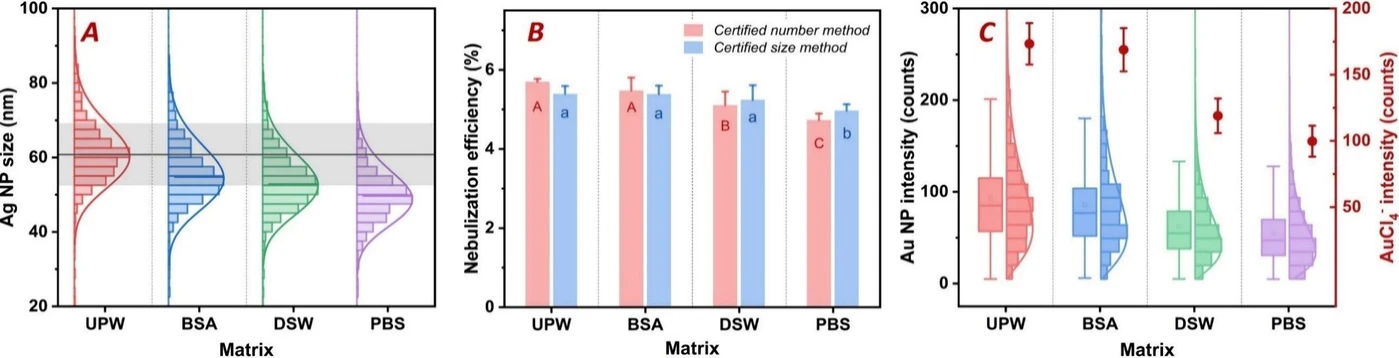 Anal. Chem. 2025, 97, 51, 28139–28147: Figure 2. (A) Particle size distribution of Ag NPs in different matrices without matrix matching. The gray line and band denote the mean and standard deviation of the particle size determined by TEM. (B) Nebulization efficiency of Au NPs in different matrices. The letters on columns indicate the statistical difference obtained from one-way ANOVA test (p < 0.05). (C) Signal intensity of standard Au NPs and AuCl4– solution in different matrices.
Matrix-induced attenuation/enhancement of signal intensity fundamentally arise from changes in the transport efficiency of the analyte. Transport efficiency is defined as a combination of several components (Figure 1): (i) the aerosol introduction efficiency (or nebulization efficiency) from the sample introduction system (typically comprising a nebulizer and spray chamber) to the ICP torch, as calculated using Equation 1) or 2); (ii) the ionization efficiency of the analyte within the ICP torch; and (iii) the subsequent extraction and transport efficiency of ions from the sampling cone to the detector.
Validation of Online Internal Standard Calibration
Figure 4A displays the Ag NP size distribution determined when the three inlet streams (Ag NP suspension, Au NP suspension, and Pd solution) were mixed at equal flow rates (3 × 100 μL min–1). For all the matrices, the measured particle sizes showed good agreement with the actual sizes determined by TEM. Note that since both the Au NP suspension and Pd solution were prepared using UPW, the matrix containing analyte Ag NPs would be diluted upon online mixing. For real-world samples, excessive dilution could potentially change sample properties and reduce measurement throughput. To prevent excessive dilution, the calibration results were further assessed under conditions of reduced internal standard flow rates (Ag NP flow rate: 260 μL min–1; internal standard flow rates: both 20 μL min–1) (Figure 4B). Furthermore, an offline spiking approach was also tested by adding both the internal standards directly into the sample suspension (Figure S7A). The measured sizes also agreed well with the true values. For easier access and use, online mixing using a peristaltic pump was also tested and demonstrated to accurately determine the particle sizes (Figure S7B). The results demonstrate that neither the introduction approach and the mixing ratio affected the calibration performance, suggesting the high reliability and flexibility of the internal standard calibration method.
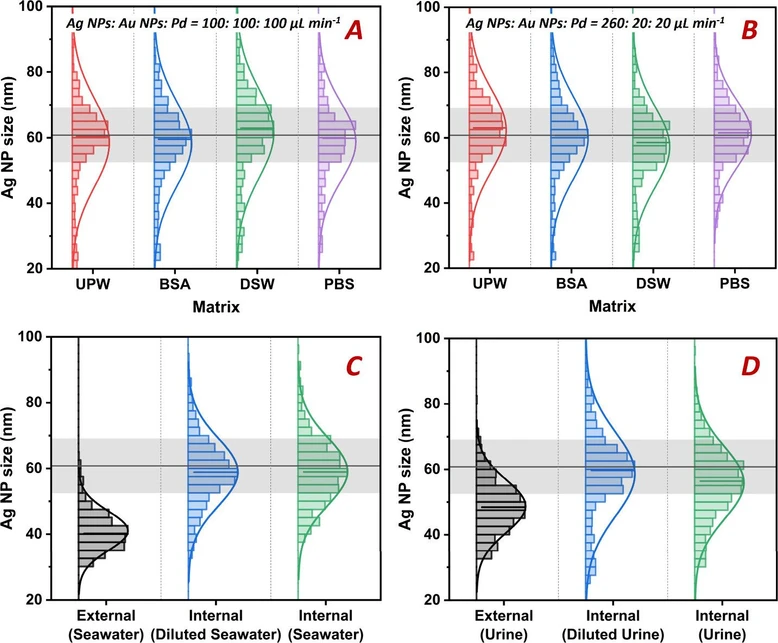 Anal. Chem. 2025, 97, 51, 28139–28147: Figure 4. (A, B) Particle size distribution of Ag NPs in different matrices measured by the internal standard calibration method. (A) Flow rates of the analyte and internal standards were all 100 μL min–1. (B) Flow rates of the analyte and internal standards were 260 and 20 μL min–1, respectively. (C, D) Particle size distribution of Ag NPs in natural seawater (C) and human urine (D) matrices measured by external standard calibration or online internal standard calibration method. the flow rates of the analyte and internal standards were 260 and 20 μL min–1, respectively. The gray lines and bands denote the mean and standard deviation of the particle size determined by TEM.
Further, we evaluated the performance of the proposed method in handling real biological (human urine) and environmental (natural seawater) matrices (Figure 4C and D). In addition to high salt concentrations, both matrices contain abundant organic matter, which pose challenges to accurate SP-ICP-MS analysis. Without matrix matching, the sizes of Ag NPs in both matrices were significantly underestimated. Particularly in seawater, the size was underestimated by nearly 20 nm. Using the online internal standard calibration, the median sizes of Ag NPs in diluted seawater and urine matrices were 58.9 and 58.5 nm, respectively, in close agreement with those determined by TEM. Notably, the sizes of Ag NPs in undiluted real matrices can also be accurately determined, facilitating the measurement of environmental particles in the original matrix.
Conclusions
In this study, we addressed the significant challenge of matrix effects in SP-ICP-MS for accurate mass/size determination in complex environmental and biological samples. We elucidated the specific matrix effects on nebulization efficiency, ionization efficiency, and ion transport. It was demonstrated that Ag NP signal intensity decreased by approximately 32% and 46% in DSW and PBS, respectively, leading to underestimated particle sizes (12% and 19%, respectively). To address these issues, we developed and validated an online internal standard calibration strategy employing multielement detection with nonanalyte elements as internal standards. By simultaneously monitoring analyte (Ag) and internal standard elements (Au for nebulization efficiency, Pd for response factor) within a single analytical run via the peak-hopping mode, we achieved real-time correction for matrix-induced variations. Optimized time-resolution conditions, particularly a 5 ms dwell time, ensured a high probability of complete event acquisition (81.8%) while minimizing particle overlapping. The measured sizes of Ag NPs in simulated (DSW and PBS) and real (natural seawater and human urine) matrices that showed good agreement with true values. The proposed method demonstrated high reliability and flexibility, regardless of the internal standard mixing ratio (e.g., 100:100:100 or 260:20:20 μL min–1), introduction approach, and sample dilution levels. In contrast to enriched isotope internal standards, which proved ineffective in anion-rich matrices due to chemical reactions, the presented nonanalyte internal standards offer enhanced adaptability across various matrices.
This reliable and flexible method significantly extends the applicability of SP-ICP-MS to direct analysis of complex samples without laborious pretreatments. The potential for the measurement in the original matrix is particularly meaningful for single-cell analysis, allowing direct analysis of living cells in biological matrices. Note that the theory and method validated with Ag NPs are also applicable to the quantification of other elements in particles or cells. As a simplified alternative to the established online microdroplet calibration, (23) the proposed strategy shows great promise in the integration of advanced ICP-TOF-MS platforms for simultaneous calibration of multiple analyte elements.