Author
Eurachem
Eurachem
Eurachem is a European network promoting international traceability of chemical measurements and good analytical practice. It provides expert guidance, supports method validation, uncertainty evaluation, proficiency testing, and facilitates discussion on technical and policy issues in analytical quality.
Tags
Article
Academy
LinkedIn Logo

Treatment of an observed bias
Tu, 4.8.2026
| Original article from: Eurachem
How should laboratories handle a significant measurement bias? This Eurachem leaflet explains when correction is justified and how an uncorrected bias may affect measurement uncertainty.
<p>Eurachem: Treatment of an observed bias</p>

Eurachem: Treatment of an observed bias

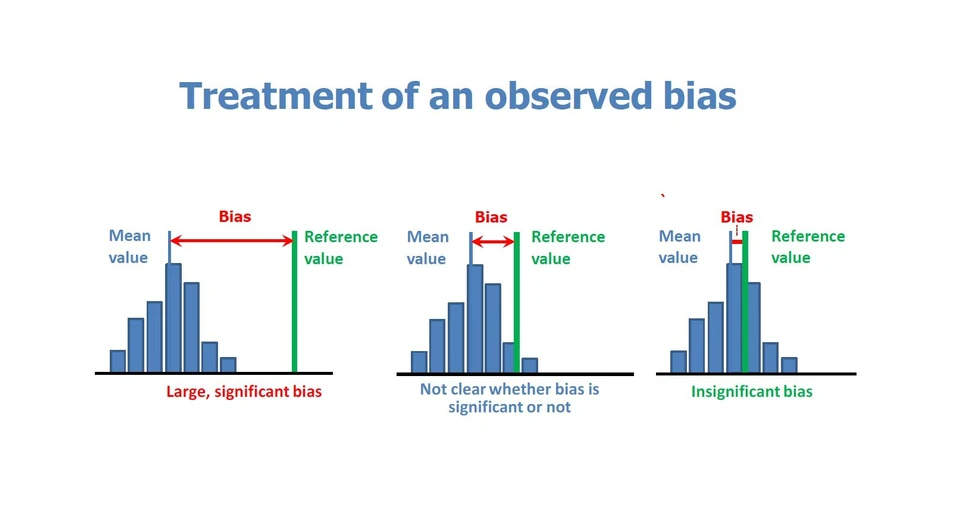
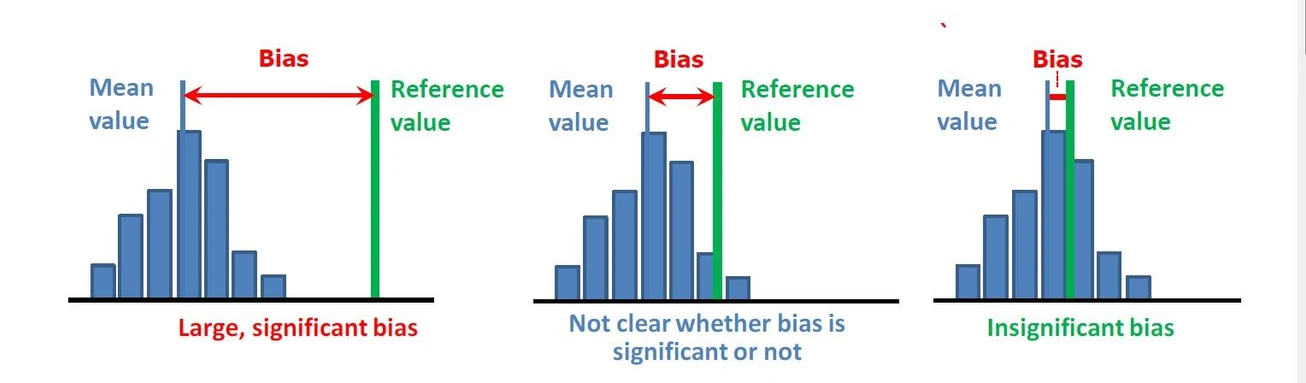
In this leaflet we discuss whether or not you should correct for an observed significant bias and the impact this may have on the measurement uncertainty (MU). How to apply the correction and how to increase the uncertainty to take account of an uncorrected bias is outside the scope of this leaflet. 

Important issues for deciding on how to treat an observed significant bias are: 

  • whether we understand the cause of the bias, and 
  • whether its size can be reliably determined. 

Further we must decide: 

  • whether the bias is consistent for all test samples within the scope of the method and 
  • whether any correction for bias should be multiplicative or additive, depending on whether the magnitude of the bias is constant or changes with the concentration level.
Eurachem: Treatment of an observed biasEurachem: Treatment of an observed bias

Should we correct, and should we increase the measurement uncertainty? 

The ISO Guide to the expression of uncertainty in measurement, GUM [1], assumes that “the result of a measurement has been corrected for all recognised significant systematic effects” (GUM 3.2.4). This implies that when developing a measurement method all known sources of bias should be investigated and if possible, eliminated or their effect minimised. If this cannot be achieved, then, if appropriate, a correction should be applied and the measurement uncertainty revised. 

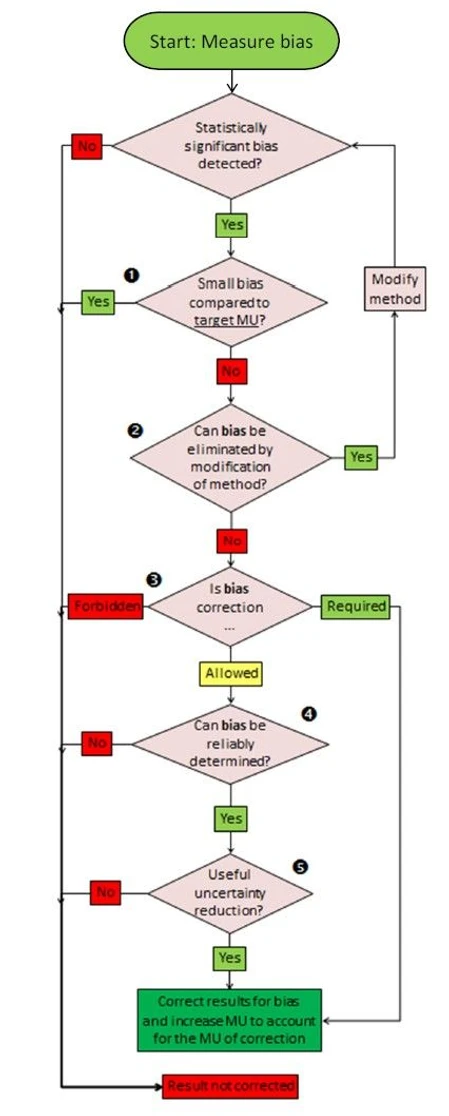
Let’s assume we have available a standardised method or a fully developed in-house method, with a clear description of the measurand, where any known bias has been minimised during method development (e.g. the effect of interferences has been minimised or a correction is included in the method). The next step, as a part of the validation, is to reliably determine any additional bias for the concentration interval and different matrices specified within the scope of the method. On the next page we present a roadmap outlining how to handle any additional significant bias. 

Note that the observed bias in a laboratory could be due to laboratory as well as method bias. For empirical methods where the measurand is operationally defined by the method, the method bias is by definition zero, however, the laboratory bias still needs to be considered.
Eurachem: Treatment of an observed biasEurachem: Treatment of an observed bias

  1. There is no point in trying to eliminate or correct a small bias, since both elimination and correction need resources. 
  2. If bias is not negligible then the best approach, if possible, is to try to eliminate it by modifying the method. 
  3. If bias is not negligible, but eliminating it is either impossible or impractical, then we can consider correcting for bias. There are three possibilities: 
    • Correction may be required (e. g. by regulations). 
    • Correction may be forbidden, in which case no correction should be made. 
    • Correction may be allowed. Then we should look at two more criteria to determine whether correction is justified. 
  4. If bias can be reliably determined and a correction method can be applied that is relevant for all test samples within the scope of the method we may decide to correct for bias. However, if the cause of bias is not known then correcting for bias cannot be generally recommended. If bias cannot be reliably determined then we should not correct for it. If we correct the result on the basis of an unreliable bias estimate then we may even increase the uncertainty of the results. 
  5. Correcting for bias is meaningful only if a useful reduction of measurement uncertainty (MU) is achieved. Correcting for the bias is only meaningful if the MU of the correction is smaller than the component of the MU arising from not applying the correction. 

If a significant bias is not corrected, it is difficult to give clear guidance on what action to take. For the case of recovery correction, IUPAC [2] lists some possibilities if no correction is applied: 

  1. No action; 
  2. Report recovery separately, including the uncertainty of both the result and the recovery 
  3. Take the bias into account in the uncertainty estimate of the results

These principles can be applied to other forms of bias. Further options have also been reviewed in the literature: See, for example, reference [3]

Resources

[1] JCGM 100:2008. Evaluation of measurement data – Guide to the expression of uncertainty in measurement. 

[2] Harmonised guidelines for the use of recovery information in analytical measurement, Pure & Appl. Chem., Vol. 71, No. 2, pp. 337–348, 1999. 

[3] B. Magnusson, S. L. R. Ellison Anal Bioanal Chem 2008, 390, 201– 213.

Eurachem
LinkedIn Logo
 

Related content

High-Precision Determination of Phosphorus and Potassium in Fertilizers by ICP-OES

Applications
| 2026 | Agilent Technologies
Instrumentation
ICP-OES
Manufacturer
Agilent Technologies
Industries
Food & Agriculture

iCAP PRO Series ICP-OES Determination of Impurity Elements in Battery-Grade NMP

Applications
| 2023 | Thermo Fisher Scientific
Instrumentation
ICP-OES, Elemental Analysis
Manufacturer
Thermo Fisher Scientific
Industries
Semiconductor Analysis

Bauxite analysis with Niton XRF analyzers

Applications
| 2026 | Thermo Fisher Scientific
Instrumentation
X-ray
Manufacturer
Thermo Fisher Scientific
Industries
Materials Testing

Quantifying Contamination in Mass Spectrometers Using SEM-EDX

Posters
| 2026 | Agilent Technologies (ASMS)
Instrumentation
Microscopy, X-ray
Manufacturer
Agilent Technologies
Industries
Materials Testing

Waters Aura Systems

Brochures and specifications
| 2026 | Waters
Instrumentation
Particle size analysis, Particle characterization, Microscopy
Manufacturer
Waters
Industries
Materials Testing
 

Related articles

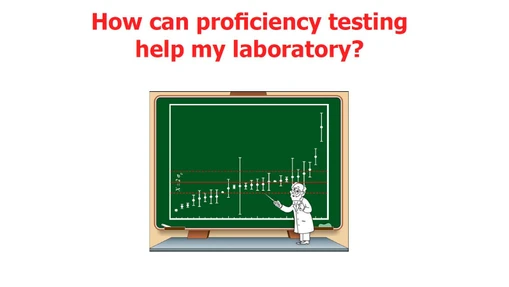
How can proficiency testing help my laboratory?
Article | Academy

How can proficiency testing help my laboratory?

Learn how proficiency testing (PT) supports quality assurance in analytical laboratories, from z-score evaluation to bias assessment and long-term performance monitoring.
Eurachem
tag
share
more
Proficiency testing schemes for sampling
Article | Academy

Proficiency testing schemes for sampling

Learn how ISO/IEC 17043 applies to proficiency testing schemes for sampling, including evaluation models, statistical design, homogeneity, assigned values, and sampling uncertainty.
Eurachem
tag
share
more
Use of surplus proficiency test items
Article | Academy

Use of surplus proficiency test items

Learn how surplus proficiency testing (PT) items can support method verification, analyst training, internal quality control, troubleshooting, and performance assessment in analytical laboratories.
Eurachem
tag
share
more
Understanding PT statistics
Article | Academy

Understanding PT statistics

Learn how proficiency testing providers calculate assigned values, uncertainty, and data dispersion, and how these statistics help laboratories interpret PT results correctly.
Eurachem
tag
share
more
 

Related content

High-Precision Determination of Phosphorus and Potassium in Fertilizers by ICP-OES

Applications
| 2026 | Agilent Technologies
Instrumentation
ICP-OES
Manufacturer
Agilent Technologies
Industries
Food & Agriculture

iCAP PRO Series ICP-OES Determination of Impurity Elements in Battery-Grade NMP

Applications
| 2023 | Thermo Fisher Scientific
Instrumentation
ICP-OES, Elemental Analysis
Manufacturer
Thermo Fisher Scientific
Industries
Semiconductor Analysis

Bauxite analysis with Niton XRF analyzers

Applications
| 2026 | Thermo Fisher Scientific
Instrumentation
X-ray
Manufacturer
Thermo Fisher Scientific
Industries
Materials Testing

Quantifying Contamination in Mass Spectrometers Using SEM-EDX

Posters
| 2026 | Agilent Technologies (ASMS)
Instrumentation
Microscopy, X-ray
Manufacturer
Agilent Technologies
Industries
Materials Testing

Waters Aura Systems

Brochures and specifications
| 2026 | Waters
Instrumentation
Particle size analysis, Particle characterization, Microscopy
Manufacturer
Waters
Industries
Materials Testing
 

Related articles

How can proficiency testing help my laboratory?
Article | Academy

How can proficiency testing help my laboratory?

Learn how proficiency testing (PT) supports quality assurance in analytical laboratories, from z-score evaluation to bias assessment and long-term performance monitoring.
Eurachem
tag
share
more
Proficiency testing schemes for sampling
Article | Academy

Proficiency testing schemes for sampling

Learn how ISO/IEC 17043 applies to proficiency testing schemes for sampling, including evaluation models, statistical design, homogeneity, assigned values, and sampling uncertainty.
Eurachem
tag
share
more
Use of surplus proficiency test items
Article | Academy

Use of surplus proficiency test items

Learn how surplus proficiency testing (PT) items can support method verification, analyst training, internal quality control, troubleshooting, and performance assessment in analytical laboratories.
Eurachem
tag
share
more
Understanding PT statistics
Article | Academy

Understanding PT statistics

Learn how proficiency testing providers calculate assigned values, uncertainty, and data dispersion, and how these statistics help laboratories interpret PT results correctly.
Eurachem
tag
share
more
 

Related content

High-Precision Determination of Phosphorus and Potassium in Fertilizers by ICP-OES

Applications
| 2026 | Agilent Technologies
Instrumentation
ICP-OES
Manufacturer
Agilent Technologies
Industries
Food & Agriculture

iCAP PRO Series ICP-OES Determination of Impurity Elements in Battery-Grade NMP

Applications
| 2023 | Thermo Fisher Scientific
Instrumentation
ICP-OES, Elemental Analysis
Manufacturer
Thermo Fisher Scientific
Industries
Semiconductor Analysis

Bauxite analysis with Niton XRF analyzers

Applications
| 2026 | Thermo Fisher Scientific
Instrumentation
X-ray
Manufacturer
Thermo Fisher Scientific
Industries
Materials Testing

Quantifying Contamination in Mass Spectrometers Using SEM-EDX

Posters
| 2026 | Agilent Technologies (ASMS)
Instrumentation
Microscopy, X-ray
Manufacturer
Agilent Technologies
Industries
Materials Testing

Waters Aura Systems

Brochures and specifications
| 2026 | Waters
Instrumentation
Particle size analysis, Particle characterization, Microscopy
Manufacturer
Waters
Industries
Materials Testing
 

Related articles

How can proficiency testing help my laboratory?
Article | Academy

How can proficiency testing help my laboratory?

Learn how proficiency testing (PT) supports quality assurance in analytical laboratories, from z-score evaluation to bias assessment and long-term performance monitoring.
Eurachem
tag
share
more
Proficiency testing schemes for sampling
Article | Academy

Proficiency testing schemes for sampling

Learn how ISO/IEC 17043 applies to proficiency testing schemes for sampling, including evaluation models, statistical design, homogeneity, assigned values, and sampling uncertainty.
Eurachem
tag
share
more
Use of surplus proficiency test items
Article | Academy

Use of surplus proficiency test items

Learn how surplus proficiency testing (PT) items can support method verification, analyst training, internal quality control, troubleshooting, and performance assessment in analytical laboratories.
Eurachem
tag
share
more
Understanding PT statistics
Article | Academy

Understanding PT statistics

Learn how proficiency testing providers calculate assigned values, uncertainty, and data dispersion, and how these statistics help laboratories interpret PT results correctly.
Eurachem
tag
share
more
 

Related content

High-Precision Determination of Phosphorus and Potassium in Fertilizers by ICP-OES

Applications
| 2026 | Agilent Technologies
Instrumentation
ICP-OES
Manufacturer
Agilent Technologies
Industries
Food & Agriculture

iCAP PRO Series ICP-OES Determination of Impurity Elements in Battery-Grade NMP

Applications
| 2023 | Thermo Fisher Scientific
Instrumentation
ICP-OES, Elemental Analysis
Manufacturer
Thermo Fisher Scientific
Industries
Semiconductor Analysis

Bauxite analysis with Niton XRF analyzers

Applications
| 2026 | Thermo Fisher Scientific
Instrumentation
X-ray
Manufacturer
Thermo Fisher Scientific
Industries
Materials Testing

Quantifying Contamination in Mass Spectrometers Using SEM-EDX

Posters
| 2026 | Agilent Technologies (ASMS)
Instrumentation
Microscopy, X-ray
Manufacturer
Agilent Technologies
Industries
Materials Testing

Waters Aura Systems

Brochures and specifications
| 2026 | Waters
Instrumentation
Particle size analysis, Particle characterization, Microscopy
Manufacturer
Waters
Industries
Materials Testing
 

Related articles

How can proficiency testing help my laboratory?
Article | Academy

How can proficiency testing help my laboratory?

Learn how proficiency testing (PT) supports quality assurance in analytical laboratories, from z-score evaluation to bias assessment and long-term performance monitoring.
Eurachem
tag
share
more
Proficiency testing schemes for sampling
Article | Academy

Proficiency testing schemes for sampling

Learn how ISO/IEC 17043 applies to proficiency testing schemes for sampling, including evaluation models, statistical design, homogeneity, assigned values, and sampling uncertainty.
Eurachem
tag
share
more
Use of surplus proficiency test items
Article | Academy

Use of surplus proficiency test items

Learn how surplus proficiency testing (PT) items can support method verification, analyst training, internal quality control, troubleshooting, and performance assessment in analytical laboratories.
Eurachem
tag
share
more
Understanding PT statistics
Article | Academy

Understanding PT statistics

Learn how proficiency testing providers calculate assigned values, uncertainty, and data dispersion, and how these statistics help laboratories interpret PT results correctly.
Eurachem
tag
share
more
Other projects
GCMS
LCMS
Follow us
FacebookLinkedInYouTube
More information
WebinarsAbout usContact usTerms of use
LabRulez s.r.o. All rights reserved. Content available under a CC BY-SA 4.0 Attribution-ShareAlike