The Effect of Microwave Oven Extraction Temperature, Time, and Power Optimization on the Determination of Heavy Metals in Apricot by ICP-MS
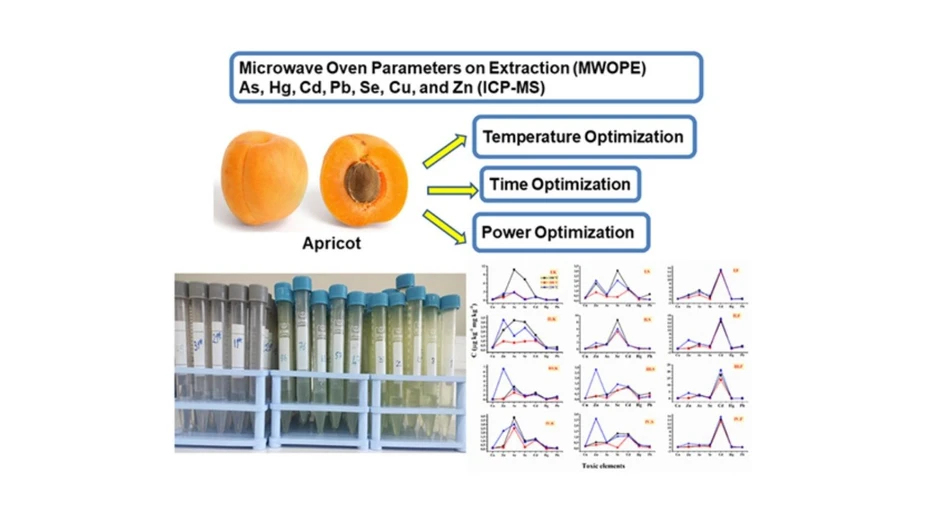
ACS Omega (2026) 11 (25): 36454–36467: Graphical abstract
This study evaluates how microwave digestion temperature, time, and power affect the extraction and ICP-MS determination of Pb, Cu, Zn, As, Se, Cd, and Hg in apricot flesh, kernels, and shells. Digestion was performed according to EPA Methods 3051A and 3052, and method accuracy was confirmed using certified reference material.
The optimized conditions significantly improved extraction efficiency and enabled reliable quantification of toxic elements across the different apricot fractions. Estimated Daily Intake and Hazard Quotient models were also applied to assess potential consumer health risks.
The original article
The Effect of Microwave Oven Extraction Temperature, Time, and Power Optimization on the Determination of Heavy Metals in Apricot by ICP-MS
Servet Askin; Nevin Çankaya* ; Halim Yılmaz
ACS Omega (2026) 11 (25): 36454–36467
https://doi.org/10.1021/acsomega.5c13020
licensed under CC-BY 4.0
Selected sections from the article follow. Formats and hyperlinks were adapted from the original.
Apricot (Prunus armeniaca L.) is a species belonging to the genus Prunus, the family Rosaceae, and the order Rosales. (10) The apricot is a drupe in structure. Anatomically, it consists of four parts: the epicarp, mesocarp, endocarp, and kernel. (10−13) Heavy metals such as As, Hg, Cd, Se, Zn, Pb, and Cu in apricots, which are consumed as fruit and nuts, can accumulate in the human body during consumption and lead to central nervous system disorders, skeletal system disabilities (osteodystrophy), urinary symptoms associated with renal failure, liver diseases and cancer, gastrointestinal disorders, hypertension, mental disorders in children in early periods, and ulceration. (14−19) As a result of the MWOD process of foods, Zor found heavy metals in spinach, lettuce, and parsley sold in the Marmara region. (20) In their study, TokalıoĞlu et al., found heavy metals in flaked red pepper (21) and Pardinho et al., identified trace elements in the Yerba mate plant by ICP-MS. (22) Umaz et al. found heavy metals in the topsoil parts of some plant species, (23) and Magalhâesa et al. identified heavy metals in edible, chia, flax, and coconut oils by ICP-MS measurement as a result of the MWOD process. (24) A study conducted by Chatterjee reported arsenic compounds in oyster tissue. (25) Ashoka et al. found trace elements in fish tissue samples, (26) Lao et al. identified heavy metals in seafood, (27) and Türkmen et al. found trace elements in fish species in the Mediterranean and Aegean seas by ICP-MS as a result of MWOD. (28) In studies conducted by Öztürk and Lee et al., using the MWOD process with cow’s milk, they determined major and minor elements in cow’s milk by ICP-MS. (29, 30) These studies demonstrate the effectiveness of MWOD coupled with ICP-MS for trace element analysis across diverse food matrices. Using the MWOD process, Lee et al. found minor and major elements in rice in Brazil, (31) and Barnet et al. identified minor and major elements in rice in South Korea by ICP-MS. (32) Shishov et al. found major and minor elements in tobacco and lettuce leaves, (33) Bhandari and Amarasiriwardena found trace elements in maple sap, (34) and Sucharova and Suchara found major and minor elements in peach leaves, spinach, pine leaves, aquatic plants, and lagarosiphon by ICP-MS as a result of the MWOD process. (35) Using the MWOD process, TokalıoĞlu found major and minor elements in medicinal herbs, (36) Barbosa et al. detected trace elements in soybean products, (37) Komorowicz et al. identified arsenic in mushroom species, (38) and Bengü et al. found major and minor elements in honey by ICP-MS. (39)
In microwave-assisted ultraviolet (UV) acid digestion, Hartwig et al. identified Ni, Pd, and Pt elements as catalysts in the production of margarine oils, (40) and Aydin identified major and minor elements in wool by ICP-MS-OES. (41) In a study conducted by Chen et al. on the quantitative identification of major and minor elements in oranges, they used the MWOD process and the ICP-MS device. (42)
This study analyzed major and minor elements separately in orange seeds, orange pulp, and orange peel. The results showed that orange is rich in Mg, K, and Ca elements. The highest amount of Mg was found in orange peel, while the highest amount of K element was found in the seeds. As, Cd, and Pb elements were found at low concentrations in orange. The wet digestion method was used for the identification of K, Mg, Ca, Cu, Zn, Fe, and Mn minerals in IĞdır apricot flesh by AAS, and the following concentrations were found, respectively: K: 262.20–144.86, Mg: 14.54–8.39, Ca: 13.66–7.53, Cu: 0.27–0.11, Zn: 0.15–0.06, Fe: 1.06–0.37, and Mn: 0.09–0.04 mg 100 g–1; whereas they were 74.5–467.6, 164.53–126.86, 40.63–30.46, 1.51–1.05, 2.39–2.01, 2.91–2.11, 0.53–0.36 mg 100g–1, respectively, in the apricot kernel. (43)
In this context, the present study applies EPA Methods 3051A (57) and 3052 (58) to determine heavy metal concentrations in the Şalak apricot variety. Microwave digestion parameters (time, temperature, and power) were optimized, and Pb, Cu, Zn, As, Se, Cd, and Hg concentrations were quantified using ICP-MS. Statistical analyses were performed using SPSS to evaluate differences among apricot parts. Furthermore, the study aims to assess potential synergistic or additive effects of heavy metals and to evaluate associated health risks using Estimated Daily Intake (EDI) and Hazard Quotient (HQ) models. (54, 55, 59, 60)
2. Material and Method
2.3. Chemicals and Tools Used
Apricot samples were digested using a microwave digestion system. Suprapure reagents including 65% HNO3, 36.5% HCl, and 30% H2O2 (Merck, Darmstadt, Germany) were used. The microwave system (ETHOS One, Milestone, Italy) consisted of polytetrafluoroethylene (PTFE)-sealed vessels (10–100 mL). Optimum extraction was achieved by microwave digestion (MWOD) with concentrated acid, using temperature (tp), time (tm), and power (pw) parameters in sealed containers. All the analyses were performed by the multielement method using an Agilent 7700 model (Agilent Corporation, USA) and inductively coupled plasma–mass spectrometry (ICP-MS). Measurement parameters obtained using ICP-MS are given in Table 1, while microwave digestion parameters are given in Tables 5, 8, and 11.
3. Results and Discussion
After separation and drying of apricot kernel, kernel shell, and flesh samples, comprehensive results were obtained through microwave digestion and ICP-MS analysis. Lead (Pb), cadmium (Cd), mercury (Hg), and arsenic (As) are classified as priority toxic elements in international food safety frameworks due to their cumulative toxicity and adverse health effects, even at low exposure levels. (1, 63) In contrast, copper (Cu), zinc (Zn), and selenium (Se) are essential trace elements with important physiological roles but may pose health risks when intake exceeds recommended limits. Therefore, monitoring both deficiency and excess levels is critical. (63) The simultaneous evaluation of toxic and essential elements in apricot matrices provides a comprehensive assessment of dietary exposure and potential health risks in line with established food safety guidelines.
In the literature, studies using ICP-MS have included: a. Solvent method: nitric acid+hydrochloric acid+hydrogen peroxide; b. Use of CRM 414 plankton material for verification. c. Different optimization applications: d. Statistical calculations and verification and evaluation methods. (18, 21, 22, 26) In addition to these established approaches, the present study was designed based on EPA Method 3052 and its analytical framework, ensuring methodological robustness and reliability. (57, 58)
3.1. Optimization of Temperature Variation
Table 4 shows the experimental parameters used for temperature optimization. Figure 1 presents the ICP-MS measurement results of toxic elements in apricot kernel, kernel shell, and flesh samples after microwave digestion at 180 °C, 200 °C, and 220 °C. The highest values obtained from ICP-MS measurements under these digestion conditions were as follows: Cu: 0.357 mg kg–1, Zn: 6.65 mg kg–1, As: 10.76 μg kg–1, Se: 8.66 μg kg–1, Cd: 21.13 μg kg–1, Hg: 0.45 μg kg–1, and Pb: 1.45 mg kg–1. When compared with World Health Organization (WHO) concentration limits (Cw), Cu, Zn, As, Cd, and Hg exceeded the reference values, whereas Se and Pb remained below the limits. (14) The lowest measured concentrations were 0.08 mg kg–1 (Cu), 0.13 mg kg–1 (Zn), 0.14 μg kg–1 (As), 0.08 μg kg–1 (Se), 1.01 μg kg–1 (Cd), 0.05 μg kg–1 (Hg), and 0.08 mg kg–1 (Pb), respectively. (14) The results further indicated that the highest Zn concentration (2.278 mg kg–1) was observed in the flesh sample from Site I at 180 °C, whereas the highest Cd concentration (17.466 μg kg–1) was detected in the flesh sample from Site III (Supporting Information 2). Comparison with previously published data on cornflakes provides additional context for these findings. (54) In that study, the reported concentrations of As (0.0831 μg kg–1), Cd (0.0636 μg kg–1), Hg (0.0233 μg kg–1), and Pb (0.0689 mg kg–1) were substantially lower than the maximum values obtained in the present study, particularly for Cd and Zn. These differences may be attributed to variations in geographical origin, soil–plant transfer mechanisms, agricultural practices, and analytical procedures, including digestion efficiency and matrix effects.
 ACS Omega (2026) 11 (25): 36454–36467: Table 4.Parameters of the Temperature Variation Optimization
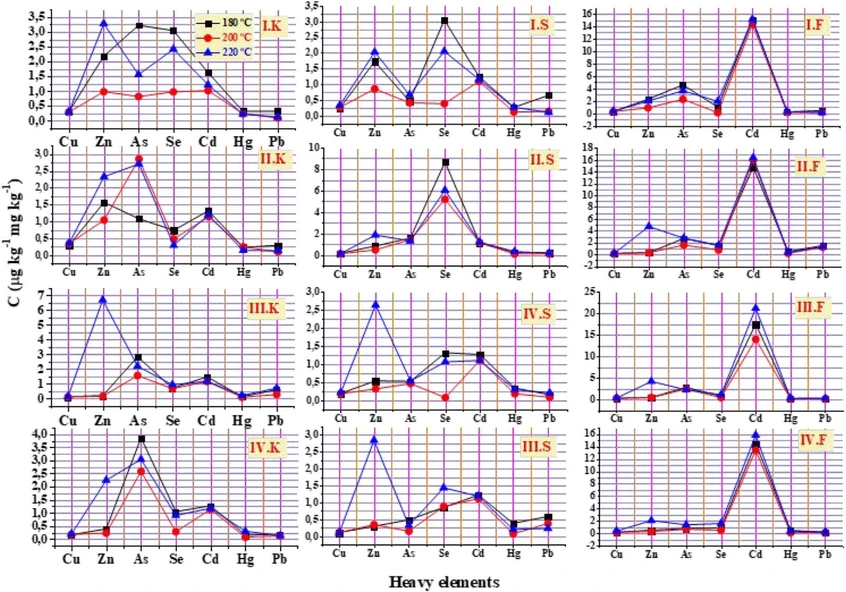 ACS Omega (2026) 11 (25): 36454–36467: Figure 1. ICP-MS measurements of apricot’s kernel regions I.K, II.K, III.K, IV.K, kernel’s shell, I.S, II.S, III.S, IV.S, and flesh I.F, II.F, III.F, IV.F in a microwave oven (at 800 W for 15 min) at 180 °C, 200 °C, and 220 °C temperature variations (Cu, Zn, and Pb concentrations: C × 103 μg kg–1).
Furthermore, the trace element levels determined in this study were compared with previously reported data for dried apricots from Türkiye. Overall, the elemental distribution pattern showed good agreement with the literature, especially for essential elements such as Fe, Zn, and Cu, which were within reported ranges. Observed quantitative differences may be associated with variations in soil composition, environmental conditions, cultivation techniques, and postharvest processing methods such as drying. These findings suggest that, despite some variability, the trace element profiles of the analyzed apricot samples are generally consistent with previously published studies. The results of microwave digestion at 200 °C (the second stage of temperature optimization) showed that the highest concentration of Pb (1.174 mg kg–1) was detected in the flesh sample from Site II, while the highest concentration of Cd (15.932 μg kg–1) was also observed in the flesh sample from Site II. Similarly, the results obtained at 220 °C (the third stage of temperature optimization) indicated that the highest concentration of Zn (6.650 mg kg–1) was found in the kernel sample from Site III, whereas the highest Cd concentration (21.127 μg kg–1) was detected in the flesh sample from Site III. Based on the μg kg–1-level measurements, it was observed that increasing temperature significantly enhanced the detection and extraction of cadmium.
An increase in temperature during microwave-assisted acid digestion improved the extraction efficiency of Zn and Pb, while the extraction efficiencies of As, Hg, Cd, Se, and Cu showed a decreasing trend. When these results were compared with World Health Organization (WHO) (2007) concentration limits (Cw), it was determined that Pb levels in Sites I, II, and III (flesh samples) and Se levels in the kernel from Site I exceeded recommended limits and may pose potential health risks. (1)
In this study, analysis of variance (ANOVA) was used to compare the elemental levels of Cu, Zn, As, Se, Cd, Hg, and Pb among different sample groups (kernel (K), kernel shell (S), and flesh (F)). Prior to analysis, normality and homogeneity of variance assumptions were tested. The sample size (n = 36) for temperature optimization was clearly defined. The Kolmogorov–Smirnov test indicated that the data were normally distributed, as all p-values were greater than 0.05. The assumption of homogeneity of variance was verified using Levene’s test, which also produced p-values above 0.05, confirming homogeneity. According to the results of one-way ANOVA, statistically significant differences were found among the groups for Zn (p = 0.000) and Hg (p = 0.000) (p < 0.05). No statistically significant differences were observed for the other elements (p > 0.05). Post hoc comparisons were performed using Duncan’s multiple range test, and the differences between groups are presented in the corresponding table (p < 0.05).
4. Conclusion
Apricot kernel, kernel shell, and flesh samples collected from four different regions were subjected to digestion processes that were repeated three times. To determine toxic elements (Cu, Zn, As, Se, Cd, Hg, and Pb), a total of 108 ICP-MS measurements were performed for temperature optimization during microwave-assisted acid digestion: 36 from the kernel, 36 from the kernel shell, and 36 from pulp samples. Similarly, 108 ICP-MS measurements were performed for time optimization and another 108 for power optimization with the same sample distribution. As part of the basic optimization grouping, quality control (QC) and quality assurance (QA) results for toxic elements in the ripe apricot were evaluated by using relative standard deviation (RSD) values obtained by ICP-MS. Although the 36 samples in each optimization group came from four different regions, the microwave digestion processes for temperature, time, and power were each repeated three times, increasing the statistical confidence interval for each element and ensuring reliable and accurate results.
This study demonstrates the importance of statistically supported optimization in microwave-assisted acid extraction for determining the elemental composition of the food samples. Analysis of apricot samples also shows that, although the daily dietary intake hazard quotient (HQ) values of toxic elements are not considered dangerous to human health, their accumulation in the body over time can contribute to the development of serious and potentially fatal diseases.
The presence of high concentrations of toxic metals in fish is of particular importance in relation to the FAO/WHO standards for Pb and Cd. The maximum permissible doses for an adult are 3 mg of Pb and 0.5 mg of Cd per week, but the recommended doses are only one-fifth of those quantities. Lead is known to induce reduced cognitive development and intellectual performance in children, as well as increased blood pressure and cardiovascular disease in adults.
The results demonstrated that heavy metal concentrations in apricot fruit are significantly influenced by the geological characteristics of cultivation areas, microwave digestion parameters, and the compositional structure of the fruit. Statistical analysis of microwave-assisted digestion processes (temperature, time, and power) further supported significant correlations among the Cu–Zn, As–Hg, and Se–Cd element pairs.