Microwave-assisted sample preparation for screening of heavy metal elements in food additives by ICP-MS

LWT, Volume 208, 15 September 2024, 116708: Fig. 1. Heatmaps for 11 heavy metals in 18 types of food additives in the correlation of (a) heavy metal concentrations in each food additives and (b) individual heavy metal distribution in the group of tested food additives in present study.
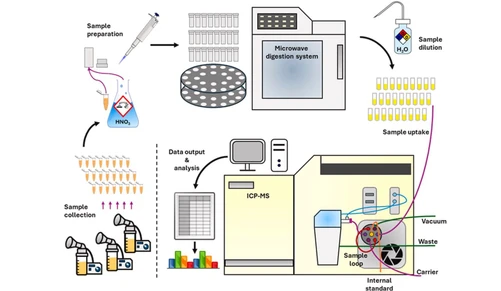
The goal of this study is to evaluate the effectiveness of microwave-assisted acid digestion combined with inductively coupled plasma-mass spectrometry (ICP-MS) for the detection and quantification of heavy metals in food additives. Due to health concerns related to excessive intake and the challenges of detecting trace metals in complex food matrices, the researchers aimed to develop a sensitive and reliable analytical method.
The study validated the protocol using glycerin as a matrix and tested it on 18 food additives for 19 heavy metals. The method demonstrated good linearity, precision, and accuracy for most of the tested elements. These results highlight the method’s potential for routine screening and regulatory monitoring, offering a practical approach for ensuring food safety and quality control in the industry.
The original article
Microwave-assisted sample preparation for screening of heavy metal elements in food additives by ICP-MS
Seo-Yeon Kwon, Yeong-In Kim, Yu-Kyeong Kim, Yang-Bong Lee, Jin Hong Mok
LWT, Volume 208, 15 September 2024, 116708
https://doi.org/10.1016/j.lwt.2024.116708
licensed under CC-BY 4.0
Selected sections from the article follow. Formats and hyperlinks were adapted from the original
Heavy metals are the main contaminants to food resources, which exist naturally in the earth at very low concentrations. They can enter and bind to vital cellular components of human, animal, and plant tissues. By the chronic exposure to heavy metals and their accumulation in the human body, a variety of health problems, such as persistent dysbiosis and interfering organ functioning, resulting in disorders or failure, can occur (Balali-Mood et al., 2021; Briffa et al., 2020; Kim et al., 2022; Kim et al., 2020; Renu et al., 2021). Recently, there have been further reports on the direct and indirect biological toxic problems, including inhibitory or lethal effects on all life forms, as not being broken down easily - some heavy metals, such as arsenic (As) and lead (Pb) in low concentrations, can lead to cause serious health issues (Balali-Mood et al., 2021). With growing concerns for heavy metals in foods, accordingly, the importance of quality control standards and risk assessment for their contamination have become highly controversial regarding the internationalization process (Kumar et al., 2019; Nelson et al., 2022).
Conventionally, analyses for heavy metal quantification include pretreatment steps for sample digestion, such as wet digestion, pressure tank digestion, dry-ashing, ammonium persulphate-ashing, and UV radiation (Bai et al., 2021; Flores et al., 2023; Naicker et al., 2023). Among these digestion methods, microwave (MW)-based digestion has been preferred with greater capability to break down complex matrices with minimum analyte loss and sample contamination, leading to high efficiency and precision for quantification of analytes (Bizzi et al., 2017; Sheehan & Furey, 2024). For a sample preparation step, to extract metal ions from a wide range of food materials, electromagnetic waves, generally 2.45 GHz, are applied for inducing directly interactions with polar solvent molecules by using dipole rotation and ionic conduction and this energy allows the analytes to partition from the sample matrix into the solvent. This method has been recognized by its digestion speed, simplicity in use, and versatility in handling diverse sample types, which are feasible for both sample preparation steps and quantitative analytical methods (Altundag & Tuzen, 2011; Dico et al., 2018). Besides these benefits of this technique, the usage of a large volume of solvent is the main drawback.
This study aims to provide a comprehensive information and potentials on new analytical method for heavy metal elements in food additives by emphasizing validation of the characteristics and taking advantages of microwave digestion and inductively coupled plasma-mass spectrometry (ICP-MS) technique. ICP-MS can offer superior sensitivity, multi-element capabilities, and isotopic information with sub-ppt or picomol/L level of detection limits (Ahmed et al., 2017). There were several reports for application of ICP-MS for heavy metal screening in natural resources or foods (Chevallier et al., 2015; Paniz et al., 2018). Also, approaches using green chemistry, aiming not to be harmful to the environment, are also suggested for sample preparation (Alahmad et al., 2023; Muller et al., 2017). Thereby, we proceeded the optimization of sample preparation steps for microwave-assisted acidic digestion with consideration for being sustainable and minimizing the consumption of chemicals and samples. Then, determination of 19 heavy metals in 18 types of food additives using ICP-MS was evaluated with validation.
2. Materials and methods
2.2. Instrumentation - ICP-MS analysis
Heavy metals in standard samples according to HNO3 concentration were analyzed by inductively coupled plasma-mass spectrometry (ICP-MS; Agilent 7850 ICP-MS, USA). The operating conditions of the device are shown in Table 1.
2.5. Sample preparation – microwave (MW)-assisted acid digestion
Before using samples, Teflon vials (183652, Anton Paar GmbH, Austria) for digestion were meticulously nitric acid-washed and rinsed with metal-free water to make chemical equilibria and prevent contamination. Approximately 0.25 g of the sample was introduced into the Teflon vial. In cases where the moisture content was high, about 1 g of the sample was used, as suggested MFDS of Food code (MFDS, 2022) and Food codex (MFDS, 2023), to achieve the measurable heavy metal contents even after subsequent drying. It is crucial to ensure that the test tubes are thoroughly cleaned with nitric acid before use. To facilitate digestion, a mixed solution of 3 mL of 11.11 mol/L HNO3 and 1 mL of 10.15 mol/L HCl was added to the test vials, respectively. The solution was allowed to stabilize for at least 2 h. The same procedure was followed for control tests without adding sample. The samples were kept in the microwave oven (1550 W, Anton Paar microwave 7000, Austria) at 220 °C for the 30-min duration (Ramp time: 28.8 min and Hold time: 30 min), as described in Mindak and Dolan's study (2010). The temperature was ramped up at a rate of 7.5 °C per min and the pressure was maintained at a minimum of 40 bar. Following digestion, the sample solution was filtered through a microfilter with a pore size of 0.4 μm. To complete the process, the test tube was rinsed with 0.79 mol/L HNO3 solution (1 mL), and the rinse solution was combined with ultrapure water to reach a final volume of 100 mL. The final concentration of the matrix was prepared by mixing of 0.79 mol/L HNO3 and 0.20 mol/L HCl.
3. Results and discussion
3.3. Verification of analytical method via tests with food additives
The optimized digestion method in present study was applied for the elemental analysis of 18 commercially available food additives by ICP-MS. As discussed earlier, we selected 11 heavy metals (Table 7). As shown in Table 7, the differences in elemental concentrations of heavy metals were observed in the various types of food additives. From the preliminary tests that we conducted the experiments with HNO3 concentrations of higher than 0.48 mol/L but lower than 0.79 mol/L for digestion of samples in the food additives, we observed interferences, which may be derived from incomplete digestion (Data not shown). Thereby, we kept using the 0.79 mol/L HNO3, of present study, and its subsequent microwave process for the tests with food additives.
 LWT, Volume 208, 15 September 2024, 116708: Table 7. Screening results of 11 heavy metals in 18 types of food additives.
As seen in a heatmap from Fig. 1(a), the most existing heavy metals in the tested food additives, were in order of Sb > Cu > Ni = Ba >Mn > Cr > Cd > Pb > Se > As > Sn. Interestingly, Sb was the most abundant heavy metal element with the highest concentration (454.86 mg/kg), which was in the benzoyl peroxide, as marked in the darkest red in Fig. 1(a). Cu was secondly most existing heavy metal element, found in 17 of food additives, as marked in light green and blue, except for ester gum (in navy) – the highest Cu concentration was found in hexane (approximately 194.76 mg/kg). In the case of Sn, it was only found in D-sorbitol solution and all marked in navy in a heatmap for concentration comparison. When we compared in heavy metal contents distribution (Fig. 1(b), max: 1 in red, min: 0 in navy), active carbon and benzoyl peroxide contain a variety of heavy metals at high concentration as marked in red-orange color – active carbon for Pb, Cd, and Se and benzoyl peroxide for As, Cd, Ni, Mn, and Sb. This result can offer information for regulation guidelines for selected food additives with heavy metal contents, which are vulnerable to expose via food additive consumption, for their screening.
LWT, Volume 208, 15 September 2024, 116708: Fig. 1. Heatmaps for 11 heavy metals in 18 types of food additives in the correlation of (a) heavy metal concentrations in each food additives and (b) individual heavy metal distribution in the group of tested food additives in present study.
With respect to the regulatory limit of heavy metals in food additive, it was worthy of analyzing the obtained results, even though it varies depending on the countries, regions, and agencies. For example, all measurements of Cd contents in food additives have shown up to 13.71 mg/kg, which was found in benzoyl peroxide. Our results of Cd, which is regulated by Europe to limit of concentration as 1 ppm among the 65 listed food additives (EFSA, 2011), presented exceeded in benzoyl peroxide, glycerin esters of fatty acids (emulsifier), lysosome (enzyme), and silicon dioxide (anti-caking agent). Compared to the Korea's regulatory concentration for Cd, set at 1 ppm, in food additives such as acidity regulators, nutritional enhancers, stabilizers, and flavorings, it showed more than maximum limits. In the case of Pb, which has been set its limit to 1–4 mg/kg (JECFA, 2004), suggested by Joint FAO/WHO Expert Committee on Food Additives (JECFA), all of tested food additive samples can be shown to ‘qualified’. Cautiously, for appropriate uses, there are specific applications with their maximum limits and restriction; for example, when liquid paraffin is used as a lubricant, Pb should not exceed the regulatory concentration of 1 ppm, while it was shown exceeded in our measurement (MFDS, 2023). For the As, except for benzoyl peroxide, the detected concentrations were below 0.1 mg/kg – The experimental results complied with its regulatory limit for food additive, set by JECFA, which was in the range of 1–3 mg/kg (JECFA, 2004). However, benzoyl peroxide was shown to be 7.89 mg/kg, exceeding the maximum limit, suggested by JECFA.
Based on the results of this study and measurements from the selected food additives, the developed method can be applied for quantification of selected heavy metals in food additives without sample decomposition and matrix effects for multi-element analysis. It can be useful to estimate the recommended daily intake for adults or infants for the processed foods with addition of food additives. The compiled information for heavy metals in specific food additives can provide the estimated contribution to levels of heavy metals through dietary intake and it can be useful for mitigating the health risks associated with dietary intake of metals. Further, the suggested approach in this study would meet the recommendation for the green analytical chemistry as a safer and more eco-friendly analytical method. Based on these findings, future studies should focus on the formation of standardized testing protocol and the development of rapid and accurate mapping of heavy metal contents in food matrix to prevent the transfer of metallic contaminants into the food chain and to formulate suitable control strategies.
4. Conclusion
Beyond the detection, the screening and identification of heavy metals in food and agro-products are indispensable to ensure food safety. Recently, despite the rapid progress of the available techniques, the feasible criteria of analytical methods have provided as wider range of possibilities for reliable and eco-friendly method.
The results from this study presented the effectiveness of the microwave-assisted diluted-acid digestion methods (0.79 mol/L HNO3) and ICP-MS for quantification of heavy metal elements in food additives. The correlation coefficients for 14 out of 19 metals were obtained with a high degree of linearity in the calibration curve and 11 of them showed the reliable accuracy in recovery in both standard solutions and food additives. However, there are still remained challenges for quantification of high concentrations of alkali metals, such as Na, Mg, Al, Zn, Ca, and Fe, due to their highly active ionization, even if they exist in the food additives.
Collectively, the analytical method with combination of microwave-assisted diluted-acid digestion and ICP-MS was effective and suitable for analyzing selected metal contents in food additives. The suggested method can be applied for food industries to monitor the food quality and to control the specific heavy metal compounds, which may pose a threat to the health of consumers.