First Results for the Elemental Composition of Copaiba Oil Resin (Copaı́fera Spp.) from Flona Carajás By ICP–OES
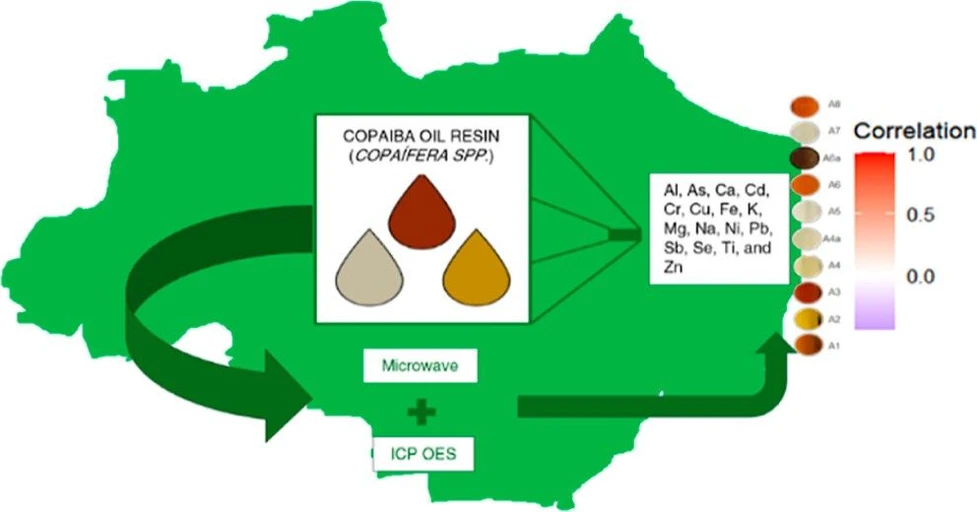
ACS Omega 2026, 11, 1, 1521–1529: Graphical abstract
This study reports the first elemental characterization of copaiba oil resin from the Carajás National Forest in the Brazilian Amazon using microwave digestion and ICP-OES analysis. Sixteen elements, including Ca, Fe, and Zn, were quantified with good recoveries, demonstrating reliable analytical performance.
Elemental concentrations varied widely and correlated with resin color, indicating compositional differences among samples. These findings contribute to understanding the inorganic profile of copaiba oil and support its sustainable extraction and valorization as an important non-timber forest product.
The original article
First Results for the Elemental Composition of Copaiba Oil Resin (Copaı́fera Spp.) from Flona Carajás By ICP–OES
Charles M. S. Borges, Patricia de O. Nunes, Jonathan B. O. Souza, Isamara de S. C. Benathar, Selma L. Goulart, Fábio I. M. Carvalho, Marcos Rodrigues, Heronides A. D. Filho, and Kelly G. F. Dantas*
ACS Omega 2026, 11, 1, 1521–1529
https://doi.org/10.1021/acsomega.5c10478
licensed under CC-BY 4.0
Selected sections from the article follow. Formats and hyperlinks were adapted from the original.
The importance of the Amazon Rainforest in regulating the global climate and its great biodiversity place the region at the center of the bioeconomy debate, thus highlighting the need to create a bioeconomy for the Amazon that values economic viability but guarantees sustainability and environmental protection (1,2)
Nontimber forest products are goods that emphasize the maintenance of ecosystem services provided by trees and, in a broader sense, by forests. Despite their growing recognition as viable economic alternatives to traditional agricultural and timber production in many tropical forests, several challenges stand in the way of their wider adoption, including the lack of standardized production processes that meet the stringent requirements of more demanding markets (1)
In the southeast of the Pará state, there is the Carajás National Forest (Flona Carajás), a conservation unit for sustainable use in the Brazilian Amazon, whose main activity is mining. This forest has the potential for the growth of bioeconomy-related activities, including the extraction of copaiba oil resin; however, studies on such activities in the region are still incipient (3)
Copaibeira is a large tree from which copaiba oil resin is extracted and is considered a rich source of active compounds. (4,5) Copaiba oil resin can be used pure (fresh or distilled) by oral administration or topical application, where it is used as a healing, anti-inflammatory, antiseptic, and antitumor agent and as an agent to treat bronchitis and skin diseases. In addition, it can be consumed as a component of products such as ointments, soaps, and syrups (5,6))
The use of various vegetables and other natural products, such as copaiba oil resin, in herbal medicine has become widespread in recent years. Therefore, there is growing interest in studies on their chemical compositions, both for organic constituents, which have their primary medicinal effects, and inorganic constituents such as macronutrients, micronutrients, and toxic elements. (7) The composition of inorganic elements in copaiba oil resin has not yet been reported. There are existing studies on the organic chemical composition of copaiba oil resin, where its anti-inflammatory, (8) antibacterial, (9) photochemical, (10) and volatile components (11) are evaluated.
As the quality of oils is directly related to the concentration of trace metals, multielement analysis has gained more importance in recent years. This type of analysis can be considered innovative and useful for obtaining nutritional and toxicity information, which is critical for its commercialization. (12) However, there are still a few studies on multielemental determination in Amazonian nonwood products such as copaiba oil resin.
Multielement analysis of oil samples is particularly difficult because some elements are present at very low levels. Sample preparation is a critical step in the entire analytical procedure, making the analysis extremely susceptible to contamination during preparation and requiring sensitive instrumental methods. In addition, its high viscosity makes it difficult to introduce the sample into the equipment, and its high organic load increases the matrix effect and the possibility of polyatomic molecular interferences from elements such as C, N, and S. This high organic content can result in carbon deposition in the sampling cone and loss of sensitivity. (12−16)
Analyzing oil samples is more challenging because of the complexity of the matrix. Pretreatment is a crucial step in the multielement analysis of oils, and microwave-assisted digestion is the most commonly used sample preparation method for determining metals in oils and other complex organic matrices. (17,18) Microwave radiation has been described as a successful assistant for sample pretreatment in analytical chemistry, where a closed system is used to avoid volatile compound losses and reduce the number of reagents required for sample preparation and the hypothesis of sample contamination. (14)
Atomic spectrometric methods are popular for the determination of trace elements in vegetable and biodiesel samples. (19,20) Metals in vegetable oils are typically determined using atomic spectrometric techniques such as flame absorption spectrometry (FAAS), (21) graphite furnace atomic absorption spectrometry (GFAAS), (22) inductively coupled plasma optical emission spectrometry (ICP–OES), (23) inductively coupled plasma mass spectrometry (ICP–MS), (24) and microwave-induced plasma optical emission spectrometry (MIP–OES). (15,25)
Inductively coupled plasma optical emission spectroscopy (ICP–OES) or atomic emission spectroscopy (ICP–AES) is a widely used analytical technique for the multielement analysis of a wide range of samples. The operating conditions of ICP–OES can be optimized by following simple procedures, and it is relatively easy to use. The advantages of the ICP–OES technique include its multielement capability for around 75 elements, acceptable sensitivities and limits of detection (LOD), and its ability to analyze samples of diverse matrices, such as agricultural, environmental, geochemical, metallurgical, petrochemical, and worn metals. (26) The literature reports studies using ICP–OES for multielement determination in various types of matrices, such as fish, (27) soil, (28) geopropolis, (29) and petroleum samples. (30)
However, no studies have characterized the inorganic constituents of copaiba oil resin, in addition to it being a complex and highly viscous Amazonian matrix. The microwave digestion method and ICP–OES determination are an alternative to overcome challenges such as matrix effects and the high organic load present in natural oils and resins. The determination of efficient methods can contribute both to the prospecting potential of this extractive activity and to the possibility that this oil resin obtained from the Carajás National Forest has a chemical composition different from those in other locations in the Amazon due to the characteristics of the region’s soil, (31) with a predominant area of mining exploration. Therefore, this study aimed to determine Al, As, Ca, Cd, Cr, Cu, Fe, K, Mg, Na, Ni, Pb, Sb, Se, Ti, and Zn in copaiba oil resin samples obtained from FLONA Carajás by ICP–OES.
Results and Discussion
Quantification of Analytes by ICP–OES
Table 5 shows the concentrations of Al, As, Ca, Cd, Cr, Cu, Cu, Fe, K, Mg, Na, Ni, Pb, Sb, Se, Ti, and Zn in copaiba oil resin by ICP–OES after microwave acid digestion in an oven with a cavity. The results for the investigated elements are expressed in mg kg–1. The precision of the procedure was evaluated by triplicate determinations of each sample, and the relative standard deviation (RSD) values were below 10% for most elements, indicating good repeatability of the ICP–OES measurements.
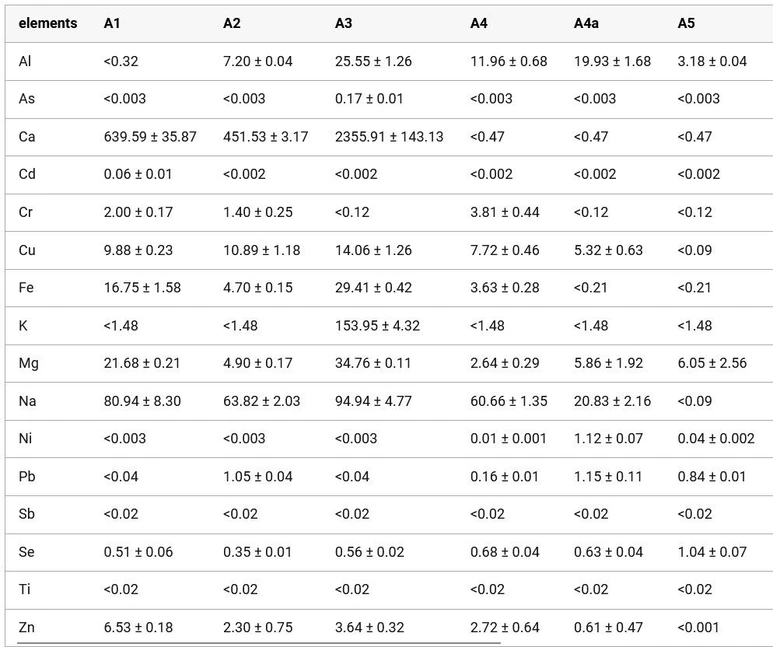 ACS Omega 2026, 11, 1, 1521–1529: Table 5. Element Concentrations (mg kg–1) in Copaiba Oil Resin by ICP–OES and Their Respective Standard Deviations (n = 3)_part 1
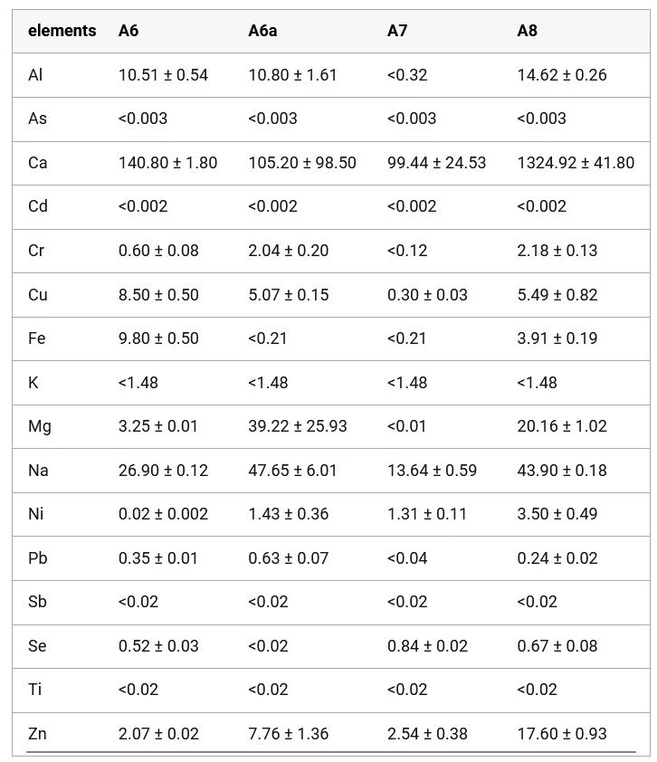 ACS Omega 2026, 11, 1, 1521–1529: Table 5. Element Concentrations (mg kg–1) in Copaiba Oil Resin by ICP–OES and Their Respective Standard Deviations (n = 3)_part 2
Aluminum is considered a neurotoxic agent that can increase the likelihood of developing Alzheimer’s disease, as well as cause cognitive impairment and neurological diseases. Aluminum can interfere with certain essential elements, such as calcium, and calcium metabolism is one of the most important processes in the human body. (38) Al was found in most samples at levels between 3.18 ± 0.04 and 25.55 ± 1.26 mg kg–1. These values were close to those found by (35) (10.3 ± 0.03 mg kg–1) and (36) (5.3 ± 0.42 mg kg–1) and above those found by (15) (0.06 ± 0.01–0.12 ± 0.02 mg kg–1) in different vegetable oils. Samples A1 and A7 had values below the LOD.
The Ca values found in the samples varied from 99.44 ± 24.53 to 2355.9 ± 143.13 mg kg–1, which is close to that found by (36) (273.9 ± 2.58 mg kg–1) for some samples but above the concentrations reported by (35) (41.0 ± 0.6 mg kg–1) and (37) (12 ± 0.4 mg kg–1) in sunflower oil samples. The Ca levels in samples A4, A5, and A4a were below the LOD.
Copper is a trace element that has several biochemical functions in living organisms. It plays an important role in cardiac function, osteogenesis, carbohydrate metabolism, and collagen tissue lipogenesis. It strengthens the immune system. It also has an effect on plant growth. Excessive consumption has a toxic effect on the body, preventing the performance of some enzymes. Fe is a necessary and useful element for organisms and a significant part of tissue and blood in animal and human bodies. It enters the structure of the hemoglobin that forms erythrocytes and has an important role in the formation of blood and function. (39) For Cu, only sample A5 obtained a value below the LOD. All other samples exhibited levels between 0.300 ± 0.026 and 14.06 ± 1.26 mg kg–1. For Fe, levels between 3.63 ± 0.28 and 29.41 ± 0.42 mg kg–1 were found in 6 of the 10 samples; only the values for samples A5, A7, A4a, and A6a were below the LOD. The levels of Cu and Fe are higher than those reported by (35) (Fe = 1.3 ± 0.02 mg kg–1; Cu < LOD) and close to those found in sunflower oil by (37) (Cu = 2.7 ± 0.11 mg kg–1; Fe = 8.6 ± 0.21 mg kg–1).
Chromium in its hexavalent form possesses high mobility in soil, permeability through biological membranes, and the capacity to generate reactive oxygen species, thereby disrupting DNA integrity and protein function. (40) The Cr levels in the samples were between 0.60 ± 0.08 and 3.81 ± 0.44 mg kg–1, with the values for samples A3, A5, A7, and A4a falling below the LOD. The levels of Ni in the samples ranged between 0.011 ± 0.0008 and 3.50 ± 0.49 mg kg–1, except for A1, A2, and A3, whose values were below the LOD. The Ni concentration levels in the copaiba oil resin samples were close to those reported by (15) (0.92–1.7 mg kg–1) and (35) (3.6 ± 0.11 mg kg–1)
Magnesium is a cofactor of more than 300 enzymatic reactions, acting either on the enzyme itself as a structural or catalytic component or on the substrate, especially for reactions involving ATP, which makes magnesium essential in the intermediary metabolism for the synthesis of carbohydrates, lipids, nucleic acids, and proteins. Magnesium deficiency can cause hipocalcemia and hypokalemia, leading to neurological or cardiac symptoms when it is associated with marked hypomagnesemia. (41) The concentrations of Mg ranged from 2.64 ± 0.29 to 39.22 ± 25.93 mg kg–1, with only the value for sample A7 being below the LOD. The Zn concentrations in the samples were between 0.61 ± 0.47 and 17.6 ± 0.93 mg kg–1. Only in the A5 sample was the Zn concentration below the LOD. These results were close to those reported by (37) (Mg = 25.1 ± 0.5 mg kg–1; Zn = 2.2 ± 0.12 mg kg–1), (35) (Mg = 22.5 ± 0.14 mg kg–1; Zn = 4.5 ± 0.54 mg kg–1), and (36) (Mg = 3.2 ± 0.16 mg kg–1; Zn = 2.1 ± 0.078 mg kg–1).
Na+ is the dominant cation in the extracellular fluid (ECF) of the body. The functions of sodium lie in its participation in the control of the volume and systemic distribution of total body water; enabling the cellular uptake of solutes. Sodium chloride added during industrial food processing and discretionary use or food preservation is the major source of dietary sodium in Western diets. Other sources of sodium include inherently native sources and sodium-containing food additives, in which sodium may be associated with anions other than chloride. (42) The levels of Na were between 13.64 ± 0.59 and 94.94 ± 4.77 mg kg–1, except for sample A5, which presented a lower LOD. These values were lower than those reported by (36) (152.4 ± 11.4 mg kg–1) and (35) (243.5 ± 27.80 mg kg–1) and close to those reported by (37) (12.4 ± 0.4 mg kg–1).
Pb can be found in edible vegetable oils as a result of environmental contamination, refining processes, transfer during transport, or packaging processes. In addition, Pb is a heavy metal that accumulates in the body, altering cellular metabolism and causing various harmful effects on human health, such as a decrease in the number of erythrocytes needed for the synthesis of red blood cells and hemoglobin, due to the inhibition of enzymes caused by exposure to this heavy metal. (43) The levels of Pb in the samples varied between 0.16 ± 0.01 and 1.15 ± 0.11 mg kg–1, and only the values for samples A1, A3, and A7 were below the LOD. These concentrations were lower than those reported by (36) (7.7 ± 0.23 mg kg–1).
Selenium was once considered a toxic element, but today it is recognized that selenium is an essential element necessary for various biological functions in humans and animals. Selenium is critical for optimal human health due to its antioxidant activity. Selenium protects the body from oxidative stress, reducing cellular damage caused by free radicals. (44) The Se concentrations in the copaiba oil resin samples were between 0.35 ± 0.01 and 1.04 ± 0.07 mg kg–1, except for sample A6a, whose value was below the LOD. The concentrations are close to those found by (35) (0.9 ± 0.08 mg kg–1).
The difference between the levels of the chemical elements found in the copaiba oil resin samples is probably due to the fact that they were collected from different trees and at different collection sites. Even in trees in nearby locations, the elemental concentrations within the tree can fluctuate. Several factors can influence the concentration of chemical elements in copaiba oil resin, such as the type of copaiba species, soil, topography, altitude, tree health, absorption, and transport of chemical elements contained in the soil absorbed by the root to other parts of the tree. (45)
Conclusions
This study presents the first investigation into the elemental composition of copaiba oil resin. The protocol proposed in this study, with the acid digestion of the samples with nitric acid and peroxide, and the determination of the elements by ICP–OES, proved effective for quantifying the examined elements. Except for Sb and Ti, all the elements studied were found in at least one sample, with a wide variation in their levels. The analysis of Pearson correlation coefficients presented a relationship between samples with a more intense color tone and how this characteristic may be linked to the content of some of the elements studied. A significant positive correlation was observed between samples obtained from the same tree. The analytical procedure established for ICP–OES, applied to a complex organic matrix of copaiba oil resin, represents an innovative analytical application for natural products from the Amazon. As a limitation, the restricted availability of samples and natural variability among trees may influence the representativeness of the results, but the methodology proved to be robust and reliable for the intended purpose. The inorganic composition results of this study can be further applied to investigate the organic composition and other physicochemical properties of copaiba oil resin and contribute to the valorization of this product and the activity of extracting copaiba oil resin, which is a source of income for many Amazonian families and communities and plays an important role in preserving biodiversity and conserving the Amazon rainforest.
Experimental Section
Instrumentation
Acid digestion of the samples was performed in a microwave oven with a cavity (Start E model, Milestone, Sorisole, Italy).
To determine the elements Al, As, Ca, Cd, Cr, Cu, Fe, K, Mg, Na, Ni, Pb, Sb, Se, Ti, and Zn in the copaiba oil resin samples, an ICP–OES system (iCAP 6500 Duo Model, Thermo Fisher Scientific, Cambridge, England) with two configurations (axial and radial) and iTEVA operating software was used. The digested samples were introduced into the plasma using a concentric nebulizer and a cyclonic nebulizer chamber. The operating parameters followed those recommended by the manufacturer, which were as follows: 1.15 W of radio frequency, 12 L min–1 of plasma gas flow, 0.5 L min–1 of auxiliary gas flow, and 0.5 L min–1 of gas flow in the nebulizer. All wavelengths were chosen to obtain the highest emission peak and the absence of spectral interference with the signal of the other elements, with the following lines atomic (I) or ionic (II): Al I: 396.152 nm; As I: 189.042 nm; Ca II: 396.847 nm; Cd I: 228.802 nm; Cr II: 283.563 nm; Cu I: 327.396 nm; Fe I: 238.204 nm; K I: 769.896 nm; Mg II: 279.553 nm; Na I: 589.592 nm; Ni II: 221.647 nm; Pb I: 216.999 nm; Sb I: 206.833 nm; Se I: 196.090 nm; Ti II: 336.121 nm; Zn II: 202.548 nm. All measurements were performed using argon (99.999% purity, White Martins, Belém, PA, Brazil) to purge the optics and form the plasma.