Elemental profile of traditional, commercially available Greek cheeses
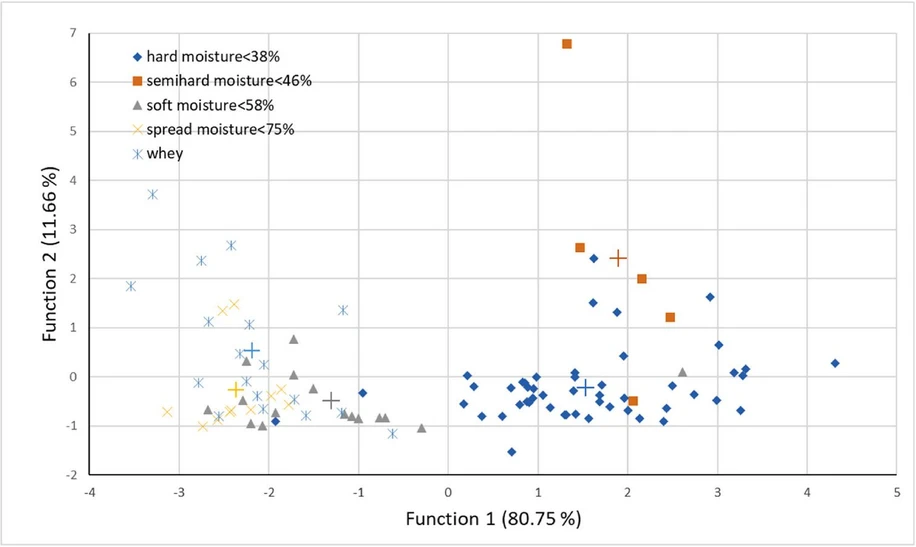
International Dairy Journal, Volume 169, 2025, 106315: Fig. 1. Discriminant analysis for different cheese types using two discriminant functions of elemental profile of cheese samples (+ indicates group centroid).
This study analyzed the elemental composition of 102 non-PDO (non–Protected Designation of Origin) Greek cheeses from both mainland and island regions, made from various milk types and production methods. Using ICP-MS, concentrations of essential elements (Cr, Cu, Fe, Mn, Mo, Se, Zn) and heavy metals were determined. Nutritional values were calculated based on these elements.
Results showed low levels of heavy metals, confirming the cheeses are safe for consumption, and highlighted their contribution to daily intake of essential nutrients like Cr and Zn. Discriminant analysis demonstrated differentiation based on milk and cheese type. A database of elemental profiles was created to support the promotion of these lesser-known local cheeses to Greek and European consumers.
The original article
Elemental profile of traditional, commercially available Greek cheeses
Eleni C. Pappa, Efthymia Kondyli, Athanasios C. Pappas, Lida Papalamprou, Andrea Mara, Panagiota Kyriakaki, Evangelos Zoidis, Agori Karageorgou, Elisavet Giamouri, Aikaterini Sarri, Panagiotis Simitzis, Michael Goliomytis, Gavino Sanna, Eleni Tsiplakou, Constantinos A. Georgiou
International Dairy Journal, Volume 169, 2025, 106315
https://doi.org/10.1016/j.idairyj.2025.106315
licensed under CC-BY 4.0
Selected sections from the article follow. Formats and hyperlinks were adapted from the original.
Greece possesses an established tradition in cheesemaking, producing a diverse array of cheeses. Twenty-two of these cheeses, such as Feta, Formaella Arachovas Parnassou, and Ladotyri Mytilinis, hold a Protected Designation of Origin (PDO) status, ensuring their authenticity and regional specificity. Additionally, Krasotyri Kos (Tyri tis Possias) and Kashkaval Pindou possess a Protected Geographical Indication (PGI) status, signifying its bond to a specific geographical area (European Union, 2019, 2024).
Despite the prominence of PDO/PGI cheeses, Greece also produces significant quantities of cheeses without such designations. In 2021, production included 23,473 tons of hard/semi-hard cheeses, 23,891 tons of whey cheeses, and 41,769 tons of soft cheeses that do not have PDO/PGI designation (Pappa & Kondyli, 2023). These cheeses contribute substantially to local economies, reflecting regional traditions and manufacturing techniques. Their production is inherited from one generation to another, while some of them are consumed seasonally and are associated with specific festivities. Variability in production methods and local traditions endow these cheeses with distinct identities. Many of these cheeses despite being recognized within their production areas, they remain unfamiliar to Greek, let alone European consumers. Nowadays, consumers are interested in local food products and are willing to pay higher prices taking into account the culture of these products as well as their characteristics and manufacturing conditions (Licitra, 2010; Braghieri et al., 2014; Kamber, 2015).
Cheese contains important nutrients such as protein, fat, vitamins and minerals and has a crucial nutritional role (Walther et al., 2008). There are twenty minerals essential for humans which are divided into macro-elements, sodium (Na), potassium (K), chloride (Cl), calcium (Ca), magnesium (Mg), phosphorus (P) and trace elements iron (Fe), copper (Cu), zinc (Zn), manganese (Mn), selenium (Se), iodine (I), chromium (Cr), cobalt (Co), molybdenum (Mo), fluoride (F), arsenic (As), nickel (Ni), silicon (Si), boron (B). Also, several other elements such as lithium (Li) and aluminum (Al) occur but are not nutritionally essential (Cashman, 2002). Iron, although found in low concentrations, is an essential trace element which is involved as a catalyst in certain metabolic reactions and plays an important role in the transport, storage and utilization of oxygen. Copper is an essential element that enables the proper function of many enzymes involved in the antioxidant defense of the body. Zinc is a trace element essential for growth, development, wound healing, and normal functioning of the immune system. Manganese is involved in the metabolism of biogenic amines and participates in the regulation of carbohydrate metabolism. Selenium is a component of selenoprotein glutathione peroxide which helps to protect cell components from oxidative damage. Chromium is regarded as an essential nutrient for humans and the earliest detectable effect of deficiency is an impairment of glucose tolerance. Cobalt is an essential component of vitamin B12 (Cashman, 2002; Miller et al., 2007; National Research Council, 1989). Therefore, determination of elemental profile is a very important analysis (Georgiou & Danezis, 2015).
Generally, the elements’ levels of a cheese depend on their levels in raw milk, reflecting the composition of soil used for pasture and the environmental contamination. The type of animal, i.e., sheep, goat, cow, their genetical characteristics, the type of pasture used, the stage of lactation, the seasonal and regional variations can influence the elemental concentration of a cheese (Miller et al., 2007; Sola-Larranaga & Navarro-Blasco, 2009). During cheese manufacture, different treatments such as heating of milk, curdling and salting can modify the element composition (Khozam et al., 2012; Schone et al., 2003). Moreover, the concentration of some elements can be increased by the transfer of metals from containers and tools, with which milk or curd come into contact, especially when metal containers are used for cheese storage such as brined cheeses (Blunden & Wallace, 2003; Coni et al., 1995).
The elemental profile of PDO and PGI cheeses was previously determined (Danezis et al., 2020). The aim of the present work was to provide a compositional elemental description of cheeses from the Greek market which do not bear a certification of geographical indication. Their physicochemical content was studied previously by Pappa et al. (2023). Their elemental profile may add value and greater significance contributing to better consumer recognition and to increased producers’ income. Therefore, in this work twenty elements, namely Al, vanadium (V), Cr, Mn, Fe, Co, Cu, Zn, As, Se, rubidium (Rb), strontium (Sr), niobium (Nb), Mo, tin (Sn), cesium (Cs), barium (Ba), gold (AU), lead (Pb), uranium (U) were determined and a database was created. Also, the nutritional value, in terms of dietary recommended intakes, for some elements (Cr, Cu, Fe, Mn, Mo, Se, Zn), was calculated.
2. Material and methods
2.4. ICP-MS analysis
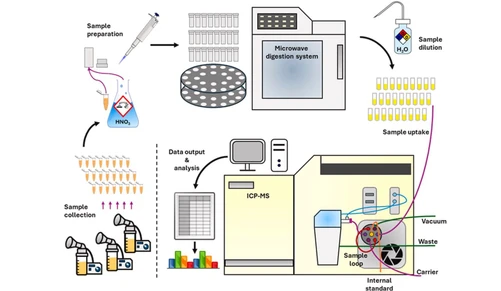
Elemental content was determined with iCAP RQ ICP-MS (Thermo Scientific, MA, USA) taking advantage of its rapid ultra-trace level multi-element determinations capability (Georgiou & Danezis, 2015). The ICP-MS parameters were as follows: nebulizer gas flow of 1.04 L min−1; cooling gas flow of 14.00 L min−1, auxiliary gas flow of 0.8 L min−1; spray chamber temperature of 270 °C; ICP RF power of 1550 W; extraction lens of −200.0 V; CCT focus lens of 1.80 V; detector voltages of −1800/2000 V; Q-cell active in KED mode to solve potential polyatomic interferences and matrix effect. Collision gas He-flow of 8.5 mL min−1; pole bias of −15.0 V and CCT bias of −8.0 V. Twenty elements were determined, namely 27Al, 51V, 52Cr, 55Mn, 57Fe, 59Co, 63Cu, 66Zn, 75As, 77Se, 85Rb, 88Sr, 93Nb, 95Mo, 118Sn, 133Cs, 137Ba, 197Au, 207Pb and, 238U. Each of these elements was selected based on its relevance to food analysis, its nutritional value, its potential to be a geographical indicator and/or an indicator of authenticity, as well as for the detection of eventual exposure to environmental contaminants. By analyzing a wide range of heavy metals, essential elements and toxic elements, a detailed elemental fingerprint for different cheese varieties can be developed, which can be used for quality control, as well as ensuring compliance of cheeses with food safety standards.
3. Results and discussion
3.1. Elemental profile of local non-PDO cheeses
Traditional Greek hard cheeses exhibited statistically significant differences (P < 0.05) for Nb, Mo, Cs, Ba, and Au, while no significant differences (P > 0.05) were observed for other elements, as presented in Table 1. These elements could serve as markers for differentiating cheeses based on their origin or production methods, while the absence of significant differences for other elements implies consistency across samples, indicating a stable baseline for those elements in traditional Greek cheeses. In detail, Saganaki exhibited the highest concentrations of Nb (10 μg/kg) and Au (46 μg/kg), Pecorino had the lowest concentrations of Au (1 μg/kg), Mo (9 μg/kg), and Cs (<LoD) -as was also evident for Tyri Mpournias of Andros-, but the highest concentration of Se (25 μg/kg). Melichloro of Limnos showed the highest concentration of Cs (12 μg/kg), and Ba (2200 μg/kg). Tyri of Mpounias from Andros had the highest concentrations of Mo (180 μg/kg), the lowest concentration of Ba (300 μg/kg), and Cs below the LoD. Although statistically not significant, Fe concentration showed the highest concentration in Tyri of Mpournias from Andros (13000 μg/kg), while the lowest was found in Malathouni of Tinos (2800 μg/kg). Variations of certain elements in animal products, like meat or cheese, could be attributed to variations or differences in soil composition, water sources, or feed (Danezis et al., 2017).
 International Dairy Journal, Volume 169, 2025, 106315: Table 1. Concentration of elements (μg kg−1) in traditional Greek hard cheeses.
3.2. Discrimination among cheese types
Discriminant analysis of the elemental fingerprint according to the type of cheese is presented in Fig. 1. Three discriminant functions were significant (P < 0.01) for the classification of samples among different cheese type groups. Fig. 1 depicts the first two discriminant functions. Two clusters were formed, one consisting of hard and semihard cheese samples and one with soft, spread and whey cheese samples.
International Dairy Journal, Volume 169, 2025, 106315: Fig. 1. Discriminant analysis for different cheese types using two discriminant functions of elemental profile of cheese samples (+ indicates group centroid).
Additionally, in Table 6, the different cheese types were classified based on their total elemental profile through discriminant analysis. 70.4 % of the samples were correctly classified into the appropriate cheese type group. The highest rate of correct classification was observed for hard cheese samples (90 %) whereas the rest of the samples were correctly classified at rates lower than 72.2 %. The elements Cr, Co, Cu, Zn, Sr, Au and U were found responsible for the discrimination of samples into cheese type groups according to the stepwise discriminant analysis applied. Under this context, previous studies applied elemental profile as a mean to discriminate among different cheese types. Aceto et al. (2017) reported that the distribution of lanthanides could be considered as a fingerprint tool to relate the soil of the pastureland on which cows graze and to the bottled milk. Magdas et al. (2019) reported that Mn content together with rare earth element concentrations were good predictors of two traditional cheese specialties of Romania. Mara et al. (2024) found elements such as Se and Zn to discriminate samples based on the cheese-making process of pecorino cheese from Sardinia, Italy.
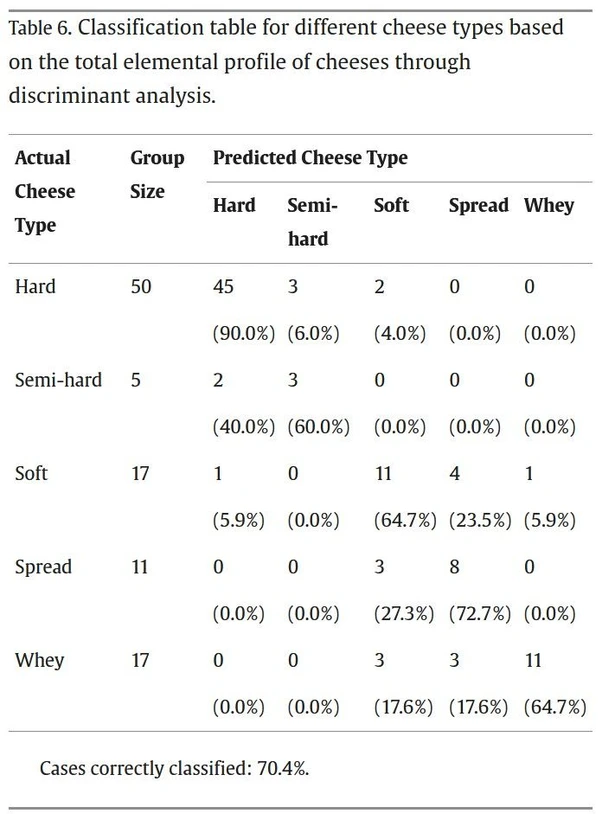 International Dairy Journal, Volume 169, 2025, 106315: Table 6. Classification table for different cheese types based on the total elemental profile of cheeses through discriminant analysis.
4. Conclusions
The present study provides important input on the levels of selected elements of commercially available, non-designated, Greek cheeses. The findings of the study indicate that these cheeses can be regarded as safe, given their low levels in heavy metals, and on the other hand, they cover a considerable percentage of the dietary recommended intake for elements like Cr and Zn. Additionally, the results of this work indicated that discriminant analysis may facilitate cheese differentiation based on cheese- and milk type, as an initial step enhancing their unique properties regarding milk type and cheese making. The cheese elemental profile assessed in the present study may provide added value and better consumer recognition towards an increased producers’ income.