News from LabRulezICPMS Library - Week 23, 2026
LabRulez / AI: News from LabRulezICPMS Library - Week 23, 2026
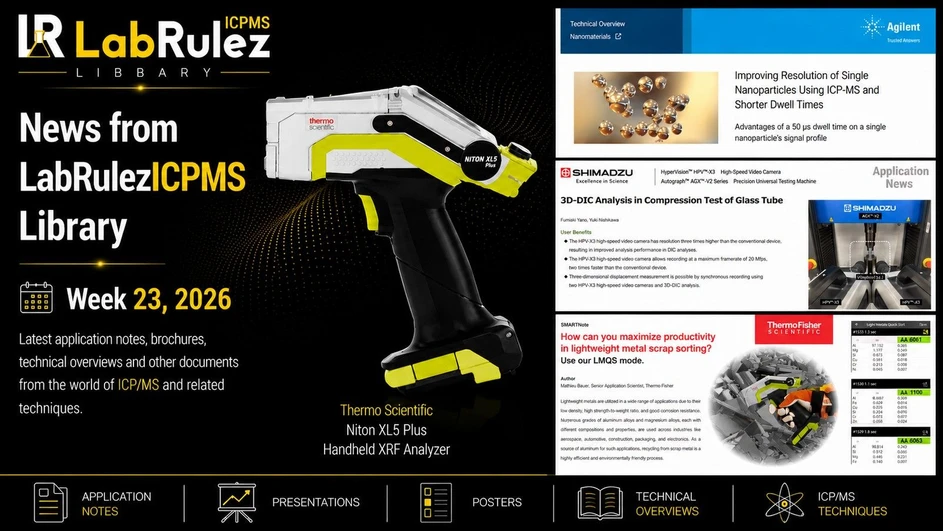
Our Library never stops expanding. What are the most recent contributions to LabRulezICPMS Library in the week of 1st June 2026? Check out new documents from the field of spectroscopy/spectrometry and related techniques!
👉 SEARCH THE LARGEST REPOSITORY OF DOCUMENTS ABOUT SPECTROSCOPY/SPECTROMETRY RELATED TECHNIQUES
👉 Need info about different analytical techniques? Peek into LabRulezLCMS or LabRulezGCMS libraries.
This week we bring you technical note by Agilent Technologies, application note by Shimadzu and other document by Thermo Fisher Scientific!
1. Agilent Technologies: Improving Resolution of Single Nanoparticles Using ICP-MS and Shorter Dwell Times
Advantages of a 50 µs dwell time on a single nanoparticle’s signal profile
- Technical note
- Full PDF for download
Single nanoparticles (sNPs) are defined as particles with diameters below 100 nm. Owing to their distinct physical and chemical properties, engineered nanoparticles are incorporated into a wide range of products to enhance performance or functionality. At the same time, they are increasingly recognized as potential contaminants or pollutants. In the semiconductor industry, for example, even single-digit nanometer-sized sNPs present in process chemicals can cause electrical shorting to occur and reduce product yield. Although the effects of sNPs on environmental and biological systems are still being investigated, researchers have developed methods to determine sNPs using single particle-ICP-MS (spICP-MS).1 Agilent ICP-MS instruments are widely used to characterize sNPs because of their fast-scanning multi-element capability, ultra-high sensitivity, low background, and integrated data analysis software.2-5
sNPs are decomposed, atomized, and ionized in the high-energy ICP. Any ions that are generated from a particle enter the vacuum chamber as ion clusters and are then detected as transient signal peaks above the background signal. The signal from each sNP event usually lasts between 400 and 1,300 µs. To detect this short-lived signal with high resolution, a fast time-resolved analysis (fast-TRA) acquisition is employed. Typically, a default dwell time of 100 µs is used. However, if higher peak resolution is required, the Agilent 9500 Triple Quadrupole ICP-MS (ICP-QQQ) can be operated with a dwell time as low as 50 µs. During the development of the 9500 ICP-QQQ, improvements to the instrument’s hardware enabled reliable control of TRA at much shorter timing intervals. These enhancements enable the 9500 to operate with high stability at a 50 µs dwell time, making it an effective instrument for high-resolution sNP analysis. The robust plasma of Agilent ICP-MS instruments, as indicated by a CeO+ /Ce+ ratio < 1%, also reduces matrix effects between standards and samples.
In this study, we conducted a fundamental evaluation of sNP analysis using a dwell time of 50 µs. Gold (Au), silica (SiO2 ), and platinum (Pt) nanoparticles were analyzed by the 9500 ICP-QQQ, and the results were compared with those obtained with a 100 µs dwell time.
Experimental
Instrumentation
The Agilent 9500 ICP-QQQ used the standard configuration (Ni cones and u-lens), except for the torch. A quartz torch with a 1.5 mm inner diameter (id) injector was used to minimize diffusion of ion clusters in the ICP and obtain sharper, better-resolved peaks.
Multi-element NP data acquisition and analysis were carried out using the Rapid Multi-Element Nanoparticle Analysis mode of the optional Single Nanoparticle Application Module for the Agilent OpenLab ICP-MS software. In Rapid MultiElement Nanoparticle Analysis mode, multi-element data are collected sequentially from a single sample acquisition, and all data are combined into a single file. This method saves time, as only one sample uptake and rinse are needed for all analytes. Data quality is likely enhanced, since the risk of sample contamination is considerably lower with a single analysis than with multiple separate analyses.
Conclusion
For high-resolution nanoparticle analysis, the Agilent 9500 ICP-QQQ can be operated in single-particle mode with a 50 µs dwell time, as well as the default 100 µs setting. The reduction of dwell time is enabled by advancements in both hardware and software that work together to support higher-resolution single-nanoparticle measurements.
Improved peak resolution was demonstrated for Au, SiO2 , and Pt nanoparticles, while maintaining equivalent performance to the standard 100 µs dwell time setting. The mean particle sizes obtained at 50 µs for the nanoparticle suspensions were within the manufacturer’s certified ranges. Likewise, the particle size distributions measured at both 50 and 100 µs closely matched the distributions provided by the manufacturer.
In addition to improved peak resolution, a shorter dwell time reduces the likelihood of multiple particles being detected within a single dwell period, potentially improving data accuracy.
Since the total data volume increases inversely with dwell time, a 50 µs dwell time generates more data points per unit time. To reduce processing time when handling large datasets, Agilent ICP-MS software (both ICP-MS MassHunter and OpenLab ICP-MS) uses multithreaded CPU‑based computation for sNP data analysis, maintaining efficient data management.
Although 50 µs may not be necessary for many sNP analyses, having the option to use this shorter dwell time provides greater flexibility. For example, it could enable samples with unexpectedly high particle counts to be analyzed without needing additional dilution.
2. Shimadzu: 3D-DIC Analysis in Compression Test of Glass Tube
- Application note
- Full PDF for download
User Benefits
- The HPV-X3 high-speed video camera has resolution three times higher than the conventional device, resulting in improved analysis performance in DIC analyses.
- The HPV-X3 high-speed video camera allows recording at a maximum framerate of 20 Mfps, two times faster than the conventional device.
- Three-dimensional displacement measurement is possible by synchronous recording using two HPV-X3 high-speed video cameras and 3D-DIC analysis.
Glass is used in various industries, such as electronic devices and automobiles. Depending on the intended application, mechanical properties are measured by material testing, but to achieve further improvements in performance, it is necessary to observe the origin of fracture and the condition of crack propagation. However, glass displays brittle fracture behavior, which is difficult to observe visually. In our previous reports, we observed the fracture behavior of glass specimens in ring-on-ring tests 1, 2, and those observation results indicated that a high-speed video camera with a recording speed (framerate) of several Mfps or higher is required to observe the fracture behavior of glass. In this experiment, the fracture behavior of a glass tube during a compression test was observed with an HPV-X3 high-speed video camera. In addition, synchronous videorecording was carried out using two HPV-X3 cameras, and the strain distribution during fracture was visualized by a 3D-DIC (three-dimensional digital correlation) analysis.
Specimen Information and Measurement System
The glass tube used as the specimen was compressed in the axial direction using an AGX-V2 precision universal testing machine. Table 1 and Table 2 show the equipment configuration and the specimen dimensions, respectively. In this article, fracture observation in the compression test and visualization of the strain distribution by 3D-DIC analysis were carried out. Fig. 1 shows the condition of the test for the 3D-DIC analysis. When an observation target such as a glass tube has a curved shape, a 3- dimensional strain analysis is necessary. Therefore, synchronous recording from two directions was conducted using two HPV-X3 high-speed video cameras, with a random pattern drawn on the specimen surface, as shown in Fig. 2. Table 3 shows the recording conditions.
Conclusion
The fracture of a glass tube during a compression test was observed using two HPV-X3 high-speed video cameras, and a 3D-DIC analysis was carried out. In fracture observation, the crack that became the origin of fracture could be identified, and the condition of crack propagation was clearly captured. In the 3D-DIC analysis, it was possible to observe the concentration of strain in front of the crack and the decrease in strain after crack propagation. Since glass fracture is brittle and is extremely rapid, a high-speed video camera with a recording speed of 5 Mfps or higher, such as the HPV-X3, is an effective instrument for fracture observation.
3. Thermo Fisher Scientific: How can you maximize productivity in lightweight metal scrap sorting?
- Other document
- Full PDF for download
Handheld XRF (HHXRF) has long been an important tool for sorting scrap metals. While handheld XRF can identify most grades of stainless steel, as well as titanium, nickel, cobalt, and copper alloys within 1 to 2 seconds, sorting aluminum alloys can take significantly longer. This is especially true if those alloys cannot be specifically identified by the content of their transition metals, such as manganese, copper zinc, nickel, iron chromium or titanium. The separation of grades within the AA 1000, AA 5000 and AA 6000 series, as well as casting alloy family grade separation, requires the measurement of light elements such as magnesium or silicon. Those elements are generally measured using an X-ray beam with a lower voltage, which results in longer measurements of typically 10 seconds or more. About a decade ago, handheld laser-induced breakdown spectroscopy (LIBS) emerged as an alternative for sorting aluminum and magnesium alloy grades within a few seconds. These include the smaller spot size and fluctuations related to the transient nature of the laser-induced plasma. Compared to a wider, continuous beam of X-rays, LIBS analysis is intrinsically more sensitive to surface roughness and surface contamination, and thus less precise than HHXRF.
More recently, the Light Metal Quick Sort (LMQS) mode available on the Thermo Scientific™ Niton™ XL5 series of handheld XRF analyzers uses a different logic than conventional HHXRF instruments. Provided with a 5W (up to 500µA) tube and a stateof-the-art silicon drift detector (SDD) with a graphene window, the analyzer starts measuring, at low voltage, elements from magnesium to zinc. This enables identification of most aluminum and magnesium alloy grades within one to three seconds, as well as the identification of other families of alloys. Longer measurements can be set for the few aluminum alloy grades that are identified based on zirconium, tin, lead, or bismuth contents.