News from LabRulezICPMS Library - Week 18, 2025
LabRulez: News from LabRulezICPMS Library - Week 18, 2025
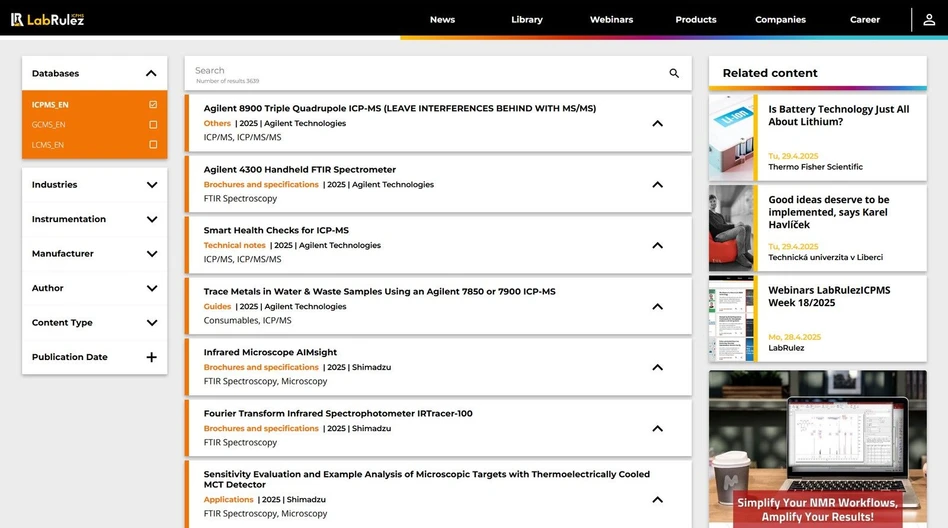
Our Library never stops expanding. What are the most recent contributions to LabRulezICPMS Library in the week of 28th April 2025? Check out new documents from the field of spectroscopy/spectrometry and related techniques!
👉 SEARCH THE LARGEST REPOSITORY OF DOCUMENTS ABOUT SPECTROSCOPY/SPECTROMETRY RELATED TECHNIQUES
👉 Need info about different analytical techniques? Peek into LabRulezLCMS or LabRulezGCMS libraries.
This week we bring you application notes by Agilent Technologies, Shimadzu and Thermo Fisher Scientific!
1. Agilent Technologies: Cocaine Detection with Agilent Resolve—a Handheld SORS System
Safe and rapid identification of physically and chemically concealed drugs
- Application note
- Full PDF for download
In 2022, cocaine production reached a record high of 2,757 tons, marking a 20% increase from 2021. During the same period, global coca bush cultivation—the primary source of cocaine—expanded by 12%, reaching 355,000 hectares.1 According to the World Drug Report, published by the United Nations Office on Drugs and Crime (UNODC) in June 2024, "A prolonged surge in cocaine supply and demand is bringing violence to countries along the supply chain and increased health harms at destination, most notably in Western and Central Europe."2
Traffickers of illicit drugs such as cocaine use various methods to evade detection by law enforcement agencies. One particularly challenging method involves chemically concealing or masking the drug within commercial shipments. Cocaine that has been incorporated into materials such as plastics or beverages must undergo processing to extract the drug from its chemically concealed state.3
Raman spectroscopy is a laser-based technique that illuminates a sample and analyzes the scattered light to identify the compounds present. The technique has been used extensively for the identification of illegal drugs and adulterants, including cocaine. Raman is a rapid and nondestructive way to perform sample characterization, with no need for chemical reagents. SORS is a variant of Raman that uses multiple measurements to allow samples to be identified inside sealed, thick, colored, and opaque containers or drugs concealed within materials or products.4 SORS improves the speed, efficiency, and safety of Raman drug identification methods.
The Agilent Resolve Tactical Handheld Raman Analyzer is a powerful tool that combines the capability of SORS with the portability of a handheld device (Figure 1). In addition to its unique ability to identify materials concealed behind barriers such as colored and opaque plastics, dark glass, paper, and fabric, Agilent's proprietary SORS optical setup allows Resolve to produce high quality data and reliable results. Resolve onboard libraries, which are available in three packages, are preloaded on the system and contain reference spectra for approximately 15,000 items. A large selection of spectra for controlled substances can be found in the Agilent Narcotics and New Psychoactive Substances library.
Cocaine detection
Pure forms of cocaine
Cocaine is a natural stimulant drug extracted from coca leaves. It has a high potential for addiction and comes in various forms that vary in color, purity, purpose, and effect.5 The hydrochloride salt form of cocaine is usually snorted, while the free-base and crack forms are smokable. To ensure that cocaine identification is successful in a range of situations, the Resolve Raman Narcotics and New Psychoactive Substances library contains spectra from several forms of pure cocaine. Spectra for some of the cocaine entries in the library are shown in Figure 2. Figure 3 shows an example of the results screen following the analysis of cocaine using the Resolve. The sample scan (green spectrum) was identified as cocaine with a 99% match quality score compared to the onboard library scan for cocaine (black spectrum).
Concealed cocaine
Narcotics and other illegal substances are often concealed within bottles and containers or disguised as legal substances such as toys, foods, and other common objects to avoid detection by the authorities.
Physical concealment and camouflage
Resolve's through-barrier SORS measurement capability, together with its high data quality and extensive libraries, can enhance the detection of hidden or masked controlled substances. SORS offers additional advantages for narcotic identification through barriers including operator safety and the preservation of evidence. Removing the need to open packages and sample the unknown substance means that operators reduce the risk of accidental exposure to potentially lethal narcotics.
As shown in Figure 5, common forms of concealed cocaine, such as paper wrappers or plastic-wrapped bullets used in body concealment, can be analyzed without the need to destroy the wrapping, preserving the evidence as found. Cocaine can still be identified using SORS, even when more unusual physical concealment methods, such as green plastic electric cord (Figure 5), are used. A recent study has shown the handheld SORS technology to offer a rapid and accurate technique for locating drugs concealed inside some vegetable and fruit products.4
Pink cocaine
Pink cocaine is a synthetic drug that produces similar effects to cocaine, but it is not actually cocaine. It is a mixture of several different substances, dyed to achieve a characteristic pink appearance. Originally composed of 2C-B, a psychedelic phenylethylamine, it now rarely contains 2C-B. Currently, pink cocaine typically comprises a mixture of substances, with the composition varying from batch to batch. The identity of substances in a batch remains unknown until a sample is tested.13 Some identified combinations of pink powders include:
- Ketamine and MDMA
- Methamphetamine, ketamine, and MDMA
- Cocaine and fentanyl
- Fentanyl and xylazine
The variability and unpredictability of the pink cocaine mixtures makes them highly dangerous for consumption and can often lead to hospitalization and risk of death.14 The types of aforementioned narcotics can be identified with Raman spectroscopy and are included in the Resolve library, Figure 13.
Conclusion
Cocaine remains a high-production, high-value, and highly sought-after drug – factors that continue to drive significant illegal trade. Traffickers use increasingly complex and diverse concealment techniques to smuggle drugs across borders and evade detection by law enforcement agencies.
This study demonstrates the versatility of the Agilent Resolve handheld spectrometer with offset Raman spectroscopy (SORS) technology for the identification of cocaine, which had been concealed or masked using a variety methods.
Some of the physical methods included mixing the drug with other substances, wrapping powders in paper or plastic, or inside plastic electrical cord cable, and disguising it as a commonly used object or product. The through-barrier SORS scanning mode allowed Resolve to analyze these samples directly, without the need to remove them from their original containment, preserving valuable evidence. The chemically concealed methods included adding the drug to alcohol and disguising the liquids as beverages, adding cocaine to plastics, and mixing cocaine with a large amount of a common merchandise material such as charcoal.
The Resolve handheld analyzer enabled:
- Generation of high quality data for improved detection of target compounds in powders and liquids, including cocaine, chemicals that are commonly used in the production of cocaine, and "pink cocaine"
- Access to the Agilent Narcotics and New Psychoactive Substances library, an extensive spectral library containing a large selection of spectra for controlled substances
- The direct analysis of unknown samples in less than one minute through barrier materials, ensuring the safety of the operator
- Identification of up to three components in mixtures
- Clear visual display of on-screen alerts and spectral identification information on samples – Access to saved onboard metadata to facilitate decision making
- The adsorption of a drug sample onto the metallic surface to enhance the Raman signal using SERS to detect a low concentration of cocaine
Overall, the Resolve handheld analyzer with SORS technology enhances the ability of law enforcement agencies to safely and quickly detect and intercept illicit drugs while preserving the integrity of evidence.
2. Shimadzu: Analysis of Total Oil and Grease (TOG) and Total Petroleum Hydrocarbons (TPH) in Water Using FTIR Spectroscopy Based on ASTM D7678-17
- Application note
- Full PDF for download
User Benefits:
- Quantitative analysis of TOG and TPH in water based on ASTM D7678-17 is possible with quantitation mode in LabSolutionsTM IR.
- Low concentrations of hydrocarbon in water can be measured using IRXross with high sensitivity.
Hydrocarbon contamination in various water bodies has become increasingly common around the world. It typically results from spills, leaks, or runoff from industrial activities. Once present in water, hydrocarbons can disperse throughout the environment, causing detrimental effects on environmental and human health as they infiltrate the food chain and pollute drinking water. Thus, it is essential to monitor and assess hydrocarbon contamination in these water bodies.
There are various regulated methods available for determining hydrocarbon content in water samples, such as ISO 9377-2:2000 [1], which is based on gas chromatography, and ASTM D7678- 17 [2], which uses Fourier Transform Infrared (FTIR) spectroscopy. In ASTM D7678-17, the total oil and grease (TOG) and total petroleum hydrocarbons (TPH) can be determined from water samples. Cyclohexane is used for solvent extraction, which is relatively safer and more environmentally friendly than the halogenated solvents employed in previous methods, such as ASTM D3921.
This application news demonstrates the analysis of hydrocarbon in water with cyclohexane as the extraction solvent using IRXross (Figure 1), Shimadzu FTIR spectrometer.
Results and Discussion
The IR spectra and calibration curve of tetradecane in cyclohexane standards are displayed in Figure 2 and Figure 3 respectively. A good correlation coefficient (r2) of more than 0.999 was obtained, indicating a high level of linearity.
Conclusion
This application news demonstrates that IRXross is suitable for the determination of hydrocarbon in water based on ASTM D7678-17 with relatively good sensitivity. Good linearity obtained from the calibration indicates high level of data correlation. Additionally, the results from validation standards shows the method’s high accuracy and good level of precision.
3. Thermo Fisher Scientific: Determining the geographical and botanical origins of honey by harnessing the power of triple quadrupole ICP-MS technology
- Application note
- Full PDF for download
Different types of honey have distinct flavors, colors, and nutritional profiles, which are influenced by the plants from which the bees collect nectar and in turn by geographical origin. However, fraud is a growing concern worldwide, and fraudulent producers resort to chemical adulteration. For example, dyes, artificial flavors, or preservatives are added to enhance the appearance, texture, or preservation of honey. Studies have been conducted to understand the scale of the problem, revealing that a large percentage of samples analyzed are potentially adulterated with the addition of extraneous sugar.1 The falsification of the geographical origin of honey, by mixing with honey from different locations despite making a local origin label claim, is also common.
Determining the botanical and geographical origin of honey is important for various reasons. It helps ensure the authenticity and quality of the honey, enabling consumers to make informed choices based on their preferences and dietary needs. Honey authenticity testing is also crucial for traceability, food safety, and compliance with local applicable quality standards and regulations. This information is particularly important for people with allergies, as they can avoid honey from regions where specific allergenic plants are prevalent. It also supports the preservation of biodiversity and local ecosystems, encouraging sustainable beekeeping practices and helps protect native plant species that are crucial for pollinators' survival.
Government authorities, international organizations, and the beekeeping industry are working together to combat honey fraud.2 Quality control measures, laboratory tests, and stricter regulations are put in place to ensure the authenticity of honey and protect consumers. The use of Inductively Coupled Plasma Mass Spectrometry (ICP-MS) is widespread because it allows reliable quantitative analyses of trace elements, as well as indispensable isotopic analyses for authenticity studies.
This study outlines a comprehensive method for honey authentication using the elemental composition, complimentary to traditionally used methods based on isotope ratio measurements.3 A full workflow is presented for a large sample suite of >100 honey samples of different geographical and botanical origin, including sample preparation, elemental analyses, and statistical data management.
Experimental
A Thermo Scientific™ iCAP™ TQ ICP-MS and a SC-4DX Autosampler with FAST valve (Elemental Scientific, Inc., Omaha, NE, USA) were used for analysis of 37 elements in 122 honey samples. Analysis was performed in kinetic energy discrimination (KED) mode using pure helium and using oxygen as the reactive gas in triple quadrupole (TQ-O2 ) mode. The instrument was operated using the configuration and parameters highlighted in Table 1. This analysis can also be carried out using a Thermo Scientific™ iCAP™ MTX ICP-MS with equivalent results and even better performance.
Software
The Thermo Scientific™ Qtegra™ Intelligent Scientific Data Solution™ (ISDS) Software was used for the ICP-MS analysis, including method definition, data acquisition, and evaluation. To statistically evaluate all results, Minitab™ Statistical Software (Minitab, LLC, State College, Pennsylvania, United States) was chosen. The flexible and easy data modelling options along with the large number of samples analyzed help to build a solid and reliable database. The software easily combines resulting concentration data from the ICP-MS and automatically generates statistical models based on the data. Minitab Statistical Software determines the contributions of each element and builds tree diagrams based on the type of model selected. The software automatically selects the most relevant elements to establish a prediction on the geographical and floral origins of unknown samples.
Results and discussion
Geographical origin
To determine the authenticity of European honey products, an initial model was established with all the analyzed honey samples, except 19 random samples. Unlike some commercial samples, most samples were of known and certified geographical origins, the accuracy of which affects the reliability of the model. The elements sodium, phosphorous, chromium, and potassium were automatically selected by the Minitab Statistical Software to establish five terminal nodes for the model and to determine the regional origin of the honey samples. This binary model is represented by a tree diagram (Figure 3) with a 2% error rate (5 samples misclassified out of 247 samples).
Given the quality and reliability of the model generated by Minitab Statistical Software, it is possible to perform a predictive analysis of geographical origins (EU or Non-EU) on unknown samples. For this, the remaining 19 randomly selected samples that were not used for generating the model were tested with this model and the prediction results are given in Table 5.
The model generates a prediction index under the category prediction event (PEvent) between 0 and 1, which is a measure of the probability of the honey sample coming from Europe. The closer the PEvent is to 1, the greater the probability that the sample is of European origin. For all the honey samples tested with this model, the predictive analyses are consistent for all samples with PEvent indices not less than 0.8 for EU samples, and not more than 0.1 for non-EU samples. These predictive results confirm the accuracy of the established model.
Country of origin
To identify the authenticity of unknown honey samples and determine their countries of origin, a second model with focus on the more precise origins of the honey samples was generated. This is a binary model in the form of a tree diagram generated by Minitab Statistical Software (Figure 4), built with data from French and Chinese samples only. The software automatically selects phosphorous and sodium as the main elements to identify the French and Chinese geographical origins of honey.
Conclusion
This study describes a workflow and the results obtained for the authenticity analyses of honey samples using ICP-MS. The analysis of more than 120 honey samples with certified origins allows the construction of a substantial database for a reliable statistical model. An accurate prediction of the geographical and botanical origin of the unknown samples can be realized, giving consumers more confidence about the origin of the products consumed. Furthermore, this workflow can be easily implemented in testing laboratories to control the raw materials used during production, as well as control the authenticity of the finished products and discover potential fraud.
This study highlights the need to obtain an accurate and reliable database and the key points to constitute it.
- The automation of acid digestion ensured by the EasyFILL acid dispenser and the ultraWAVE microwave digestion system offers excellent precision and reproducibility of the sample preparation, necessary to ensure validity of results. This fully automated sample preparation can be adapted to other food sample matrices.
- The iCAP TQ ICP-MS is dedicated to run quantitative and isotopic analyses to cover all the needed parameters for the creation of the honey database.
- The robustness and the linearity range of the iCAP TQ ICPMS allow simultaneous analyses of major and trace elements in a single run.
- The combination of helium and oxygen in a single method ensures the effective suppression of polyatomic and isobaric interferences to obtain an excellent accuracy for quantitative analyses.