Pyrolysis Compound-Specific Isotope Analysis of Proteins in Aged Paintings: Diketopiperazine δ13C Values as Collagen Source Indicators
Anal. Chem. (2026) 98 (29): 21183–21196: Visual abstract
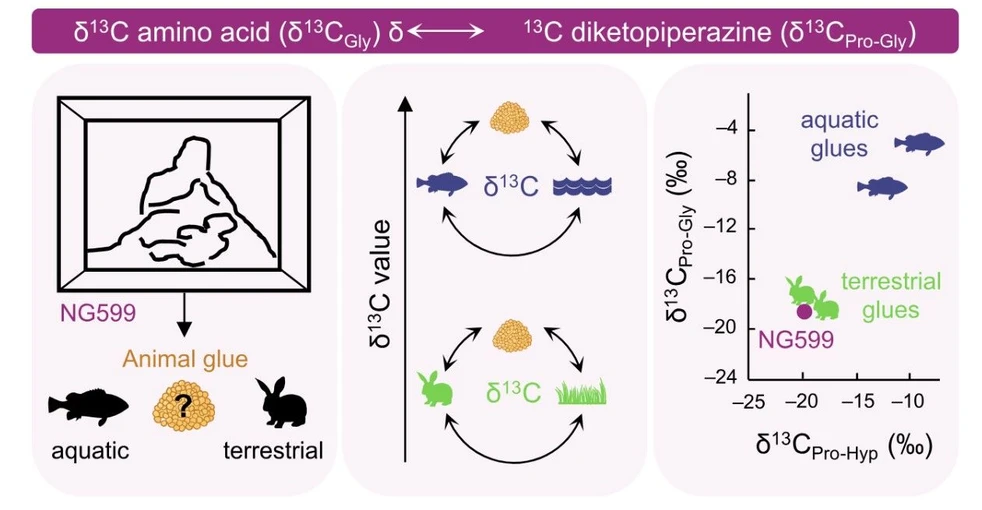
This study introduces a highly sensitive compound-specific isotope analysis method for identifying protein binders in aged paintings. Using direct inlet pyrolysis-GC-combustion-isotope ratio mass spectrometry (DIP-GC-C-IRMS), the method targets δ13C values of pyrolytic diketopiperazines and reduces the required sample size from milligrams to micrograms.
Reference materials showed that diketopiperazine isotope signatures preserve the distinction between terrestrial and marine collagen sources. Analysis of two 16th-century Italian paintings yielded values consistent with terrestrial animal glue, demonstrating that these isotopic markers can survive aging and degradation and support minimally destructive analysis of cultural heritage objects.
The original article
Pyrolysis Compound-Specific Isotope Analysis of Proteins in Aged Paintings: Diketopiperazine δ13C Values as Collagen Source Indicators
Eugenia Geddes da Filicaia* ; David A. Peggie; Iain P. Kendall; Ian D. Bull; Richard P. Evershed
Anal. Chem. (2026) 98 (29): 21183–21196.
https://doi.org/10.1021/acs.analchem.5c07901
licensed under CC-BY 4.0
Selected sections from the article follow. Formats and hyperlinks were adapted from the original.
The complexities and challenges presented by the analysis of protein paint binders illustrate the need for novel methods of identification for these materials, in particular to distinguish between terrestrial and fish-animal glues. An alternative approach with great potential may be found in the neighboring field of archeology, where collagen in bones and teeth has been used as a palaeodietary indicator since the 1970s. Determination of bulk δ15N values may suggest the position of an organism in the respective food web, while δ13C values offer insight into their diet. (27−29) Bulk δ13C and δ15N values of collagen are weighted averages of the δ13C and δ15N values of their constituent AAs, which reflect both dietary sources and metabolic processes. Serine, glycine, and alanine (Ser, Gly, and Ala) are part of the glucogenic AA group, which is biosynthesized from intermediates of glycolysis. As pyruvate is the end product of glycolysis, considered the catabolic pathway of carbohydrates, the isotopic signature of these AAs should reflect that of dietary carbohydrates. Aspartic acid and glutamic acid (Asp and Glu), asparagine (Asn), and Pro are part of the ketogenic AA group, originating from intermediates of the tricarboxylic acid (TCA) cycle. Due to their TCA cycle precursors, the isotopic signature of these AAs should reflect that of the whole diet, if biosynthesized de novo. Finally, Hyp and hydroxylysine cannot be incorporated into proteins from the diet and are formed after the polypeptides are synthesized, during posttranslational processing of collagen. Hydroxylysine is formed from lysine (Lys), whereas Hyp results from hydroxylation of Pro residues. (30) Moreover, AAs in the “trophic group“ tend to display a large enrichment in 15N with increasing trophic level, unlike those belonging to the “source group.“
Significant limitations therefore surround the interpretation of bulk stable isotope ratios, which, however, may be overcome by compound-specific isotope analysis (CSIA). Individual AA δ13C values have proven invaluable for distinguishing terrestrial from marine diets of our ancestors, (30−35) while AA δ15N values are being increasingly used in archeological trophic position studies. (36−39) Despite the similarity in target material, CSIA has never been extended to the analysis of animal glue, or any other protein, in paintings. Reasons for this are likely linked to the sample sizes required for standard protocols for GC-combustion-isotope ratio MS (GC-C-IRMS), which, however, as illustrated by recent studies, (40−42) may be significantly reduced by undertaking direct inlet pyrolysis (DIP)-GC-C-IRMS. Here, this technique is applied to the analysis of proteins of paintings, in particular by targeting, for the first time, the stable carbon isotope composition of DKPs, protein pyrolysates. Having confirmed that DKPs reflect the isotopic signature of their constituent AAs, DKP δ13C values may be used to distinguish terrestrial from aquatic animal glue in aged paintings.
Materials and Methods
Instrumental Analyses
For elemental analysis (EA)-IRMS, GC-FID, and GC-C-IRMS methods, please see SI1. All chromatograms were replotted in RStudio. DIP-GC-MS was carried out on an Agilent Technologies 7890A GC coupled to an Agilent Technologies 5975C MSD (Agilent Technologies, Santa Clara, CA, USA), a single quadrupole MS. The GC was equipped with a nonpolar fused-silica capillary column (30 m × 0.25 mm i.d. × 0.25 μm film thickness) with a BPX5 stationary phase (5% phenyl polysilphenylene-siloxane, SGE) and a TSP in the multimode inlet (MMI), operated in splitless mode. The initial TSP temperature was 50 °C, set to rise to 450 °C (900 °C min–1, 3 min isothermal hold), before cooling to 250 °C (25 °C min–1, 40 min isothermal hold). The oven temperature began at 40 °C, was increased to 200 °C (10 °C min–1), and then to 310 °C (6 °C min–1) with a final hold time of 20 min. He was used as a carrier gas at a constant flow (1.2 mL min–1).
The MS was set to acquire in full scan mode (m/z 50–650) at 0.2 scan s–1, and was operated at an EI potential of 70 eV with a solvent delay of 6.5 min. The MS transfer line temperature was set to 280 °C, the ion source temperature to 230 °C, and the quadrupole to 150 °C. Data acquisition was undertaken using Agilent Technologies Chemstation, and data processing with Agilent Technologies MassHunter software (version 10.0) and the AMDIS deconvolution software (NIST, version 2.66). Peaks were identified using a combination of mass spectral information, GC retention times (RTs), and comparison to the NIST mass spectral library (Mass Spectral Search Program version 2.0 and NIST 08 MS Library), published data sets, and NG databases. An n-alkane “ladder“ (with a characteristic bell-shaped peak profile) standard, containing C7–C40 saturated alkanes (0.01 mg mL–1 in n-hexane), was used to monitor instrument performance.
DIP-GC-QTOF-MS analysis was carried out on an Agilent Technologies 7890B GC coupled to an Agilent Technologies 7200 Accurate Mass QTOF MS (Agilent Technologies, Santa Clara, CA, USA). The same method was used, except that the MMI was held at 450 °C for 1 min only. The MS was set with an acquisition rate of 5 spectra s–1, an acquisition time of 200 ms spectrum–1, and an emission current of 2.1 μA. DIP-GC-C-IRMS analysis was carried out on an Agilent Technologies 8890 GC coupled to an Elementar isoprime precisION IRMS via an Elementar GC5 combustion interface, using a combustion reactor containing CuO pellets and Ag wool (Elementar Analysensysteme GmbH, Hanau, Germany), maintained at 850 °C. The GC parameters were identical to those for DIP-GC-MS, except that the MMI, after being held at 450 °C for 3 min, was cooled to 300 °C (900 °C min–1, isothermal hold for 50 min). Additionally, the oven program was typically shortened by setting a lower maximum temperature (280 °C instead of 310 °C), where it was held for 10 min. He was used as a carrier gas at a constant flow (2 mL min–1).
Results and Discussion
Pyrolytic Marker Identification from DIP-GC-MS of Protein References
The thermal degradation of intact proteins has been shown to be a multistep reaction, (45) where the formation of DKPs, occurring in the first degradation step (Tmax = 325 °C), does not require high Py temperatures. (21) Protein markers may therefore be detected through DIP-GC-MS, as testified by the analysis of a soapstone fragment from Qarmaaluit (18th–19th century CE). (46) Nonetheless, given that this technique is not widely reported in the literature, modern protein references were analyzed by DIP-GC-MS, and pyrolytic profiles obtained were compared to published Py-GC-MS data. Studies have been undertaken with (22, 47, 48) and without (22, 26) TMAH, hence, both methods were carried out here. Results were scrutinized, in particular, to identify pyrolytic markers suitable for DIP-GC-C-IRMS analysis. Egg yolk, which presents a similar AA composition as egg white, was not examined, as its high fat content was deemed to interfere with the analysis.
In general, DIP-GC-MS analyses involving derivatization with TMAH, in particular for animal glues, featured many more compounds compared to the total ion chromatograms (TICs) obtained without derivatization (see Figure S1 for G1, aged gelatin spread). In this case, GC-MS TICs exhibited better baseline separation with the most abundant peaks corresponding to the targeted DKPs. Further analysis of glue samples was therefore carried out without derivatization, as good baseline resolution is central to reliable compound-specific stable isotope determinations. (43) Analysis of rabbit skin glues (GRS1 and GRS2) and isinglass glues (GI1 and GI2) yielded GC-MS TICs identical to each other. In accordance with the literature, (21, 22, 49) as illustrated in Figure 1a, they are dominated by peaks corresponding to diketodipyrrole (peak 8) and cyclo(Pro-Gly) (peak 10). Because of its relatively high polarity, or overloading, the latter produces a broad (fronting) peak. (50)
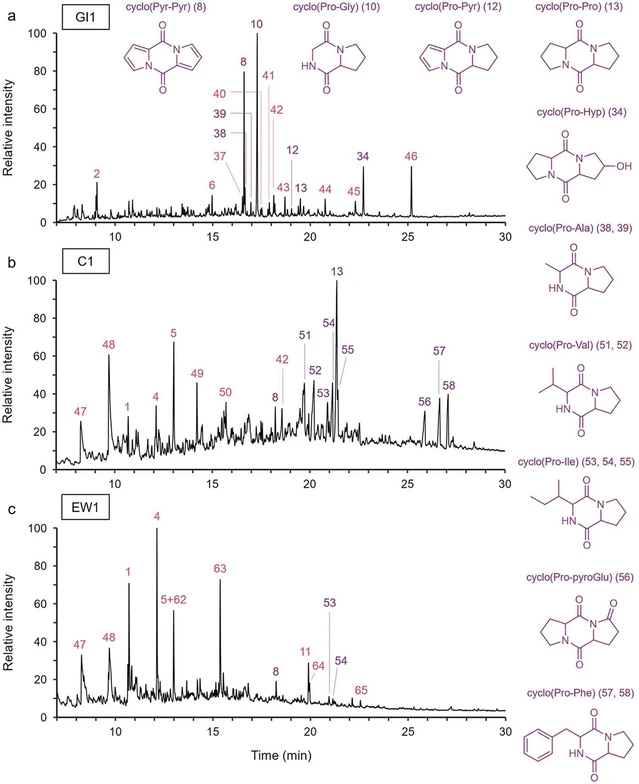 Anal. Chem. (2026) 98 (29): 21183–21196: Figure 1. Partial DIP-GC-QTOF-MS total ion chromatograms (TICs) for (a) isinglass, GI2, (b) casein, C1, and (c) egg white, EW1. Information on relevant DKPs (in purple) and other peaks (in pink) is listed in Table S1.
DIP-GC-C-IRMS for Source Determination of Proteins in Paintings from The National Gallery
Ground layer samples from two Italian Renaissance paintings in the National Gallery collection, NG599 (Madonna of the Meadows) and NG6368 (Tanaquil), were analyzed by GC by White in the 1980s. (15) The author reported AA profiles consistent with the presence of animal glues, which, for this purpose, would be expected to be of terrestrial origin. However, given the low proportion of Pro and Hyp in NG6368, White discussed a possible aquatic origin for this glue. Analysis was repeated with the aforementioned DIP techniques, revealing very similar profiles to those of the reference animal glues (Figure S6). The protein binder in the ground layers of both paintings exhibited similar DKP stable carbon isotope signatures. In particular, δ13CPro-Gly values were determined to be −18.4‰ (±0.1) and −17.6‰ (±0.1) for NG599 and NG6368, respectively. The δ13CPro-Hyp values were found to equal −19.8‰ (±0.4) and −18.6‰ (±0.001), respectively.
It should be noted that the SD observed for these determinations is lower than what was reported for some of the reference binders discussed above. These errors are in line with those observed for standard GC-C-IRMS methods. As these paint fragments were in the form of very fine powder, typical of paint samples, these results support that sample inhomogeneities might be primarily responsible for wide SDs, rather than the DIP-GC-C-IRMS method itself. In the case of marine animal glues, more enriched δ13CDKP values would be expected than those observed here, especially for cyclo(Pro-Gly). Instead, the determined δ13CDKP values suggest a terrestrial origin for the glues in both paintings. Indeed, by plotting the values as described above, as shown in Figure 7, both paintings fall extremely close to the reference rabbit skin glues. Hence, for NG599, these results are in agreement with the previous analysis by White (1984). However, regarding the origin of the binder from NG6368, these findings support a similar terrestrial origin, suggesting that a lower-than-average concentration of Pro and Hyp is not characteristic of fish glues.
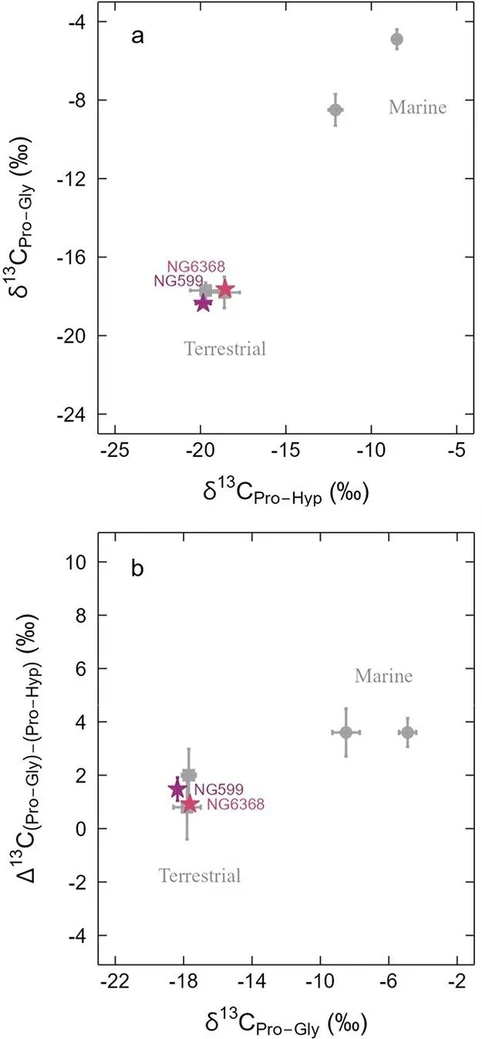 Anal. Chem. (2026) 98 (29): 21183–21196: Figure 7. (a) δ13CPro-Gly values for the ground layers from paintings NG599 (purple star) and NG6368 (pink star), against their δ13CPro-Hyp values. Modern references for marine (GI1 and GI2) and terrestrial (GRS1 and GRS2) animal glues are in gray. (b) Corresponding Δ13C(Pro-Gly)–(Pro-Hyp) values against their δ13CPro-Gly values. The error bars represent the SD on either side (±) of the value. The δ13C values have been corrected to take into account post-Industrial Revolution effects of burning fossil fuels by the addition of 1.2‰. (68) Instrumental precision was 0.3‰.
Although a wider range of reference material needs to be analyzed before this method may be reliably used, these results indicate that DIP-GC-C-IRMS is able to differentiate between terrestrial and marine animal glues in painting samples. Given the challenges currently faced by this field to differentiate fish glues from other animal glues, this innovative technique might enable new information to be gathered on artist techniques and the history of use of these materials. It is important to note that the method can be applied to many other fields of research. In addition to painting analysis, this minimally invasive protocol is pertinent to any discipline that involves the analysis of degraded proteins, heterogeneous and complex matrices, or where access to samples is restricted due to ethical implications or lack of material. This includes environmental and forensic sciences, paleo- and zooarcheology, paleoecology, and anthropology.
Conclusions
Aged proteins encountered in painted cultural heritage have usually undergone extreme structural changes from the freshly applied material, often rendering unambiguous protein source determination unattainable. In particular, the distinction between terrestrial and aquatic animal glues is typically not possible without proteomics approaches. Nonetheless, this paper demonstrates that, with minimal sample sizes, DIP-GC-C-IRMS permits determination of δ13C values of DKPs arising from pyrolysis of aged proteinaceous material, providing the first record of the isotopic signature of these compounds. In this study, δ13C values of DKPs were shown to reflect the δ13C values of the parent AAs and, therefore, to permit unambiguous differentiation between terrestrial and marine animal glues, analogous to the use of CSIA of archeological collagen for palaeodietary reconstruction.
Remarkably, DIP-GC-C-IRMS, requiring a considerably smaller sample (in the microgram range) than typical GC-C-IRMS methods (in the milligram range), renders CSIA accessible for the investigation of proteinaceous material in painted cultural heritage for the first time. This widens the application of CSIA to precious, unique, and fragile objects in cultural heritage and beyond. Moreover, the rapidity of the analysis places DIP-GC-C-IRMS as a useful screening method to identify materials of interest for further proteomic analyses.
First, the isotopic imprint of modern references for rabbit skin glues, isinglass glues, casein, chicken, and duck eggs was confirmed through established EA-IRMS and GC-C-IRMS methods. As expected, bulk and individual AA δ13C and δ15N values for terrestrial animal glues exhibited a higher depletion in 13C and 15N than the marine glues. The δ13C values of DKPs arising from DIP-GC-C-IRMS of the same materials were found to retain this relationship. Furthermore, the ground layers of two 16th-century Italian paintings from the National Gallery collection, known to contain animal glue, yielded δ13CDKP values consistent with the terrestrial variety, confirming that the isotopic signature of these compounds is retained through aging and degradation.