News from LabRulezICPMS Library - Week 32, 2026
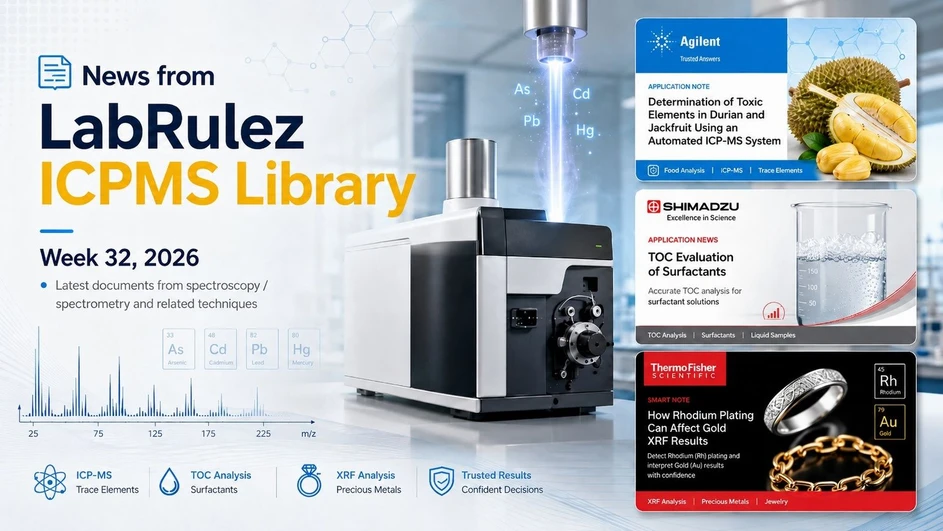
LabRulez / AI: News from LabRulezICPMS Library - Week 32, 2026
Our Library never stops expanding. What are the most recent contributions to LabRulezICPMS Library in the week of 3rd August 2026? Check out new documents from the field of spectroscopy/spectrometry and related techniques!
👉 SEARCH THE LARGEST REPOSITORY OF DOCUMENTS ABOUT SPECTROSCOPY/SPECTROMETRY RELATED TECHNIQUES
👉 Need info about different analytical techniques? Peek into LabRulezLCMS or LabRulezGCMS libraries.
This week we bring you application notes by Agilent Technologies and Shimadzu and other document by Thermo Fisher Scientific!
1. Agilent Technologies: Determination of Toxic Elements in Durian and Jackfruit Using an Agilent Automated ICP-MS System According to China GB 5009.268
- Application note
- Full PDF for download
Fruit is an essential part of daily human nutrition, providing vital vitamins, minerals, and dietary fiber.3 The Chinese market, with over 1.4 billion people, has become one of the largest fruit markets in the world. It is expected that China's total fruit consumption will reach about 312 million tons by 2025.4 Additionally, fruit imports are projected to exceed 9 million tons annually, underscoring the country's strong domestic demand and reliance on imported supplies.
Within this context, China has become a major export destination for Asian countries, including Vietnam, Thailand, Laos, Cambodia, Philippines, Indonesia, and others. Thanks to favorable climate conditions and a wide variety of tropical fruit cultivars, these countries have strategically increased their fruit exports to satisfy Chinese market demand. Specifically, products such as durian and jackfruit have gained significant popularity, playing an increasingly vital role in regional agricultural trade.
However, the biggest challenge for those countries when entering the Chinese market is strict food safety regulations, especially limits on trace elements and heavy metals such as lead (Pb), cadmium (Cd), mercury (Hg), and arsenic (As). The General Administration of Customs of the People's Republic of China (GACC) sets very low Maximum Residue Limits (MRLs, Table 1). Additionally, the large, continuous volume of fruit exports makes time a critical factor, as any delay can affect product quality and reduce its economic value. This situation places significant pressure on testing laboratories, requiring the development of stable, rapid, and accurate methods to ensure continuous and reliable operations.
To address these challenges, the Agilent ICP Workflow Automation System offers a practical solution. The ICP‑MS 7900 provides high-throughput, highly sensitive, and precise measurements of trace elements and heavy metals, including Pb, Cd, Hg, and As. The combination of ADS2 and AVS helps reduce sample turnaround time and cost per analysis. The Advanced Dilution System (ADS2) automatically performs important tasks such as preparing a multipoint calibration from a single stock standard up to 400 times, diluting samples above the calibration range, or, if there is an internal standard recovery issue, eliminating the need for manual dilution. The Advanced Valve System (AVS) automatically rinses the sample introduction system while the next sample is being analyzed, virtually eliminating the delays typical of conventional analysis. Using controlled argon bubble injection between the sample and rinse solution prevents mixing, reducing uptake and rinse times. This study describes the use of the Agilent 7900 ICP-MS, Agilent SPS 4 autosampler, AVS, and ADS2 auto-dilution for the analysis of four toxic elements in durian and jackfruit samples using the China GB 5009.268 method.1
Results and discussion
Automatic calibration standards and Instrument stability
A 7-point calibration curve automatically prepared using the ADS 2 demonstrated excellent linearity over the concentration range of 0.05–10 µg/L. Using a 1/x weighted regression without forcing the calibration through the origin, all analytes achieved coefficients of determination (R²) ≥ 0.995 (Figure 3), with back-calculated concentrations within 90–110% of their theoretical values, confirming the suitability of the calibration range for routine quantification. The integrated automation workflow significantly improved laboratory productivity by completing calibration preparation and analysis in approximately 1.5 minutes per sample. By minimizing manual operations and operator intervention, the ADS 2 reduced the risk of contamination and human error while enabling higher sample throughput for routine food safety testing.
To evaluate instrument stability during continuous operation, the variation in internal standard recoveries was monitored throughout an analytical sequence of more than 70 consecutive samples. The recoveries of the three internal standards across different measurement modes remained consistently within the ±20% acceptance limit throughout the analytical sequence (Figure 4). Blank samples interspersed between concentration intervals showed no evidence of carryover, demonstrating effective system cleanliness and analytical robustness. These results confirm the excellent long-term stability and robust matrix tolerance of the Agilent 7900 ICP-MS, providing reliable performance for high-throughput routine food safety testing.
Conclusion
The Agilent 7900 ICP-MS, integrated with the SPS 4 autosampler, ADS 2, and AVS, delivers a fully automated, high-throughput workflow for routine trace-level multi-element analysis. By eliminating manual standard preparation and minimizing operator intervention, the solution reduces labor costs, improves data consistency, and empowers laboratories to maximize productivity and analytical capacity to meet increasing testing demands.
Excellent sensitivity, long-term stability, and robust interference removal, together with satisfactory recoveries, repeatability, and reproducibility for As, Cd, Pb, and Hg at an LOQ of 5 µg/kg, demonstrate reliable analytical performance. Compliance with Chinese regulatory requirements further position the Agilent automation solution as a cost-effective platform for high-volume food safety testing and export quality assurance, enabling laboratories to confidently support the growing demand for exports to the Chinese market.
2. Shimadzu: TOC Evaluation of Surfactants
- Application note
- Full PDF for download
User benefits
- TOC can be evaluated accurately using the TC-IC method, even for foaming surfactants.
- The ASI-L autosampler enables automatic, continuous measurement of multiple samples, improving analytical efficiency.
Surfactants are important chemicals widely used in detergents and dispersants for pharmaceutical equipment cleaning processes, chemical manufacturing processes, and environmental water management. If surfactant residues remain after such processes, they can not only affect manufacturing processes and final product quality, but also increase the organic load in wastewater and environmental water. Therefore, quality control is also needed for organic matter derived from surfactants.
Total organic carbon (TOC) analysis is effective for evaluating the quality of surfactants. In general, the NPOC (non-purgeable organic carbon) method is often selected for TOC measurement in terms of sample volume and analysis time requirements. On the other hand, because surfactants have both hydrophilic and hydrophobic groups in their structure, they tend to foam even at low concentrations. When such samples are measured by the NPOC method, which involves acid addition and sparging, foaming can cause the sample to overflow from the syringe vessel inside the instrument into the waste line. That can result in measurement valuesthat are lower than the true value.
This article compares TOC measurement results for surfactants obtained by the NPOC method and the TC-IC method using the Shimadzu TOC-L total organic carbon analyzer, which uses the combustion oxidation method.
Conclusion
Table 5 summarizes the results obtained by measuring sodium dodecylbenzenesulfonate solutions, used here as representative surfactant samples, by the NPOC method and the TC-IC method. With the NPOC method, the TOC recovery rates were below 50 % for all samples, whereas the TC-IC method produced satisfactory TOC recovery rates close to 100 % for all samples.
Sodium dodecylbenzenesulfonate solutions (carbon concentration: 0.5 mg/L) is also used in Japanese Pharmacopoeia (JP) recovery tests. For surfactants that readily foam, such as in this example, NPOC measurements involving acid addition and sparging may affect measurement accuracy due to sample loss. For such samples, accurate TOC values can be obtained by using the TC-IC method. In addition, by using the ASI-L autosampler, multiple samples can be measured automatically and continuously.
3. Thermo Fisher Scientific: How rhodium plating can affect gold XRF results
Thermo Scientific™ Niton™ XRF Analyzers can help precious metals professionals detect rhodium (Rh) plating and interpret gold (Au) results with confidence.
- Other document (smart note)
- Full PDF for download
Benefits of XRF in jewelry analysis
Niton XRF analyzers provide capabilities that can enhance a jeweler’s operations in several ways:
- Identify Rh-plated gold items during routine testing
- Reduce confusion around unexpected Au readings
- Support more confident buying, selling, refining, and verification decisions
- Help explain results to customers, suppliers, and trading partners
Reduce risk in precious metals trading
In precious metals trading, small differences in reported gold concentration can affect pricing, settlement, customer trust, and supplier relationships. Recognizing Rh plating helps users avoid unnecessary disputes, retesting, or destructive testing when the surface finish is influencing the measurement.
Best practices
One should always check the result for Rh when Au appears lower than expected.
- Test multiple locations, especially where plating may vary
- Look for worn or unplated areas when appropriate
- Interpret Au results in the context of surface finish and item history
- If appropriate, remove the rhodium plating prior to XRF analysis to evaluate the underlying alloy
The bottom line
Rhodium plating can make a properly karated gold item appear to return a lower Au result when it is evaluated by XRF. Niton XRF analyzers can detect Rh at the surface, helping precious metals professionals recognize plating, interpret results correctly, and make more confident decisions.