News from LabRulezICPMS Library - Week 14, 2026
LabRulez: News from LabRulezICPMS Library - Week 14, 2026
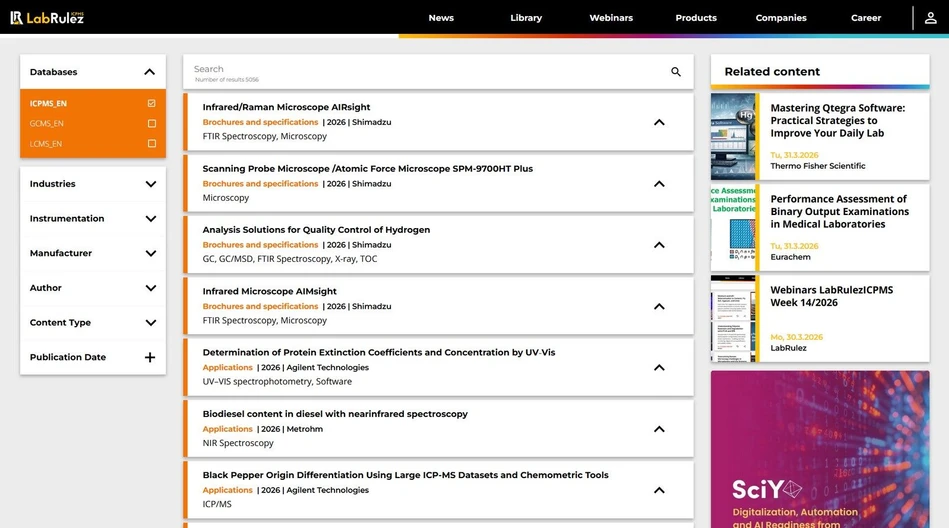
Our Library never stops expanding. What are the most recent contributions to LabRulezICPMS Library in the week of 30th March 2026? Check out new documents from the field of spectroscopy/spectrometry and related techniques!
👉 SEARCH THE LARGEST REPOSITORY OF DOCUMENTS ABOUT SPECTROSCOPY/SPECTROMETRY RELATED TECHNIQUES
👉 Need info about different analytical techniques? Peek into LabRulezLCMS or LabRulezGCMS libraries.
This week we bring you application notes by Metrohm, Shimadzu, Thermo Fisher Scientific and Waters Corporation!
1. Metrohm: Quantification of methanol in contaminated spirits
Protecting consumers from contaminated beverages
- Application note
- Full PDF for download
An alarming global trend highlights the serious harm that can result from ingesting illegal, improperly distilled alcohol. Home-distilled spirits prepared using industrial solvents (i.e., wood alcohol) and presented as legitimate alcoholic beverages often contain methanol. Methanol causes blindness and can lead to death when ingested. This has led to fatal consequences around the world [1–3].
The breaking point for the Czech Republic came in September 2012. The sale of hard liquor was temporarily banned after 20 people died from the consumption of spirits with dangerous levels of methanol [2]. After an exhaustive study using various screening tools, the Czech Republic adopted Raman spectroscopy as the method of choice for identifying and quantifying methanol in contaminated spirits. This Application Note demonstrates how Raman spectroscopy can be employed as an efficient and rapid screening method for samples of rum contaminated with methanol.
EXPERIMENT
This example study measures commercially available coconut rum that is spiked with methanol in concentrations between 0.33% and 5.36%. The iRaman NxG 785H with a fiber-optic probe is used to collect Raman spectra of the mixtures (Figure 3). Table 1 lists the relevant equipment and instrument settings used for this application study. The peak at around 1000 cm-1 (highlighted by the inlay of Figure 3) visibly increases with increasing concentration of methanol, becoming significant at approximately 1%.
CONCLUSION
These results validate that Raman spectroscopy can be used for rapid, quantitative screening of dangerous adulterants in alcoholic beverages. This technique can be expanded to investigate adulteration in other media such as food, petroleum, and pharmaceutical drugs [4].
2. Shimadzu: Evaluation of Organic Impurities in Lithium Carbonate by TOC Analysis
- Application note
- Full PDF for download
User Benefits
- TOC analysis enables effective control of organic impurities in lithium carbonate.
- Using the combustion tube kit for high-salt samples can extend the lifespan of the combustion tube and catalyst, reducing maintenance frequency.
- With the ASI-L autosampler, multiple samples can be measured automatically, improving throughput and efficiency
Lithium carbonate (Li2CO3) is an important material used in a wide range of applications in the lithium-ion battery industry. For example, it is used as a lithium source for cathode active material synthesis and electrolyte salt production, as a raw material for oxide-based solid electrolytes, and as a form of lithium commonly recovered in recycling processes.
Because impurities in lithium carbonate can affect downstream processes and final products, appropriate control is essential. In particular, organic impurities require especially careful attention because they may originate from so many sources, such as solvents and processing aids used during purification, residual organics from manufacturing steps, or contamination introduced during handling and storage.
Total organic carbon (TOC) analysis offers an effective way to manage such organic impurities in raw materials. This article presents an example of using a Shimadzu TOC-L total organic carbon analyzer (Fig. 1) to evaluate the TOC content of lithium carbonate.
TOC Analysis
TOC Analysis Methods
Two commonly used methods are available for TOC analysis:
(1) TC - IC method: Total carbon (TC) and inorganic carbon (IC) are measured separately, and then TOC is calculated as the difference (TOC = TC – IC).
(2) NPOC method: TOC is measured as non-purgeable organic carbon (NPOC). After acidifying the sample to pH < 3, IC is subsequently removed by sparging and the remaining carbon is measured as TC, which is regarded as TOC. The acidification and sparging steps are performed automatically by the instrument.
For lithium carbonate solutions, the amount of carbonatederived IC is typically very high. As a result, the TC–IC method tends to yield calculated TOC values with a larger relative error. Therefore, the NPOC method isrecommended.
In lithium carbonate solutions prepared as described above, IC is expected to be present mainly as bicarbonate (HCO3 –) and carbonic acid (H2CO3). If IC is not fully removed during NPOC pretreatment, the TOC result may be overestimated. Therefore, thorough IC removal is critical for samples with high IC content. For actual samples, sparging parameters, such as sparge gas flow rate and sparge time settings, can be adjusted.
Combustion Tube for High-Salt Samples
The prepared lithium carbonate solution contains a large amount of salts. When a large number of salt-containing samples are analyzed, salts may accumulate inside the combustion tube, which can lead to catalyst clogging, reduced sensitivity, and poorer repeatability.
For this analysis, the optional combustion tube for high-salt samples was used, shown in Fig. 2. The high-salt combustion tube has a larger diameter than the standard combustion tube and contains larger catalyst particles to help mitigate saltrelated clogging. Thus, the frequency of combustion tube replacement can be significantly reduced.
Conclusion
In this article, TOC analysis was performed for a 10 g/L lithium carbonate solution using a Shimadzu TOC-L total organic carbon analyzer. By measuring TOC in the prepared solution, the TOC content in the lithium carbonate solid was calculated. The results showed good recovery rates in the spike-recovery test and consistent performance was also confirmed during long-term continuous analysis. These findings demonstrate that the TOC-L is a reliable solution for measuring TOC in lithium carbonate and for effective management of organic impurities.
When applying the NPOC method to lithium salt-containing solutions, careful selection of the acid is essential because salts formed during acidification can affect both data quality and instrument condition. For this example, sulfuric acid is recommended.
In addition, using the optional combustion tube kit for high-salt samples can extend the lifespan of the combustion tube and catalyst, thereby reducing maintenance frequency. This option is especially helpful for samples with high salt concentrations.
In addition to lithium carbonate, the TOC-L can also be applied to TOC analysis of lithium hydroxide solutions, determination of water-extractable TOC in recycled black mass, and analytical needs in lithium refining processes based on direct lithium extraction (DLE). With its broad applicability across various upstream materials, recycling streams, and refining processes, the TOC-L supports both quality control and process optimization operations throughout the lithium-ion battery value chain.
3. Thermo Fisher Scientific: Evaluating Silicon using Raman Microscopy
- Application note
- Full PDF for download
Raman spectroscopy is a form of vibrational spectroscopy that probes chemical bonds and molecular structure and is sensitive to small changes in chemical and structural environments. The Raman spectrum of a material is a molecular “fingerprint” that can be used for identification of unknown materials and for characterizing and qualifying expected materials. Since intermolecular effects and lattice vibrations are also detected, it can be used to evaluate crystallinity. Mechanical phenomena such as strain can also be detected from peak shifts in Raman spectra. Raman imaging allows visualization of the distribution of components or changes in physical state across the sample.
Silicon in aluminum
Silicon is used in alloys with aluminum to increase the strength of lightweight aluminum-based parts. Addition of silicon to aluminum also alters the viscosity of melted aluminum, improving the castability. These alloys typically contain 3% to 25% silicon. While silicon and aluminum can form a eutectic mixture, it is common to have finely dispersed silicon particles throughout the material.¹ The size and distribution of silicon particles can affect the strength of the aluminum.
One common example of an aluminum product, aluminum foil, is made up of almost pure aluminum (approximately 98.5%) but it does contain small amounts of silicon and iron.² Raman imaging of a piece of aluminum foil reveals small particles of silicon (Figure 1). A Thermo Scientific™ DXR3xi Raman Imaging Microscope was used with a 532 nm laser and a 100X metallurgical objective to collect the Raman imaging data. An area of 408 μm x 208 μm was imaged using an image pixel size of 1 μm. The Raman image, based on the 520 cm-1 peak of silicon, shows the spatial distribution of the particles and image analysis provides size and shape information. In this case, 81 silicon particles were identified with a size (area) range of 6-151 μm². This analytical approach may be extrapolated to other types of Si/Al alloy parts.
Conclusion
The importance of silicon as a technologically significant material cannot be overstated. It has properties that make it useful in numerous different types of products. Raman micro-spectroscopy has proven itself an important tool for the assessment of molecular structure and physical states of silicon. Raman images provide a way to observe the spatial distribution of silicon and silicon-containing components, structural variations such as crystallinity, and physical effects such as strain. This note showed a few representative examples to illustrate some of the advantages offered by Raman microscopic analysis of silicon. The coverage is not intended to be comprehensive as there are numerous other areas where the Raman analysis of silicon is currently employed and other opportunities where it could be used. The Thermo Scientific DXR3 Raman Microscope and the Thermo Scientific DXR3xi Raman Imaging Microscope have both been shown to be excellent choices for the Raman analysis of silicon samples.
4. Waters Corporation: High-Throughput Detection of Degraded Polysorbate in Biological Formulations with FMM
- Application note
- Full PDF for download
The FDA requires that all biologic formulations be free of visible particles and has defined allowable levels of subvisible particles (SVPs) larger than 10 µm to ensure the potency, efficiency, and safety of these drug.1 While most protein drug particle analysis focuses on particles formed due to formulation instability, SVPs formed through the degradation of formulation excipients must also be considered.
Polysorbates 20 (PS20) and 80 (PS80), best known as Tween-20 and -80, are excipients used in >70% of marketed parenteral biological drugs to improve product stability and shelf life.2 However, when these formulations are stored for long periods of time (>6 months) at low temperatures (4 °C), visible and subvisible particles are formed due to the enzymatic hydrolysis of the polysorbates by host cell proteins (HCPs) such as esterases and lipases.3,4 PS20 in particular has been found to be extremely prone to degrading into fatty acid particles.5 Lauric, myristic and palmitic acids are the most common fatty acid degradation products, and there is a direct correlation between low fatty acid solubility and particle formation in common formulation buffers.3–7 However, high-throughput, sensitive, and specific analysis of polysorbate particles has been difficult due to their complex chemistry and their low concentrations (<<0.5%) in high protein concentration (>100–200 mg/mL) formulation environments, making it a perennial needle in a haystack problem.
In this application note, we introduce the Aura™ polysorbate degradation assay, a specific and quantitative assay that detects free fatty acid particles (FFAs) formed during polysorbate degradation on Aura PTx System. The assay analyzes 96 samples using anywhere from 5 µL–10 mL of sample in a few hours. Aura™ Systems use backgrounded membrane imaging (BMI) and fluorescence membrane microscopy (FMM) to count, size and ID particles from 1 µm to 5 mm. Fluorescent labels utilized by FMM are selected based on thier ability to interact with particles of a certain nature, allowing for the generation of key information related to identity of the particles.
Results and Discussion
Morphological Appearance of Different Fatty Acid Particles
Aura systems image every particle, enables subvisible particle size distributions analysis, and makes morphological differentiation possible using built-in image analysis filters. When we analyze different free fatty acid solutions with Aura PTx System, we find that each forms particles with different morphological characteristics. Lauric acid particles are large and irregular clusters, myristic acid particles are small and oval shaped, and palmitic acid particles form fibril-like particles and small circular clusters (Figure 2a-c). These unique morphological characteristics suggest the presence of free fatty acid particles that can then be confirmed with FMM using labeled fluorescence.
Conclusion
Aura PTx System and Aura+ System can easily detect the major degradation components of PS20 in proteincontaining samples at any stage of the drug manufacturing process. The method only requires 5 µL of sample, is specific and sensitive, and can analyze 96 samples in just a few hours, far outperforming other techniques. Aura PTx System and Aura+ System can also identify and differentiate the key degraded particulates from polysorbate formulation by their distinguishable shape, appearance, and specific labeling with BODIPY FL C16. The Aura polysorbate assay can detect FFAs at concentrations relative to lauric acid above 9.38 µM (>2183 counts/mL) and quantitate above 18.75 µM (>2976 counts/mL).