Evaluation of the Biostimulant Activity of the Microalgae Chlorella sorokiniana and Scenedesmus sp. and Their Resistance to the Most Widely Used Agricultural Pesticides
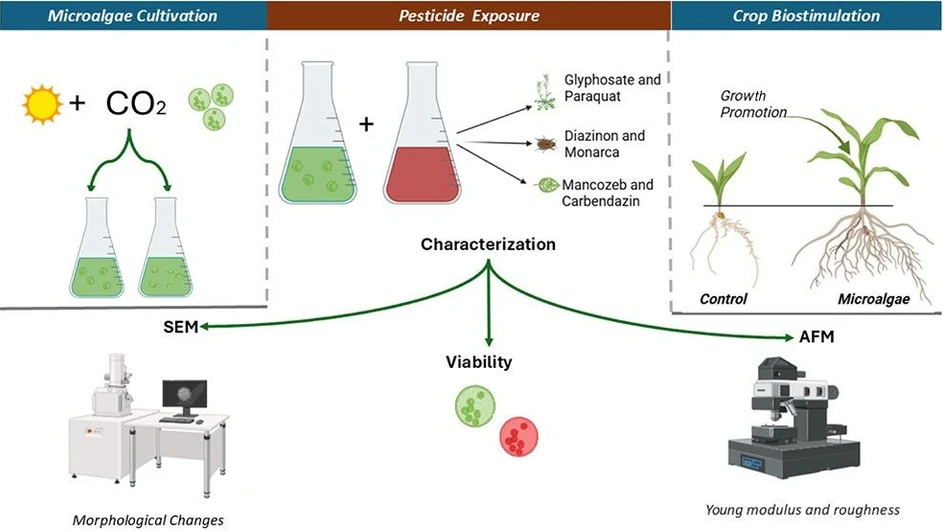
ACS Omega 2026, 11, 20, 29541–29549: Graphical abstract
The study investigates the biostimulant properties of the microalgae Chlorella sorokiniana and Scenedesmus sp. alongside their tolerance to commonly used agricultural pesticides. Both species promoted plant development by improving germination, root growth, cotyledon thickness, and chlorophyll content, demonstrating strong potential to enhance crop productivity.
Pesticide tolerance varied depending on the chemical and microalgal species, with fungicides causing the greatest cellular damage, confirmed by atomic force and scanning electron microscopy. The findings highlight the potential of these microalgae as sustainable agricultural bioinputs compatible with modern crop management practices.
The original article
Evaluation of the Biostimulant Activity of the Microalgae Chlorella sorokiniana and Scenedesmus sp. and Their Resistance to the Most Widely Used Agricultural Pesticides
Karina Rodríguez-Mora, Fabian Villlalta-Romero*, Yariela Nuñez-Salazar, Alex Ossa, and Mavis L. Montero
ACS Omega 2026, 11, 20, 29541–29549
https://doi.org/10.1021/acsomega.5c11935
licensed under CC-BY 4.0
Selected sections from the article follow. Formats and hyperlinks were adapted from the original.
The rapid growth of the global population is driving an unprecedented demand for food, water, energy, and other resources. (1,2) To meet the rising food requirements, intensive agricultural practices are increasingly relying on synthetic pesticides. (1) While effective against pests, these compounds are applied at high rates, lack selectivity, and pose significant risks due to their persistence and toxicity. (3) Excessive pesticide use contributes to nutrient leaching, eutrophication, soil and air pollution, and adverse effects on human health. (4)
Many herbicides induce oxidative stress, which leads to lipid peroxidation, thereby compromising membranes. Even insecticides, though not intended to target photosynthetic processes, have been shown to impair photosynthesis. (5)
This trend is largely driven by an agro-industrial economy and the tropical climate, which requires more frequent applications compared to temperate regions. (6,7) The consequences are immense, with widespread environmental impacts, economic costs, and a high incidence of poisoning, much of which remains underreported (8) Developing sustainable agricultural alternatives has therefore become a national priority.
Biological inputs have gained attention as a promising strategy to enhance crop productivity while reducing environmental and health risks. (4,9) Among them, microalgae are particularly attractive due to their ability to produce phytohormones, bioactive metabolites, and macro- and micronutrients that stimulate plant growth and suppress pathogens. (4,10)
Living organisms applied as monocultures or consortia offer important advantages, as they multiply directly in the soil, require minimal processing, and enhance plant growth parameters. They also fix atmospheric nitrogen and secrete phytohormones that promote growth, suppress pests, and reduce pollutants by mechanisms such as metal immobilization and the degradation of pharmaceutical residues. These effects, however, vary depending on the strain. (11)
Microalgae are particularly relevant due to their production of bioactive compounds with the potential to mitigate environmental impacts and support sustainable agricultural systems. (12) For this reason, they have been widely proposed as alternatives to chemical fertilizers. (13) Among the compounds of greatest agronomic interest are phytohormones such as cytokinins (e.g., isopentenyl adenine), gibberellins, and auxins (indole-3-acetic acid), which stimulate root initiation and elongation. (14) To assess these effects, four biostimulant activity protocols were performed using live microalgae at three different doses.
Chlorella sorokiniana is a cosmopolitan freshwater green algae with spherical cells and broad environmental adaptability, (15) whereas Scenedesmus sp. is a colonial species characterized by ellipsoidal or ovoid cells arranged in parallel rows. (16−18) These microalgae were selected for their potential as agricultural bioinputs. (19)
The objective of this study is to assess different microalgal doses for their capacity to promote plant growth and to identify the dose that produces the optimal biostimulant effect. Subsequently, the influence of agrochemicals on cellular morphology and viability is examined by using the previous dose, with the goal of enabling the integration of live microalgae with agrochemicals to support the transition toward more sustainable farming practices.
Materials and Methods
Elemental Characterization and X-ray Fluorescence (XRF)
The elemental analysis was carried out using a CHNS/O analyzer (FlashSmart Elemental, Thermo Fisher Scientific, Waltham, MA, USA) based on the modified Dumas method. The analysis was done in triplicate. For the XRF technique, a Bruker AXS S8 TIGER Series 2 (Karlsruhe, Germany) sequential wavelength dispersive X-ray fluorescence spectrometer (WDXRF) was used for direct analysis of the samples. (20)
Scanning Electron Microscopy (SEM)
Scanning electron microscopy (26) was used to determine morphological changes in microalgae. A Zeiss Sigma 300 scanning electron microscope was used, which belongs to the Center for Research in Microscopic Structures (CIEMic). For sample preparation, 20 μL of the previously washed suspension was deposited onto the carbon tape, allowed to air-dry, and subsequently coated with a thin layer of gold.
Results and Discussion
Elemental Characterization of Microalgae
The composition of the growth medium has a strong influence on the biochemical profile of microalgal biomass and, consequently, the properties of its derived products. (28) Table 2 presents the elemental analysis of the two species studied. As expected, carbon and oxygen were the predominant elements, consistent with the accumulation of polysaccharides and lipids in microalgal cells (29)
 ACS Omega 2026, 11, 20, 29541–29549: Table 2. Elemental Characterization of Microalgae
The average C/N ratios were 6.73 for Chlorella and 9.78 for Scenedesmus. For comparison, biofertilizers typically present C/N ratios of at least 2.8–17. (30) These values indicate relatively good ratios in the analyzed strains. However, for agricultural bioinputs, chemical composition alone is not a decisive criterion for assessing their effects on plant growth, crop yield, or nutritional value. Unlike conventional fertilizers, which only incorporate mineral nutrients, the impact of bioinputs is largely mediated by indirect effects on soil processes (31)
When applied to soil, microalgae can promote the formation of microaggregates, release phytohormones, and stimulate atmospheric nitrogen fixation. (32,33) These mechanisms highlight their potential value as bioinputs, even when elemental ratios differ from those of traditional fertilizers. For this reason, microalgae have a limited application in biofertilizers and the potential to be used as biostimulants.
A detailed profile of the elemental composition of the studied microalgae is presented in Table S1. The main macronutrients detected were Ca, K, and S, while the micronutrients Zn, Fe, and Mg were also present, all of which are essential for growth, stored within the cellular structure, and act as protein cofactors (34−36)
Overall, the elemental composition of Chlorella sorokiniana and Scenedesmus sp. does not indicate hazardous levels of heavy metals or pollutants. Instead, the biomass primarily contains elements essential for development and some accumulated from the growth environment. Combined with CHON analysis, these results reinforce the potential of both species as safe and effective agricultural bioinputs.
Pesticide Resistance
The viability assay is particularly relevant, as it quantifies the percentage of cells that preserve membrane integrity without rupture or chemical lysis. These results can be directly correlated with the Young’s modulus values obtained through AFM, which reveal morphological changes at the membrane level induced by stress factors such as pH, pollutants, temperature, and salinity. AFM-based mechanical testing thus provides valuable insights into cell wall elasticity and stiffness, allowing for a more precise assessment of structural alterations under chemical stress (41)
This is further illustrated in Figure 2, where error bars denote significant differences between treatments, highlighting the differential tolerance of each microalga. Both microalgae demonstrated good resistance to the two herbicides tested (Figure 2A). However, resistance to Paraquat was lower than glyphosate, consistent with its mechanism of action, because it interferes with the PSI electron transport chain, leading to superoxide anion production, oxidative stress, and subsequent membrane disruption and cell death. (42) In contrast, Scenedesmus sp. showed greater tolerance, suggesting species-specific resistance mechanisms.
 ACS Omega 2026, 11, 20, 29541–29549: Figure 2. Viability of microalgae using different pesticides and doses: A) Herbicides. B) Fungicides. C) Insecticides. The dose used for each of the pesticides was described in Table 1. All treatments present significant differences (p < 0.05) when compared between microalgae exposed to the different pesticides Table 2.
Figure 4 shows all morphological changes with the use of pesticides on microalgae. For the herbicides, C. sorokiniana has a rougher surface and tends to aggregate in the presence of glyphosate (Figure 4E). This is expected because, as previously indicated, the species is more prone to aggregation when its Z potential is lower. Although Scenedesmus sp. exhibits surface modifications, they are not as noticeable.
 ACS Omega 2026, 11, 20, 29541–29549: Figure 4. Micrography of electron microscopy for microalgae with pesticides on C. sorokiniana and Scenedesmus sp.
With the use of the insecticide diazinon, a clear morphological shift was observed, as the cells transitioned from a relatively smooth surface to a highly wrinkled and irregular structure, as shown in Figure 4G and H. Whereas Monarca observed a high interaction; C. sorokinana showed something similar to a film on the surface, and in Scenedesmus sp., the microstructure displayed disrupted morphology characterized by cracks, folds, and collapsed regions, indicating a loss of integrity. Additionally, Figure 5 shows the morphology observed using the AFM technique, where crystals on microalgae were noted.
 ACS Omega 2026, 11, 20, 29541–29549: Figure 5. AFM microscopy for determining the morphology of Scenedesmus sp. and C. sorokiniana.
The experiment with fungicides (Figure 4 K and L) shows that the microalgae have pesticide crystals attached to or close to them. However, C. Sorokiniana is the one that most clearly shows deformation and adhesion on its surface from the remaining crystals of Carbenzazin. The Mancozeb treatment could not be observed due to the excess pesticide residue.
Conclusions
The results demonstrate the biostimulant responses of Scenedesmus sp. and Chlorella sorokiniana under the experimental conditions evaluated. Scenedesmus sp. promoted seed germination and primary root elongation, whereas C. sorokiniana primarily induced cotyledon thickening at low application doses. Both microalgae increased the chlorophyll content during early plant development.
When exposed to agrochemicals, both species exhibited differential sensitivity, showing greater tolerance to herbicides compared with fungicides and insecticides. AFM and SEM analyses evidenced surface roughness alterations and localized membrane damage under chemical stress, which were more pronounced in C. sorokiniana.
Overall, these findings indicate that microalgae-based bioinputs support their potential use as complementary biostimulants within integrated and sustainable agricultural management strategies.


![Gunacins: Novel Benzo[g]chromene Derivatives from the Fungus Exobasidium sp. and Their Potent Anti-Leishmania and Trypanosoma Activities](https://icpms.labrulez.com/labrulez-bucket-strapi-h3hsga3/ACS_Omega_2025_10_22_23222_23234_Graphical_abstract_cover_68d40d7cfd_s.webp)