Low-Temperature Synthesis of Monetite/Dextran Hybrid Coatings with Tailored Corrosion Resistance on Ti6Al4V
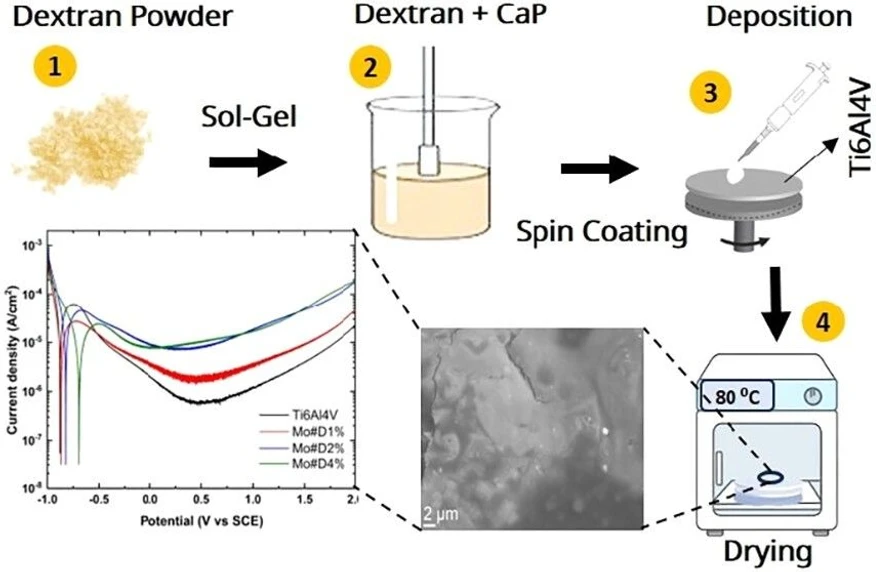
ACS Omega 2025, 10, 34, 39081–39086: Graphical abstract
Hybrid coatings of crystalline monetite (CaHPO₄) and kefir-derived Dextran were synthesized on Ti6Al4V substrates via a low-temperature (≤80 °C) sol–gel-assisted process, allowing biopolymer incorporation without degradation. XRD confirmed triclinic monetite nanocrystals (~152 nm), while FTIR and SEM/EDS analyses verified uniform Dextran integration, especially in 4 wt % films that produced compact, homogeneous surfaces.
Electrochemical tests in artificial saliva showed a major increase in corrosion resistance, with open-circuit potential shifting from −0.272 V to −0.034 V and polarization resistance rising from 1987 Ω to 5573 Ω. The hybrid structure enhances defect sealing, barrier formation, and interfacial stability. These results demonstrate that monetite/Dextran coatings are a scalable, sustainable, and biocompatible solution for advanced implant protection.
The original article
Low-Temperature Synthesis of Monetite/Dextran Hybrid Coatings with Tailored Corrosion Resistance on Ti6Al4V
Robert S. Matos*, Henrique D. da Fonseca Filho, Michael D. S. Monteiro, Nilson S. Ferreira*
ACS Omega 2025, 10, 34, 39081–39086
https://doi.org/10.1021/acsomega.5c05440
licensed under CC-BY 4.0
Selected sections from the article follow. Formats and hyperlinks were adapted from the original.
Titanium alloys are widely used in biomedical implants due to their favorable mechanical properties and biocompatibility. (1) However, their long-term performance can be compromised by limited corrosion resistance in physiological environments. To overcome this challenge, surface coatings that combine protective and bioactive functions have gained increasing attention. Recent advances in surface functionalization have focused on enhancing the bioactivity, corrosion resistance, and osseointegration of titanium-based implants, particularly Ti6Al4V, which remains a gold standard in orthopedic and dental fields due to its excellent mechanical strength and biocompatibility. Despite these advantages, its native oxide layer offers limited bioactivity, often necessitating the development of surface coatings capable of promoting cellular interaction while protecting against degradation in physiological environments. (1,2) A wide range of strategies has been proposed to address this limitation, including plasma electrolytic oxidation (PEO), microarc oxidation (MAO), and sol–gel-assisted deposition methods. For instance, Nadaraia et al. (3) reported the formation of composite PEO–PDA coatings on three-dimensional (3D)-printed titanium, incorporating hydroxyapatite and polydopamine to improve corrosion resistance and biomimetic mineralization. Similarly, Coan et al. (4) developed MAO coatings doped with transition metal oxides (TiO2, MoO3, Fe2O3, and MnO2) and bioactive Ca/P species, achieving enhanced wear resistance, osteogenic potential, and antimicrobial selectivity.
Herein, we present hybrid Monetite/Dextran coatings developed on Ti6Al4V substrates using a low-temperature sol–gel-assisted method. The coatings were thoroughly characterized, and corrosion testing confirmed their enhanced protective performance. The process, carried out at ≤80 °C, preserved the structural integrity of the Dextran component. The approach ensures molecular-level dispersion of kefir-derived Dextran without compromising its structural integrity, enabling uniform coverage and enhanced corrosion resistance. The proposed method complements existing techniques by offering a sustainable and biocompatible alternative, with potential applications in next-generation biomedical implants. This eco-friendly approach offers a versatile route to biobased, multifunctional coatings with potential for biomedical and surface protection applications.
2. Materials and Methods
2.2. Characterization
Thermogravimetric analysis (TGA) was performed using a Shimadzu DTG-60H from room temperature to 400 °C at 10 °C/min under N2. Attenuated total reflectance-Fourier transform infrared (ATR-FTIR) spectra were acquired on an Agilent Cary 630 in the 650–4000 4 cm–1 range at 4 cm–1 resolution. X-ray diffraction (XRD) was conducted using a Shimadzu LabX XRD-6000 (Cu Kα, λ = 1.54056 Å, 40 kV, 40 mA, 2°/min, 2θ = 10–60°). Surface morphology and elemental composition were analyzed by scanning electron microscopy (SEM) (JEOL JSM-5700) with energy dispersive X-ray spectroscopy (EDS) at 10 kV. Corrosion resistance was evaluated in Fusayama artificial saliva using a Metrohm Autolab PGSTAT204 potentiostat. A three-electrode setup was used (SCE reference, Pt counter, coated disc working electrode). Open-circuit potentials were monitored for 50 min, followed by polarization from −1 V (vs OCP) to 2 V (vs SCE) at 0.1667 mV/s.
3. Results and Discussion
The thermal stability of kefir-derived Dextran was evaluated by thermogravimetric analysis (TGA) to determine appropriate postdeposition conditions for preserving the biopolymeric structure in the hybrid coating (Figure 1a). The TG curve revealed a characteristic three-step degradation profile. The first stage exhibited an initial weight loss of approximately 26% between 25–150 °C (Tonset ≈ 95 °C), which is attributed to the desorption of physically adsorbed moisture and residual solvent from the hydrophilic polysaccharide matrix. This step reflects the inherent hygroscopicity of Dextran due to the abundance of hydroxyl groups capable of hydrogen bonding with water molecules. (14) A thermal plateau was observed between 150–200 °C, indicating a relatively stable intermediate region with minimal mass change. This plateau precedes the main decomposition event and is often associated with the onset of thermal rearrangements or limited cross-linking that do not result in significant volatilization. The most prominent degradation phase occurred between 200–400 °C (Tonset ≈ 286 °C), where a major weight loss of ∼74% was recorded. This region corresponds to the thermal decomposition of the polysaccharide chains, primarily involving the cleavage of glycosidic bonds and depolymerization of the Dextran backbone. The degradation pathway leads to the release of volatile compounds such as water vapor, carbon dioxide, carbon monoxide, and low molecular weight carbonaceous fragments. (15) The breakdown of the polymer structure in this range is consistent with the known thermal behavior of Dextran and similar microbial exopolysaccharides such as kefiran, (14) which exhibit a sharp decline in mass due to the scission of C–O–C linkages and subsequent volatilization of degradation products. Based on this thermal profile, a postdeposition heat treatment at 70 °C was selected to ensure efficient solvent evaporation while remaining well below the decomposition onset, thereby preserving the structural and functional integrity of the kefir-derived Dextran component in the final hybrid coating.
The XRD pattern of the Monetite/Dextran composite containing 1 wt % Dextran (Figure 1b) displays well-defined diffraction peaks characteristic of crystalline CaHPO4, confirming successful formation of the Monetite phase. CaHPO4 crystallizes in a triclinic unit cell with an anorthic structure (space group P1, ICSD#87196), and the observed reflections, indexed to the (001), (002), (210), (201), (022), (202), (003), (230), and (041) planes, are in good agreement with the reference pattern. The average crystallite size, estimated using the Scherrer equation, (16) is approximately 152 nm, indicative of a well-developed crystalline phase. For comparison, the XRD pattern of the bare Ti6Al4V substrate is included in Figure 1b, showing characteristic diffraction peaks of both α–Ti (space group P63/mmc, ICSD#076265) and β–Ti (space group Im3̅m, ICSD#076165) phases. The absence of Monetite-specific reflections in the uncoated alloy unequivocally confirms that the crystalline CaHPO4 phase is formed exclusively as a result of the coating process. Additionally, a broad halo centered between 15–20° (2θ) suggests the presence of an amorphous component, likely associated with the semicrystalline nature of Dextran. This diffuse scattering does not overlap with the principal diffraction peaks, implying molecular-level dispersion or partial disorder of the polymer within the matrix. Collectively, the data support the formation of a hybrid structure comprising a crystalline Monetite phase embedded in an amorphous Dextran-rich environment.
 ACS Omega 2025, 10, 34, 39081–39086: Figure 1. (a) TG/DTG curves of the pure Dextran biopolymer. (b) XRD pattern of the Monetite coating loaded with 1% Dextran; the inset shows the crystal structure of Monetite. (c) FTIR spectra of pure Dextran and Monetite/Dextran composites.
FTIR analysis further supported this hybrid nature (Figure 1c). The spectrum of pure kefir-derived Dextran displayed typical polysaccharide bands: a broad O–H stretching vibration at 3420 cm–1, C–H stretching at 2929 cm–1, and H–O–H bending at 1673 cm–1. Additional bands at 1360 cm–1 (CH2/O–H bending), 1000–1200 cm–1 (C–O–C stretching), and 900–530 cm–1 (α-d-glycosidic linkages) confirm the carbohydrate backbone. (17) The weak band at 2359 cm–1 is attributed to the asymmetric stretching of trace atmospheric CO2 physically adsorbed onto the hydrophilic Dextran matrix during sample preparation or FTIR data acquisition, and is not related to any structural or decomposition-derived species. In the composites, new bands appeared at ∼962, 1030–1090, and a doublet at ∼602 and 563 cm–1, corresponding to of PO43– vibrations, validating the formation of Monetite. Notably, shifts and intensity changes in the fingerprint region with increasing Dextran content suggest specific molecular interactions, likely hydrogen bonding, between the phosphate groups and the polysaccharide chains, in agreement with the hybrid structure observed by XRD. These structural and chemical modifications were accompanied by clear morphological evolution, as observed in SEM images (Figure 2a–c), which show a progressive surface transition from granular textures at low Dextran content (Mo#D1%) to smoother, more homogeneous coatings at higher concentrations (Mo#D4%). This transformation suggests polymer-induced matrix restructuring during hybrid formation. EDS spectra (Figure 2d–e) further support this trend, revealing a marked reduction in calcium and phosphorus signals, complete masking of the Ti6Al4V substrate, and a concurrent increase in carbon and oxygen content, evidence of increasing organic phase incorporation. At 4 wt % Dextran, the coating appears fully continuous and chemically organic-rich, consistent with surface homogenization and phosphate signal suppression. These observations align with FTIR data, which showed enhanced C–O–C and O–H stretching vibrations and diminished phosphate bands, confirming polymer integration and partial suppression of the inorganic phase. Altogether, these results demonstrate that Dextran content serves as a key parameter for tailoring coating morphology, composition, and hybrid character.
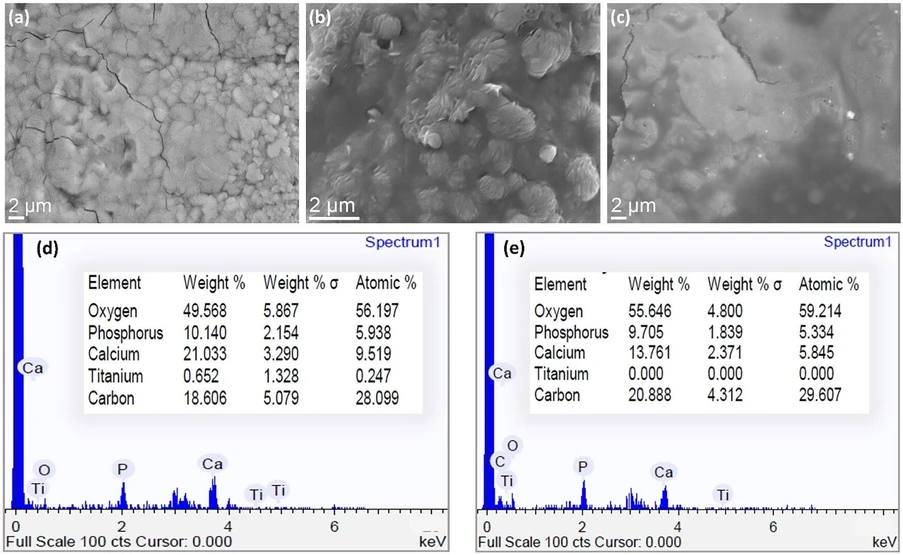 ACS Omega 2025, 10, 34, 39081–39086: Figure 2. SEM micrographs of Monetite/Dextran composite coatings with increasing Dextran content: (a) Mo#D1%, (b) Mo#D2%, and (c) Mo#D4%. EDS spectra and elemental compositions are shown for (d) Mo#D1% and (e) Mo#D4%, based on mapping analysis.
4. Conclusions
In conclusion, we have developed a low-temperature, sol–gel-derived hybrid coating comprising crystalline Monetite and kefir-derived Dextran, applied to Ti6Al4V substrates. Structural and spectroscopic analyses confirmed a biphasic architecture, while morphological and electrochemical data demonstrated that increasing Dextran content improves surface uniformity and corrosion resistance. The Mo#D4% formulation achieved over 2-fold enhancement in polarization resistance under simulated physiological conditions. These results underscore the potential of biopolymer-assisted hybrid coatings as sustainable, cost-effective alternatives for the protection of titanium-based biomedical devices.