Elucidation of Dual Antimicrobial and Anti-Parkinsonian Activities through an In-Silico Approach of Ipomoea mauritiana Jacq. in the Context of the Gut–Brain Axis
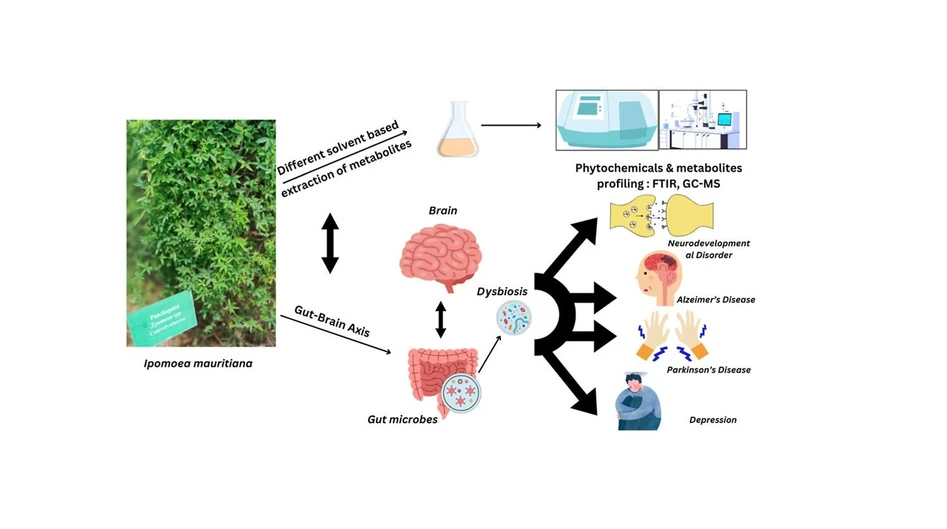
ACS Omega 2026, 11, 3, 4021–4036: Graphical abstract
This study explores the phytochemical composition and dual antimicrobial and anti-Parkinsonian potential of Ipomoea mauritiana. GC–MS and FTIR analyses revealed a diverse profile of phytosterols, fatty acids, and bioactive compounds, while in vitro assays demonstrated moderate antibacterial activity with low cytotoxicity.
In silico docking identified key compounds, such as stigmasterol and γ-sitosterol, as promising candidates for multitarget Parkinson’s disease modulation. The findings suggest that these bioactives may influence microbial activity and neurodegenerative pathways via the gut–brain axis, highlighting the plant’s potential for future nutraceutical and therapeutic applications.
The original article
Elucidation of Dual Antimicrobial and Anti-Parkinsonian Activities through an In-Silico Approach of Ipomoea mauritiana Jacq. in the Context of the Gut–Brain Axis
Dhaneswar Swain, Lipsa Leena Panigrah, iSukanta K. Pradhan, Manoranjan Arakha, Kundansing R. Jadhao, and Gyana Ranjan Rout*
ACS Omega 2026, 11, 3, 4021–4036
https://doi.org/10.1021/acsomega.5c07870
licensed under CC-BY 4.0
Selected sections from the article follow. Formats and hyperlinks were adapted from the original.
The global pharmaceutical pipeline remains disproportionately reliant on a narrow subset of well-characterized plant species, despite the immense phytochemical diversity harbored by underutilized and underexplored taxa, particularly in tropical and subtropical regions. Ethnobotanical bioprospecting has historically yielded transformative therapeutics like artemisinin from Artemisia annua, galantamine from Galanthus spp., and cephalosporins from fungal sources. (1,2)
However, many species remain scientifically underexplored. Recent reviews emphasize that natural products and derivatives account for nearly 27% of newly approved drugs (1981–2019), with plant-derived compounds offering higher clinical translation rates and favorable safety profiles when compared to fully synthetic molecules . (3,4) The genus Ipomoea (Convolvulaceae) includes over 500 species, several of which are used in traditional Indian medicine under the name “Vidari”. (5,6) The name “Vidari” is applied to the tubers of Ipomoea mauritiana Jacq. (Convolvulaceae), Pueraria tuberosa (Roxb. ex Willd.) DC. (Fabaceae), Adenia hondala (Gaertn.) de Wilde (Passifloraceae), as well as the pith of Cycas circinalis L. (Cycadaceae), all of which are traded under this common vernacular name. (5) Among these, I. mauritiana is the most widely accepted botanical source of “Vidari Kand” due to its consistent use in Ayurvedic formulations and pharmacological validation. Widely distributed across South and Southeast Asia, Africa, and parts of Oceania, Ipomoea mauritania thrives in diverse agroecological zones yet remains underutilized in modern pharmacognosy. (7) Ethnomedicine cites the use of I. mauritiana as a nervine tonic, galactagogue, diuretic, and cognition enhancer. (8−10)
Herbal compounds showing antioxidant, anti-inflammatory, and mitochondrial-protective activities are increasingly explored for neurodegenerative applications due to their multifunctionality and low toxicity. (10−12) Natural extracts are being evaluated not only for classical central nervous system targets but also for modulation of systemic axes such as the gut–brain axis. (12,13) Neurodegenerative diseases, including Parkinson’s disease (PD), pose escalating global healthcare and socioeconomic burdens, particularly in aging populations. (14)
According to the World Health Organization, global estimates in 2019 indicated that more than 8.5 million individuals were living with PD, reflecting a substantial increase in both prevalence and disease burden worldwide (World Health Organization, 2023). As of 2021, approximately 11.8 million people worldwide lived with PD, with incidence and disability-adjusted life years steadily rising. (15,16) Prevalence is forecasted to rise by over 112% by 2050, reaching approximately around 25 million, driven especially by demographic aging and increased disease rates in Asia and Sub-Saharan Africa. (17,18) In India, PD cases are projected to increase by ∼168%, reaching ∼2.8 million by midcentury, constituting ≈10% of the global burden. (18,16) PD substantially impairs motor function (tremor, rigidity, bradykinesia, postural instability) as well as cognitive, emotional, sleep, and sensory systems.
The current therapies primarily levodopa/carbidopa and newer dopaminergic agonists offer symptomatic relief but not disease modification. (19) Emerging therapies such as tavapadon and GLP-1 analogs show promise but are in early stages and not yet curative. (20) Recent paradigms emphasize gut microbiota’s pivotal role in PD etiology. It is hypothesized that dysbiosis may exacerbate α-synuclein aggregation, neuroinflammation, and mitochondrial dysfunction via the gut–brain axis. (21−23)
Additionally, it is important to note that while these associations are well documented, the directionality and causality of the gut–brain link in PD remain under active debate. For instance, Polygala tenuifolia (yuan zhi) root extracts have demonstrated cognitive enhancement and cholinergic modulation in Alzheimer models. (24,25) Similarly Corydalis mucronifera alkaloids show potent acetylcholinesterase inhibition relevant to cognitive decline. (25) However, I. mauritiana has not been similarly investigated for its gut-targeted antimicrobial activity in conjunction with docking against neuronal targets. Phytochemical investigations have revealed a rich repertoire of bioactive constituents, including phytosterols, triterpenoids, fatty acid esters, and glycosides, many of which have been individually reported to exhibit both antimicrobial and neuroprotective properties. To bridge these gaps, the present study combined metabolomic profiling, in vitro antibacterial assays, and in silico docking to evaluate I. mauritiana. While previous work, reported by Roney et al., employed molecular docking to explore antibacterial mechanisms of I. mauritiana, those studies were largely limited to pathogen-focused interactions. (26)
They have focused on identifying lead compounds with strong binding and drug-like properties from plant extracts through in silico molecular docking; their scope was limited to broad antibacterial targets and extract-based screening. In contrast, our approach advances the field by primarily identification and authentication of I. mauritiana followed by GC–MS–based metabolomic data to establish a comprehensive bioactive profile, second validating antibacterial effects experimentally against gastrointestinal pathogens, and extending docking analyses beyond microbial targets to neuronal receptors relevant to PD. Here, we integrate GC–MS–based untargeted metabolomic profiling, in vitro antimicrobial assays, and in silico docking analyses to elucidate the dual antimicrobial and neuroprotective potential of I. mauritiana through its interaction with gut-associated bacteria and Parkinson’s-related α-synuclein.
2. Experimental Details
2.2. Phytochemical Screening Using GC–MS and FTIR
GC–MS analysis was carried out using an Agilent 7890A GC system coupled with an Agilent 5975C inert XL EI/CI MSD detector. The capillary column used was HP-5MS (30 m × 0.25 mm, 0.25 μm film thickness). The oven temperature was initially held at 60 °C for 3 min, ramped to 280 °C at 10 °C/min, and held for 10 min. The injector temperature was set at 250 °C, with helium as the carrier gas at a flow rate of 1.0 mL/min. Compounds were identified by comparing mass spectra with NIST 14 (National Institute of Standards and Technology) and Wiley 10th edition spectral library databases. The software assigns each search result a match factor (ranging from 0 to 999) and an identification probability estimate. A match factor >900 indicates excellent similarity; 800–900 is considered good, while values below 800 are regarded as fair or poor. In this study, compounds were accepted as putatively identified when they exhibited a high match factor along with a clearly higher identification probability for the top-ranked hit compared with subsequent candidates, ensuring reliable discrimination and minimizing false positives. The GC analysis was performed in triplicate and only the reproducible peaks were taken for analysis. (28) Fourier-transform infrared (FTIR) spectra of the methanolic extract were recorded using a Bruker Alpha spectrometer in the range of 4000–400 cm–1. For sample preparation, the dried extract was directly analyzed in the attenuated total reflectance mode. Characteristic functional groups were interpreted based on IR absorption peaks.
3. Results
3.2. Metabolite Analysis of I. mauritiana Leaf Extract
3.2.1. Bond Level Characterization
The FTIR spectral analysis of the I. mauritiana extract revealed the presence of diverse functional groups, indicating a complex phytochemical profile (Figure 2). A broad absorption band at 3287 cm–1 corresponds to the O–H stretching vibrations of hydroxyl groups, typically present in alcohols and phenolic compounds. Peaks observed at 2912 and 2845 cm–1 are indicative of C–H stretching vibrations from aliphatic −CH2 and −CH3 groups. The distinct bands at 2346 and 2328 cm–1 are attributed to the presence of CO2, likely adsorbed from the atmosphere or due to carboxylic acid groups. A strong peak at 1725 cm–1 is characteristic of C═O stretching in carbonyl groups, possibly from esters, aldehydes, or ketones. The bands at 1643 and 1540 cm–1 suggest the presence of N–H bending and C═C stretching of aromatic rings or amide groups. Peaks in the range of 1378 to 1243 cm–1 correspond to C–N stretching or bending vibrations, likely from amines and phenolic ethers. The absorptions at 1161 cm–1 and 1020 cm–1 may be due to C–O stretching in alcohols, carboxylic acids, or polysaccharides. Notably, the spectral region below 1000 cm–1, often referred to as the “fingerprint region,” exhibited distinct absorption bands at 923, 671, 553, 533, and 484 cm–1. This region is highly characteristic of complex molecular vibrations and is crucial for identifying specific functional groups and molecular frameworks unique to phytochemical constituents. The absorption at 923 cm–1 is typically associated with out-of-plane C–H bending of aromatic rings or glycosidic linkages, suggesting the presence of flavonoid or polyphenolic glycosides─a common class of bioactives in medicinal plants. The band near 671 cm–1 corresponds to C–Cl or C–Br bending vibrations or could also arise from substituted aromatic structures, which are often found in plant secondary metabolites such as alkaloids and coumarins. Further, the absorptions at 553 cm–1 and 533 cm–1 are indicative of metal–oxygen (M–O) stretching vibrations.
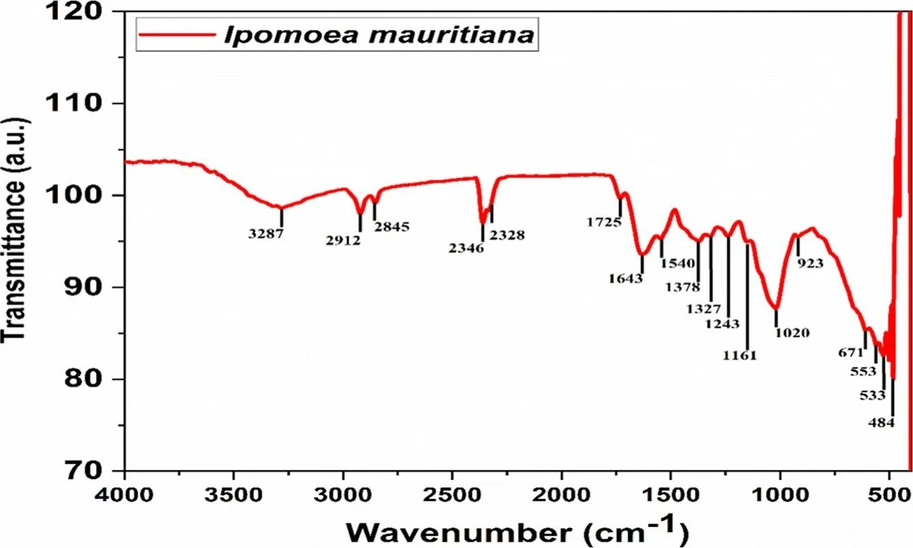 ACS Omega 2026, 11, 3, 4021–4036: Figure 2. FTIR spectrum of I. mauritiana Jacq. extract.
3.2.2. GC–MS Analysis of I. mauritiana Extract
The GC–MS analysis of I. mauritiana extract revealed a diverse phytochemical profile, encompassing 38 distinct peaks with retention times ranging from 6.98 to 30.08 min (Figure 3). The phytoconstituents identified included a broad array of bioactive compounds spanning fatty acid derivatives, long-chain hydrocarbons, sterols, tocopherols, terpenoids, and esters (Table 2). Notably, l-(+)-ascorbic acid 2,6-dihexadecanoate was the most abundant compound, comprising 10.94% of the total area, suggesting antioxidant potential due to its esterified ascorbate moiety with palmitic acid. Among the major lipophilic bioactives, stigmasterol (9.12%), γ-sitosterol (8.38%), and campesterol (4.35%) were prominent sterol constituents, reinforcing the plant’s pharmacological relevance in modulating lipid metabolism, inflammation, and neurodegeneration, as previously demonstrated in high-impact nutraceutical studies. The extract also contained vitamin E (1.06%) and dl-α-tocopherol (0.68%), corroborating its antioxidant richness. Additionally, lupeol (1.79%), a pentacyclic triterpenoid with known anti-inflammatory and neuroprotective effects, was detected along with distearylthiodipropionate (2.64%), which may act as a lipid-based antioxidant. The presence of fatty acids, such as octadecanoic acid (5.19%), eicosanoic acid (1.04%), and hexadecanoic acid derivatives, further underscores the nutritive and therapeutic value of the plant, potentially contributing to gut health and lipid regulation. Importantly, the profile included 13-methyl-Z-14-nonacosene at three distinct retention times (1.73%, 3.57%, and 3.47%), possibly indicating isomeric diversity or fragmentation variants, as well as nonadecyl heptafluorobutyrate (cumulative ∼6.11%), suggesting derivatized long-chain alcohol esters. The detection of compounds such as trichloroacetic acid esters, benzenedicarboxylic acid derivatives, and propanoic acid esters may point to less common aliphatic-aromatic hybrids or possible interactions between phytoconstituents and solvents used during extraction. Collectively, the identified metabolites in I. mauritiana validate its traditional use in ethnomedicine and provide strong molecular leads for its reported antioxidant, antimicrobial, and potential neuroprotective activities. The richness in sterols and tocopherols especially supports its relevance in modulating gut–brain axis communication, aligning well with the bioinformatics and docking findings targeting neurodegeneration-linked proteins such as α-synuclein, DJ-1, and Parkin.
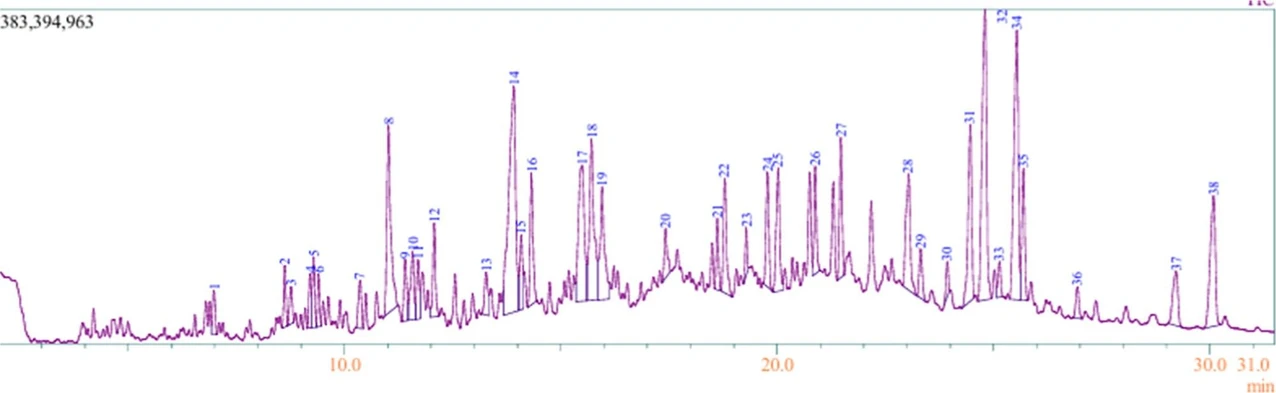 ACS Omega 2026, 11, 3, 4021–4036: Figure 3. GC–MS chromatogram of the plant extract of I. mauritiana Jacq.
3.5. Docking-Based Interaction Analysis
Molecular docking experiment between gamma-sitosterol and three proteins, viz., Alpha-synuclein, DJ1, and Parkin (Figure 9) resulted in 8 different energetically favorable binding conformations within each ligand complex. Among these, the conformation with lowest binding energy was observed between gamma-Sitosterol-Parkin (−6.70 kcal/mol) followed by gamma-Sitosterol-DJ1 (−6.60 kcal/mol) and gamma-Sitosterol-Alpha-synuclein(−5.20 kcal/mol). Likewise, the Stigmasterol was docked with the same three proteins, the complex with lowest binding energy was observed between Stigmasterol-Parkin (−7.50 kcal/mol) followed by Stigmasterol-DJ1 (−5.80 kcal/mol) and Stigmasterol- Alpha-synuclein (−5.60 kcal/mol). The lowest binding energy is generally preferred for favorable binding mode during the docking of small compounds which may be due to the stability of docked structure. It was observed that there was existence of various interactions including hydrogen and hydrophobic between the small molecules’ docked complexes Figures 10 and 11, which may be due to presence of hydrophilic, hydrophobic, as well some positively and negatively charged atoms within the binding pocket of the proteins shown in Tables 3 and 4.
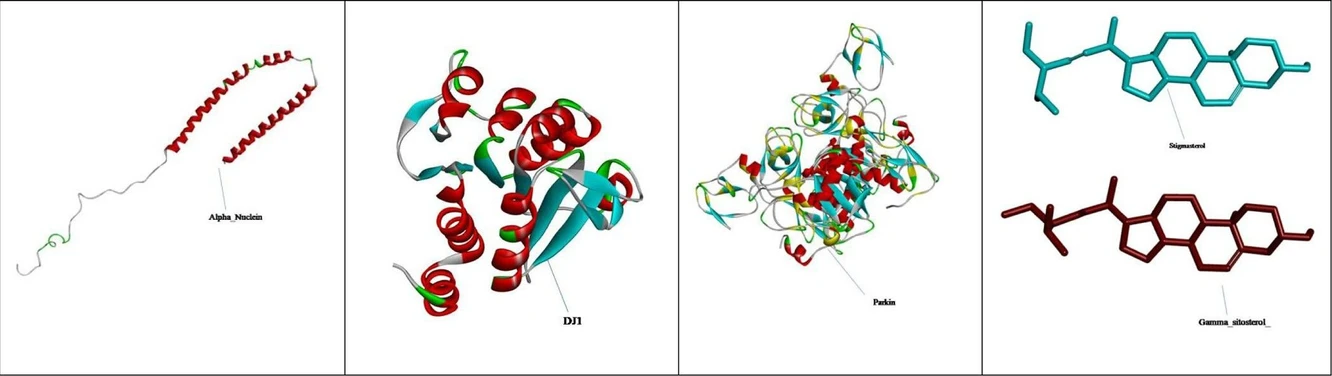 ACS Omega 2026, 11, 3, 4021–4036: Figure 9. Structures of Alpha syn nuclein, DJ1, Parkin protein, and molecules of stigmasterol and gamma sitosterol for in-silico docking.
5. Conclusions
The study investigates I. mauritiana as a phytochemically rich underutilized vegetable plant with promising yet moderate antibacterial activity against E. coli and E. faecalis. The presence of bioactive sterols, fatty acids, and antioxidant esters supports both microbial inhibition and the gut epithelial safety. While not highly potent as a standalone antimicrobial, the extract’s multifactorial action and minimal cytotoxicity highlight its potential in gut–brain axis therapeutics. As gut microbial balance is increasingly linked to mental and neurological health, I. mauritiana is predicted to emerge as a valuable plant for future gut-targeted neuropharmacological interventions. Further in vivo and mechanistic studies are warranted to translate these findings into functional food or phytopharmaceutical formulations.