Comprehensive IC-ICP-MS analysis of polyphosphonates and their transformation products

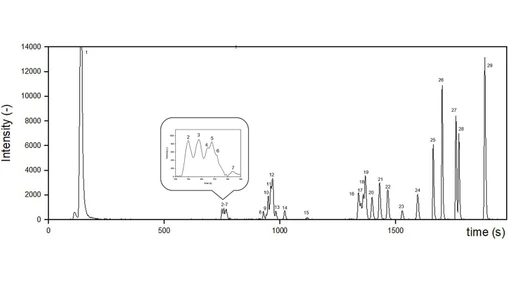
Journal of Chromatography A, Volume 1748, 2025, 465843: Fig. 5. IC-ICP-MS chromatogram of the last time point (28 h) of the transformation experiment of DTPMP with MnO2 in comparison with a nine-species standard mix (15 µg/L P). Matching peaks are labelled as known TPs (green), not matching peaks are labelled as uncertain TPs (orange) and peaks not overlapping with a standard are labelled as unknown TPs (red). Unknown TPs are numbered according to their retention time. Not all unknown TPs are present at the shown time point.
The goal of this study is to develop a rapid, sensitive, and robust analytical method for the speciation and quantification of polyphosphonates (PPs), aminopolyphosphonates (APPs), and their transformation products (TPs) in environmental matrices. Given the increasing use of PPs in detergents and antiscalants in Europe and the recognition that APPs can degrade during wastewater treatment, there is a critical need to better understand their environmental fate.
To address this, the study introduces a novel IC-ICP-TQ-MS method capable of separating and detecting nine phosphorus-containing species, including glyphosate and AMPA, within a single 205-second run. The method enables both species-specific detection and total phosphorus balance evaluation through species-unspecific calibration. The successful application of the method to monitor the transformation of DTPMP with MnO₂ under environmental conditions demonstrates its effectiveness in tracking phosphorus species and closing the phosphorus mass balance.
The original article
Comprehensive IC-ICP-MS analysis of polyphosphonates and their transformation products
Mathis Athmer, Anna M. Röhnelt, Torben J. Maas, Stefan B. Haderlein, Uwe Karst
Journal of Chromatography A, Volume 1748, 2025, 465843
https://doi.org/10.1016/j.chroma.2025.465843
licensed under CC-BY 4.0
Selected sections from the article follow. Formats and hyperlinks were adapted from the original.
Recent research revealed glyphosate, a controversially discussed herbicide, as a transformation product (TP) of the widely used diethylenetriamine penta(methylenephosphonate) (DTPMP) under environmentally relevant conditions [1]. Another study investigating European wastewater effluents and surface waters identified wastewater effluents as the major source for glyphosate and AMPA - glyphosate's main TP - contamination in European surface waters since several decades [2]. DTPMP belongs to the group of aminopolyphosphonates (APPs), which is a subgroup of polyphosphonates (PPs). PPs are strong complexing agents and widely used in industry or household applications as complexing agents, antiscalants, dispersing agents and stabilizing agents. Due to the wide range of applications and generally being considered safe, the usage of general phosphonates (including PPs and APPs) increased enormously in recent decades to about 49,000 t/a in the European Union in 2012 [3,4]. Due to their reported recalcitrance - assigned to the stable C-P bond and threshold effectiveness - APPs are increasingly used as substitutes for PPs. The commercially most relevant APPs are DTPMP, aminotris(methylene phosphonate) (ATMP) and ethylenediaminetetra(methylene phosphonate) (EDTMP) [[4], [5], [6]]. APPs are typically eliminated due to strong sorption onto sewage sludge in waste water treatment plants (WWTP) [4,7]. However, APPs seem to be not as stable as assumed under environmentally relevant conditions [1,4,[8], [9], [10]]. Due to the increased emission and unknown environmental implications, like potentially concerning TPs, contribution to eutrophication and potential remobilization of heavy metals, the environmental fate, biodegradability and effective removal of APPs are topics of interest [[4], [5], [6],11]. Here abiotic transformation processes like photo-degradation and various oxidative processes are relevant and result in the transformation into known TPs like phosphate, iminodi(methylene phosphonate) (IDMP) and aminomethylphosphonic acid (AMPA). [4,[8], [9], [10]] Additionally, the recent discovery of glyphosate as a TP due to transformation by manganese oxides raises ecotoxicology concerns and likely explains the usual and persistent detection of glyphosate and AMPA in WWTP effluents as manganese oxides are ubiquitous in the environment and municipal sewage sludge in WWTPs [1,2,[12], [13], [14], [15], [16]]. Although glyphosate is only a minor TP with molar yields below 0.5 mol%, the vast emission volume of phosphonates could cause an ecotoxicologically relevant emission into the aquatic environment [1]. These aspects furthermore highlight the necessity of further research regarding APP transformation [2,12,16]. The chemical structures of common APPs, their potential TPs and monophosphonate species are shown in Fig. 1.
Aim of this work was to develop a comprehensive, fast, robust and sensitive quantification method for the most commonly used APPs and their potential TPs as well as relevant monophosphonate compounds. With a fully automated IC-ICP-MS system, a robust separation over a broad range of size and potentially negative charge should be established to allow the simultaneous analysis of APPs and their TPs within a single run. The elemental detection of phosphorus should also allow the quantification of unknown TPs with a species-unspecific calibration approach in transformation studies to close the phosphorus mass balance (PMB). The method will be tested for robustness, reproducibility and the sensitivity and the figures of merit will be determined. The applicability of the developed method will be demonstrated by the analysis of a transformation experiment of DTPMP under environmental oxidative conditions over several time points to gain insight into the transformation mechanism into known and unidentified TPs.
2. Experimental
2.3. Instrumentation
The automatic sample dilution, chromatographic separation, and addition of a post-column internal standard were performed with a prepFAST IC system (Elemental Scientific, Omaha, NE, USA) equipped with two 500 µL sample loops and operated with Xceleri Online 1.1.0.213 by Elemental Scientific. For the chromatographic separation, an anion exchange column CF-Cr-01 (50 × 4 mm) from Elemental Scientific was used. The prepFAST IC was connected to an iCAP TQ ICP-MS (Thermo Fisher Scientific, Bremen, Germany) for atomization, ionization, mass selection, and detection. Qtegra 2.14 software (Thermo Fisher Scientific, Bremen, Germany) was used to control the instrument. The chromatographic efflux was nebulized with a MicroFlow PFA-ST nebulizer from Elemental Scientific and transported into the plasma with a 2.5 mm quartz injector. The interface of the ICP-MS consisted of a nickel sampler and skimmer with a high-sensitivity skimmer insert. To overcome interferences and reduce background noise, triple quadrupole mode with oxygen as a reaction gas was selected and phosphorus was detected as 31P16O+ and indium as 115In+ with dwell times of 100 ms each. The ICP-MS was tuned automatically to reach maximum sensitivity and an CeO+/Ce+ ratio below 2.5 %. Table 1 gives additional plasma and operating conditions.
3. Results and discussion
3.1. Method development
After a successful tentative separation of phosphate, EDTMP and DTPMP, a multi-standard of all species shown in Fig. 1 was prepared and used for optimisation of the eluental composition, gradient mixing and gradient timing as well as the runtime of the chromatographic separation. The optimised chromatographic separation of the nine analytes was achieved within 205 s, as illustrated in Fig. 3, which also depicts the applied concentration gradient. The separation of all species yielded symmetrical peak shapes. It has to be noted that the effects of gradient modifications in the chromatogram are subject to a temporal delay corresponding to the column's void volume, which was estimated to be 25 s by evaluation of the expected signal shift in the PCIS signal due to changed eluent conditions. The employment of a step-gradient was chosen to benefit from the element-specific response in the ICP-MS. During a gradient step, similar plasma conditions are achieved allowing the quantification of potential unknown species. Within the first gradient step, the structurally similar and earliest eluting species 2-AEP and AMPA could be separated by a low eluent concentration of 13 mM ammonium nitrate. Additionally, adjusting the pH of eluent A to 9.2 resulted in enhanced chromatographic resolution for these two analytes. Subsequently, phosphate elutes with the second gradient step, followed by glyphosate, IDMP and PAA in the third gradient step with refocussed peaks. During the fourth gradient step, ATMP elutes, while EDTMP and DTPMP only elute at the highest concentration of 132 mM ammonium nitrate in the last gradient step. The necessity of five consecutive increases in elution strength over this short run time highlights the differences in retention of the analytes and the flexibility and adaptability of the used IC system. All peaks and their retention times were verified by the injection of single standards. The blank chromatogram shows an impurity of phosphate for the used doubly distilled water. Also, the baseline increases over time due to the increasing concentration of ammonium nitrate (containing phosphorus impurities). All features in the blank chromatogram are highly reproducible for each analysis and were neglected by the use of a blank subtraction during integration. After the injection of late eluting species with concentrations in the upper half of the calibration range (above 50 ug/L P), additional blank injections were necessary to restore sufficient baseline levels of the phosphorus signal. This rapid and proficient separation highlights the applicability of this novel IC-ICP-MS method for high-throughput screening of a broad range of various analytes ranging vastly in size and retention behaviour.
 Journal of Chromatography A, Volume 1748, 2025, 465843: Fig. 3. IC-ICP-MS chromatogram of a nine species standard mix (25 µg/L P each, blue) and a blank injection (red) for phosphorus oxide (31P16O+) and gradient steps and ratios of eluent B. Peaks are labelled with the corresponding species.
3.3. Transformation experiment of DTPMP
With the rapid separation of the nine species, low LODs and LOQs, high robustness and reproducibility and quantification of potentially unknown transformation products, the developed method was employed to monitor the transformation DTPMP under environmentally relevant conditions. All major phosphorus species could be determined within a single run including the initial component. Also, quantification for all species including potentially unknown species could be performed to close the phosphorus mass balance (PMB). Here, phosphorus recoveries were calculated as the ratio of the sum of all detected species to the initially used concentration of 1 mM DTPMP. Immediately after sampling, the aqueous phase was treated with a cation exchange resin to transform the analytes into the free acid form suitable for analysis. Fig. 4 shows the sampling time points and chromatograms for the beginning and the end of the transformation experiment.
 Journal of Chromatography A, Volume 1748, 2025, 465843: Fig. 4. Overview of the sampling time points and chromatograms of the first (0 h) and last time point (28 h) of the transformation experiment of DTPMP with MnO2. DTPMP and peaks of transformation products are marked. Differences in the signal intensity result from different instrumental dilutions.
At time point t = 0 h, the major peak at 195 s represents the initial component DTPMP. A second, minor peak at 182 s is visible, which most likely presents an impurity or artefact from the used chemicals and IC-ICP-MS system, as it appears in blank injections and single injections of the DTPMP standard solution. Including both species, a PMB of 101 ± 18 % is reached. In comparison, no peak for DTPMP can be detected for the last time point, indicating a complete transformation under these conditions after 28 h. New peaks emerging in the range from 45 s to 182 s represent P-containing transformation products of DTPMP. The sum of these TPs results in a PMB of 84 ± 3 %. In the following, the transformation products are categorised, identified and quantified over the course of the transformation experiment. By using phosphorus-specific ICP-MS, species identification is merely based on retention times. Therefore, unequivocal molecular identification is not possible, as other phosphorus species could exhibit the same retention time. For this reason, TPs are categorised into known, uncertain and unknown TPs. Known TPs match the corresponding species standard peak, while uncertain TPs show slight shifts in retention time compared to the peak of the species standard, have peak shoulders or show double peaks. These TPs were quantified with the species-specific calibration of the corresponding standard. Unknown TPs do not match any standard peak and therefore cannot be identified at all. These TPs are labelled as U and given a number according to their retention order. Some of these also consist of peaks with shoulders or double peaks, which were integrated as one and quantified using the species-unspecific approach based on the calibration of the closest standard peak. Fig. 5 shows the chromatogram of the last time point (28 h) in comparison to the standard mix.
Journal of Chromatography A, Volume 1748, 2025, 465843: Fig. 5. IC-ICP-MS chromatogram of the last time point (28 h) of the transformation experiment of DTPMP with MnO2 in comparison with a nine-species standard mix (15 µg/L P). Matching peaks are labelled as known TPs (green), not matching peaks are labelled as uncertain TPs (orange) and peaks not overlapping with a standard are labelled as unknown TPs (red). Unknown TPs are numbered according to their retention time. Not all unknown TPs are present at the shown time point.
4. Conclusion
A rapid anion-exchange chromatography method coupled to ICP-TQ-MS detection was developed for analysing APPs, as well as monophosphonates and potential TPs. The optimized gradient with DTPA addition separated nine structurally diverse phosphorus species within 205 s, including closely related compounds (e.g., AMPA and 2-AEP) and those with vastly different retention times (e.g., AMPA and DTPMP). Utilizing 31P16O+ detection in oxygen reaction mode, the method achieved high sensitivity with species-specific LODs of 0.06 to 0.73 µg/L P for individual species. Fully automated calibration and sample analysis, including dilution, enables high-throughput analysis without run-to-run equilibration. The method's applicability was demonstrated by monitoring DTPMP transformation by MnO2, mimicking environmentally relevant oxidative conditions. The developed method successfully characterized the DTPMP transformation experiment, identifying phosphate and IDMP as major stable TPs. The elemental detection and species-unspecific elemental response in ICP-MS enabled quantification of unidentified TPs, revealing the formation of several unknown reaction intermediates with varying kinetics. This comprehensive analysis closed the phosphorus mass balance, achieving complete phosphorus recoveries for all investigated time points. However, the method faced limitations in identifying and quantifying compounds such as AMPA due to potentially overlapping peaks. To overcome this limitation in future studies, coupling the separation to an additional detector, such as ESI-MS, could provide structural information for unknown compounds. The rapid, sensitive, robust, and comprehensive analysis of APPs and their TPs (both identified and unidentified) represents a significant advancement over previously published methods, which often required multiple techniques to achieve a complete picture. This makes the developed method a valuable tool for further investigating APPs and their environmental fate.