ICPMS
More information
WebinarsAbout usContact usTerms of use
LabRulez s.r.o. All rights reserved. Content available under a CC BY-SA 4.0 Attribution-ShareAlike
Author
Institute of Organic Chemistry and Biochemistry of the Czech Academy of Sciences
The Institute of Organic Chemistry and Biochemistry of the Czech Academy of Sciences (IOCB Prague) is a leading scientific institution in the Czech Republic, recognized internationally. Its primary mission is basic research in the fields of chemical biology and medicinal chemistry, organic and material oriented chemistry, chemistry of natural compounds, biochemistry and molecular biology, physical chemistry, theoretical chemistry, and analytical chemistry.
Tags
Article
Science and research
Video
Scientists
LinkedIn Logo

A unique method of rare-earth recycling can strengthen the raw material independence of Europe and America
We, 2.7.2025
| Original article from: IOCB Prague
Scientists at IOCB Prague created an eco-friendly method to recycle rare earths like neodymium from magnets, offering a sustainable alternative to mining and boosting EU & US raw material security.
Video placeholder
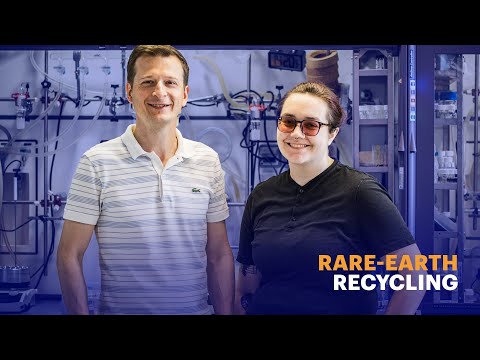
  • Photo: IOCB Prague / Tomáš Belloň: Dr. Miloslav Polášek, head of the Coordination Chemistry research group at IOCB Prague, and Kelsea Grace Jones, PhD student in Dr. Miloslav Polášek’s group. 
  • Video: IOCB Prague: A method of rare-earth recycling developed at IOCB Prague can strengthen our material independence

The scientific team of Dr. Miloslav Polášek at IOCB Prague has developed a new method of separating the rare earth elements, or lanthanides, which are widely used in the electronic, medical, automotive, and defense industries. The unique method allows metals such as neodymium or dysprosium to be purified from used neodymium magnets. The environmentally friendly process precipitates the rare earths from water without organic solvents or toxic substances. The results were published in the Journal of the American Chemical Society (JACS) at the end of June.

IOCB Prague / Tomáš Belloň: Dr. Miloslav Polášek, head of the Coordination Chemistry research group at IOCB Prague, and Kelsea Grace Jones, PhD student in Dr. Miloslav Polášek’s group.IOCB Prague / Tomáš Belloň: Dr. Miloslav Polášek, head of the Coordination Chemistry research group at IOCB Prague, and Kelsea Grace Jones, PhD student in Dr. Miloslav Polášek’s group.

Global demand for rare earths is driven primarily by their use in extremely strong neodymium magnets, which enable efficient conversion of motion into electrical energy and vice versa. They are essential to manufacturers of electric cars, wind power plants, mobile phones, computers, and data centers. As these industries develop, demand for rare earths will continue to grow. However, the process of mining and purifying these elements is highly energy intensive and produces large amounts of toxic and radioactive waste.

The rare-earth market is dominated by China, giving it leverage over Europe and North America. It is therefore strategically advantageous to focus on so-called urban mining, i.e. the recycling, renewal, and reuse of materials from discarded equipment, such as electric vehicles, as a significant domestic source of rare earths.

In the future, we won’t be able to cover the growing consumption of rare earths with primary mining. We know that within ten years at the latest, it will be necessary to manage these materials more carefully. In order to achieve this, the development of new technologies must start now,” explains Miloslav Polášek, head of the Coordination Chemistry group. “Our method solves the fundamental problems of recycling neodymium magnets. We can separate the right elements so that new magnets can be produced. Our process is environmentally friendly, and we believe that it will work on an industrial scale. Fortunately, unlike plastics, chemical elements don’t lose their properties through repeated processing, so their recycling is sustainable and can compensate for traditional mining.

IOCB Prague / Tomáš Belloň: A product of separation carried out using a method developed in Dr. Miloslav Polášek’s lab. He and his team processed a magnet from an electric car and obtained 99.7% pure neodymium.IOCB Prague / Tomáš Belloň: A product of separation carried out using a method developed in Dr. Miloslav Polášek’s lab. He and his team processed a magnet from an electric car and obtained 99.7% pure neodymium.

The topic, which Polášek’s group has been working on for a long time, is part of Kelsea G. Jones’s doctoral thesis. “We’ve developed a new type of chelator, which is a molecule that binds metal ions. This chelator specifically precipitates neodymium from dissolved magnets, while dysprosium remains in solution, and the elements are easily separated from each other. The method is also adaptable for the other rare earths found in neodymium magnets,” says Jones. “The separation is done in water and generates no hazardous waste. We achieve the same or better results than current industrial methods that rely on organic solvents and toxic reagents.

The new technology is patented and responds to a fundamental global problem at the right time. “We’re impatiently awaiting the results of a feasibility study, which will help us direct this research from the laboratory into practice. I believe that in cooperation with the investors and business partners we’re approaching, this new technology from IOCB Prague has the potential to influence a wide range of industrial sectors,” says Milan Prášil, director of the transfer company IOCB Tech.

IOCB Prague / Tomáš Belloň: Milan Prášil, director of the transfer company IOCB Tech.IOCB Prague / Tomáš Belloň: Milan Prášil, director of the transfer company IOCB Tech.

This research has also yielded another important finding: namely, that the element holmium is used in neodymium magnets of newer electric cars. Scientists from Polášek's team discovered this by analyzing samples from the electric motors of European and Chinese cars. However, professional publications have not yet mentioned this fact, and most recycling projects do not take it into account when processing waste from electric cars. These findings will undoubtedly influence other development and recycling projects, even beyond the automotive industry.

IOCB Prague / Tomáš Belloň: Kelsea Grace Jones, PhD student in Dr. Miloslav Polášek’s research groupIOCB Prague / Tomáš Belloň: Kelsea Grace Jones, PhD student in Dr. Miloslav Polášek’s research group

The original article

Macrocyclic Chelators for Aqueous Lanthanide Separations via Precipitation: Toward Sustainable Recycling of Rare-Earths from NdFeB Magnets

Kelsea G. Jones, Tomáš David, Martin Loula, Stanislava Matějková, Jan Blahut, Anatolij Filimoněnko, Miroslava Litecká, Jan Rohlíček, Jiří Böserle, Miloslav Polasek*

J. Am. Chem. Soc. 2025

https://doi.org/10.1021/jacs.5c04150

licensed under CC-BY 4.0

Selected sections from the article follow. Formats and hyperlinks were adapted from the original.

Abstract

Rare-earth elements (REEs) are critical materials in modern industry, but their production has a significant environmental footprint. Environmentally friendly separation methods would enable efficient, sustainable recycling of REEs. This work introduces a class of cyclen-based macrocyclic chelators that induce significant differences in solubility for REE chelates, enabling their selective precipitation from pH-neutral aqueous solution. The process was refined using simple coordinating additives (e.g., acetate) to form ternary coordination compounds to fine-tune these chelate solubilities. Conditions were optimized for the REEs found in NdFeB magnets, allowing separations of even adjacent lanthanides by repeated precipitations. Separation factors comparable to those of industrial solvent extraction methods were achieved without organic solvents. Analysis of NdFeB magnets from current electric car motors revealed an unexpected presence of holmium as a supplement and/or replacement for terbium and dysprosium, suggesting shifting industrial trends with implications for future recycling efforts. In a case study, one such automotive magnet was processed to obtain a 99.7% pure neodymium product. Scalable, tunable, and entirely aqueous, this approach advances the sustainable use of REEs toward a circular economy.

Materials and Methods

Liquid chromatography: Analytical HPLC experiments were performed on 1260 Infinity II with UV (DAD, part number G7115A, 190 – 400 nm) and MS (single quadrupole, G6125B) detectors from Agilent (referred to as LC-MS or HPLC) equipped with a Luna Omega Polar C18 column (5 µm, 100 Å, 150 × 4.6 mm) using H2O–MeCN gradients (1 mL min−1 flow rate) either with additives or without additives (specified where relevant). The UV-absorption profiles given for the characterization of the chelators and/or chelates were obtained from these chromatograms. Preparative HPLC experiments were performed on 1260 Infinity II (Agilent) equipped with YMC-Actus Triart C18 column (5 µm, 100 Å, 250 × 20.0 mm) using H2O–MeCN gradients (20 mL min−1 flow rate) with either TFA (0.1%) or no additional additive.

High-resolution mass spectra: HRMS (with ESI ionization) were recorded on an Agilent 5975C MSD Quadrupole, Q-Tof micro from Waters or LTQ Orbitrap XL from Thermo Fisher Scientific.

Elemental analysis: CHN elemental analysis was performed on PE 2400 Series II CHN Analyzer from Perkin Elmer. Fluorine elemental analysis was performed by combustion of the sample in quartz vessel, followed by adsorption of HF in H2O and determining its concentration by potentiometry using F- -selective electrode. Lanthanide content was determined by ICP-OES (SPECTRO Arcos Multiview from SPECTRO Analytical Instruments). All EA data are presented as: calcd. (found).

NMR spectroscopy: 1H and 13C NMR spectra were recorded on a Bruker Avance III™ HD 400 MHz spectrometer (401.0 MHz for 1H, 100.6 MHz for 13C) equipped with a broad-band Prodigy cryo-probe with ATM module (5 mm CPBBO BB-1 H/19F/D Z-GRD) or on an Avance II™ 500 MHz (Bruker, 499.9 MHz for 1H, 125.7 MHz for 13C) spectrometer equipped with a 5 mm TBO probehead. The measurement temperature is indicated for the respective chelator. Chemical shifts are in ppm and coupling constants in Hz. Spectra were referenced using the residual DMSO-d6 solvent signal (2.50 ppm in 1H; 39.52 ppm in 13C), or to the signal of t-BuOH external standard (1.25 ppm in 1H; 32.43 ppm in 13C) for spectra measured in D2O. Integrals in showcased NMR spectra were rounded to integers for clarity; obscured signals that cannot be exactly integrated due to overlap with peak from solvent are coloured grey. Signals of the cyclen macrocycle are abbreviated mc.

X-ray powder diffraction: Data were acquired using the Debye-Scherrer transmission configuration on the powder diffractometer Smartlab (Rigaku) equipped with a Cu X-ray source (Cu/Kα radiation; λ = 1.5418 Å), focusing mirror (CBO-E), capillary holder and D/tex ultra 250 detector. The sample was ground, placed in a 0.5 mm borosilicate-glass capillary, and measured at 298±5 K over 18 h from 3° to 65° 2θ with 0.01° step size and with variable counting time.

Institute of Organic Chemistry and Biochemistry of the Czech Academy of Sciences
LinkedIn Logo
 

Related content

Detection of Phenol Leakage into Wastewater Using TOC Measurement

Applications
| 2026 | Shimadzu
Instrumentation
TOC
Manufacturer
Shimadzu
Industries
Environmental

Routine Analysis of Rare Earth Elements in Basalt using ICP-MS

Applications
| 2026 | Agilent Technologies
Instrumentation
ICP/MS
Manufacturer
Agilent Technologies
Industries
Materials Testing

Analysis of rare earth elements in clay using XRF and XRD

Applications
| 2026 | Thermo Fisher Scientific
Instrumentation
XRD
Manufacturer
Thermo Fisher Scientific
Industries
Materials Testing

Measurement of TOC in Chloroisocyanuric Acid Used as Disinfectant

Applications
| 2026 | Shimadzu
Instrumentation
TOC
Manufacturer
Shimadzu
Industries
Pharma & Biopharma

High Precision Analysis of Major Components in Precious Metals by ICP-OES

Applications
| 2025 | Agilent Technologies
Instrumentation
ICP-OES
Manufacturer
Agilent Technologies
Industries
Materials Testing
 

Related articles

UA-DMSPE Determination of Cu(II), Cd(II), and As(III) in Water, Soil, and Tomato Using a Novel Thiosemicarbazone Sorbent: ICP-OES Performance with DFT Characterization and Antimicrobial-Target Docking
Scientific article | Science and research

UA-DMSPE Determination of Cu(II), Cd(II), and As(III) in Water, Soil, and Tomato Using a Novel Thiosemicarbazone Sorbent: ICP-OES Performance with DFT Characterization and Antimicrobial-Target Docking

UA-DMSPE with a new thiosemicarbazone sorbent allows selective ICP-OES detection of Cu(II), Cd(II), and As(III) in water, soil, and tomatoes.
LabRulez
tag
share
more
Registration to 19th Czech - Slovak Spectroscopic Conference & Mössbauer Spectroscopy in Material Science
Article | Events

Registration to 19th Czech - Slovak Spectroscopic Conference & Mössbauer Spectroscopy in Material Science

Register for the 19th Czech–Slovak Spectroscopic Conference (CSSC) in Olomouc and join leading experts in atomic, molecular, and advanced spectroscopy. Early-bird registration is open—secure your place now.
Spektroskopická společnost Jana Marka Marci
tag
share
more
You talk, we understand – The way out of the tower of Babel
Article | Science and research

You talk, we understand – The way out of the tower of Babel

Why a shared metrology vocabulary matters in analytical laboratories. This Eurachem guide clarifies key terms, reduces misunderstandings, and supports reliable, fit-for-purpose measurement results.
Eurachem
tag
share
more
LabRulez at analytica 2026
Article | Events

LabRulez at analytica 2026

Meet LabRulez at analytica 2026 in Munich - A1.506. Explore live portal demos, discover marketplace instruments and spare parts, and learn how our online platforms support analytical chemistry professionals.
LabRulez
tag
share
more
 

Related content

Detection of Phenol Leakage into Wastewater Using TOC Measurement

Applications
| 2026 | Shimadzu
Instrumentation
TOC
Manufacturer
Shimadzu
Industries
Environmental

Routine Analysis of Rare Earth Elements in Basalt using ICP-MS

Applications
| 2026 | Agilent Technologies
Instrumentation
ICP/MS
Manufacturer
Agilent Technologies
Industries
Materials Testing

Analysis of rare earth elements in clay using XRF and XRD

Applications
| 2026 | Thermo Fisher Scientific
Instrumentation
XRD
Manufacturer
Thermo Fisher Scientific
Industries
Materials Testing

Measurement of TOC in Chloroisocyanuric Acid Used as Disinfectant

Applications
| 2026 | Shimadzu
Instrumentation
TOC
Manufacturer
Shimadzu
Industries
Pharma & Biopharma

High Precision Analysis of Major Components in Precious Metals by ICP-OES

Applications
| 2025 | Agilent Technologies
Instrumentation
ICP-OES
Manufacturer
Agilent Technologies
Industries
Materials Testing
 

Related articles

UA-DMSPE Determination of Cu(II), Cd(II), and As(III) in Water, Soil, and Tomato Using a Novel Thiosemicarbazone Sorbent: ICP-OES Performance with DFT Characterization and Antimicrobial-Target Docking
Scientific article | Science and research

UA-DMSPE Determination of Cu(II), Cd(II), and As(III) in Water, Soil, and Tomato Using a Novel Thiosemicarbazone Sorbent: ICP-OES Performance with DFT Characterization and Antimicrobial-Target Docking

UA-DMSPE with a new thiosemicarbazone sorbent allows selective ICP-OES detection of Cu(II), Cd(II), and As(III) in water, soil, and tomatoes.
LabRulez
tag
share
more
Registration to 19th Czech - Slovak Spectroscopic Conference & Mössbauer Spectroscopy in Material Science
Article | Events

Registration to 19th Czech - Slovak Spectroscopic Conference & Mössbauer Spectroscopy in Material Science

Register for the 19th Czech–Slovak Spectroscopic Conference (CSSC) in Olomouc and join leading experts in atomic, molecular, and advanced spectroscopy. Early-bird registration is open—secure your place now.
Spektroskopická společnost Jana Marka Marci
tag
share
more
You talk, we understand – The way out of the tower of Babel
Article | Science and research

You talk, we understand – The way out of the tower of Babel

Why a shared metrology vocabulary matters in analytical laboratories. This Eurachem guide clarifies key terms, reduces misunderstandings, and supports reliable, fit-for-purpose measurement results.
Eurachem
tag
share
more
LabRulez at analytica 2026
Article | Events

LabRulez at analytica 2026

Meet LabRulez at analytica 2026 in Munich - A1.506. Explore live portal demos, discover marketplace instruments and spare parts, and learn how our online platforms support analytical chemistry professionals.
LabRulez
tag
share
more
 

Related content

Detection of Phenol Leakage into Wastewater Using TOC Measurement

Applications
| 2026 | Shimadzu
Instrumentation
TOC
Manufacturer
Shimadzu
Industries
Environmental

Routine Analysis of Rare Earth Elements in Basalt using ICP-MS

Applications
| 2026 | Agilent Technologies
Instrumentation
ICP/MS
Manufacturer
Agilent Technologies
Industries
Materials Testing

Analysis of rare earth elements in clay using XRF and XRD

Applications
| 2026 | Thermo Fisher Scientific
Instrumentation
XRD
Manufacturer
Thermo Fisher Scientific
Industries
Materials Testing

Measurement of TOC in Chloroisocyanuric Acid Used as Disinfectant

Applications
| 2026 | Shimadzu
Instrumentation
TOC
Manufacturer
Shimadzu
Industries
Pharma & Biopharma

High Precision Analysis of Major Components in Precious Metals by ICP-OES

Applications
| 2025 | Agilent Technologies
Instrumentation
ICP-OES
Manufacturer
Agilent Technologies
Industries
Materials Testing
 

Related articles

UA-DMSPE Determination of Cu(II), Cd(II), and As(III) in Water, Soil, and Tomato Using a Novel Thiosemicarbazone Sorbent: ICP-OES Performance with DFT Characterization and Antimicrobial-Target Docking
Scientific article | Science and research

UA-DMSPE Determination of Cu(II), Cd(II), and As(III) in Water, Soil, and Tomato Using a Novel Thiosemicarbazone Sorbent: ICP-OES Performance with DFT Characterization and Antimicrobial-Target Docking

UA-DMSPE with a new thiosemicarbazone sorbent allows selective ICP-OES detection of Cu(II), Cd(II), and As(III) in water, soil, and tomatoes.
LabRulez
tag
share
more
Registration to 19th Czech - Slovak Spectroscopic Conference & Mössbauer Spectroscopy in Material Science
Article | Events

Registration to 19th Czech - Slovak Spectroscopic Conference & Mössbauer Spectroscopy in Material Science

Register for the 19th Czech–Slovak Spectroscopic Conference (CSSC) in Olomouc and join leading experts in atomic, molecular, and advanced spectroscopy. Early-bird registration is open—secure your place now.
Spektroskopická společnost Jana Marka Marci
tag
share
more
You talk, we understand – The way out of the tower of Babel
Article | Science and research

You talk, we understand – The way out of the tower of Babel

Why a shared metrology vocabulary matters in analytical laboratories. This Eurachem guide clarifies key terms, reduces misunderstandings, and supports reliable, fit-for-purpose measurement results.
Eurachem
tag
share
more
LabRulez at analytica 2026
Article | Events

LabRulez at analytica 2026

Meet LabRulez at analytica 2026 in Munich - A1.506. Explore live portal demos, discover marketplace instruments and spare parts, and learn how our online platforms support analytical chemistry professionals.
LabRulez
tag
share
more
 

Related content

Detection of Phenol Leakage into Wastewater Using TOC Measurement

Applications
| 2026 | Shimadzu
Instrumentation
TOC
Manufacturer
Shimadzu
Industries
Environmental

Routine Analysis of Rare Earth Elements in Basalt using ICP-MS

Applications
| 2026 | Agilent Technologies
Instrumentation
ICP/MS
Manufacturer
Agilent Technologies
Industries
Materials Testing

Analysis of rare earth elements in clay using XRF and XRD

Applications
| 2026 | Thermo Fisher Scientific
Instrumentation
XRD
Manufacturer
Thermo Fisher Scientific
Industries
Materials Testing

Measurement of TOC in Chloroisocyanuric Acid Used as Disinfectant

Applications
| 2026 | Shimadzu
Instrumentation
TOC
Manufacturer
Shimadzu
Industries
Pharma & Biopharma

High Precision Analysis of Major Components in Precious Metals by ICP-OES

Applications
| 2025 | Agilent Technologies
Instrumentation
ICP-OES
Manufacturer
Agilent Technologies
Industries
Materials Testing
 

Related articles

UA-DMSPE Determination of Cu(II), Cd(II), and As(III) in Water, Soil, and Tomato Using a Novel Thiosemicarbazone Sorbent: ICP-OES Performance with DFT Characterization and Antimicrobial-Target Docking
Scientific article | Science and research

UA-DMSPE Determination of Cu(II), Cd(II), and As(III) in Water, Soil, and Tomato Using a Novel Thiosemicarbazone Sorbent: ICP-OES Performance with DFT Characterization and Antimicrobial-Target Docking

UA-DMSPE with a new thiosemicarbazone sorbent allows selective ICP-OES detection of Cu(II), Cd(II), and As(III) in water, soil, and tomatoes.
LabRulez
tag
share
more
Registration to 19th Czech - Slovak Spectroscopic Conference & Mössbauer Spectroscopy in Material Science
Article | Events

Registration to 19th Czech - Slovak Spectroscopic Conference & Mössbauer Spectroscopy in Material Science

Register for the 19th Czech–Slovak Spectroscopic Conference (CSSC) in Olomouc and join leading experts in atomic, molecular, and advanced spectroscopy. Early-bird registration is open—secure your place now.
Spektroskopická společnost Jana Marka Marci
tag
share
more
You talk, we understand – The way out of the tower of Babel
Article | Science and research

You talk, we understand – The way out of the tower of Babel

Why a shared metrology vocabulary matters in analytical laboratories. This Eurachem guide clarifies key terms, reduces misunderstandings, and supports reliable, fit-for-purpose measurement results.
Eurachem
tag
share
more
LabRulez at analytica 2026
Article | Events

LabRulez at analytica 2026

Meet LabRulez at analytica 2026 in Munich - A1.506. Explore live portal demos, discover marketplace instruments and spare parts, and learn how our online platforms support analytical chemistry professionals.
LabRulez
tag
share
more
Other projects
GCMS
LCMS
Follow us
FacebookLinkedInYouTube
More information
WebinarsAbout usContact usTerms of use
LabRulez s.r.o. All rights reserved. Content available under a CC BY-SA 4.0 Attribution-ShareAlike