Trace Metal Analysis in High Salt Matrices by ICP-MS

Thermo Fisher Scientific: Trace Metal Analysis in High Salt Matrices by ICP-MS
Overcoming matrix suppression and signal drift in environmental samples and industrial brines
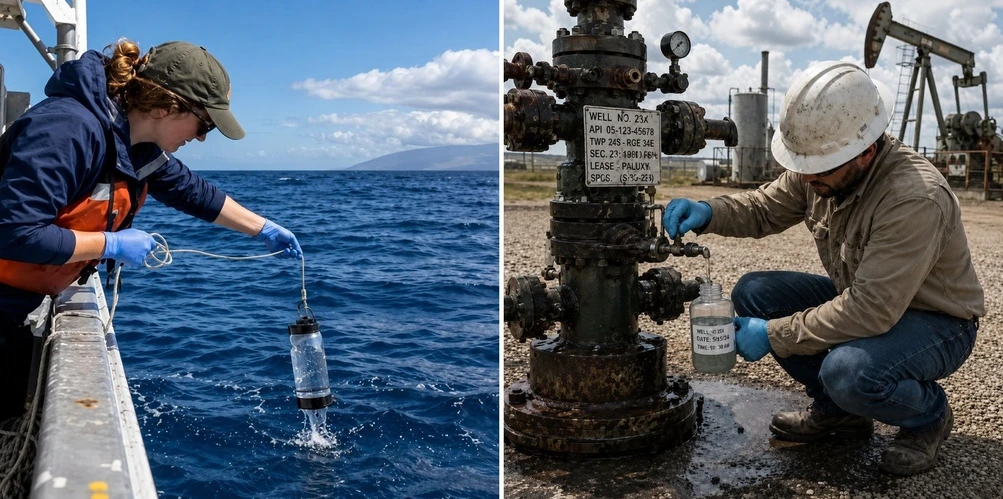
As demand for lithium, rare earth elements (REEs), and environmental monitoring continues to grow, laboratories are increasingly challenged by one of the most difficult sample types in elemental analysis: high-salinity waters. Whether analyzing lithium-rich underground brines for electric vehicle battery production or monitoring seawater and brackish water for environmental compliance, laboratories require a solution that combines sensitivity, robustness, and productivity.
The Thermo Scientific iCAP MSX ICP-MS addresses these challenges by delivering reliable trace element analysis across a wide range of salt concentrations—from seawater to highly concentrated brines containing up to 25% sodium chloride.
Why high-salt samples challenge ICP-MS
Brines and seawater present significant analytical obstacles. High dissolved solids can cause:
- Signal drift and matrix suppression
- Nebulizer blockages
- Torch injector fouling
- Interface cone contamination
- Increased maintenance and downtime
Traditional workflows often require extensive manual dilution, frequent recalibration, and additional operator intervention. These steps reduce throughput and increase operating costs.
A unified solution for brines and seawater
 Thermo Fisher Scientific: Trace Metal Analysis in High Salt Matrices by ICP-MS
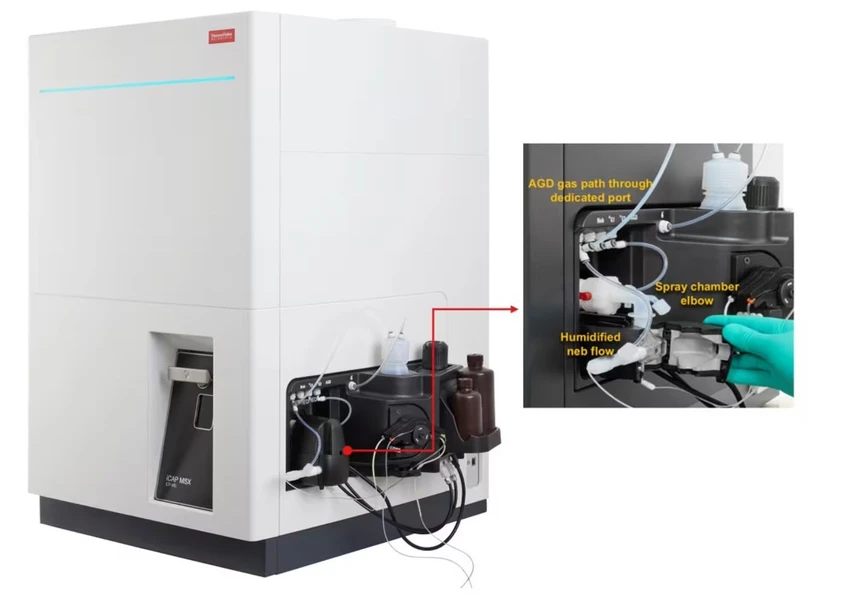
The iCAP MSX ICP-MS leverages integrated Argon Gas Dilution (AGD) technology to enable direct analysis of challenging high-matrix samples while maintaining excellent sensitivity and stability.
Key advantages include:
- Analysis of brines up to 25% NaCl without manual dilution
- High matrix tolerance with the AGD High setting
- Automated tuning and instrument health monitoring
- Stable internal standard performance
- Reduced maintenance requirements
- Consistent data quality across varying salt concentrations
- Reduced sample handling, dilution apparatus, and potential for contamination
 Thermo Fisher Scientific: Trace Metal Analysis in High Salt Matrices by ICP-MS
This unified approach allows laboratories to use a single method for multiple sample types, improving efficiency and simplifying operations.
Engineered for robustness
Several hardware innovations contribute to the system’s performance:
Collision / Reaction Cell
The Thermo Scientific QCell Collision / Reaction Cell utilizes a proprietary Flatapole design and integrated low-mass cutoff technology to provide effective interference removal while maintaining high ion transmission and sensitivity.
RAPID lens technology
The Right Angle Positive Ion Deflection (RAPID) lens system uses a fully focused 90-degree ion deflection design that helps keep the mass spectrometer maintenance-free after the interface region.
Flexible AGD operation
Unlike alternative matrix-handling approaches, AGD offers selectable dilution levels fully integrated within the Thermo Scientific Qtegra Intelligent Scientific Data Solution (ISDS) software, simplifying operation while maintaining performance.
Supporting the growing lithium and rare earth economy
The rapid expansion of electric vehicle production has intensified the need for reliable impurity analysis in lithium-rich underground brines. Accurate determination of trace metals and rare earth elements is essential for:
- Resource characterization
- Process optimization
- Product quality assurance
- Regulatory compliance
The ability to analyze both concentrated brines and seawater using a single workflow enables laboratories to support upstream extraction, refining operations, and environmental monitoring with greater efficiency.
Improving productivity through intelligent automation
Beyond analytical performance, the iCAP MSX ICP-MS is designed to reduce the operator’s workload through:
- Automatic instrument tuning
- Integrated health monitoring
- Hawk Consumables and Maintenance Assistant
- Simplified maintenance planning
- Reduced risk of unplanned downtime
These features help laboratories maximize instrument uptime while maintaining confidence in data quality.
Seawater validation data demonstrates excellent accuracy and sensitivity
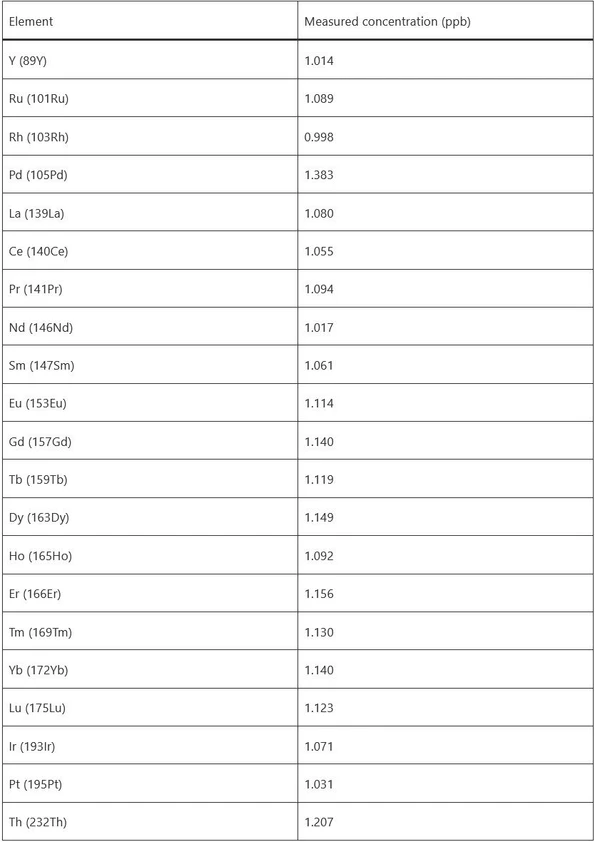
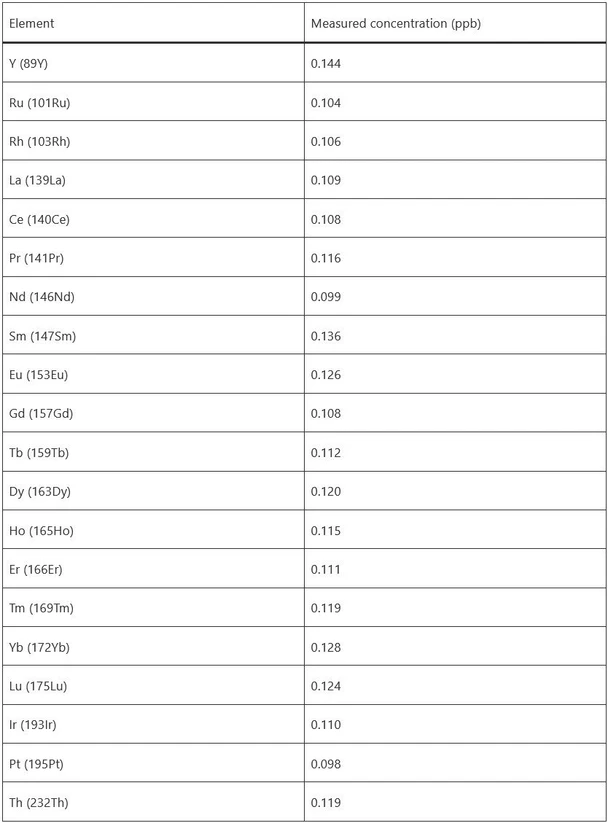
To evaluate analytical performance in a challenging marine matrix, seawater samples were analyzed both unspiked and with trace-element spike additions of 1 ppb and 0.1 ppb. The study included transition metals, precious metals, and Rare Earth Elements (REEs) measured using KED mode.
1 ppb spike recovery results
The 1 ppb spike experiment demonstrated strong recoveries across most analytes:
 Thermo Fisher Scientific: Trace Metal Analysis in High Salt Matrices by ICP-MS
The majority of REEs showed recoveries between approximately 102% and 116%, demonstrating excellent accuracy in a high-salt seawater matrix. Particularly noteworthy were Er (115.6%), Dy (114.9%), Yb (114.0%), and Gd (114.0%), highlighting the capability of the system for strategic element monitoring.
0.1 ppb spike recovery results
Performance remained strong at ten-fold lower concentration levels:
 Thermo Fisher Scientific: Trace Metal Analysis in High Salt Matrices by ICP-MS
These results demonstrate reliable quantification at sub-ppb concentrations, supporting environmental monitoring and trace impurity applications where ultra-low detection capability is essential.
What does this mean for laboratories?
The seawater data confirms that the iCAP MSX ICP-MS can deliver:
- Accurate recovery of trace metals and rare earth elements
- Reliable measurements at low and sub-ppb concentrations
- Excellent sensitivity across a broad elemental range
- Robust operation in challenging high-salt matrices
- A single workflow applicable for seawater, brackish water, and concentrated brines
For laboratories supporting lithium extraction, critical minerals programs, environmental monitoring, or industrial process control, these capabilities translate directly into higher confidence in analytical results and increased operational efficiency.
Conclusion
As industries increasingly rely on accurate elemental analysis of high-salinity samples, laboratories need instrumentation capable of balancing sensitivity, robustness, and productivity. The iCAP MSX ICP-MS provides a comprehensive solution for both industrial brine applications and environmental seawater monitoring, delivering accurate recoveries, low detection limits, and reliable performance across some of the most challenging matrices encountered in ICP-MS analysis.
From lithium extraction to environmental stewardship, the future of trace element analysis depends on technologies that can turn difficult samples into dependable data.
Register for our on-demand webinar to learn more about the iCAP MX Series ICP-MS New ICP-MS innovations to ignite productivity and efficiency in your laboratory
- Visit us on LinkedIn: #ICPMS #EnvironmentalTesting #REEs #ElementalAnalysis