Low-Dimensional Zeotypes Templated by Stacked Cyclic Benzimidazolium Revealed by Electron Crystallography
J. Am. Chem. Soc. 2026, 148, 6, 6686–6694: Graphical abstract
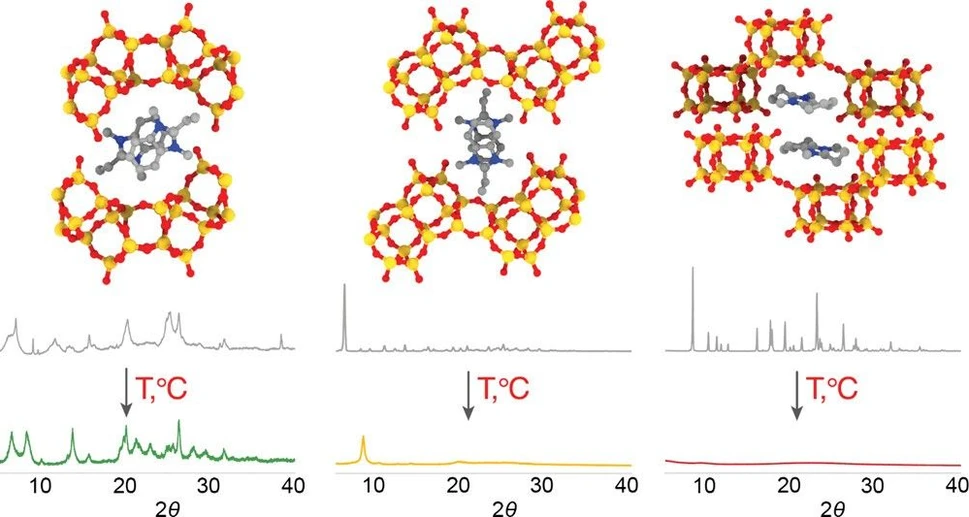
This study reports three low-dimensional zeotypic materials synthesized using benzimidazolium-based organic structure-directing agents. Their atomic structures were determined by three-dimensional electron diffraction, revealing how the bulky organic templates guide the formation of layered and chain-like zeolitic architectures instead of conventional three-dimensional frameworks.
Thermal treatment triggered distinct structural transformations, including topotactic condensation of the layered zeotype EMM-75P into a previously unknown three-dimensional zeolite framework. These findings provide valuable insight into zeolite formation mechanisms and demonstrate how low-dimensional intermediates can serve as routes to new porous materials.
The original article
Low-Dimensional Zeotypes Templated by Stacked Cyclic Benzimidazolium Revealed by Electron Crystallography
Evgeniia Ikonnikova, Jung Cho, Xiaodong Zou, Andre Sutrisno, Allen W. Burton, Trong Pham*, and Tom Willhammar*
J. Am. Chem. Soc. 2026, 148, 6, 6686–6694
https://doi.org/10.1021/jacs.5c22569
licensed under CC-BY 4.0
Selected sections from the article follow. Formats and hyperlinks were adapted from the original.
Zeolites are generally defined as crystalline microporous aluminosilicates with three-dimensional structures built from corner-sharing tetrahedrally coordinated atoms. Zeolites contain one-, two-, or three-dimensional channel systems that may be interconnected. According to the Structural Commission of the International Zeolites Association, (1) 264 different framework structures have been accepted so far. Two-dimensional (2D) layered zeolitic materials possess a structure extending only in two dimensions, with a framework interrupted in the third dimension. They may condense to a 3D periodic zeolite structure upon calcination by topotactic silanol condensation; such 2D zeolitic materials are referred to as 2D layered zeolitic precursors. A limited number of such 2D layered zeotype materials have emerged, among them EU-19 (CAS), (2) PREFER (FER), (3) MCM-22P (MWW), (4) Nu-6(1) (NSI), (5,6) EMM-9 (SFO), (7) RUB-15 (SOD), (8) CIT-8P (HEU), (9) EU-12 (ETL), (10) and HPM-3 (JSN). (11) PST-9 is a notable recent addition where a layered phase transforms hydrothermally into the small pore zeolite EU-12 (ETL) through a phase transformation. Another interesting example is the topotactic condensation of a layered aluminosilicate precursor CIT-8P to CIT-8 (HEU) by synthesis using a diquaternary organic structure-directing agent. 1D zeotype materials are rare, with one recent example being the silica chain ZEO-2, which can be converted into a 3D zeolite upon calcination. (12) Zeotypes are typically formed using hydrothermal synthesis where the choice of organic structure-directing agent (OSDA) is one of the most important parameters to guide the formation of a desired material. An alternative approach to obtain zeolites using 2D zeolitic materials is the Assembly, Disassembly, Organization, and Reassembly (ADOR) method, where 2D zeolitic precursors are obtained from 3D germanosilicate zeolites followed by a guided assembly to form new zeolite materials. (13,14) With an increased understanding of the role of the OSDA in the formation of low-dimensional zeotype materials, new materials, currently unfeasible by direct hydrothermal synthesis, can be obtained. (15)
Several databases compile information about zeolite synthesis conditions and enable prediction of zeolite synthesis and phase competition using large-scale simulations and machine learning (ML). (16−20) In contrast, when it comes to low-dimensional zeolitic materials, databases are still at an early stage, given that these materials have been less explored. (21,22) An intriguing aspect of zeolitic materials is the opportunities for postmodification via pillaring, (23) delamination, (24,25) intercalation, etc., to synthesize derivative structures. Often, the bottleneck in the growth of zeolites via conversion from low-dimensional materials to a 3D zeolite is the condensation process, where the OSDA degradation occurs. By learning more about the structure-directing mechanisms of the OSDA in the formation of low-dimensional zeotypes and the subsequent condensation to form a 3D zeolite, the trial-and-error approach in the synthesis of novel zeolites from low-dimensional precursors can be minimized. Therefore, improved comprehension could pave the way toward a more systematic approach driven by ML for designing novel low-dimensional zeotypes.
In general, the structure elucidation of zeotype materials and specifically low-dimensional zeotypes poses challenges due to their small crystal size in combination with large unit cell volume. This prevents the use of single-crystal X-ray diffraction (SCXRD) and results in peak broadening and significant peak overlap in powder X-ray diffraction (PXRD) patterns. The three-dimensional electron diffraction (3D ED) method has been shown to be highly advantageous for determining complex structures of materials with a submicrometer crystal size. (26−28) The electron probe interacts much more strongly with matter compared to X-rays, enabling the acquisition of single-crystal data from small crystals and thereby enabling accurate crystal structure determination, including the location of the organic structure-directing agent. (29,30) Understanding the interactions between the framework and OSDA provides valuable insight into the structure-directing role of the organic molecule in the formation of a framework, as well as possibly the location of the active site within the framework. (31)
Herein, we present the structure determination of three new low-dimensional zeotype materials, the 2D layered phases EMM-75P and EM-L01 synthesized using 2-ethyl-1,3-dimethylbenzimidazolium as OSDA molecule, and the 1D silicate, EM-L02, synthesized with a similar hydrogenated OSDA, 2-ethyl-1,3-dimethyl-4,5,6,7-tetrahydrobenzimidazol-3-ium. We demonstrate the formation of a new zeolite framework, EMM-75, by topotactic condensation of the layered EMM-75P. Moreover, the atomic structures of the OSDAs within the crystals were revealed using 3D ED data for all three as-made zeotype materials and their interaction with the framework was described. The structural changes upon calcination were investigated via in situ PXRD, thermogravimetric analysis (TGA), differential scanning calorimetry (DSC), nuclear magnetic resonance (NMR), and scanning transmission electron microscopy (STEM) images. Together, these methods provide important insights into the role of the OSDA in the formation of low-dimensional zeolitic materials and their structural transformations upon removal of the OSDA to form a 3D zeolite material.
Experimental Section
Characterization
Three-Dimensional Electron Diffraction Data Collection
3D ED data collection was performed using a JEOL JEM2100 LaB6 TEM operated at 200 kV, equipped with a Timepix hybrid pixel detector (Amsterdam Scientific Instruments), using the continuous rotation electron diffraction (cRED) method implemented in software Instamatic (38) at room temperature. In the cRED method, the goniometer is continuously rotated in the microscope while frames are being collected.
The powders were crushed in a mortar, dispersed in ethanol (99%) and sonicated for 2 min and then transferred onto a Lacey carbon holey grid. A standard sample solution of Lu3Al5O12 (39) was added by drop casting of a dispersion to every grid as an internal standard to determine more accurate lattice parameters. The grid with the investigated sample and standard sample was then transferred to a single-tilt holder with a high-tilt retainer and loaded into the TEM.
Solid-State Nuclear Magnetic Resonance
All the solid-state NMR measurements were done at room temperature and with 1H decoupling during data acquisition. Solid-state 13C, 19F, and 27Al MAS NMR spectra were recorded at 14.1 T using a Bruker Avance NEO 600 MHz standard-bore spectrometer (where the corresponding Larmor frequencies of 13C, 19F, and 27Al are 150.9, 564.5, and 156.4 MHz, respectively). The samples were loaded in either 3.2 or 4 mm-outer diameter (o.d.) MAS rotors and spun at the magic angle at a rate of 12–20 kHz.
The 13C CPMAS NMR spectra were acquired using a pulse delay of 2 s and a contact time of 2 ms. 13C chemical shifts were referenced using a secondary standard, solid adamantane with a chemical shift of 38.5 ppm.
The 19F MAS NMR spectra were acquired using a pulse delay of 5 s. 19F chemical shifts were referenced using a secondary standard, neat liquid HFB (hexafluorobenzene) with a chemical shift of −165 ppm.
The 27Al MAS NMR spectra were acquired using a pulse delay of 0.5 s. 27Al chemical shifts were referenced using a secondary standard, solid Al(NO3)3 with a chemical shift of −3 ppm.
The 29Si solid-state NMR spectra were recorded at 9.4 T on a Varian InfinityPlus 400 MHz wide-bore spectrometer (where the corresponding Larmor frequency of 29Si is 79.5 MHz). The samples were loaded in 7.5 mm o.d. MAS rotors and spun at the magic angle at a rate of 4 kHz. The 29Si MAS spectra were obtained using a pulse delay of 30 s. The chemical shifts were referenced using a secondary standard, Q8M8 (octakis(trimethylsiloxy)silsesquioxane) with a chemical shift (δSi-CH3) of 12.40 ppm.
Elemental Analysis
The elemental analysis that probed the C, N, and H content was obtained using ThermoFisher Flash 2000 CHNS/O.
Scanning Electron Microscopy
The SEM images of EMM-75P, EM-L01, and EM-L02 were collected on a JEOL JSM IT-800 with a Shottky-type field-emission gun. Images were collected with secondary electron and backscattered electron detectors.
Results and Discussion
EMM-75P and layered EM-L01 were synthesized using the same diquaternary OSDA, 2-ethyl-1,3-dimethylbenzimidazolium (OSDA1, Figure 1a), and EM-L02 was prepared using the partially saturated form 2-ethyl-1,3-dimethyl-4,5,6,7-tetrahydrobenzimidazol-3-ium (OSDA2, Figure 1b). The structural integrity and spatial confinement of OSDAs occluded within the structure of the zeotype materials were probed by 1H/13C cross-polarization magic-angle spinning (CPMAS) NMR (see Figures S1a, S2a, and S3a). The gel composition in the synthesis of EMM-75P was Si/Al = 15, OSDA1(OH)/Si = 0.5, H2O/Si = 10, HF/Si = 0.5. The synthesis conditions for EM-L01 were identical to EMM-75P, except for Si/Al = 30. EM-L02 resulted from a synthesis gel with composition H2O/Si = 4, OSDA2(OH)/Si = 0.5, HF/Si = 0.5. HF was used to control the pH during synthesis in the presence of hydroxide, in order to ensure OSDA stability. The fluorine environment in EMM-75P, EM-L01, and EM-L02 was studied using 19F MAS NMR and revealed both sharp and broad resonance, which were attributed to fluoride species interacting with various framework and extra-framework components (Figures S1b, S2b, and S3b).
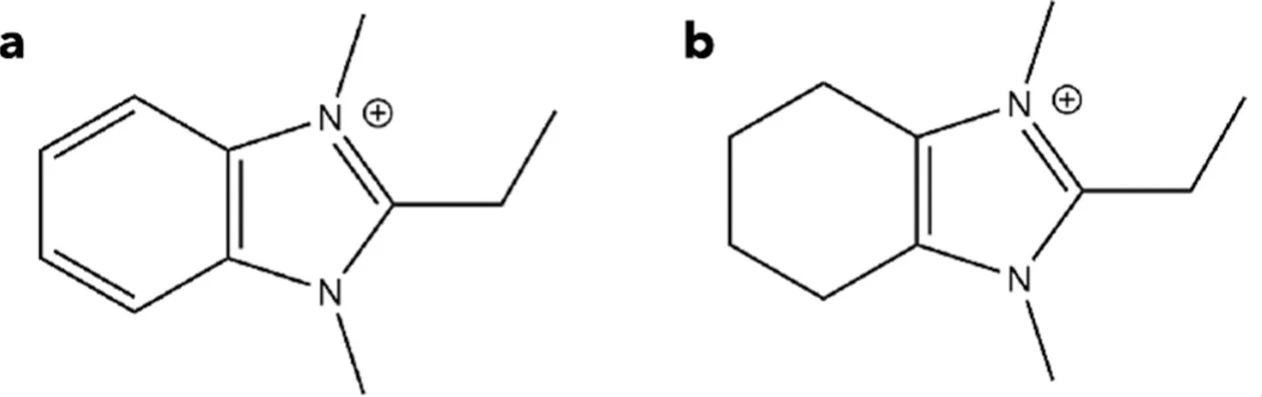 J. Am. Chem. Soc. 2026, 148, 6, 6686–6694: Figure 1. Organic structure-directing agents used in the synthesis. (a) 2-Ethyl-1,3-dimethylbenzimidazolium (denoted OSDA1) used to form EMM-75P and EM-L01 and (b) 2-ethyl-1,3-dimethyl-4,5,6,7-tetrahydrobenzimidazol-3-ium (denoted OSDA2) used to form EM-L02.
All three phases in their as-synthesized forms exhibit PXRD patterns indicative of crystalline phases (see Figures S4a,c,e). The 27Al MAS NMR spectra (Figure S5a) reveal that EMM-75P predominantly contains tetrahedrally coordinated framework aluminum species (AlIV), accounting for approximately 90% of the total aluminum signal with a minor broad resonance near 0 ppm attributed to hexacoordinated extra-framework aluminum species (AlVI). The 29Si NMR spectrum (Figure S6a) of EMM-75P shows peaks consistent with tetrahedrally coordinated Si species, Q4(0Al) and Q4(1Al) as well as silanol groups (≡Si–OH, Q3). Based on peak deconvolution, NMR suggests a silanol content of 15.4% in close proximity to the theoretical value (16.7%).
In contrast, the 27Al MAS NMR spectrum of EM-L01 exhibits a strong signal corresponding to tetrahedral framework AlIV, with no detectable resonance at 0 ppm, indicating the absence of significant extra-framework Al species (Figure S5b). A sharp, low-intensity peak (∼2%) at ∼20 ppm is assigned to hexacoordinated aluminum (AlVI), possibly originating from trace Al2O3 impurities. (32) The 29Si NMR spectrum shows resonances indicative of fully condensed Q4 Si(0Al) environments, with a shoulder indicative of Q3 species (see Figure S7a).
The 29Si MAS NMR spectrum of EM-L02 (Figure S8) indicates a significant degree of framework connectivity of fully condensed silica species (Q4, Si(0Al)) with notable signals attributed to Q3 species.
Scanning electron microscopy (SEM) images reveal plate-like crystal morphologies of EMM-75P and EM-L01 and a rod-like shape of the EM-L02 phase (see Figure 2). Upon calcination in air, the PXRD data indicates the transformation of EMM-75P to a new crystalline phase (Figure S4b), whereas the PXRD patterns of EM-L01 and EM-L02 only show partial (Figure S 4d) and no crystallinity (Figure S 4f), respectively. The 29Si NMR spectrum of calcined EMM-75 shows no distinct peak corresponding to Q3 species.
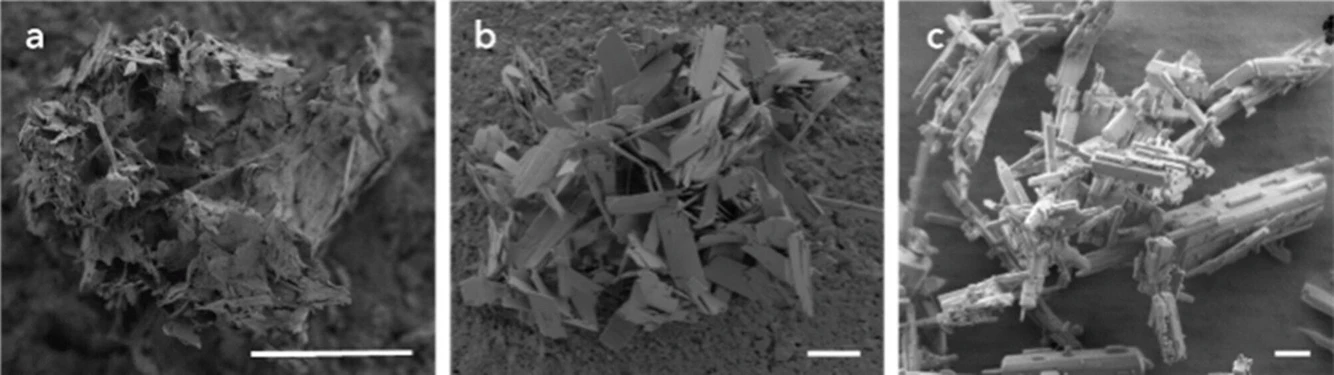 J. Am. Chem. Soc. 2026, 148, 6, 6686–6694: Figure 2. SEM images show the crystal morphology of (a) EMM-75P, (b) EM-L01, and (c) EM-L02 (scale bars 5 μm).
Conclusions
Three new low-dimensional zeotype materials have been synthesized using similar cyclic benzimidazolium OSDAs. 3D ED data revealed their framework structures as well as the precise atom-by-atom location of the OSDA molecules in all three materials, the EMM-75P, EM-L01, and EM-L02. Based on the obtained structures, light was shed on the role of the OSDA in the formation of the structures of these low-dimensional zeolitic materials. The imidazolium group directs the growth of the zeolitic framework, where the π–π interactions between OSDA molecules promote the formation of straight channels, and the bulkier benzene group and the rigidity and limited mobility of the OSDAs prohibit the growth of three-dimensional framework structures.
Among the three materials, only EMM-75P topotactically condenses upon calcination to form a novel three-dimensional material, the new zeolite EMM-75, whereas EM-L01 partially condenses into the zeolite framework STF, and EM-L02 does not form a crystalline material upon calcination. A decisive factor for the success of the topotactic condensation appears to be the distance between terminal silanol groups, which is a consequence of the OSDA packing, and their interaction with the adjacent layers. Based on our study, the distance should ideally fall within the hydrogen bond interaction with an upper limit of ∼3.8 Å. In conclusion, the rigid and bulky nature of the OSDA molecules are key factors to form low-dimensional zeolitic materials, and the relative proximity of the terminal silanol groups is an important factor for a successful topotactic condensation.
This study provides a valuable understanding of the formation of low-dimensional zeotype materials synthesized by direct hydrothermal synthesis and the structure-directing role of the OSDAs. This will help to facilitate the synthesis of new low-dimensional zeotype materials, a viable route to obtain zeolite materials unfeasible to form by direct synthesis.