

New Synthetic Approach to C‑30 Ethers, Esters, and Amines of Betulin Using the Mitsunobu Reaction and Biological Evaluation of the Products
ACS Omega (2026) 11 (16): 24564–24579: Graphical abstract
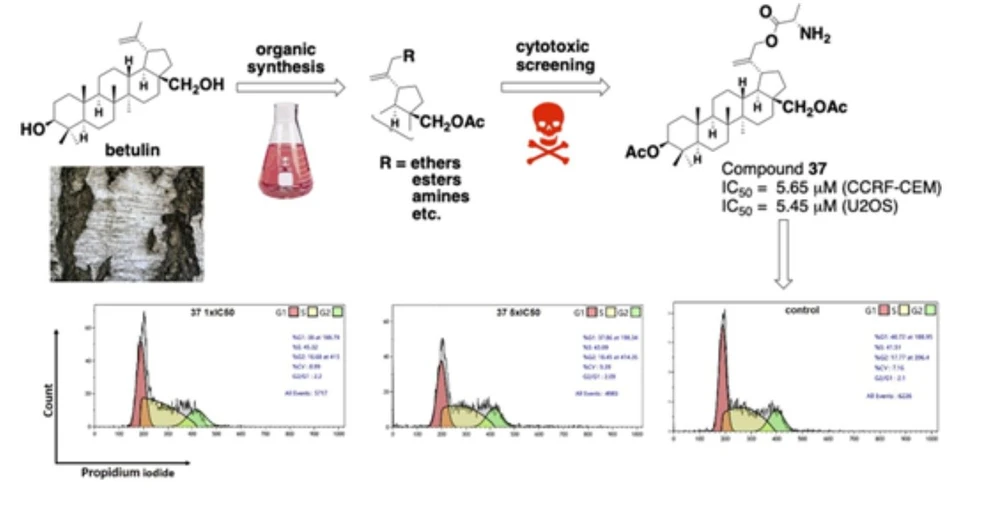
The study presents a new three-step synthetic route for modifying betulin at the C-30 position using the Mitsunobu reaction. The optimized method produced 39 novel ethers, esters, and amines in good to high yields, significantly expanding the range of accessible betulin derivatives.
The synthesized compounds were evaluated for cytotoxicity against multiple cancer cell lines. Two derivatives showed the highest activity, with one demonstrating broad-spectrum anticancer effects by disrupting DNA and RNA synthesis and inducing cell death through distinct mechanisms, highlighting its potential as a lead candidate for future anticancer drug development.
The original article
New Synthetic Approach to C‑30 Ethers, Esters, and Amines of Betulin Using the Mitsunobu Reaction and Biological Evaluation of the Products
Jan Bachořík; Ivo Frydrych; Soňa Gurská; Štěpán Dostál; Jan Pokorný; Petr Džubák; Marián Hajdúch; Milan Urban *
ACS Omega (2026) 11 (16): 24564–24579
https://doi.org/10.1021/acsomega.6c00716
licensed under CC-BY 4.0
Selected sections from the article follow. Formats and hyperlinks were adapted from the original.
According to the data published in 2024, nature offers a non-negligible percentage of compounds that met the criteria of clinical trials and regulatory approval for medical usage. (1) It also highlighted natural products and their derivatives as more viable options than synthetic compounds in medical research due to lower toxicity. (1) These are strong and compelling findings for further development of natural products and their derivatives as potential new drugs.
Among many substances involved in contemporary research activities, pentacyclic triterpenoid betulin garnered significant attention of scientists including our research group. One of the primary reasons is its high availability in natural resources. It is commonly found and easily isolated from white parts of birch bark in large quantities, as reviewed and reported. (2−4) Another key contribution is the wide range of biological activities of betulin derivatives including anticancer effects, which was thoroughly reviewed in 2015, (5) as well as their antiviral (6) and anti-inflammatory (7) potential useful in the treatment of multiple sclerosis. (8) Despite their abundance and numerous interesting biological effects, betulin analogues face significant challenges that need to be addressed before serious development, which include enhancement of biological effects and low solubility in water (0.08 μg/mL according to Jäger et al.). (9)
To improve these shortcomings, more modifications of the betulin chemical structure emerged, which became a powerful strategy to optimize the unfavorable properties of originally discovered lead structures. Betulin has several positions at its structures to be accessible to chemical modifications, and these were highly explored in the past, such as position C-3 and position C-28. (10−19) Among the intriguing and less studied sites for chemical modification in the structure of betulin is the allylic position C-30. The majority of synthetic work at allylic position C-30 was achieved through the introduction of a bromine to this site via the NBS/CCl4 protocol (20−32) that was subsequently substituted by a variety of nucleophiles such as carboxylates, (21,22) amines, (27,28) azides, (24,26,30,31) pyridines and other nitrogen heterocycles, (25) thioethers, (33,34) silver nitrate, (32) and phosphite. (35) Consequent tests of biological activities revealed that some of these modifications at position C-30 showed a significant enhancement of anticancer activity, which motivated us to expand the numbers of such compounds and which became one of the goals of our current research interests. Specifically, a comprehensive study published by Chrobak et al. described the modification of betulin using ester functionalities. (36) The results from the screening showed enhancement of the cytotoxic effects against cancer cells. The IC50 values ranged from 1.24 to 6.03 μM.
Inspired by previous work and recognizing a scarcity of progress in modification of betulin at its position C-30, we aimed to make an advancement in this area. In particular, we sought to establish a new and more robust procedure that would help to supersede the standard route dependent on the NBS/CCl4 protocol. Tetrachloromethane is being gradually phased out due to environmental and regulatory concerns, (37) and the original procedure usually provided moderate to low yields. In this work, we describe optimized conditions for the introduction of the OH group at position C-30 in two steps followed by the Mitsunobu protocol for substitution with oxygen and nitrogen-based coupling partners. This reaction is versatile, high yielding, and proceeds under mild conditions, which is especially beneficial for natural products. (38) A set of 39 new compounds was prepared and tested for cytotoxic activity. Out of these 39 new compounds, seven are esters analogous to the compounds from ref (36), differing only by a different substituent.
Experimental Section
All reagents were of reagent grade and were used without further purification. Starting betulin diacetate in purity 98% was purchased from the company Betulinines (www.betulinines.com). All other chemicals and solvents including dry ones were purchased from Merck (Germany). The course of the reactions was monitored by TLC on Kieselgel 60 F254 plates (Merck, Germany) and detected by UV light (254 nm) followed by visualization using 10% aqueous H2SO4 and heating process to 150–200 °C. Purification was performed using column chromatography on Silica gel 60 Merck 7734 (Merck, Germany). All 1H and 13C NMR experiments were recorded at 500 MHz (JEOL JNM-ECX-500) or 400 MHz (JEOL JNM-ECA400II) for 1H NMR, and 126 or 100 MHz for 13C NMR, respectively, at 25 °C in CDCl3. Chemical shifts δ are reported relative to the residual solvent peak (for CDCl3δH = 7.26 ppm, δC = 77.16 ppm). Chemical shifts δ are reported in parts per million (ppm), and coupling constants J are reported in Hertz (Hz). HRMS analyses were performed on a SELECT SERIES Cyclic IMS QTOF (Waters Corp., Wilmslow, U.K.) equipped with an Atmospheric Solid Analysis Probe (ASAP) source operated in positive mode. Sodium iodide 2 μg/μL in propan-2-ol/water (1:1, v/v) was used for the mass calibration (m/z 50–2000). Instrumental parameters were set as follows: corona current 2 μA and desolvation temperature of 400 °C under standard conditions and 500 °C for less efficiently ionizing analytes, respectively. Data were acquired with a lockmass correction using leucine enkephalin at a concentration of 50 pg/μL in water/acetonitrile (1:1, v/v) containing 0.1% formic acid, monitoring the [M + H]+ ion at m/z 556.2771. Samples were dissolved in acetone and analyzed at a concentration of 10 μg/mL, with an increased concentration of 50 μg/mL applied for compounds exhibiting poorer ionization efficiency. For ASAP introduction, a quartz capillary was immersed directly into the sample solution and subsequently positioned in the ASAP source for direct analysis. IR samples were analyzed by Fourier transform infrared spectroscopy in attenuated total reflectance (ATR) mode using a Nicolet iS50 FTIR spectrometer (Thermo Fisher Scientific).
Results and Discussion
Chemistry
Our proposed three-step sequence starts from commercially available betulin diacetate. First, betulin diacetate was selectively oxidized at the allylic position (Scheme 1). Instead of the previously described conditions (39−41) that required large quantities of selenium dioxide, we used a catalytic system (SeO2/TBHP). This not only improved our yields from the previously reported 56% (using the original methodology) (39) to 84% using the new procedure but also prevented the extensive formation of colloidal elemental selenium that was always difficult to fully remove from the final product. In the second step, selective reduction of aldehyde (1) was performed under Luche conditions.
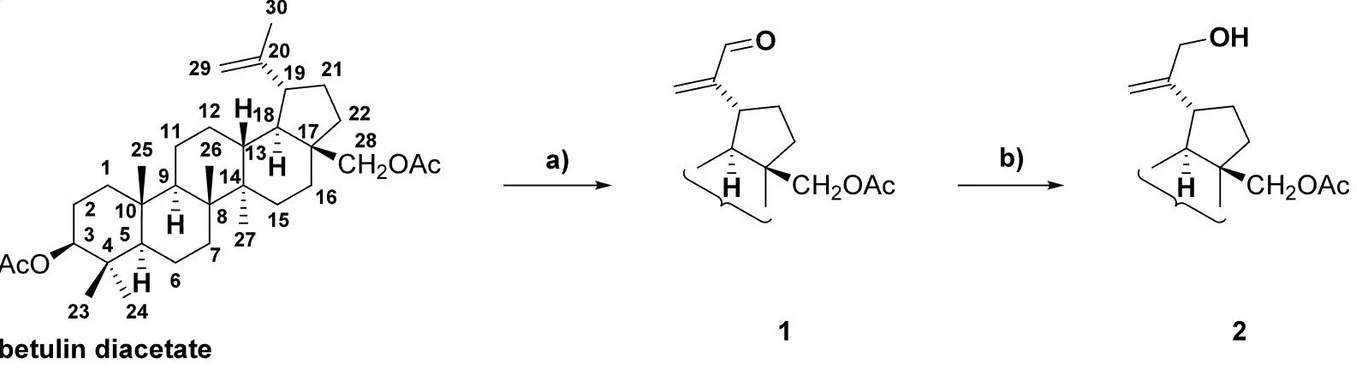 ACS Omega (2026) 11 (16): 24564–24579: Scheme 1. Modification of Betulin Diacetate at C-30 Using the Allylic Oxidation/Reduction Sequence. Reagents and conditions: (a) SeO2, TBHP, DCM, AcOH, rt, 48 h, 84%; (b) NaBH4, CeCl3·7H2O, THF, MeOH, 15 min, 78%.
Investigation of Cell Cycle Alterations, DNA/RNA Synthesis, and Apoptosis after Treatment with 30 and 37
To ensure transparent interpretation of all measured cellular end points, the flow cytometry results in this study are presented in the form of representative histograms and dot plots. These graphical outputs represent the primary readouts of multiparametric flow cytometry and directly illustrate treatment-induced changes in DNA content, mitotic activity, DNA and RNA syntheses, and apoptosis without requiring additional bar graph summarization. All relevant gates, subpopulations, and positivity thresholds are clearly annotated in the displayed plots to facilitate straightforward interpretation. Using this approach, we next assessed how compounds 30 and 37 influence cell cycle progression and biosynthetic processes in CCRF-CEM leukemia cells. To gain insight into the mechanisms underlying their cytotoxicity, we analyzed cell cycle distribution, mitotic index (pH3Ser10), DNA synthesis (BrdU incorporation), RNA synthesis (BrU incorporation), and apoptosis (sub-G1) after 24 h exposure at 1× and 5× IC50 concentrations (Figure 1).
 ACS Omega (2026) 11 (16): 24564–24579: Figure 1. Multiparametric flow cytometry analysis of the cellular response to compounds 30 and 37 in CCRF-CEM cells. (A) Cell cycle distribution. Representative PI histograms showing G1, S, and G2/M phase profiles after 24 h treatment with compounds 30 and 37 at 1 × IC50 and 5 × IC50. PI fluorescence (x-axis) was used to quantify total DNA content; only live, single-cell events were included. Untreated cells served as control. (B) Mitotic index (pH3Ser10). Flow cytometric detection of phospho-histone H-3 (Ser10)–positive cells as a measure of mitotic activity. Cells were stained with the anti-pH3Ser10 antibody following identical treatment conditions. Percentages represent the proportion of mitotic cells within the PI-gated population (region B). (C) DNA synthesis activity (BrdU incorporation). Cells were pulse-labeled with BrdU prior to harvesting. BrdU-positive cells (region B) reflect actively replicating populations. Dot plots show the relative BrdU incorporation under each treatment condition. (D) RNA synthesis activity (BrU incorporation). BrU-labeled nascent RNA was detected by flow cytometry using an anti-BrdU antibody cross-reactive with BrU. Region B denotes BrU-positive cells. Data illustrates treatment-dependent modulation of transcriptional activity. (E) Apoptotic cell death (sub-G1). Representative PI histograms showing the proportion of cells with sub-G1 DNA content following 24 h exposure to the compounds. The sub-G1 fraction quantifies apoptotic DNA fragmentation. All experiments were performed in biological triplicates with similar results. Flow cytometry data were processed and quantitatively evaluated using Kaluza software (Beckman Coulter). Collectively, these multiparametric analyses provide an integrated overview of how compounds 30 and 37 affect cell cycle dynamics, biosynthetic capacity, and cell death pathways in leukemia cells.
Collectively, these assays provide a multifaceted view of how these compounds affect critical cellular processes linked to proliferation and survival. Interestingly, neither compound induced substantial alterations in cell cycle distribution compared to untreated controls (Figure 1a). For both 30 and 37, the proportions of cells in the G0/G1, S, and G2/M phases remained remarkably stable across tested concentrations. This observation suggests that cell cycle arrest is not a dominant mechanism of action for these compounds. Instead, their cytotoxicity appears to arise from more subtle or indirect perturbations of key biosynthetic processes. This notion is supported by analysis of the mitotic index, measured via pH3Ser10 expression (Figure 1b). While minor fluctuations were observed (slightly increased at 1 × IC50 and decreased at 5 × IC50), neither compound consistently elevated the mitotic population, further indicating that direct blockade of mitotic progression is unlikely to account for the cytotoxic effects (Figure 1b). A more revealing pattern emerged from the assessment of DNA synthesis (Figure 1c). At lower concentrations (1 × IC50), both 30 and 37 stimulated DNA synthesis or BrDU incorporation compared to control cells (56.18 and 54.95 vs 49.26%, respectively). This transient increase could reflect a compensatory hyper-replication/replication stress or DNA repair response triggered by initial cellular damage. However, at higher concentrations (5 × IC50), a divergent profile emerged: 30 displayed only a modest reduction in DNA synthesis (46.61%), whereas 37 profoundly suppressed DNA synthesis (12.35%). Such concentration-dependent inhibition is consistent with induction of replication stress, which is a well-documented trigger of DNA damage signaling, cell cycle checkpoints, and ultimately apoptosis. An analogous pattern was observed in the RNA synthesis assays (Figure 1d). At 1 × IC50, both compounds stimulated RNA synthesis (47.94 and 41.17 vs 37.32%, respectively), perhaps as part of an early adaptive response to stress. However, at higher concentrations (5 × IC50), both compounds, particularly 37, induced a marked suppression of RNA synthesis (30: 26.73%; 37: 2.64%). The profound inhibition of RNA synthesis by 37 at 5 × IC50 is especially striking and suggests disruption of transcriptional machinery, which can rapidly compromise cell viability and trigger programmed cell death pathways. Taken together, these findings point toward a multifaceted mechanism of cytotoxicity in which 30 and 37, rather than imposing overt cell cycle arrest, likely interfere with DNA replication and transcriptional processes, especially at higher concentrations. The initial mild stimulation of DNA/RNA synthesis at lower doses might reflect compensatory S-phase entry due to unscheduled replication in response to DNA damage rather than regular proliferation. However, at higher doses, especially for 37, this dynamic shifts dramatically toward robust inhibition of both DNA and RNA synthesis, consistent with a collapse of essential biosynthetic pathways and activation of cell death. Mechanistically, such inhibition could arise from direct or indirect interference with DNA or transcriptional machinery. Notably, these results align with the concept that targeting fundamental biosynthetic processes can be an effective anticancer strategy, particularly in rapidly proliferating leukemia cells such as CCRF-CEM. Overall, the present data highlight 37, in particular, as a potent modulator of essential cellular pathways, supporting its prioritization for further preclinical evaluation as a potential anticancer agent. Given the observed impact of these compounds on biosynthetic processes, we next explored whether these perturbations translate into the activation of programmed cell death, assessed as the sub-G1 apoptotic population. Apoptosis induction was evaluated as the sub-G1 population using flow cytometry, providing key insights into the cell death mechanisms triggered by 30 and 37 (Figure 1e). In untreated CCRF-CEM cells, the sub-G1 fraction accounted for 5.01% of the population, reflecting baseline levels of apoptosis. Treatment with 30 at a concentration equivalent to its IC50 resulted in a modest increase in the sub-G1 fraction (6.97%), indicating a limited pro-apoptotic response at lower doses. However, at 5 × IC50, a dramatic increase in the sub-G1 population was observed (27.20%), pointing to a concentration-dependent induction of apoptosis. This finding aligns seamlessly with the observed modest inhibition of DNA and RNA synthesis at higher concentrations of 30, suggesting that while the compound does not induce strong cell cycle arrest or mitotic blockade, its interference with biosynthetic processes eventually triggers apoptotic cell death. In contrast, 37 demonstrated a different apoptotic profile. At 1 × IC50, it produced a modest increase in the sub-G1 fraction (6.5%), comparable to 30, indicating early signs of apoptosis induction. However, even at 5 × IC50, the sub-G1 fraction reached only 10.67%, substantially lower than the apoptotic response observed for 30 at the same concentration. This observation is particularly intriguing given that 37 exhibited a more pronounced suppression of DNA and RNA synthesis at higher concentrations than 30. The dissociation between the strong suppression of biosynthetic processes and the relatively modest induction of apoptosis suggests that 37 may engage additional, nonapoptotic mechanisms of cytotoxicity, such as necrosis, autophagy, or irreversible replication stress culminating in mitotic catastrophe. Alternatively, the timing of the measurement may have captured an early phase of cell death before full apoptotic commitment occurs. Taken together, these data highlight the complex interplay between biosynthetic disruption and apoptosis induction. While both compounds interfere with DNA and RNA syntheses, especially at higher concentrations, only 30 induces robust apoptosis as reflected by the sub-G1 accumulation, whereas 37 triggers a less pronounced apoptotic response despite its potent inhibition of macromolecular synthesis. This polarity underscores the importance of integrating multiple analytical end points to fully define the cytotoxic mechanisms of novel anticancer agents.
Conclusions
The main goal of this research was to find an optimized synthetic sequence for derivatization of betulin at its position C-30 and expand the library of known semisynthetic derivatives. Our new synthetic pathway led to the synthesis of various triterpenoid ethers, esters, phthalimides, and sulfonamides. The synthesis was done through a three-step process: first, optimized allylic oxidation, followed by a selective reduction of carbonyl group, ending with Mitsunobu substitution. This synthetic strategy generated a broad range of novel compounds in good to high yields and opens many options for future syntheses of multiple-compound libraries.
Basic screening of the cytotoxic activity in a set of cancerous and healthy cells showed that compound 37 was the most active (IC50 values 5.65 in CCRF-CEM and 5.45 μM in U2OS). This study reveals that within this structurally diverse compound library, only a small subset exhibited meaningful cytotoxicity, highlighting the importance of structural fine tuning to achieve potent anticancer activity. Notably, 30 and 37 emerged as the most promising candidates, displaying pronounced activity against CCRF-CEM leukemia cells, with 37 demonstrating a broader cytotoxic profile across additional cancer cell lines. Although compounds 30 and 37 exhibit poor predicted biopharmaceutical properties, they serve as lead scaffolds. Future structure optimization will focus on reducing lipophilicity and exploring other strategies (e.g., lipid-based carriers) to enhance the solubility and absorption of these hydrophobic candidates. Mechanistic investigations revealed that the cytotoxicity of these compounds is not primarily mediated by classical cell cycle arrest or mitotic blockade, but rather by profound perturbations of essential biosynthetic processes, particularly DNA and RNA syntheses. The pronounced concentration-dependent inhibition of DNA and RNA synthesis observed for 37, coupled with its modest apoptotic induction, suggests a complex mechanism involving replication stress and potential engagement of alternative cell death pathways. Conversely, 30 demonstrated robust apoptosis at higher concentrations, indicating a more direct link between biosynthetic inhibition and programmed cell death. These findings underscore the therapeutic potential of targeting biosynthetic machinery as an anticancer strategy and position 37, in particular, as a compelling lead candidate for further preclinical development. The study further highlights the importance of integrated cytotoxicity, cell cycle, and apoptosis analyses in unravelling the multifaceted mechanisms of novel anticancer compounds, providing a strong rationale for future mechanistic and in vivo studies.




![Gunacins: Novel Benzo[g]chromene Derivatives from the Fungus Exobasidium sp. and Their Potent Anti-Leishmania and Trypanosoma Activities](https://icpms.labrulez.com/labrulez-bucket-strapi-h3hsga3/ACS_Omega_2025_10_22_23222_23234_Graphical_abstract_cover_68d40d7cfd_s.webp)


