CEITEC Chemists Capture Electron Storms in Gold and Mercury

CEITEC: CEITEC Chemists Capture Electron Storms in Gold and Mercury
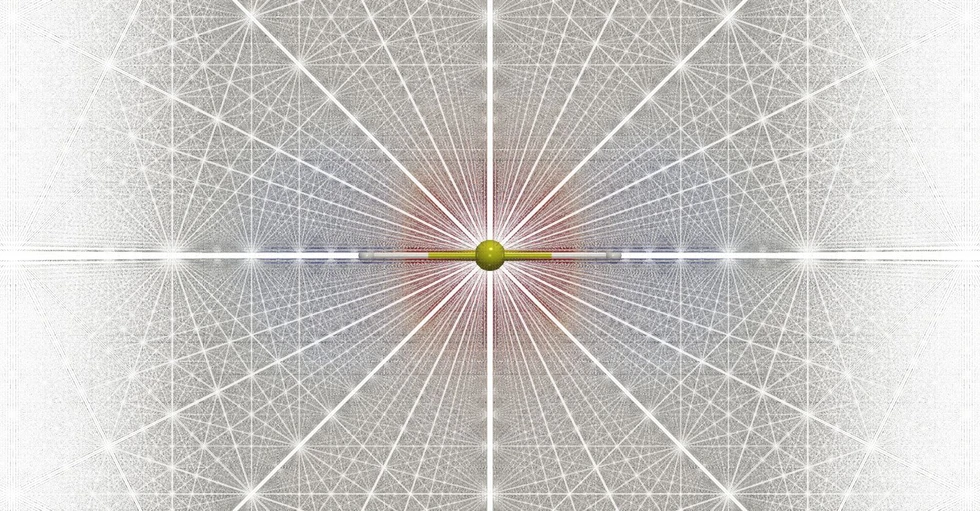
Colourful vortices, loops and currents resembling magnetic storms or abstract digital art. This is what maps of magnetically induced electron currents look like, created by an international team including chemists from CEITEC Masaryk University while studying molecules containing gold, mercury and the rare element astatine.
 CEITEC: CEITEC Chemists Capture Electron Storms in Gold and Mercury
What may at first glance resemble visualisations of outer space or ocean currents is in fact taking place inside molecules themselves. Here, electrons form complex currents and vortices whose shapes vary depending on the type of atom and the nature of the chemical bond.
 CEITEC: CEITEC Chemists Capture Electron Storms in Gold and Mercury
And this is where Einstein enters the picture. In heavy elements, electrons move so rapidly that their behaviour is influenced by the effects of special relativity. Without relativistic physics, some of these remarkable electron patterns would not exist at all.
CEITEC: CEITEC Chemists Capture Electron Storms in Gold and Mercury
While some atoms are surrounded by almost perfectly symmetrical current flows, others generate distorted vortices or local turbulences resembling miniature electron storms. Using advanced computational methods, the researchers were able to capture these differences in unprecedented detail.
 CEITEC: CEITEC Chemists Capture Electron Storms in Gold and Mercury
The results provide not only new insights into the behaviour of heavy elements but also a visually fascinating glimpse into a world that normally remains hidden from human eyes.
 CEITEC: CEITEC Chemists Capture Electron Storms in Gold and Mercury
Scientists study such phenomena because the behaviour of electrons determines how stable molecules are, how they react, and what properties they possess. In heavy elements, however, the rules of classical chemistry often reach their limits – and relativity comes into play.
 CEITEC: CEITEC Chemists Capture Electron Storms in Gold and Mercury
A better understanding of these effects could eventually contribute to the design of new catalysts or materials based on heavy metals. For the researchers themselves, studying such electron structures is also a way of exploring one of the least intuitive realms of modern chemistry.
The study was published in JACS Au.
 CEITEC: CEITEC Chemists Capture Electron Storms in Gold and Mercury
Original article
Link between Spin–Orbit Relativity and Magnetically Induced Current Densities in Heavy-Atom Hydrides: trans-Ligand Influence
Daniel Blasco, Jan Novotný, James R. Asher, Raphael J. F. Berger, Stanislav Komorovsky, Radek Marek
JACS Au 2026, 6, 6, 3323–3335
https://doi.org/10.1021/jacsau.6c00346
licensed under CC-BY 4.0
Abstract
Interactions between individual atoms underpin the structure and behavior of matter. These interactions govern atomic positions and dynamics, as well as the organization of electrons─particularly in the frontier region. Because electrons lie at the core of chemical phenomena, numerous theoretical frameworks have been developed to rationalize the molecular structure and properties. Electronic motion within molecules and the resulting induced currents provide powerful probes of the molecular or supramolecular structure, building on and going beyond molecular orbital and valence bond theories. In particular, current density offers a spatially-resolved description of the electronic response to external perturbations, enabling direct analysis of electron delocalization and magnetic response in molecular systems. In this work, the effect of relativistic spin–orbit (SO) coupling on the strength and topology of the magnetically induced current density (MICD) is analyzed in depth for a series of model heavy-atom hydrides at the four-component Dirac-Kohn–Sham level. For the most simple molecules, TlH, HAt, and AuH, we demonstrate a connection between the SO effects on the molecular geometry, strength and topology of MICDs, and ligand 1H NMR shielding. For model HMX molecules, where M = AuI, HgII; X = F, Cl, Ph, CH3, H, SiH3, BH2, the hydride deshielding due to the slight elongation of the M–H bond upon increasing the trans-ligand influence (TLI) of X is shown to be marginal when compared to that originating from the electronic SO effect. In particular, the inclusion of SO effects gives rise to highly localized paratropic MICD vortices on the hydride position of those complexes bearing strong TLI ligands. Our results disprove the previously proposed governing role of the current around the metal atom (similar to the classical Buckingham-Stephens model for transition metal hydrides) associated with TLI-induced variations in the metal–hydrogen bond length in determining the characteristic ligand 1H NMR shifts.