Hydrogen Production from Biomass Gasification Using Dolomite and Mechanical Mixtures of CaO–MgO–K2CO3
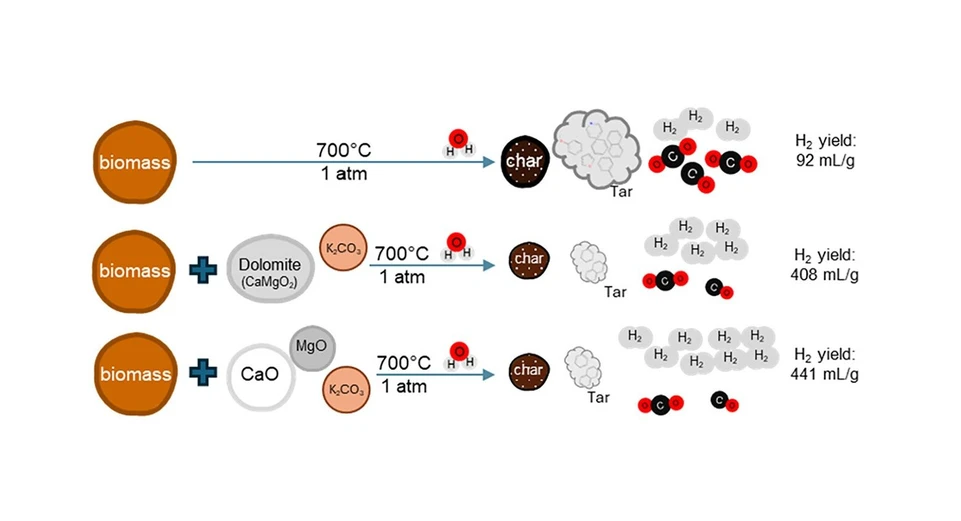
ACS Omega 2026, 11, 6, 10132–10143: Graphical abstract
This study explores hydrogen production from biomass steam gasification using dolomite and mechanical mixtures of CaO, MgO, and K₂CO₃ in a fluidized bed reactor. Mechanical mixtures achieved performance comparable to or better than dolomite, with the highest hydrogen yield reaching 441 mL/g biomass feed.
The results suggest synergistic interactions between calcium and magnesium oxides, while K₂CO₃ contributed to reducing tar formation. These findings support the development of low-cost and sustainable catalyst systems for efficient renewable hydrogen production from biomass gasification.
The original article
Hydrogen Production from Biomass Gasification Using Dolomite and Mechanical Mixtures of CaO–MgO–K2CO3
Omar Campuzano-Calderon, and Alejandro Montesinos-Castellanos*
ACS Omega 2026, 11, 6, 10132–10143
https://doi.org/10.1021/acsomega.5c11150
licensed under CC-BY 4.0
Selected sections from the article follow. Formats and hyperlinks were adapted from the original.
Worldwide, over 1.2 billion tonnes of corn (Zea mays) are harvested annually, (1) producing 1.9 billion tonnes of corn stover, (2) from which 40 million tonnes are burned each year. This combustion releases significant emissions, equivalent to 23 million tonnes of CO2, (3−5) contributing to global warming. To achieve net-zero emissions by 2050, these practices need to be avoided as per the Paris Agreement. (6) Corn stover can be utilized to produce industrial goods like hydrogen, methane, ethylene, and methanol via gasification, a process that converts biomass into gas and byproducts at high temperatures using agents like steam or air. (7,8) Hydrogen, a crucial substance in the chemical industry, primarily comes from fossil fuels through methane reforming. (9) To mitigate climate change, it is important to promote the production of H2 using renewable energy sources. Biomass gasification is an alternative technology that can produce H2 and reduce the level of CO2 emissions. However, it is currently costlier than methane reforming due to additional steps required (3.5 vs 1.3 USD/kg-H2). (9−11) To make biomass gasification a commercial technology for H2 production, other options, like catalyst addition, must be considered that can increase the H2 yield with a lower tar generation at the reactor outlet, minimizing the cost process.
The most efficient catalysts used on biomass gasification are based on nickel, platinum, ruthenium, and rhodium. (12) However, other materials like dolomite, CaO, and potassium compounds are preferred due to their nontoxicity, high performance, higher availability, and lower costs. Dolomite is a common naturally occurring material, which is mainly composed of 50–70% CaO and 20–40 wt % MgO. (13) When used on gasification, dolomite is first activated by calcination above 900 °C. Calcined dolomite (CaMgO2) has proved to be a good option, as it can enhance gas and H2 yield up to three times in biomass gasification, as well as reduce the amount of released tar by 80%. (13−15) This performance has been attributed to interactions within the CaMgO2 structure and the presence of trace metals like Fe that may have played a catalytic role during gasification. (13,15,16) CaO, a significant component of dolomite, facilitates H2 yield and reduces tar by shifting the chemical equilibrium of the water–gas reaction (WGS). (17−20) The amount of CaO fed in the biomass gasification process is often specified by the Ca/C molar ratio. The Ca/C = 1 ratio means that a stoichiometric amount of CaO is present to take up the total C from biomass as CaCO3. Nevertheless, some reports have studied the effect of the Ca/C ratio on H2 concentration and observed that the higher increase of H2 concentration was reached at Ca/C = 0.5. (17) MgO is also present in dolomite and has similar properties to CaO. There are very few studies using MgO in biomass gasification that have shown to increase H2 yield and reduce tar concentration. (21−23) However, it has shown a lower capacity for CO2 via carbonation due to the relatively low decomposition temperature of MgCO3 (<500 °C). (24) Potassium compounds such as K2CO3 can improve gas quality and yield and reduce tar when used in biomass gasification. (25−28) They work by forming KOH in steam, facilitating the breakdown of char and tar. The synergistic effects of CaO and potassium were reported, showing an increase in the quality and quantity of gas produced. These effects might result from the formation of KOH in the steam environment, which acts as an O/OH donor that can react with char and tar and convert them into smaller molecules as CO and CO2. (25−27) Additionally, it has been observed that CaO can be doped with potassium during the gasification process, forming oxygen vacancies, enhancing its oxidizing properties for reducing tar, and thus increasing H2 yield. (29) Most of the studies have shown the synergetic effect of CaO and potassium, but further investigation is needed to explore its performance when it is mixed with dolomite, especially by mechanical addition.
Despite numerous published works using dolomite or CaO in biomass gasification, studies involving the mixtures of CaO and MgO are scarce. In one study, Bunma et al. (30) compared CaO–MgO mixtures in the gasification of sugar cane leaves on a fixed-bed reactor and reported that CaO–MgO presented a high synergistic effect toward H2 yield. However, their results were not compared with dolomite, and tar reduction results were absent. Thus, it is difficult to determine if their mixtures would have a similar performance to dolomite.
Regardless of the number of published studies on dolomite gasification, (13,31,32) conclusive results that relate performance and these properties are yet to be found. Due to their natural origin, dolomite composition varies between extraction sites, and thus, its effectiveness in biomass gasification varies accordingly. (33,34) Because finding a second dolomite ore with identical properties is highly improbable, it is needed to understand the specific properties like composition, surface area, pore size, crystal phases, and acid–basic sites, among others, that enhance H2 yield. Understanding these properties would allow the synthesis of better catalysts for biomass gasification without the use of heavy metals. Besides, the past efforts using mixtures of calcium and potassium compounds had shown promising results, but mixtures of dolomite and potassium compounds have been overlooked. Therefore, a systematic assessment of a few properties of dolomite at a time, such as composition, would minimize errors and help to identify its most important properties to fully understand its potential for the high production of H2 via biomass gasification.
In agreement with the above discussion, the aim of this study is to compare the performance of dolomite with the mechanical mixtures of CaO and MgO in biomass steam gasification by using a fluidized bed reactor. Additionally, their effects will be compared with and without the addition of K2CO3. Since biomass gasification is a chemical process that involves several reactions occurring simultaneously, the experimental tests were compared based on H2 yield. Also, the concentrations of tar were analyzed and compared. Such an analysis will help to understand the catalytic behavior of the materials used here, which will be crucial for biomass gasification in the future.
Methods
Biomass and Additives
Sun-dried corn stover (Zea mays) obtained from a local farm was used as the biomass. Proximate and ultimate analyses (PUA) were performed using an elemental analyzer (Flash 2000 CHNS-O, Thermo Scientific) to determine moisture, volatile matter, fixed carbon, ash, and elemental (C, H, N, S, and O) contents according to ASTM E870, E871, E872, and D1102 standards. Before the gasification test, biomass was crushed and sieved to obtain powders with particle sizes of 850–600 μm. Then, the biomass was dried at 105 °C for 10 h to remove any residual moisture.
Commercial-grade dolomite was obtained from a local provider, which was crushed and sieved to obtain a particle size of 300–425 μm. Metal content (mainly Ca, Mg, K, Na, and Fe) was determined with inductively coupled plasma optical emission spectrometry (ICP–OES; Thermo Scientific iCAP 6000 series). Analytical-grade CaO, MgO, and K2CO3 were obtained from Sigma-Aldrich and were not further characterized due to their reagent grade. Dolomite, CaO, and MgO were calcined in air at 950 °C for 240 min before characterization and the gasification test.
Gasification System and Tests
A PC-controlled stainless-steel fluidized bed reactor (Parr, Model 5410) was used for all of the tests (Figure 1). This reaction system comprised a tube of 1 in. (25.4 mm) diameter and 39.4 in. (1000 mm) height connected to a cyclone separator, condenser, and gas output. The reactor had a K-type thermocouple inside a 3/8 in. (9.5 mm) thermowell in the center to measure the inner temperature. The top, middle, and bottom parts of the reactor were independently heated by electric resistances and were thermally isolated. N2 was fed to the bottom of the reactor using flow controllers (Brook Instruments, SLA5800 series), and steam was fed using a high-pressure, high-performance liquid chromatography pump (Teledyne SSI, LS Class) with deionized water and a steam generator. The reactor outlet was connected to a cyclone of 3 in. (76.2 mm) diameter and 11 in. (279.4 mm) height to retain solid particles and was heated up to 450 °C with a heating mantle to prevent liquid condensation. The cyclone was connected downstream to a condenser that used 3 °C water as a cooling fluid. The generated tar and condensable vapors were collected in a 1000 mL vessel. Gas samples were collected via a sampling port connected to the tar vessel. The temperatures of the reactor, cyclone, and steam generator were measured using K-type thermocouples, and the internal pressure was monitored using a pressure transducer (Ashcroft series).
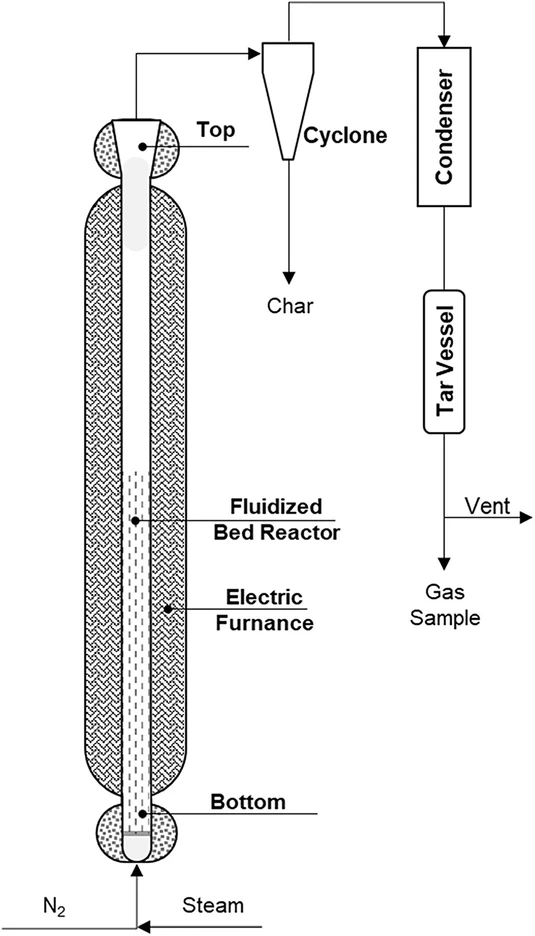 ACS Omega 2026, 11, 6, 10132–10143: Figure 1. Schematic of the fluidized bed gasification reactor system. The top, middle, and bottom parts of the reactor were heated independently. Steam was generated by a pump and an electrical heater. The condenser used water at 3 °C.
Results and Discussion
Gas, Tar, and Char Distribution
The mass distribution profiles of gas, tar, and char, as depicted in Figure 2, were quantitatively analyzed after a reaction duration of 240 min in each gasification test.
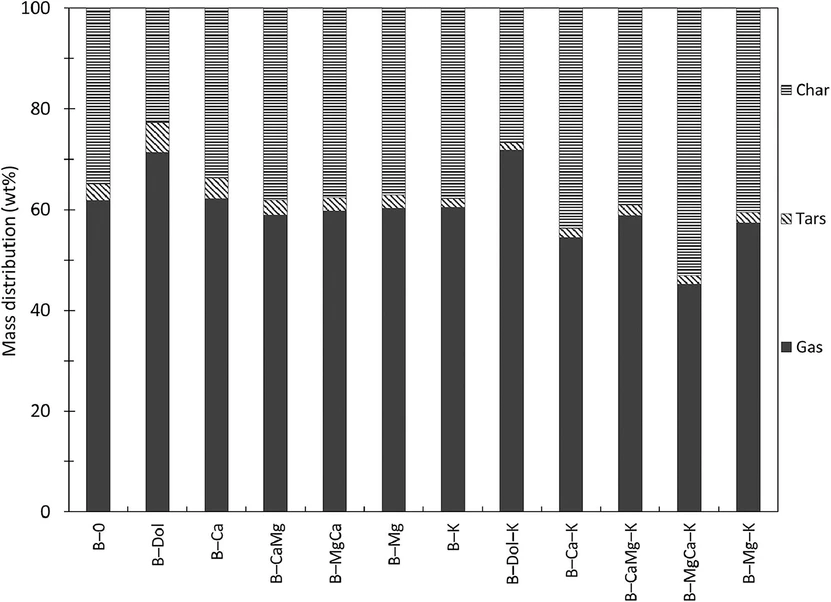 ACS Omega 2026, 11, 6, 10132–10143: Figure 2. Mass distribution of gasification outlet streams measured after 240 min of reaction (T = 700 ± 5 °C, P = 1 atm, and steam flow rate = 0.33 g/min).
For the B–0 test, gas, tar, and char yields were 62, 3, and 35 wt %, respectively. Their mass distributions were comparable to those reported in previous studies conducted using fluidized bed reactors at similar temperatures. (27) In every test, gas was the major constituent produced (45–71 wt %), followed by char (1–53 wt %) and tar (1–6 wt %). B–Dol and B–Dol–K tests presented the highest gas and the lowest char amounts with ∼72 and ∼25 wt %, respectively. These results were comparable to the volatile matter and fixed carbon results from PUA (Table 2). In the case of tar, the highest proportion was detected in the B–Dol test, whereas the lowest proportion was present in the B–Dol–K test. These results implied that potassium reacted with tar and char (27) to produce more gases such as CO, CO2, and H2.
In the test where only CaO and MgO mechanical mixtures were added, the mass distribution of gas, char, and tar was comparable to that observed in the B–0 test. This suggested that the addition of CaO and MgO did not alter the mass distribution of gas and char; however, they did affect gas composition and H2 yield, as discussed in Section Effects of Additives on H2 Production. The results of B–Mg were similar to the results from the B–0 test, probably due to the minimum effect of MgO on biomass gasification reactions at 700 ± 5 °C.
For the tests where K2CO3 was added, a lower gas and tar amount was obtained than that obtained in the B–0 test. This gas amount reduction could be due to the removal of CO2 via the carbonation of CaO. The tar amount reduction may be caused by the doping of K2CO3 inside the CaO structure, as reported before. This interaction may generate oxygen vacancies that would help to dissociate steam into H• and OH•, which promoted cracking and reforming reactions. (27,29,49)
Effect of CaO–MgO and K2CO3
The differential gas yields obtained from these tests are shown in Figure 6. Also, the accumulated H2 yield produced at different times is shown in Figure S2 (see the Supporting Information). As observed, the highest differential H2 yield was obtained in the B–CaMg–K test (344 mL/g-biomass-fed), closely followed by the B–Dol–K test (311 mL/g-biomass-fed). In this case, the mechanical mixture presented an 11% higher H2 yield than dolomite. Similarly, the H2 yield in the B–Ca–K test was almost three times higher than the H2 produced in the B–0 test. On the contrary, the lowest differential H2 yield was obtained in the B–K test (30 mL/g-biomass-fed), where only K2CO3 was added. These results suggested that the addition of only K2CO3 had a minor effect on promoting H2 production, but its effect was greatly increased when it was mixed with CaO. The differential yields of CO, CO2, CH4, and C2+ were practically lower than the respective gas yields in the B–0 test. Therefore, most of the effects of CaO–MgO–K2CO3 mixtures promoted H2 yield.
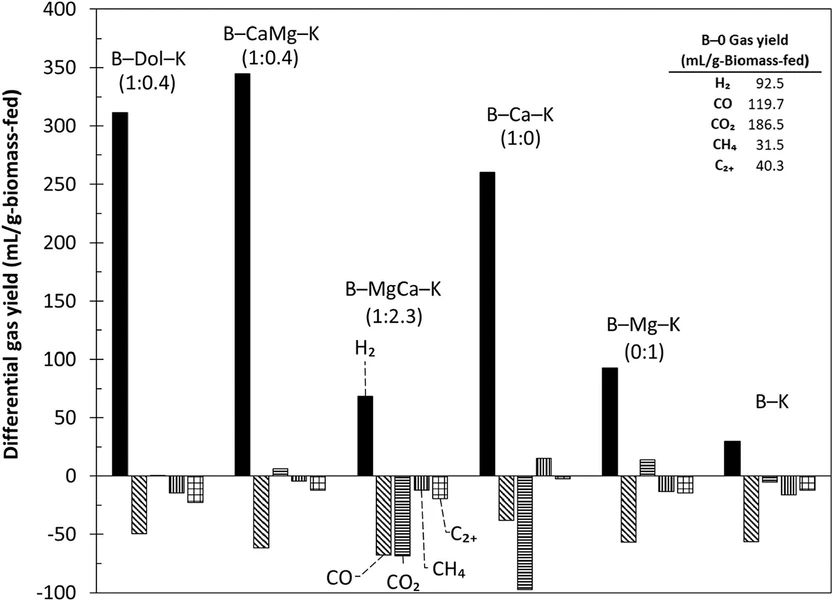 ACS Omega 2026, 11, 6, 10132–10143: Figure 6. Differential gas yields between the B–0 test and the test with additives. The Ca:Mg molar ratio is shown in parentheses (T = 700 ± 5 °C, P = 1 atm, and steam flow rate = 0.33 g/min).
This synergism between CaO and K2CO3 might be caused by the promotion of biomass carbon gasification into the CO and WGS reaction. Previously, it has been reported that calcium and potassium might produce some intermediates like −COO–Ca and −COK that release H2 and CO2. (25−27) These interactions might be enhanced when CaO and K2CO3 are close to each other. Another explanation could be the formation of a solid phase like fairchildite (K2Ca(CO3)2). Although fairchildite has not been extensively studied, some reports have detected its presence in the ashes generated from biomass combustion (60,61) and biomass air gasification. (62) It has been demonstrated that this solid phase can be synthesized at 1 atm and 600 °C via mechanical mixing of CaCO3 and K2CO3. (63) Additionally, it can be an active phase for coal steam gasification. (64)
Conclusions and Recommendations
Herein, biomass steam gasification was performed by comparing dolomite and mechanical mixtures of CaO and MgO, with the addition of K2CO3, aimed to increase H2 yield and reduce tar production. As anticipated, the use of dolomite during gasification resulted in a higher H2 yield. Surprisingly, a similar result was observed when a mechanical mixture of CaO and MgO was added at a Ca:Mg molar ratio of 1:0.4. The mechanical addition of K2CO3 further enhanced the H2 yield in the tests, and a H2 yield of 441 mL/g-biomass-fed was obtained with the mechanical mixture of CaO, MgO, and K2CO3, which was 11% higher than the yield from the dolomite–K2CO3 mixture with the same proportions. These results revealed that there was a synergetic effect between CaO and MgO, which was ∼55% more than the expected results without synergism. When K2CO3 was present, the CaO–MgO synergism was ∼35% but with a higher H2 yield, indicating that the CaO–MgO synergism remained even with the presence of K2CO3. As a first step, this study tested several mechanical mixtures of CaO, MgO, and K2CO3. Given that the mechanical mixtures of these additives have been scarcely considered for biomass gasification, future research should explore a broader range of proportions of calcium, magnesium, and potassium, reuse cycles, and varied reaction temperatures to identify the best conditions for higher H2 yield. Furthermore, a focused study that tracks the phase transitions during the reaction would be ideal to reinforce the mechanism proposed.
Various types of tar were detected, including N-heterocyclics such as pyridine and its derivatives. Both CaO and K2CO3 showed significant tar reduction properties, with CaO being more effective on acidic molecules like phenols and K2CO3 on basic and non-basic molecules like N-heterocyclics. Thus, a combination of these additives is crucial for effective reduction of tar. N-Heterocyclic tar was detected during biomass gasification at 700 °C, a finding often overlooked in previous reports due to either a lack of detection focus or its low concentration. As most biomass inherently contains nitrogen, the formation of these types of toxic compounds should not be ignored. Future studies must prioritize the detection and mitigation of N-heterocyclic tar to ensure the development of safer and more environmentally friendly biomass gasification processes.
In this study, mechanical mixtures of CaO–MgO were probed to have a comparable performance to dolomite, revealing that a complex preparation of these materials like wet mixing or impregnation might be unnecessary. This kind of research is pivotal for developing cost-effective catalysts using these abundant and inexpensive materials, paving the way for biomass gasification to become a truly viable and sustainable method for large-scale H2 production.