KOH-Promoted Catalyst Derived from Coffee Husk and Eggshell Composite for Biodiesel Production from Waste Frying Oil
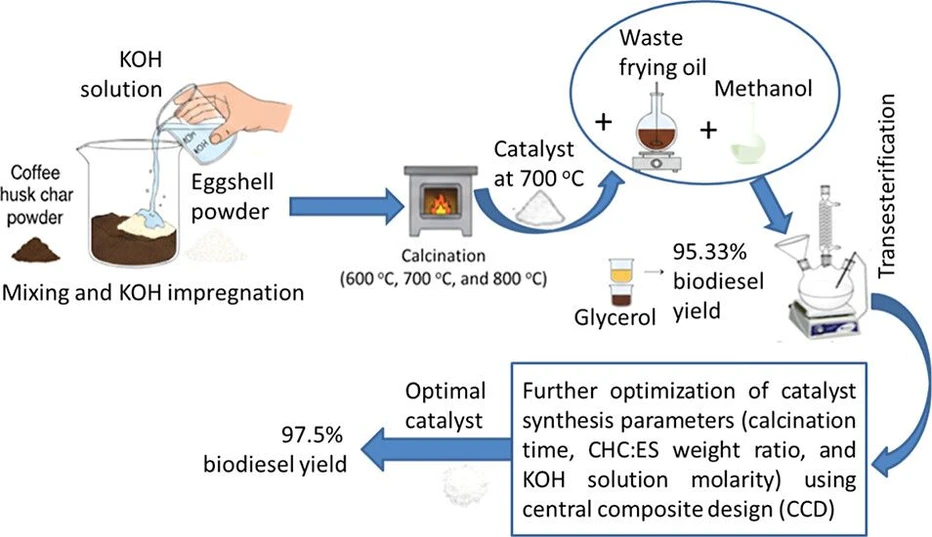
ACS Omega 2025, 10, 51, 63501–63514: Graphical abstract
This study reports the development of a sustainable heterogeneous catalyst derived from a composite of potassium hydroxide, eggshell powder, and coffee husk char for biodiesel production from waste frying oil. Calcination at 700 °C enabled the formation of active CaO and K₂O phases while significantly lowering the temperature typically required for eggshell-based catalysts.
The optimized catalyst achieved biodiesel yields up to 97.5% after process optimization. Although catalytic activity gradually decreased over multiple reuse cycles, the approach demonstrates a promising strategy for converting agricultural and food waste into valuable biofuels while reducing production costs and environmental impact.
The original article
KOH-Promoted Catalyst Derived from Coffee Husk and Eggshell Composite for Biodiesel Production from Waste Frying Oil
Seid Mohammed Seid, Girma Gonfa, Sintayehu Mekuria Hailegiorgis, and Demelash Tilahun Bekele*
ACS Omega 2025, 10, 51, 63501–63514
https://doi.org/10.1021/acsomega.5c10478
licensed under CC-BY 4.0
Selected sections from the article follow. Formats and hyperlinks were adapted from the original.
Energy has always been and remains fundamental to human history, driving economic advancement and representing national strength in the modern era. (1) Therefore, ensuring energy access and promoting sustainable energy are key priorities in alignment with the United Nations’ Sustainable Development Goals. (2) Achieving this goal requires replacing petroleum fuels with renewable and eco-friendly alternatives like biodiesel. (3) Biodiesel is a mixture of fatty acid monoalkyl esters with varying carbon chain lengths and degrees of unsaturation. (4) Its benefits include low sulfur, a high flashpoint, efficient combustion, and biodegradability. (5) Biodiesel can be produced from domestic feedstock and mitigates greenhouse gas emissions. (6) Despite its disadvantages, such as a lower energy density than fossil fuels and the emission of nitrogen oxides during combustion, (7) the main obstacle to biodiesel’s large-scale use is its higher production cost compared to fossil diesel. (8)
The economic viability of biodiesel production is significantly impacted by feedstock costs, which currently account for over 70% of the total expenditure. (9) While transesterification remains the prevalent method for converting these feedstocks, (4) the dominant industrial practice (exceeding 95%) relies on edible oils such as soybean, rapeseed, sunflower, and palm. (10) However, the utilization of these resources raises concerns regarding food security and economic feasibility, rendering this approach increasingly unsustainable. Consequently, contemporary research efforts are predominantly directed toward exploring nonedible alternatives, including nonedible vegetable oils, animal fats, and algal oils, (11) with waste frying oil (WFO) presenting a particularly advantageous option due to its low cost and status as a waste stream, thereby mitigating both feedstock expenses and environmental disposal issues. (12)
While addressing the challenge of feedstock is a major step, the transformation of these nonedible oils into biodiesel faces another significant obstacle, namely the need for efficient and cost-effective catalysts. (4) A variety of catalysts were investigated for the synthesis of biodiesel, including alkali, acid, bifunctional, and enzyme catalysts. (13) The catalysts may be generally classified as homogeneous and heterogeneous catalysts. (14) The employment of homogeneous catalysts in biodiesel manufacture elevates costs due to the need for extensive product purification to meet quality standards. Furthermore, these catalysts are corrosive to reactors and cannot be recovered for reuse. (15) While researchers have also explored enzymes for biodiesel synthesis due to their efficiency and nonpolluting nature, enzymatic catalysts have been found to be inhibited by alcohol, costly, and require extended transesterification times for maximum conversion. (16) Consequently, current research increasingly focuses on heterogeneous catalysts, as they offer the advantages of high reusability and simple separation from the final reaction mixture. (17) These properties of heterogeneous catalysts contribute to lowering biodiesel production costs.
Despite the advantages of reusability and easy separation offered by heterogeneous catalysts, issues such as high cost, low stability, low activity, small pore size, and limited surface area still persist. (17) Therefore, much of the current research on heterogeneous catalyst synthesis for biodiesel production aims to address one or more of these limitations, with solutions including the selection of suitable catalyst precursors. (18,19) These precursors can include biomasses, chemicals, or a combination thereof. (4,20) While chemical precursors can yield highly active catalysts, their synthesis processes are often costly and environmentally hostile. (21) Consequently, the utilization of biomasses has become a prevalent approach in numerous catalyst synthesis investigations, (22) encompassing lignocellulosic biomasses (LBs), animal bones, teeth, and shales, and eggshells. (4) Due to their renewable origin and ability to reduce net CO2 emissions in catalyst synthesis, LBs are becoming more popular as precursors. (23) Furthermore, utilizing LBs can also reduce the overall cost of the resulting catalyst. (21)
Given the significantly higher reaction rates they exhibit compared to acidic and bifunctional catalysts, alkali catalysts have garnered considerable attention for transesterification reactions. (24) Researchers have successfully developed highly active alkali catalysts from various LB sources, including the ashes of passion fruit peel, (25) palm bunch, (26) Musa paradisiaca plant parts, (27) walnut shell, (21) orange peel, (28) and acai seed. (29) These ash catalysts, often rich in compounds like K2CO3, K2Ca(CO3), CaCO3, and KCl, can be obtained through LB calcination processes. (30) A crucial factor in this process is that the decomposition temperature of these compounds in a mixture differs from their individual values. For example, CaCO3 decomposes at a lower temperature when mixed with K2CO3, (31) and the decomposition temperature of K2CO3 into K2O is also lowered in the presence of carbon (a product of LB decomposition). (32). By leveraging this phenomenon, highly active metal oxide-containing catalysts can be produced more efficiently and economically. (33)
Although LB ashes are appropriate for this purpose due to their mixed compound content, their low ash (catalyst) yield compared to CaCO3 rich biomasses like eggshells presents a challenge. (34,35) For example, the ash content of pineapple leaves was 6 and 2.6% for cupuacu seeds. (36) This is very small compared to the ash content (45.29%) of biomasses such as eggshells. (41) Thus, blending alkali-rich (primarily K) LB ash with CaCO3-rich biomasses ash presents a promising route to enhance catalyst yield. Achieving active CaO from bare eggshells requires high calcination temperatures (800–1000 °C), but a blending approach can produce active mixed oxides at more moderate temperatures. (31,37,38) This is a notable advantage, as mixed oxides often demonstrate enhanced catalytic performance compared to single-oxide catalysts. (39) Additionally, a synergy between Ca and K has been reported to enhance feedstock transesterification. (40) The activity of ash catalysts derived from this blended biomass can also be further enhanced through chemical modification. (41) Ultimately, by combining the complementary properties of K-rich LB and eggshell biomasses with chemical modification, we can potentially develop highly efficient and sustainable catalysts for biodiesel manufacturing.
The abundance of coffee husk in Ethiopia, along with the high concentration of K compounds in its ash, presents a promising opportunity for developing an alkali catalyst. (41) This research specifically focused on developing a novel, highly active heterogeneous alkali catalyst by creating a composite from coffee husk and eggshell, and then promoting it with KOH. The primary aim was to assess the overall effectiveness of this novel catalyst as a sustainable solution for producing biodiesel from readily available WFO.
Materials and Methods
Catalyst Materials and Catalysts Characterization
To guide the selection of CCMC calcination temperatures, thermal analysis (thermogravimetric analysis (TGA) and differential thermal analysis (DTA)) was carried out with a Shimadzu DTG 60H (Japan). This analysis was conducted under a limited air environment (50 mL/min), with the temperature ramped at 10 °C/min from 25 to 1000 °C. The crystalline phases within the catalysts were identified via X-ray diffraction (XRD) using a Shimadzu XRD-7000 (Japan) instrument. The analysis was conducted with Cu Kα radiation (λ = 0.15406 nm) at 30 mA and 40 kV. Diffraction patterns were recorded within a 2θ value of 10° to 80° with a scan speed of 3°/min and a step size of 0.02°. Crystalline phases were identified by comparing observed peak 2θ values with literature data. The specific surface area of the catalysts was determined via the Brunauer–Emmet–Teller (BET) method using a surface area analyzer (Horiba Instruments, Inc. SA-9600 series, USA). Prior to the surface area examination, catalyst samples were dried at 110 °C overnight after being ground with a mortar and pestle. Furthermore, degassing of the catalysts was made at 150 °C for 3 h using the analyzer’s degassing procedure. Measurements for nitrogen adsorption isotherms were performed at a temperature of 77 K. Using data points at relative pressures of 0.1, 0.2, and 0.3 from the linear portion of the isotherm, the BET surface area was calculated. (41) Using a scanning electron microscope (SEM) (JCM-6000Plus, German) with an accelerating voltage of 20 kV, the surface morphology of the catalysts was visualized. A Fourier transform infrared spectrometer (FTIR) (Thermo Scientific Nicolet, IiS50 ABX smartiTX) was used to identify functional groups within the catalysts and intermediate products. The instrument, which featured an attenuated total reflectance (ATR) diamond crystal and a DTGS KBr detector, collected spectra from 400 to 4000 cm–1 at a resolution of 2 cm–1 and with 32 scans. In line with the procedure described by Al-Hamamre et al., (43) the catalysts total basicity of the was measured via the Hammett indicator method with phenolphthalein. A suspension of 0.15 g of catalyst in 2 mL of a 0.1 mg/mL phenolphthalein/toluene solution was prepared and stirred for 30 min. The resulting mixture was then titrated using a 0.01 M solution of benzoic acid in toluene until the color turned from pink to colorless, indicating the end point.
Results and Discussion
Qualitative Analysis of the Biodiesel Using FTIR
Figure 8 presents the FTIR spectra of WFO and WFO biodiesel (BD) produced using the C-Optimal catalyst assisted transesterifiction. The presence of strong characteristic peaks observed within the 2922–2853 cm–1 range are attributed to the C–H stretching of the methyl group. The BD showed a CH3 asymmetric bending peak at 1433 cm–1, indicating the presence of (CO)–O–CH3. Additionally, a peak between 1180 and 1220 cm–1 was observed, attributed to −O–CH3 stretching within the biodiesel’s structure. Notably, both of these peaks were absent in the WFO FTIR spectrum, highlighting their formation during the transesterification process. The presence of −C–O ester groups is further supported by a peak at 1169 cm–1. The peak at 721 cm–1 for both spectra corresponds to the rocking of the CH2 group. These findings are consistent with previous studies on biodiesel production from waste cooking oil (WFO) using KNO3-loaded CH ash catalyst (41) and from Argemone seed oil using CaO catalysts. (63)
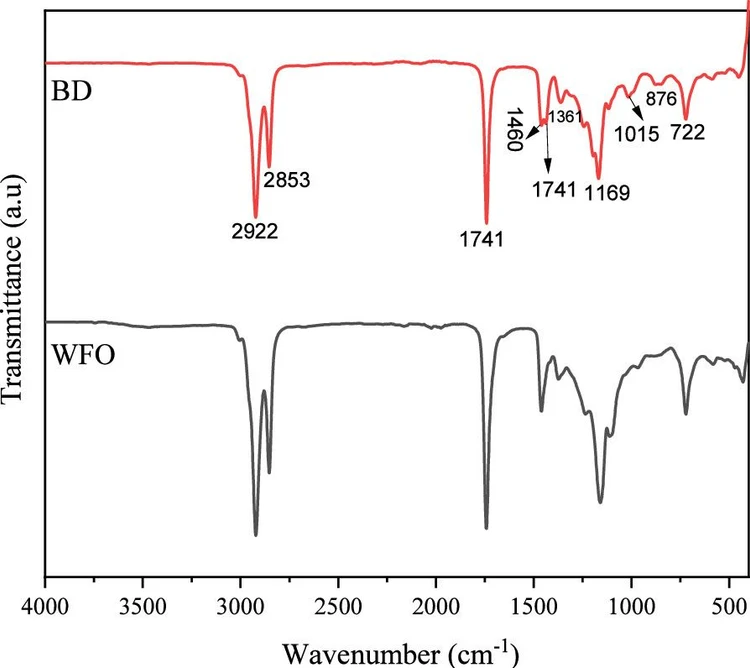 ACS Omega 2025, 10, 51, 63501–63514: Figure 8. FTIR of biodiesel and the WFO.
Biodiesel Analysis Using GC-MS
The GC–MS analysis performed on the biodiesel sample provided a detailed relative composition of its 14 identified fatty acid methyl ester (FAME) constituents (Table 7 and Figure 9). This was achieved through the normalization of chromatographic peak areas, where the area of each identified FAME peak was calculated as a percentage of the total area of all detected FAME peaks. It is crucial to highlight that, due to the methodological limitations of the GC–MS system (specifically the oven’s maximum programmed temperature of 240 °C and the MS scan range limited to 550 m/z), this analysis does not include unconverted components such as triglycerides, diglycerides, and the full spectrum of monoglycerides. Consequently, the calculated total FAME content of 100.0% represents the sum of the identified FAMEs relative only to each other, and not the overall purity of the biodiesel in terms of residual acylglycerols or other impurities.
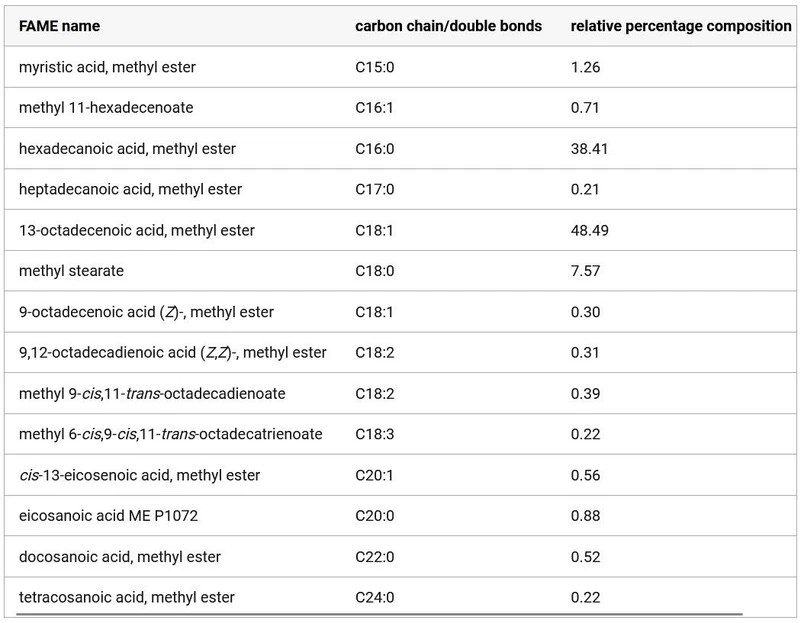 ACS Omega 2025, 10, 51, 63501–63514: Table 7. Fatty Acid Methyl Ester (FAME) Composition of the Biodiesel Sample
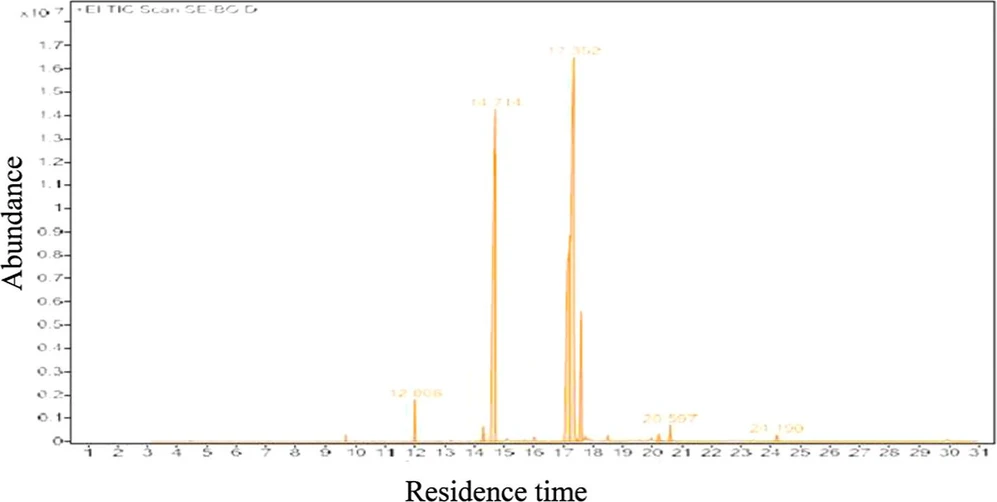 ACS Omega 2025, 10, 51, 63501–63514: Figure 9. GC–MS chromatograph of WFO biodiesel.
Focusing on the main components, the biodiesel sample is primarily characterized by 13-Octadecenoic acid, methyl ester (C18:1 isomers), comprising 48.49% of the total FAMEs, and Hexadecanoic acid, methyl ester (C16:0), at 38.41%. Methyl stearate (C18:0) further contributes 7.57% to this composition. This dominant profile, rich in both monounsaturated and saturated FAMEs, suggests a beneficial balance of fuel properties. The high proportion of C18:1 typically aids in achieving desirable cold flow characteristics, while the substantial presence of C16:0 and C18:0 enhances the biodiesel’s oxidative stability, which is vital for fuel storage and long-term performance. The minor presence of polyunsaturated FAMEs (e.g., C18:2 isomers at combined approximately 0.70% and C18:3 at 0.22%) further contributes positively to the oxidative stability profile.
Conclusions
This study successfully developed and characterized a highly active heterogeneous alkali catalyst derived from KOH-promoted coffee husk and eggshell composites for biodiesel production from waste frying oil. The comprehensive characterization elucidated the optimal catalyst synthesis conditions. It was found that a calcination temperature of 700 °C effectively promotes the formation of key active phases like CaO and K2O, while also enhancing the catalyst’s basicity, which is crucial for catalytic activity. The research achieved an optimum biodiesel yield of 97.5 ± 0.52%. However, the catalyst’s reusability was significantly limited, with biodiesel yield dropping from 71 to 52% by the second round. This necessitates further research into more robust catalyst designs or efficient regeneration for practical application. The research underscores the synergistic effect of K and Ca components from the coffee husk and eggshell, further boosted by KOH promotion, offering a promising solution for converting low-cost waste frying oil into biodiesel through a single-step transesterification process.