News from LabRulezICPMS Library - Week 20, 2026
LabRulez: News from LabRulezICPMS Library - Week 20, 2026
Our Library never stops expanding. What are the most recent contributions to LabRulezICPMS Library in the week of 11th May 2026? Check out new documents from the field of spectroscopy/spectrometry and related techniques!
👉 SEARCH THE LARGEST REPOSITORY OF DOCUMENTS ABOUT SPECTROSCOPY/SPECTROMETRY RELATED TECHNIQUES
👉 Need info about different analytical techniques? Peek into LabRulezLCMS or LabRulezGCMS libraries.
This week we bring you presentation by MDCW / Mount Royal University, application by Shimadzu, and brochure by Thermo Fisher Scientific!
1. MDCW / Mount Royal University: An Analysis of Fresh and Used Aircraft Oil: An Indication of Exposure Pathway Possibility to Inorganic and Organic Pollutants
- Presentation
- Full PDF for download
Aircraft engine oils are highly complex mixtures formulated to meet strict MIL-SPEC requirements for piston, turboprop, and jet engines, often containing proprietary additive packages designed to improve thermal stability, reduce wear, and prevent corrosion. In this presentation at the 17th Multidimensional Chromatography Workshop, Kevin Hayes investigated how aircraft oils change during engine operation and whether these changes could contribute to occupational exposure risks for flight crews and maintenance personnel. The study focused on comparing fresh and used oils from piston, turboprop, and jet aircraft to better understand how inorganic and organic contaminants accumulate or are depleted during normal engine operation.
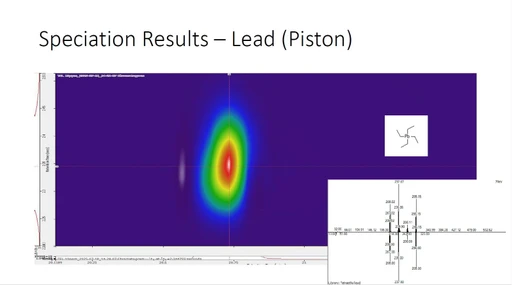
The research combined routine multi-element analysis using ICP-OES with advanced GC×GC-TOFMS speciation analysis. Used piston and turboprop oils were collected with assistance from the MRU Aviation Program, while used jet oil samples were obtained from a private European jet operator. Elemental analysis showed significant differences between new and used oils. In piston engine oils, sulfur and lead concentrations increased substantially during use, with lead accumulation linked to tetraethyl lead (TEL) from 100LL aviation fuel. Phosphorus compounds were also detected in used oils despite not being present in the fresh oil samples, indicating additional contributions from operational processes or additives.
For jet and turboprop oils, phosphorus-containing additives behaved differently. Fresh oils contained relatively high phosphorus concentrations, but these levels decreased significantly after engine operation, suggesting additive depletion or release of phosphorus-containing compounds during use. The authors highlighted that this may be particularly relevant for bleed-air systems in commercial aircraft, where oil-derived compounds could potentially enter cabin air. GC×GC-TOFMS analysis further identified several organophosphate compounds in piston engine oils. Interestingly, commonly discussed compounds such as tricresyl phosphate (TCP) were not detected, while other organophosphates were observed instead, demonstrating the importance of comprehensive speciation analysis rather than focusing solely on previously suspected contaminants.
The presentation concluded that aircraft engine oils undergo substantial chemical changes during normal operation, with both inorganic and organic compounds accumulating or being depleted in ways that are not captured by analyses of unused oils alone. While elemental analysis provided valuable first-level insight into wear metals and additive behavior, GC×GC-TOFMS delivered critical molecular-level information about specific contaminant classes and transformation products. Together, the results suggest that current hazard assessments based only on fresh oils may underestimate potential occupational exposure risks and demonstrate the value of combining elemental analysis with advanced multidimensional chromatography for a more complete understanding of aircraft oil-related exposure pathways.
2. Shimadzu: Measurement of TOC in Chloroisocyanuric Acid Used as Disinfectant
- Application note
- Full PDF for download
User Benefits
- Samples such as chloroisocyanuric acid, which are difficult to detect using a wet oxidation TOC analyzer, can be measured with high sensitivity using the combustion oxidation TOC-L, which has a strong oxidizing power.
- One sample can be measured quickly, typically within 10-20 minutes.
In facilities where people have direct contact with water, such as swimming pools, hot springs, and bathhouses, strict water quality management is essential to protect public health and safety. Total organic carbon (TOC) measurement is widely used to detect water quality degradation caused by microbial growth and contamination with foreign substances.
Solid powder chloroisocyanuric acids (including dichloroisocyanuric acid and trichloroisocyanuric acid), which exhibit minimal chlorine deactivation, are commonly used as disinfectants for swimming pool water instead of sodium hypochlorite solutions. However, because chlorinated isocyanuric acid is a recalcitrant substance, it is challenging to detect using wet oxidation TOC analyzers due to itsresistance to oxidation and decomposition. In contrast, a combustion oxidation TOC analyzer can measure chloroisocyanuric acids with high sensitivity and recovery rates due to itsstrong oxidizing power. In this application, we compared the TOC measurement results for sodium dichloroisocyanurate using a combustion oxidation TOC-LCPH analyzer and a wet oxidation TOC-VWP analyzer.
Conclusion
The combustion oxidation TOC analyzer demonstrated high accuracy in measuring the samples. Due to its strong oxidizing power, the combustion oxidation TOC analyzer is particularly suitable for measuring TOC in samples containing recalcitrant substances such as sodium dichloroisocyanurate.
3. Thermo Fisher Scientific: Exploring the surface in depth with XPS analysis
- Brochure
- Full PDF for download
The need for surface and interface analysis
In today’s rapidly evolving technological landscape, precise material analysis is crucial for the development and optimization of advanced materials and devices. X-ray photoelectron spectroscopy (XPS) is an established technique for the characterization of material surface chemistry, capable of revealing compositional information several nanometers into a sample. Depth profiling is a method that extends the analysis range of XPS; by alternating material removal and XPS analysis, it can reveal how composition changes from the surface to the bulk, or across interfaces between different compounds in a sample. This information can be just as critical as how a material’s surface interacts with its environment, and can provide a more complete picture of the material’s behavior and properties.
The Thermo Scientific™ Hypulse™ Surface Analysis System is a fully featured XPS instrument with a range of additional analytical capabilities, including reflected electron energy loss spectroscopy (REELS) and low-energy ion scattering spectroscopy (ISS). The system is equipped with a Thermo Scientific MAGCIS Dual-Mode Ion Source and a novel femtosecond laser-ablation system (fs-LA) for XPS depth profiling.
This eBook explores XPS depth profiling in detail and shows how the Hypulse System is ideally suited for this technique, helping you uncover critical surface and sub-surface information.