Sustainable Pyrotechnics: Combustion Behavior of B4C/Bi2O3 for Delay Compositions
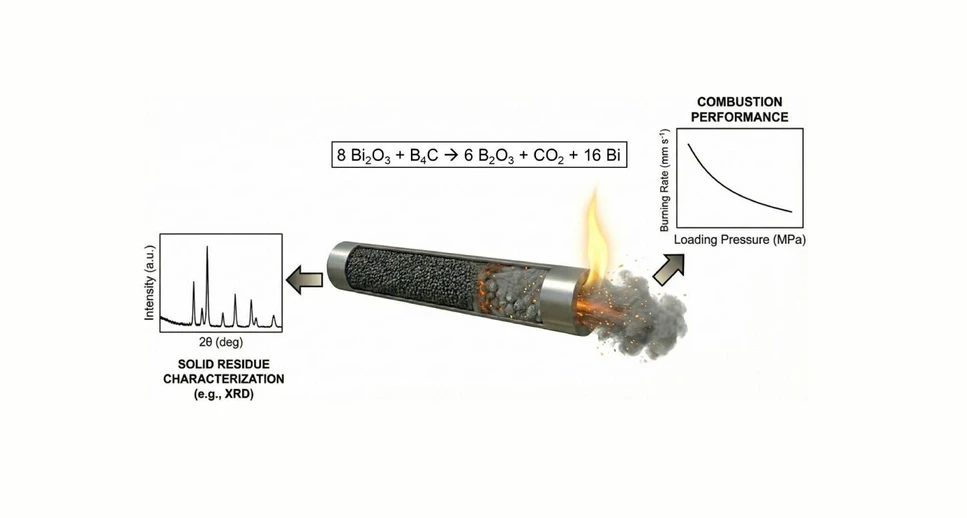
ACS Omega 2026, 11, 3, 4668–4683: Graphical abstract
This study examines the combustion behavior of B4C/Bi2O3 pyrotechnic delay compositions as sustainable alternatives to conventional materials. Thermodynamic modeling and experimental testing were used to evaluate the influence of compaction pressure, particle size, and granule size on burning performance.
Results showed that increased compaction reduced burning rates by lowering porosity and shifting combustion from convective to conductive mechanisms. Residue and gas analyses supported a multistage reaction pathway, demonstrating the potential of B4C/Bi2O3 formulations for environmentally improved pyrotechnic applications.
The original article
Sustainable Pyrotechnics: Combustion Behavior of B4C/Bi2O3 for Delay Compositions
Danillo F. Vianna Cantini, Vojtěch Pelikán*, Eva Schmidová, Jiří Pachman
ACS Omega 2026, 11, 3, 4668–4683
https://doi.org/10.1021/acsomega.5c10964
licensed under CC-BY 4.0
Selected sections from the article follow. Formats and hyperlinks were adapted from the original.
Pyrotechnic delay compositions are formulations designed to create a specific delay time, determined primarily by their burning rate. These compositions are essential in timing energetic events and are used extensively in both civilian and military applications. (1) This broad usage leads to diverse motivations for studying such materials. In civilian contexts, such as mining, the focus is typically on safety and cost-effectiveness. (2) For military purposes, reliability and precision are key factors, often with stringent performance requirements. (3)
Pyrotechnic delay compositions are classified based on their combustion behavior into gassy or gasless types. In confined, sealed and obturated environments, gasless compositions are favored, to avoid gas buildup. (1,4) However, in unconfined or vented systems, gassy compositions are not problematic. For example, in fireworks, where combustion gases freely dissipate, (1) or in vented housings like hand grenades or signaling devices, gassy delays are acceptable. (5,6)
In gassy compositions, the burning rate is influenced by the loading (or consolidation) pressure. Hot gases generated by the chemical reaction penetrate gas channels (voids) in the material, igniting unreacted material through a process known as convective heating. As loading pressure increases, these voids are gradually reduced, which diminishes convection and subsequently lowers the burning rate. In contrast, for gasless compositions, burning is driven by conductive heating, where heat is transferred through direct particle-to-particle contact, leading to the opposite effect. (7−9)
Historically, up until World War II, black powder served as the foundation for most delay elements. Nowadays, it continues to be utilized for this function and others, but on smaller scales. (1) Some more recent and traditional formulations for pyrotechnic compositions include fuels like silicon, boron, tungsten, zinc, iron, zirconium, and manganese. Examples of these are Si/Pb3O4, (8,10) B/BaCrO4 (8), W/BaCrO4/KClO4, (5,6,11) Zn/PbO2, (12) Fe/BaO2, (13) Zr/KClO4, (8) and Mn/PbCrO4/BaCrO4. (14)
Currently, researchers are actively developing several new formulations for pyrotechnic delays. One of the main motivations for this is the need to transform these compositions into “greener” ones. (1,2) This means that compositions that could cause problems for the environment or human health should be avoided. To achieve this sustainability, the identification and replacement of known or potentially harmful, toxic, and carcinogenic compounds is vital. (10) Heavy metals, persistent organic pollutants, toxic gases, volatile organic compounds and known causers of human health problems are examples of such substances to be removed. (2,5,15)
Specifically, there are several attempts to replace lead, barium, chromates, and perchlorates. (15) The reason is that most of the established delay formulations used today contain these substances. (2,5) Lead, barium and chromium (contained in chromates) are heavy metals and are known to cause serious health problems in human, specially to nervous, cardiovascular and respiratory systems. (5,16) Perchlorates are well-documented substances and are used in various pyrotechnic applications. However, they are widely recognized as contributors to thyroid issues. (5)
From the above, it is clear that modern strategies in pyrotechnics are increasingly focused on developing new materials that prioritize both efficiency and sustainability. This shift imposes numerous restrictions, meaning that formulations must be designed with precise planning and thorough investigation to meet both performance and environmental standards.
Boron could be considered the ideal fuel for pyrotechnic reactions due to its high energy content. However, it presents combustion issues for its limited reactivity due to boron oxide layer and boron agglomerates formation upon heating. (17) The boron oxide layer acts as a barrier, hindering oxygen (O) diffusion and consequently limiting the oxidation of boron. (18)
Boron carbide (B4C) is a natural candidate for combustion processes due to its lower ignition point, which is attributed to its higher reactivity. This reactivity stems from the diffusion of carbon (C) particles, which oxidize into gaseous products. These gaseous products create diffusion channels that penetrate the boron oxide layer, breaking down the layer and agglomerates, thereby further improving the reaction. (18,19) B4C presents better combustion properties, with better burning stability and reliable self-propagation, resulting in better combustion efficiency. (17)
Bismuth trioxide (Bi2O3) is an attractive oxidizer for pyrotechnic delay compositions due to several advantageous properties. Its high oxygen content and efficient oxygen release facilitate sustained combustion, while its favorable thermal properties, including a relatively low melting and decomposition temperature, ensure that oxygen is available at precisely the right moment to support a controlled reaction. (20) Additionally, Bi2O3 high density allows for compact formulations, promoting consistent and reliable burn rates. Also, it has a low heat of formation (approximately −582 kJ/mol), which is crucial to minimize the energy required to initiate its decomposition. This enhances the overall reaction efficiency, allowing Bi2O3 to rapidly release oxygen without consuming excessive energy, thus ensuring sustainable and stable combustion. (8)
In addition to their technical advantages, Bi2O3 and B4C offer a significant environmental benefit: they are considered more eco-friendly compared to other materials commonly used in pyrotechnic compositions. Bi2O3 serves as a less toxic alternative to traditional oxidizers like lead-based compounds, reducing the risk of environmental contamination and exposure to harmful heavy metals. (1,8,16) Similarly, B4C contributes to cleaner combustion, producing fewer pollutants and minimizing the environmental impact. (5) This makes both materials not only effective but also greener choices for sustainable pyrotechnic applications.
2. Experimental Section
2.8. Material Characterization
Particle and granule size distribution were measured with a Malvern Mastersizer 3000 (Malvern Panalytical). Scanning Electron Microscopy (SEM) was carried out with a TESCAN MIRA (TESCAN) to examine morphology and confirm particle size. A 40 cm3 combustion chamber was used to analyze pressure profile, quantify solid residues, and collect combustion gases for further analysis. Fourier Transform Infrared Spectroscopy (FTIR) was performed using a Nicolet iS50 FT-IR (Thermo Scientific) and standardized nitrogen (N2) background to identify gas-phase products. Thermal stability and water content assessments were conducted using TGA (NETZSCH TG 209 F3 Tarsus) and DSC (NETZSCH DSC 200 F3 Maia). Energy Dispersive X-ray Spectroscopy (EDS) was performed using a Bruker Quantax 200 (Bruker) for semiquantitative chemical composition analysis of the combustion residues. X-ray diffraction (XRD) analyses were performed using a Rigaku MiniFlex diffractometer for complementary phase identification, while surface chemical states were characterized by X-ray photoelectron spectroscopy (XPS) using a Scienta Omicron ESCA2SR system.
3. Results and Discussion
3.7. FTIR Analysis of Combustion Gases
Figure 10 compares the FTIR spectra of combustion chamber gases from stoichiometric (blue) and fuel-rich (red) tests, highlighting CO and CO2 as the main species, consistent with Horiuchi. (18) Normalizing their absorbance to concentration using standard references yielded CO2/CO ratios of 0.67 (stoichiometric) and 0.34 (fuel-rich). However, a quantitative analysis is approximate and inherently imprecise, as potential contamination during gas collection and measurement could affect the results, given the challenge of maintaining a completely controlled internal atmosphere. A small fraction of hydrocarbon species (e.g., CH4, C2H4, and C2H2) was also identified in both samples.
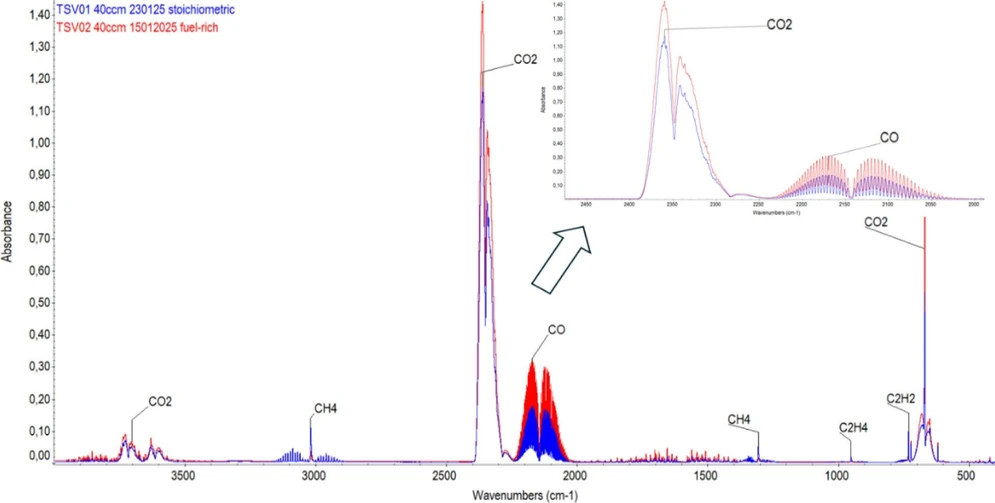 ACS Omega 2026, 11, 3, 4668–4683: Figure 10. Comparative FTIR spectra of combustion gas compositions in a combustion chamber.
While experimental results indicate a higher CO2 presence than predicted, the overall trend aligns with expectations─higher fuel content shifts combustion products toward less oxidized species. Notably, the identified gaseous products are relatively simple and exhibit low toxicity compared to halogenated or metal-containing species commonly found in traditional pyrotechnic formulations, supporting the potential of this system as a more environmentally friendly alternative.
Since the reaction involves both condensed-phase reactants and products, characterizing the solid residues is essential to evaluate the extent of reaction and gain insight into the actual progression of the reaction pathway. For this, SEM imaging and EDS analysis were employed to investigate the morphology and elemental composition of the combustion residues.
3.8. SEM and EDS of Burning Residues
Figure 11 presents the SEM analysis of solid residues from the combustion of B4. Figure S5 exhibits images of the other samples. Figure 11a shows the top view of the burned delay element, revealing the distribution of residues across the surface, while Figure 11b provides a magnified view of a region rich in bright spherical structures. These spheres are likely bismuth that transitioned through a liquid or gaseous phase during the reaction and solidified upon cooling. This phenomenon of spherical formation due to phase transition is well-documented in the literature. (33)
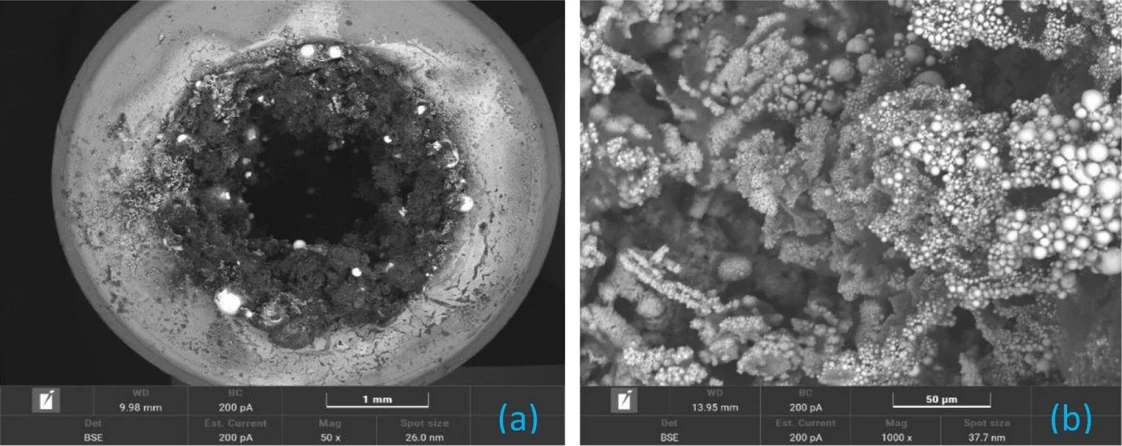 ACS Omega 2026, 11, 3, 4668–4683: Figure 11. SEM analysis of B4 after burning: (a) top view (50 ×) of the burned delay element showing the distribution of solid residues across the surface; (b) magnified view (1 k×) of a region rich in bright spherical structures.
3.10. Surface Chemistry of Combustion Residues (XPS)
Survey spectrum scans identified the main photoelectron lines corresponding to carbon, oxygen, boron, and bismuth. High-resolution scans for the O 1s, C 1s, B 1s, and Bi 4f regions of B4 are presented in Figure 19, allowing detailed peak deconvolution and chemical assignment.
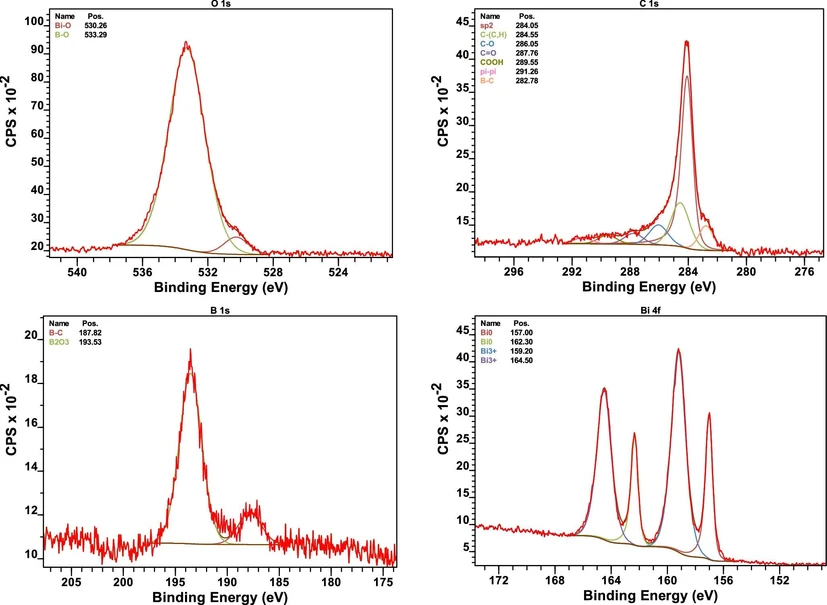 ACS Omega 2026, 11, 3, 4668–4683: Figure 19. XPS high-resolution spectra of O 1s, C 1s, B 1s, and Bi 4f regions for B4.
The analysis confirmed B2O3 as a major surface product and indicated the presence of unreacted B4C in the B4 sample through B–C bonds. sp2 carbon was also detected in B4, suggesting possible graphite formation, as predicted in thermodynamic calculations. A2 showed more Bi3+ than B4, supporting that the stoichiometric composition had more residual Bi2O3, while the fuel-rich B4 sample promoted greater reduction to Bi0. The presence of Bi3+ on the surface observed may result from postcombustion reoxidation of Bi0. These results reinforce the proposed reaction pathway and the role of fuel excess in enhancing reaction completeness. In this analysis, the B 1s spectrum further confirms the absence of BN by the lack of B–N peaks, consistent with the EDS results, which also revealed no detectable nitrogen signal.
All experimental findings contribute to the fundamental understanding of boron carbide and bismuth oxide reactions under both basic and applied conditions, particularly in delay compositions. These results provide new insights into the reaction pathway and the underlying combustion mechanism.
4. Conclusions
Stoichiometric formulations of B4C/Bi2O3, which ignited when not pressed, failed to burn after being lightly compacted; a fuel-rich composition is necessary to ensure combustion. The fuel-rich compositions ignited readily and maintained combustion without quenching. Water facilitated the granulation process and improved the final composition. With increasing loading pressure, burning rates decrease due to reduced convective heat transfer, leading the combustion process to transition toward a conductive regime. Particle size also impacted combustion, particularly with larger Bi2O3 particles, which influenced the combustion profile up to a certain threshold. Additionally, the granule size of the final composition was found to alter the burning behavior, with larger granules promoting faster combustion at lower pressures.
Thermodynamic calculations provided an initial insight into the reaction process. The findings show that the reaction progresses through distinct stages: starting in a solid–solid preignition phase, transitioning to a solid–liquid phase as components melt, and culminating in a gas phase marked by significant product volatilization, illustrating a complete combustion evolution.
FTIR analysis confirmed that the main gaseous products are CO and CO2, indicating reduced environmental toxicity. Elemental and phase analyses confirmed that the reaction followed the expected pathway, with Bi and B2O3 as the predominant products. No Bi2O3 was detected by XRD, indicating that the oxidizer was fully consumed in the bulk. Morphological analysis of the products suggests that, upon cooling, bismuth solidifies into small metallic spheres, while surface analysis indicates that B2O3 remains predominantly in the outer layer. Altogether, the results are consistent and complementary, reinforcing the reliability and scientific rigor of the study.
All these observations accentuate the necessity of conducting experiments under application-specific conditions. These findings not only enhance our understanding of the combustion dynamics of low toxicity B4C/Bi2O3 mixtures but also underscore their potential for practical applications requiring precise delay times and environmental sustainability. The successful use of water as a green solvent further highlights the viability of developing sustainable pyrotechnic compositions. This research advances the field by providing valuable insights into optimizing performance while minimizing environmental impact through careful material selection and process control.