News from LabRulezICPMS Library - Week 17, 2026
LabRulez: News from LabRulezICPMS Library - Week 17, 2026
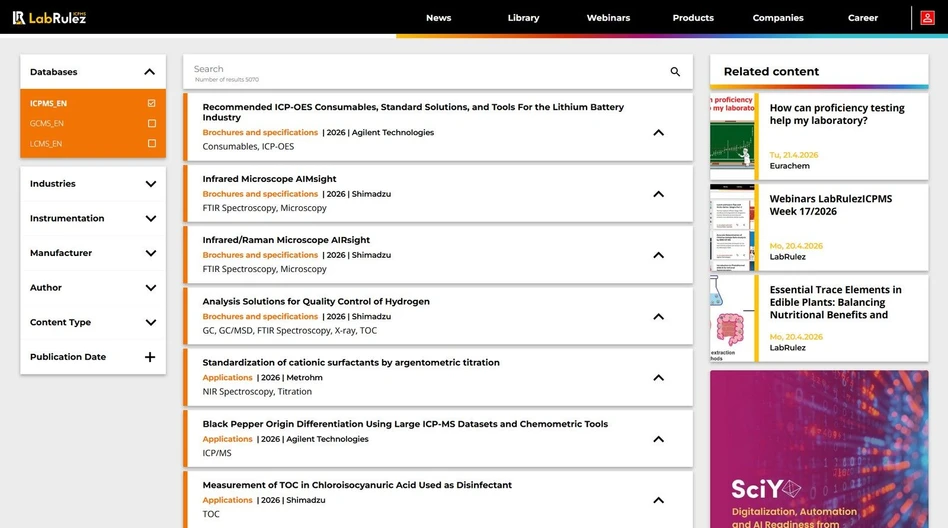
Our Library never stops expanding. What are the most recent contributions to LabRulezICPMS Library in the week of 20th April 2026? Check out new documents from the field of spectroscopy/spectrometry and related techniques!
👉 SEARCH THE LARGEST REPOSITORY OF DOCUMENTS ABOUT SPECTROSCOPY/SPECTROMETRY RELATED TECHNIQUES
👉 Need info about different analytical techniques? Peek into LabRulezLCMS or LabRulezGCMS libraries.
This week we bring you white paper by Metrohm and application notes by Shimadzu, Thermo Fisher Scientific and Waters Corporation!
1. Metrohm: Why switch to OMNIS Client/Server (C/S)?
- Other document
- Full PDF for download
This White Paper outlines the key benefits of OMNIS, highlighting its scalability, cost-saving potential, and the positive impact it lends to overall business performance. The following sections cover more specific advantages of OMNIS, providing detailed insights into how this innovative solution can transform server management and drive significant cost reductions. Whether you are a small business looking to optimize your IT infrastructure or a large enterprise seeking to enhance operational efficiency, OMNIS offers a robust and scalable solution that can meet your needs.
The cost savings for two different scenarios are calculated in this White Paper: medium- and large-scale organizations. For mid-sized environments involving 20 laboratory locations, the OMNIS Client/Server solution offers significant savings by reducing the number of servers tenfold—from 20 to just 2. For large-scale organizations with 60 laboratory locations worldwide, the solution enables substantial cost reductions by decreasing the number of servers from 60 to 6. These calculations demonstrate the scalability and costeffectiveness of the OMNIS Client/Server solution across various customer environments.
COMPARISON OF TIAMO™ MULTI AND OMNIS CLIENT/SERVER
SCALABILITY
tiamo™ multi Limitations
A dedicated tiamo™ multi server is needed for each laboratory location.
OMNIS C/S Advantages
OMNIS C/S offers exceptional scalability, allowing businesses to easily expand their server infrastructure as needed. This means that as the business grows, OMNIS can seamlessly accommodate increased demand without compromising performance or efficiency. OMNIS is designed to scale up over many locations and countries without any negative impact on performance in a wide area network installation (WAN). By reducing the number of servers required to support operations, OMNIS C/S helps organizations achieve significant cost savings. This includes lower hardware costs, reduced energy consumption, and decreased maintenance expenses, resulting in substantial annual savings.
ANALYSIS METHODS
tiamo™ multi Limitations
tiamo™ was designed as a pure titration measurement software solution.
OMNIS C/S Advantages
OMNIS is designed as a multiple measurement technology platform currently supporting titration, near-infrared (NIR) spectroscopy, and process analytics. The platform will be continuously extended to support even more measurement technologies and devices in the future
CONCLUSION
The OMNIS Client/Server solution offers a transformative approach to managing server infrastructure for laboratory environments through centralization. By leveraging its unique scaling features, OMNIS enables significant cost savings and increased operational efficiency for both medium- and large-scale organizations.
2. Shimadzu: Measurement of Fixed Carbon, Volatile Matter, and Ash of Biocoke
- Application note
- Full PDF for download
User Benefits
- The fixed carbon, volatile matter, and ash of biocoke can be measured by the DTG-60.
- The combustion characteristics of biocoke can also be evaluated by using the DTG-60.
- TG-DTA measurement can simultaneously grasp the endothermic and exothermic behaviors during pyrolysis and combustion, allowing a more comprehensive evaluation.
Biocoke is a type of solid fuel produced using plant-derived organic resources (biomass) as the raw materials. Biocoke enables high-temperature combustion over an extended time period, and has also attracted attention as a zero-emission fuel which does not generate waste in the production process. It is produced by heating biomass under high-temperature and high-pressure conditions. A stable fuel with high compressive strength can be obtained by this process, allowing easy transportation and storage, as well as long-term preservation. As a fuel for industrial furnaces and boilers, biocoke is used as a substitute for conventional fossil fuels. It is also expected to be used as a sustainable energy source because its CO2 emissions are lower than those of fossil fuels. The diversity of the raw materials that can be used to produce biocoke, which include woody materials and agricultural residues, is also another feature.
In this article, the volatile matter, fixed carbon, and ash of biocokes produced from waste wood and buckwheat husks were evaluated using a Shimadzu DTG-60 simultaneous TG/DTA.
Evaluation of Combustion Characteristics by TG-DTA Measurement
TG-DTA measurements of the size-adjusted waste wood biocoke and buckwheat husk biocoke were conducted under an air atmosphere.
- Instrument: DTG-60
- Heating rate: 10 ˚C/min
- Temperature range: 30 ˚C - 700 ˚C
- Sample weight: 8 mg
- Atmosphere: Air
Conclusion
The combustion characteristics and fixed carbon content of waste wood biocoke and buckwheat husk biocoke were evaluated using a DTG-60 simultaneous TG/DTA. TG-DTA measurement is an effective method which can determine the combustion characteristics of biocokes under an air atmosphere and the composition ratio of the volatile matter, fixed carbon, and ash under a nitrogen atmosphere. Moreover, TG-DTA enables a more comprehensive evaluation, as the endothermic and exothermic behaviors during pyrolysis and combustion can be measured simultaneously. Since the properties of various types of biocokes differ depending on the raw material used and the production conditions, TG-DTA measurement is also useful for comparative studies of biocoke quality. In addition, when a mixture of various types of biomass is to be used, it is important to know the carbon content (fixed carbon content) of each raw material.
3. Thermo Fisher Scientific: Classification of polyethylene by Raman spectroscopy
- Application note
- Full PDF for download
Polyethylene (PE) is one of the most common plastics in the world with annual global production of around 80 million tons.1 Based on density, polyethylene is generally classified as high-density polyethylene (HDPE, > 0.940 g/cm3 ) or low-density polyethylene (LDPE, < 0.930 g/cm3 ).2 These different density polyethylene’s have vastly different physical, chemical, and mechanical properties, and hence are used in different applications. For example, HDPE is primarily used for milk jugs, detergent bottles, garbage containers, and water pipes, due to its high tensile strength; LDPE, on the other hand, has a lower tensile strength and is used mainly for plastic bags and wraps. Therefore, density is one the most important properties of polyethylene, and classifying them according to their density is essential for proper PE specification.
Bulk PEs are manufactured as pellets (resins, granules), and later converted to other forms (such as films and pipes) using extrusion or molding processes. They are also made into multilayer films for a wide range of industrial applications like food and consumer product packaging. The density of bulk PE pellets and single-layer PE films can be measured and classified with relative ease using several standard techniques: ISO 1183-1/ASTM D792 (immersion method),3 ISO 1183-2/ASTM D1505 (density gradient method),4 and ASTM D4883 (ultrasound method).5 However, all these techniques require the PE in its “pure” form, which can be challenging in the case of PE in multilayer films. Extensive sample preparations (microtoming, separation of layers by dissolving in solvents) are often required6 to isolate the PE layer before analysis, which can be labor-intensive and time-consuming.
Raman spectroscopy is sensitive to changes in the molecular structure level of PE, such as the degree of crystallinity, which is the key determining factor of PE density.7,8 More importantly, the confocal capability of Raman microscopy allows for facile in situ analysis of individual PE layers in multilayer films without the need to isolate the PE layer. To our best knowledge, PE density measurement using Raman has been limited to PE pellets.7,8 In this work, we want to systematically explore the feasibility of using confocal Raman microscopy for PE film density analysis, both qualitatively and quantitatively. We demonstrate that Raman microscopy in combination with the discriminant analysis method can be successfully applied to distinguish HDPE and LDPE in both pellet and film forms.
Experimental
Method description
A Thermo Scientific™ DXR2 Raman Microscope was used for the collection of Raman data. For each type/class of the pellet samples, Raman spectra were collected from 3 different pellets and averaged. For each film sample, Raman spectra were collected from 3-4 locations across the surface of the sample. An averaged spectrum was then used for final analysis.
A 532 nm laser was used with a 2 mW laser power at the sample. A 10x objective and a 50 μm slit aperture were used to obtain more representative spectra from the samples. Total acquisition time for each spectrum was 30 seconds (3 second exposure x 10 exposures). Thermo Scientific™ OMNIC™ software was used for operation of the DXR2 Raman Microscope, and collection of Raman spectra; Thermo Scientific™ TQ Analyst™ software was used for chemometric analysis of the Raman data.
Conclusion
In this application note, we have successfully demonstrated the use of a Thermo Scientific DXR2 Raman Microscope, in combination with the TQ Analyst software, to classify polyethylene’s of different density classes in both pellet and film forms. Raman spectroscopy is nondestructive and requires minimal sample preparation. The classification method was created solely based on the Raman spectral features of LDPE and HDPE and was indifferent to the sample forms. Once the method is established, PE samples, pellets or films, can be correctly classified within minutes. Moreover, this work expands the scope of the previously reported study on PE pellets to include PE films, which broadens its applicability in the plastic/ polymer industry as well as many downstream industries. The described methodology should be applicable for in situ classification of thin PE layer(s) in multilayer films. The data were collected using an older model instrument DXR2 Raman microscope. Currently, Thermo Fisher Scientific offers an improved model, the DXR3 Raman Microscope, which offers superior speed and performance over its predecessor model.
4. Waters Corporation: Rapidly Distinguish Protein from Non-Protein Particles in Biologic Formulations
- Application note
- Full PDF for download
Current subvisible analysis techniques make accurate particle identification virtually impossible. Light obscuration (LO) is a low refractive index contrast particle counting method which cannot distinguish between different particle types. Flow imaging (FI) techniques provide more information than LO, including particle images, morphological parameters and optical characteristics of particles. However, none of these features definitively identify the type of particle imaged. Flow imagers for example cannot distinguish between plastic, protein, and degraded polysorbate which are all very similar in morphology. Technologies available for detailed chemical composition ID such as Raman microscopy/spectroscopy have been used to fill in the gaps left by particle counters; however, they are tedious, require lots of expertise and extensive signal processing, and have the throughput of a single particle per several minutes of use, making the technique useful only to expert users during failure mode analysis.
In order to fully characterize particulates and aggregates in biopharmaceutical product formulations, further information about the identity of all the particulates is crucial. Regulatory agencies expect drug manufacturers to move away from simple counting techniques and apply multiple and orthogonal methods to complement compendial methods.
In this application note we introduce fluorescence membrane microscopy (FMM). FMM, exclusively available in the Aura™ System, is a high throughput, low volume, subvisible particle identification technology. FMM enables ultra-fast, 100% sampling efficiency, characterizing all particles from a single protein aggregate to tens of millions of particles in an entire multi-sample formulation, in under two hours.
Experimental
Fluorescence membrane microscopy (FMM) is a novel particle identification method that builds on backgrounded membrane imaging (BMI) to identify, categorize, and further scrutinize the most common particles in an entire bioformulation sample by using established extrinsic fluorescent dye chemistries.
BMI, the backbone analysis technology used in the Aura and Horizon® instruments, images a 96-well membrane plate before and after sample filtration, and conducts novel, high optical contrast image analysis to resolve particles from 1 µm to 5 mm in size, with a large >36/mL counts dynamic range. Using fluorescent dyes, biopharmaceutical particles are stained and analyzed with FMM to confirm and quantify their presence. To enable FMM, Aura uses new membrane plates specifically manufactured to support labeled fluorescent workflows.
Conclusion
FMM using ThT allows one to conduct high throughput, low volume and specific protein/non-protein particle analysis. The power of FMM using ThT is the ability to obtain protein/non-protein ID for a whole 96-well plate assay down to a single individual particle in less than 90 minutes. ThT’s high solubility and specificity to protein aggregates makes it possible to differentiate protein aggregates from particles with similar morphology and refractive index like plastics and fatty acids. Compared to spectroscopic techniques, the throughput of FMM is 1000x higher, while using best in class particle sizing and counting analysis that has its roots in the wellestablished membrane microscopy found in USP 788.