News from LabRulezICPMS Library - Week 15, 2026
LabRulez: News from LabRulezICPMS Library - Week 15, 2026
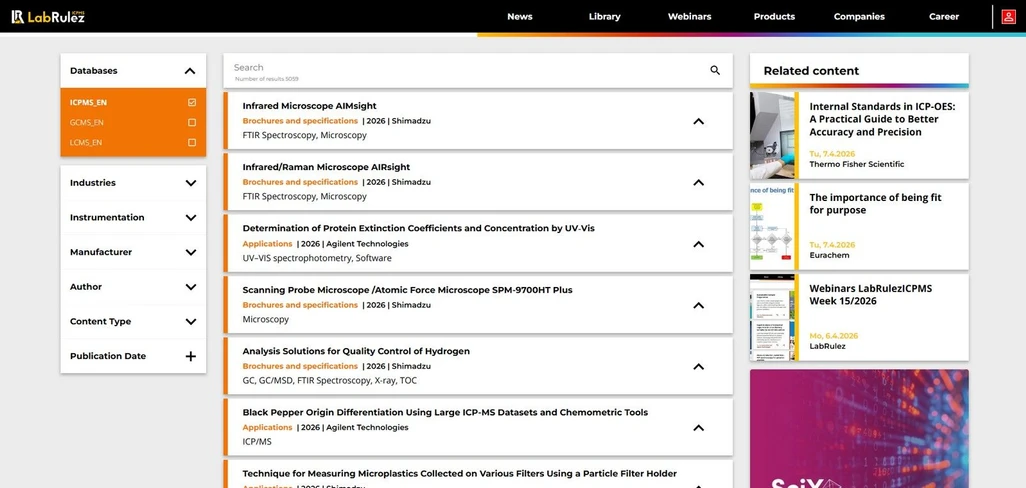
Our Library never stops expanding. What are the most recent contributions to LabRulezICPMS Library in the week of 6th April 2026? Check out new documents from the field of spectroscopy/spectrometry and related techniques!
👉 SEARCH THE LARGEST REPOSITORY OF DOCUMENTS ABOUT SPECTROSCOPY/SPECTROMETRY RELATED TECHNIQUES
👉 Need info about different analytical techniques? Peek into LabRulezLCMS or LabRulezGCMS libraries.
This week we bring you application notes by Metrohm, Shimadzu, Thermo Fisher Scientific and Waters Corporation!
1. Metrohm: Whey permeate analysis with NIRS
Monitor dairy production processes easily in seconds
- Application note
- Full PDF for download
Whey permeate, a byproduct of manufacturing whey protein powder, contains high amounts of lactose, phosphate, and minerals. Because of its sweet and mild taste, whey permeate is often used in bakeries and chocolate manufacturing. The key to optimizing whey permeate production is to control production streams in real time. It is important to monitor the production process with highthroughput analytical techniques to maximize product yield and ensure high product quality.
Nearinfrared spectroscopy (NIRS) is a fast, and chemicalfree analysis technique that can support this kind of testing. NIR spectroscopy can measure the most important quality parameters (i.e., protein, lactose, moisture, ash, pH, and phosphate) simultaneously in whey permeate without any sample preparation. The NIRS solution is fast, easy to operate, and can be used atline or offline in a quality control lab.
EXPERIMENTAL EQUIPMENT
158 whey permeate samples were analyzed on a Metrohm NIR Analyzer equipped with a small cup accessory. All measurements were performed in reflection mode (1000–2250 nm). Metrohm software was used for data acquisition and prediction model development.
CONCLUSION
This Application Note demonstrates the feasibility of using NIR spectroscopy for whey permeate quality control. Near infrared-spectroscopy is a rapid, nondestructive analytical technique that can monitor the production process of dairy products. Aside from the analysis of whey permeate, the whey protein production stream can also be monitored by NIRS.
2. Shimadzu: Measurement of Residual Metal Catalysts by X-ray Fluorescence
- Application note
- Full PDF for download
User Benefits
- ALTRACE can determine levels of heavy metals present in organic compounds at around 1 mg/kg in under 10 minutes per sample.
- Analyzing and managing levels of residual metal catalysts can be performed by simply placing samples in the sample vessel and analyzing them without the need for complex sample pretreatment.
- By increasing the X-ray tube power and optimizing the optical design, the sensitivity of ALTRACE for heavy metals has been
dramatically improved compared to the previous model.
Many industrial products we encounter every day are produced from organic compounds by manufacturing processes that utilize a range ofsynthesisreactions and metal catalysts. Catalysis can be classified as either homogeneous or heterogeneous (although drug and chemical production processes typically use homogeneous catalytic systems). While homogeneous catalysis allows for precise control over catalytic reactions, recovering the catalyst after the reaction can be difficult.
Nevertheless, managing the levels of residual catalysts in industrial products is critical to ensure safety and because of their high costs. For example, the ICH Q3D Guideline for Elemental Impurities (adopted in April 2017) requires risk assessments when materials such as metal catalysts are added intentionally during a production process.
Energy dispersive X-ray fluorescence (EDXRF) spectrometry offers a simple but effective technique for assessing the levels of residual metal catalysts. Normally, the lower limit of quantification for EDXRF spectrometric analysis of heavy metals is above 1 mg/kg, which limitsits use in quantitative analysis. However, the ALTRACE is equipped with a high-power X-ray tube that dramatically improves its sensitivity for heavy metals, enabling their determination at 1 mg/kg and below in lessthan 10 minutes. This Application News describes using ALTRACE to determine residual levels of a homogeneous catalyst after a synthesis reaction. The catalyst used in this analysis is palladium (Pd), which is a widely applied heavy metal catalyst, and the reaction catalyzed by the Pd catalyst is a cross-coupling reaction. A metal scavenger and activated carbon were each used to remove the Pd catalyst from the reaction products. Metal scavengers are frequently used in this role, and activated carbon offers a relatively cheap method for removing catalysts.
Conclusion
Common methods of elemental impurity analysis, such as atomic absorption spectrometry (AAS), ICP atomic emission spectroscopy (ICP-AES), and ICP mass spectrometry (ICP-MS), require liquid samples, so solid and powder samples must be prepared into a solution prior to analysis. However, EDXRF spectrometry can determine levels of elemental impurities regardless of the sample phase or form (solution, powder, etc.), provided the target element is distributed uniformly throughout the sample. The sensitivity of ALTRACE for heavy metals has been substantially improved compared to previous models, allowing for rapid quantitative determination of heavy metals at 1 mg/kg and below. Based on the performance presented in this article, ALTRACE is an effective tool for managing residual levels of metal catalysts.
3. Thermo Fisher Scientific: The Raman Spectroscopy of Graphene and the Determination of Layer Thickness
- Application note
- Full PDF for download
Currently, a tremendous amount of study is being directed toward graphene. This interest is driven by the novel properties that graphene possesses and its potential use in a variety of application areas that include but are not limited to electronics, heat transfer, bio-sensing, membrane technology, battery technology and advanced composites. Graphene exists as a transparent two-dimensional network of carbon atoms. It can exist as a single atomic-layer thick material, or it can be readily stacked to form stable, moderately thick samples containing millions of layers—a form generally referred to as graphite. However, the interesting properties exhibited by graphene (substantial electrical and thermal conductivity, high mechanical strength, and high optical transparency) are only observed for graphene films that contain only one or a few layers. Therefore, developing technologies and devices based upon graphene’s unusual properties requires accurate determination of the layer thickness for materials under investigation. Raman spectroscopy can be employed to provide a fast, non-destructive means of determining layer thickness for graphene thin films.
Instrument considerations
There are a few specifications that should be considered when selecting a Raman instrument for graphene characterization. First, since graphene samples are usually very small, selecting a Raman instrument with microscopy capabilities is imperative.
The next issue to consider is which excitation laser to select. While graphene measurements can be made successfully with any of the readily available Raman lasers, it is also important to consider the substrate that the graphene will be deposited onto. It is common for graphene to be deposited on on either Si or SiO2 substrates, and both of these materials can exhibit fluorescence with near-infrared (NIR) lasers such as 780 nm or 785 nm. For this reason, visible lasers are usually recommended, typically a 633 nm or 532 nm laser.
Next, since relatively small wavenumber shifts can significantly impact the interpretation of the Raman spectra, it is crucial to have a robust wavelength calibration across the entire spectrum. Using a single point wavelength calibration with some other applications may be sufficient, but this only ensures that one wavelength is calibrated and leaves room for a large margin of error. A multipoint wavelength calibration that is regularly refreshed, such as the standard calibration routine used with Thermo Scientific DXR3 Raman instruments, will provide considerably more confidence in the results. It is also necessary to have an instrument with high wavenumber precision to observe small wavenumber shifts when altering the sample. In fact, small wavenumber shifts can represent changes in the sample rather than represent the variability from the instrument. There is a common myth that it is necessary to utilize high resolution in order to achieve high wavenumber precision. Not only is this incorrect, but a high resolution will actually add considerable noise to the spectrum, which will add to the wavenumber variability. A high degree of wavenumber precision, such as that provided by the Thermo Scientific™ DXR™3 Raman Microscope, will significantly improve data confidence even when you are evaluating band shifts from low levels of strain or doping. It is also important to have exact control of your laser power at the sample and be able to adjust that laser power in small increments. This is important to control temperature-related effects and to provide flexibility to maximize Raman signal while still avoiding sample heating or damage from the laser. The DXR3 Raman systems are equipped with a unique device called a laser power regulator, which maintains laser power with unprecedented accuracy and provides exceptional ability to fine-tune laser power and optimize it for each experiment.1
Lastly, the Raman microscope must have an automated stage and associated software to generate detailed Raman point maps. As will be seen in the next section, Raman point mapping or imaging extends the single point measurement to assess a sample’s layer thickness uniformity. The Thermo Scientific OMNIC™ Software suite contains powerful mapping and processing tools that diminish the complexity of collecting highly detailed maps and interpreting their results.
Conclusions
Raman spectroscopy is an excellent tool for the characterization of graphene and layer thickness. Few techniques will provide as much information about the structure of graphene samples as Raman spectroscopy, and any lab doing graphene characterization without Raman would be at a significant disadvantage. The DXR3 Raman Microscope is an ideal Raman instrument for graphene characterization because it can provide the high level of stability, control, and sensitivity needed to produce confident results.
4. Waters Corporation: See What’s Really in Your Formulation with Backgrounded Membrane Imaging
- Application note
- Full PDF for download
Protein aggregation in therapeutic protein products can induce adverse immunogenic responses in patients1–4 . Per the FDA’s recommendations, “strategies to minimize aggregate formation should be developed as early as feasible in product development”5 and “an assessment should be made of the range and levels of subvisible particles (2–10 µm) present in therapeutic protein products initially and over the course of the shelf life”.5 Yet, accurate subvisible protein aggregation analysis has remained elusive to protein drug formulators since current subvisible analyzers are not sensitive enough to measure protein aggregates effectively. In this application note, we explore how backgrounded membrane imaging (BMI), a high refractive index contrast technique used by the HORIZON particle analysis system, performs highly sensitive measurements of subvisible protein aggregates in the 2 µm–4 mm size range, enabling 30% higher reproducibility compared to flow imaging.
Conclusion
When studying the impact of protein aggregate refractive index, IgG protein aggregates analyzed on both the HORIZON® instrument and flow imager systems produced equivalent particle count trends. However, the HORIZON® system was more sensitive (measured more overall counts) and had overall lower variability with average CVs of 14.4% compared to the flow imager which produced average CVs of 20.1%. The differences in variability and counts were most pronounced at lower concentrations and size range respectively. Given that most particles in a therapeutic drug formulation are small, the inability of flow imagers to accurately count the smallest of protein aggregates has a dramatic impact on the total number of particles measured. This can mean an undercounting by as much as 3–10X depending on the protein and formulation conditions.
High variability at low concentrations in flow imagers can pose a hurdle for early stage analysis were sample is scarce. In low volume analysis (<250 µL), the possibility of measuring fewer particles increases, therefore it is imperative to have high sensitivity measurements when already challenged by low sampling statistics.
In the excipient effect study, sucrose did not have an impact on the overall particle counts when measured using the HORIZON® system. This contrasts with previous studies comparing excipient effects on three flow imagers.10 In each case, the particle counts decreased up to 30% or more using standard sucrose formulation concentrations of 0–20%. The difference between the data generated by BMI and FI can be attributed to the fact that the HORIZON® instrument is not affected by particle or solution refractive index.
Flow imagers are deeply vulnerable to the impact of refractive index when measuring protein aggregates due to their translucency and the negative impact of surfactants. Due to this basic optical phenomenon, flow imagers can dramatically undersize and undercount particles. Finding the right tool for the job will have a critical impact on data accuracy and sensitivity. Powered with BMI, the HORIZON® system provides high refractive index contrast analysis to enable accurate, robust, and sensitive subvisible particle counting from 2 µm–4 mm in as little as 25 µL of sample and 96 samples in under 2 hours.