Chemical Composition and Biochemical Changes during Fruit Development on Seed Quality in Hot Chili (Capsicum annuum L.)
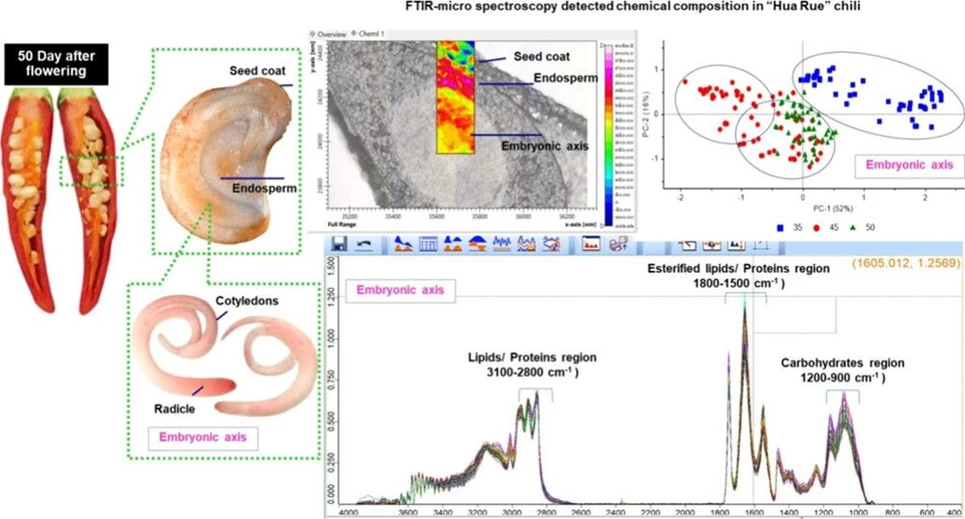
ACS Omega 2026, 11, 1, 562–571: Graphical abstract
This study investigates the relationship between fruit development and seed quality in the “Hua Rue” hot chili cultivar. Seeds harvested at 35, 45, and 50 days after flowering were evaluated for physical traits, germination performance, tissue-specific chemical composition using FTIR microspectroscopy, and biochemical activity during imbibition.
Seeds collected at 50 days after flowering showed the highest weight, germination rate, and germination speed, accompanied by increased endosperm-associated chemical accumulation and enhanced metabolic activity. FTIR analysis clearly distinguished developmental stages based on tissue-specific chemical signatures, identifying 50 DAF as the optimal harvest stage for producing high-quality chili seeds with stable storage viability.
The original article
Chemical Composition and Biochemical Changes during Fruit Development on Seed Quality in Hot Chili (Capsicum annuum L.)
Wissanee Pola*, Songsin Photchanachai, and Papungkorn Sangsawad
ACS Omega 2026, 11, 1, 562–571
https://doi.org/10.1021/acsomega.5c05947
licensed under CC-BY 4.0
Selected sections from the article follow. Formats and hyperlinks were adapted from the original.
Hot chili (Capsicum annuum L.), specifically the “Hua Rue” cultivar, is popular in the northeast region of Thailand due to its distinctive pungency and high yield. (1) Thailand ranks among the top five chili producers in Asia and is a leading exporter worldwide, with an export volume of approximately 60,000 kg and a value of 805 million baht. It is evident that chili seeds play a significant role in the country’s agricultural economy. (2) Seed production is a critical process that ensures the availability of high-quality seeds for sustainable crop production. Generally, in the large-scale production of this chili cultivar, mature fruits are harvested manually at the fully red-ripe stage, and the seeds are extracted from sun-dried fruits. However, the seed quality tends to decline rapidly during storage, particularly after six months. (2)
Typically, harvesting chili fruits at the onset of ripening is necessary for producing high-quality seeds. (3) Seeds achieve physiological maturity (PM) when they attain maximum dry weight and vigor, which vary with the variety. (4) In Capsicum species, high seed quality was achieved in fruits harvested at 50–60 days after flowering (DAF). (5) Research on sweet pepper and hot chili varieties suggested that seeds extracted at 60 DAF provided the highest germination and vigor. (6) Furthermore, enzymatic hydrolysis of storage macromolecules, particularly starch breakdown by α-amylase, is crucial for seed germination. (7) This enzyme hydrolyzes starch in the cotyledon and endosperm into simple sugar units that are then synthesized into sucrose for transport to the embryonic axis. (8)
Fourier transform infrared microspectroscopy (FTIR) is a technique used to obtain an infrared spectrum of absorption or emission of solids, liquids, and gases. (9) An FTIR spectrometer collects high-resolution spectral data over a wide spectral range simultaneously, providing a significant advantage over a dispersive spectrometer, which measures the intensity over a narrow range of wavelengths at a time. This instrument is effective for identifying biochemical compositions in living cells and tissues. (10) FTIR spectra typically reveal absorption bands corresponding to lipids (3000–2800 cm–1), proteins (1700–1480 cm–1), carbohydrates, and nucleic acids (1450–600 cm–1). (11) The measurement of chemical compositions in chili seeds using FTIR, particularly concerning the physiological maturity (PM) stage of the “Hua Rue” variety, has not been documented in recent years. The measurement of chemical compositions in chili seeds using FTIR, particularly in relation to the physiological maturity (PM) stage of the “Hua Rue” variety, has not been reported in recent years. Previous studies have mainly evaluated seed quality based on whole-seed analyses and standard germination tests. In contrast, this study provides the first detailed characterization of chemical composition profiles of individual seed organs in the “Hua Rue” variety. For this purpose, fruits were harvested at different developmental stages to investigate biochemical changes during ripening. Although the general postharvest handling and storage methods used in this study (manual extraction, shade drying, and sealed storage) slightly differ from the traditional practices employed by local seed producers, they were designed to ensure consistent sample quality for analysis. Therefore, this study aims to investigate the biochemical and chemical composition profiles of seed organs (embryonic axis, endosperm, and seed coat) as extracted from “Hua Rue” chili at various fruit developmental stages and to explore their potential relationship with seed vigor and storability.
2. Materials and Methods
2.3. Fourier-Transform Infrared (FTIR) Microspectroscopy of Seed Tissues
Seeds were collected from chili pods at three fruit developmental stages: 35, 45, and 50 DAF. Immediately after extraction, ten seeds per stage were embedded in optimal cutting temperature (OCT) compound (Tissue-Tek O.C.T. Compound, USA) and snap-frozen to preserve biochemical integrity. The embedded seeds were sectioned at −20 °C into cross sections of 8 ± 1 μm using a Leica CM1950 microtome cryostat (Cambridge Scientific). Sections were mounted on calcium fluoride (CaF2) infrared-transparent windows to facilitate FTIR analysis. Chemical imaging was performed using a HYPERION 3000 FTIR microscope (Bruker Optik GmbH) equipped with a focal plane array (FPA) detector, operating in the spectral range of 4000–600 cm–1, with 64 scans per spectrum. Spectral acquisition and preliminary processing were carried out by using OPUS 7.5 software (Bruker Optics, Ettlingen, Germany). The spectra were subsequently exported to Unscrambler X 10.5 for multivariate analysis, including the Savitzky–Golay second-derivative transformation, extended multiplicative signal correction (EMSC) normalization, and principal component analysis (PCA). The FTIR microspectroscopy was used to observe spectral pattern differences among tissues and maturation stages. Anatomical regions analyzed included the seed coat, endosperm, and embryonic axis.
3. Results and Discussion
3.1. Effect of Fruit Development on Seed Anatomy and 1000-Seed Weight
Visual observations of the ″Hua Rue” chili fruits showed mature green, breaker, and mature red colors at 35, 45, and 50 DAF, respectively (Figure 1A). This closely aligns with the ripening stages of the red pepper “Zunla-1” cultivar, as reported by Song et al. (17) where the ripening stages were divided into mature green (30 DAF), breaker (35 DAF), first immature red (38 DAF), second immature red (43 DAF), and mature red (MR, approximately 50 DAF).
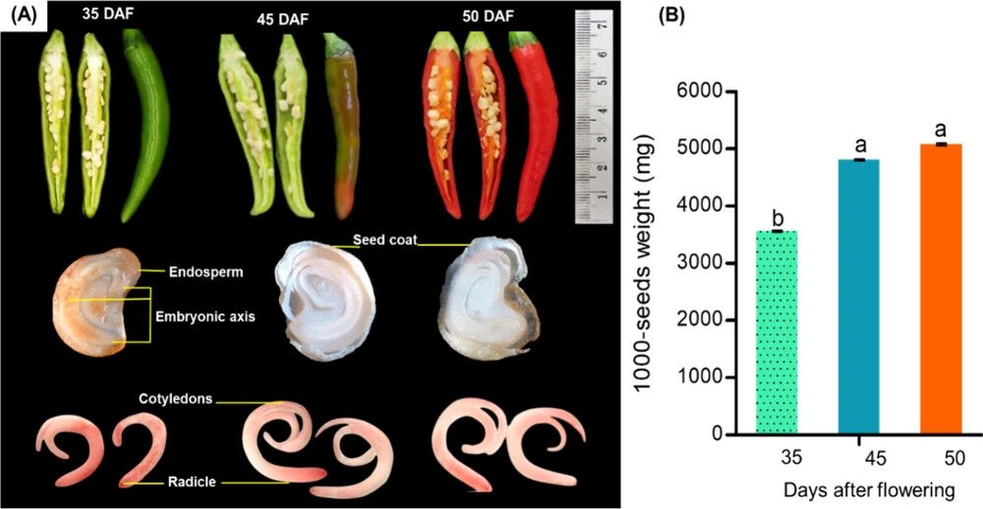 ACS Omega 2026, 11, 1, 562–571: Figure 1. Appearance of “Hua Rue” chili fruits and the interior seed structure, including seed coat, endosperm, and embryonic axis (A), and the 1000-seed weight (B) as extracted from the harvested fruits at 35, 45, and 50 days after flowering (DAF). Values are means ± SD (n = 4). Different letters (a, b) denote significant differences among treatments according to Tukey’s HSD Test (P < 0.05).
After the seeds were extracted from each fruit development stage, the interior structure of the seeds, including the endosperm and embryonic axis (cotyledons and radicle), was found to be fully developed at 45 and 50 DAF. In contrast, seeds from 35 DAF exhibited shorter cotyledons, indicating incomplete development (Figure 1A). This interior structure of chili seeds can determine seed physical integrity and predict seedling emergence. A previous study on bell pepper found that the structural integrity of seeds, as assessed by X-ray analysis, was linked to germination performance. It was discovered that a decrease in the internal area occupied by the embryo and endosperm was directly related to the incidence of abnormal seedlings and nongerminated seeds. (18) Nevertheless, the most crucial structure of the seed is the embryonic axis, which develops into the seedling. Therefore, a fully developed embryonic axis is essential for seed production.
Generally, harvesting seeds at the physiological maturity (PM) stage, which indicates the highest seed vigor and viability, is essential for cultivation. The major indicators of the PM stage are maximum seed dry weight, high seed vigor, and germination percentage. (6) In this study, the 1000-seed weight of “Hua Rue” chili ranged from 3563 to 4983 mg (Figure 1B). A significant difference in seed weight was observed between the fruit developmental stages. The lowest value was found in seeds extracted from fruit harvested at 35 DAF. Meanwhile, seeds obtained from fruit harvested at 45 and 50 DAF showed a gradual increase in weight. This indicates that early harvested chili fruit, whose seeds have reached the PM stage, should be at 45–50 DAF. Similarly, Yisa et al. (19) studied the influence of fruits at different stages (12–48 DAF) on seed quality. Their results revealed a continual increase in dry seed weight throughout the maturation process, particularly in seeds extracted from fruits harvested at 48 DAF. Similarly, Pagamas and Nawata (20) reported increasing dry seed weight in chili pepper cultivars “Huay Si Thon” and “Shishito” from 35 to 45 DAF that remained until 60 DAF. Hence, they recommended that the optimal harvest maturity period for “Huay Si Thon” and “Shishito” was at 45 DAF and 55 DAF, respectively. This suggests that harvesting during this period could yield good seed quality based on seed weight parameters, which may indicate the accumulation of nutrients in the seeds.
3.2. Effect of Fruit Development on Chemical Composition Profiles of Seeds Analyzed by FTIR Microspectroscopy
Hyperspectral images of the interior organs (embryonic axis, endosperm, and seed coat) extracted from different stages of fruit development in “Hua Rue” chili are shown in Figure 2. The color-coded regions represent variations in intensity, possibly indicating differences in chemical composition, thermal properties, or structural variations in various seed tissues. The 35 DAF seed exhibited a higher abundance of chemicals in the endosperm region, as indicated by the red color in the tissue, while it showed a lower composition in the seed coat and embryonic axis (Figure 2A). The seeds from 45 and 50 DAF contained the highest concentrations of chemicals in the endosperm, followed by the embryonic axis and seed coat (Figure 2B,C). These results indicate that the chemical compositions in each region of the seed vary, depending on the stages of seed development. In a previous study, a Raman hyperspectral imaging system was applied for online quality control of maize seeds based on the rapid and visual detection of chemical compositions. (21)
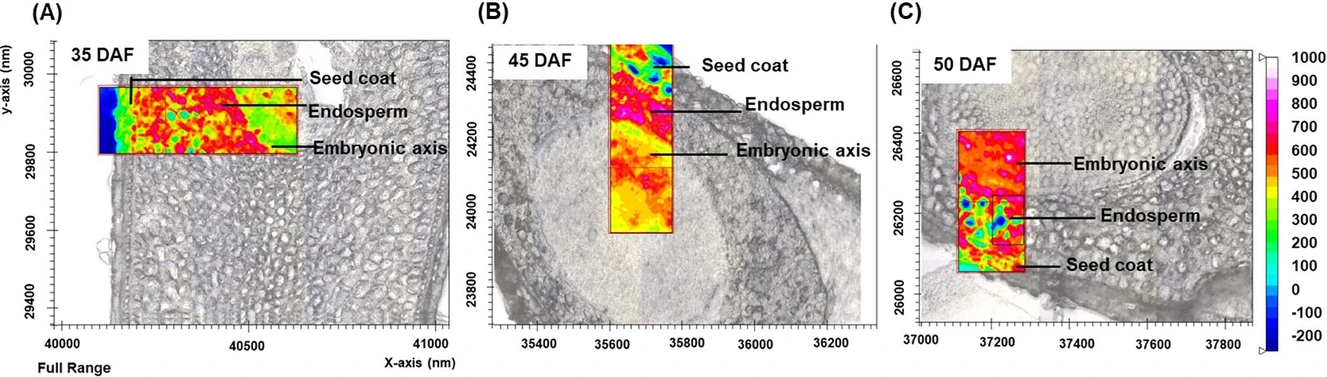 ACS Omega 2026, 11, 1, 562–571: Figure 2. Hyperspectral imaging of chili seed tissues at different fruit developmental stages: 35 days after flowering (DAF, A), 45 DAF (B), and 50 DAF (C). Seed coat, endosperm, and embryonic axis regions are indicated. The overlaid false-color maps represent the relative chemical abundance detected by hyperspectral analysis, with a color scale from −200 (blue, lowest intensity) to 1000 (white-pink, highest intensity).
The FTIR spectrum was recently applied to identify the intensity of biochemical compositions in various materials. (22) In the FTIR absorption spectrum, three major biochemical composition regions of interest have been identified according to prior studies. (23) The absorption bands of 3000–2800 cm–1 represent lipid regions, the bands of 1800–1400 cm–1 exhibit protein regions (amide I and amide II), and the spectra absorption bands of 1300–1000 cm–1 reveal carbohydrates, phospholipids, and nucleic acids. (24,10) In this study, distinctive spectral patterns were observed among the embryonic axis, endosperm, and seed coat (Figure 3A–C). Additionally, significant differences in absorption intensities were found among seeds extracted from fruit at 35, 45, and 50 DAF (Figure 3D–F).
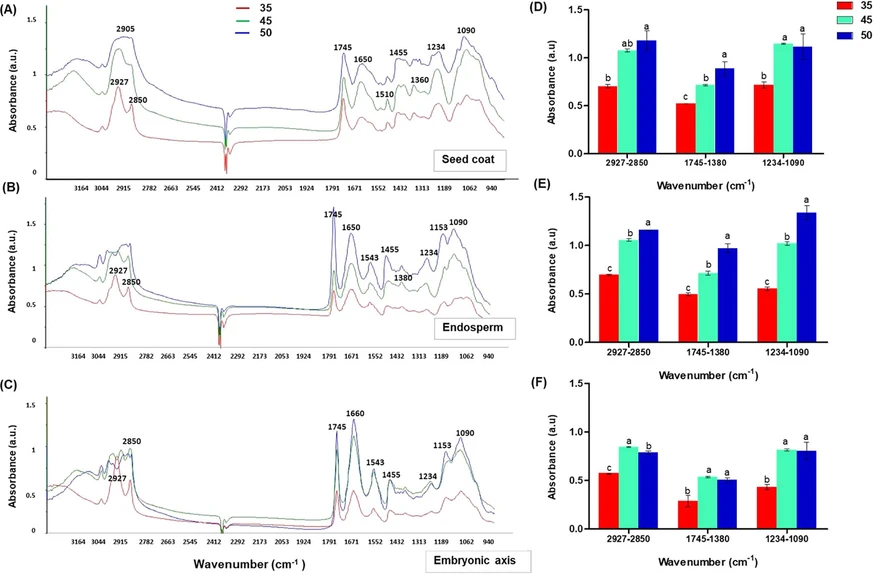 ACS Omega 2026, 11, 1, 562–571: Figure 3. FTIR analysis of chili seed tissues harvested at different developmental stages. (A–C) Mean absorption spectra of the seed coat (A), endosperm (B), and embryonic axis (C) obtained from seeds at 35, 45, and 50 days after flowering (DAF). Major absorption peaks are indicated: 2927–2850 cm–1 (C–H stretching of lipids), 1745–1660 cm–1 (amide I of proteins), 1543–1380 cm–1 (amide II of proteins), and 1234–1090 cm–1 (C–O stretching of carbohydrates/polysaccharides). (D–F) Quantitative comparisons of relative absorbance intensities at these peaks for the seed coat (D), endosperm (E), and embryonic axis (F). Bars represent the mean ± standard deviation (SD). Different letters (a–c) above bars indicate statistically significant differences among fruit developmental stages according to Tukey’s HSD test (P < 0.05).