News from LabRulezICPMS Library - Week 40, 2025
LabRulez: News from LabRulezICPMS Library - Week 40, 2025
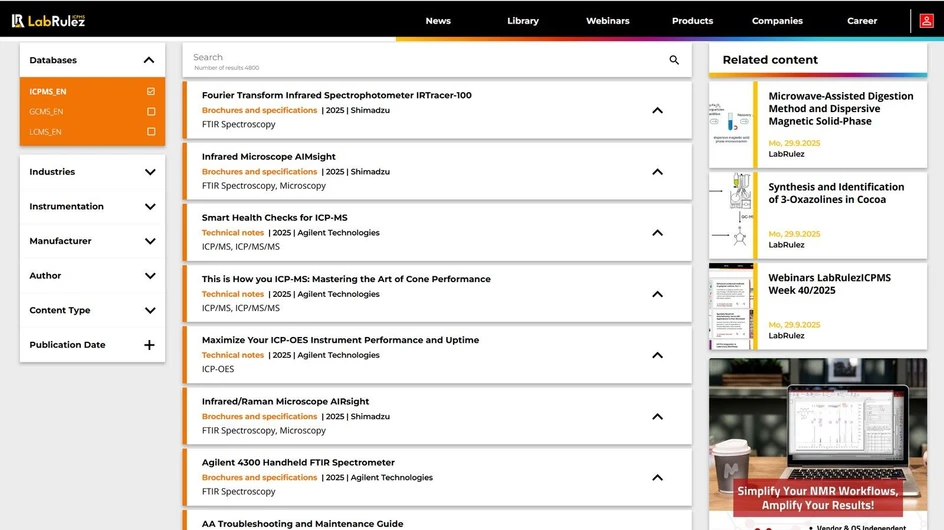
Our Library never stops expanding. What are the most recent contributions to LabRulezICPMS Library in the week of 29th September 2025? Check out new documents from the field of spectroscopy/spectrometry and related techniques!
👉 SEARCH THE LARGEST REPOSITORY OF DOCUMENTS ABOUT SPECTROSCOPY/SPECTROMETRY RELATED TECHNIQUES
👉 Need info about different analytical techniques? Peek into LabRulezLCMS or LabRulezGCMS libraries.
This week we bring you application note by Agilent Technologies and posters by Shimadzu / AOAC and Thermo Fisher Scientific!
1. Agilent Technologies: Accurate Identification of Binder Raw Materials for Li-Ion Battery Electrodes by FTIR
Rapid quality control of incoming materials using the Agilent Cary 630 FTIR
- Application note
- Full PDF for download
Lithium-ion battery (LIB) production relies on a wide variety of specialized materials sourced from numerous suppliers. In high-throughput LIB manufacturing facilities, even minor inconsistencies in raw materials can lead to significant downstream effects on cell performance. Binders are a good example: although used in small quantities to adhere active materials to metal current collectors, they are critical to electrode functionality. Binders directly influence electrode mechanical strength, uniformity, and long-term cell performance. As a result, production engineers and quality control (QC) managers consider binder verification as a key part of quality assurance (QA) workflows.
Traditional binders such as polyvinylidene fluoride (PVDF) are effective but introduce environmental and solvent-handling concerns. Alternatives such as polytetrafluoroethylene (PTFE), styrene-butadiene rubber (SBR), and carboxymethyl cellulose (CMC) are increasingly being adopted within the industry to align with evolving sustainability standards. However, these changes also introduce new risks for LIB manufacturers — particularly when material specifications vary or supply sources change. To maintain production consistency and reduce the risk of batch failure or rework, fast and accurate material identification and verification tools are needed. FTIR spectroscopy offers a simple yet powerful solution for the QA/QC of various LIB raw materials. Given the organic and polymeric nature of binders, FTIR spectroscopy offers a rapid and reliable means of identifying them, as discussed in the "Characterization of PVDF polymorphic phases" section of this application note.
This study outlines how the Agilent Cary 630 FTIR spectrometer (Figure 1) with its compact footprint can be used at the point of material receipt to verify binder identity. User-friendly Agilent MicroLab software ensures successful operation following minimal operator training. Analyses carried out using the Cary 630 FTIR support fast decision‑making, help avoid production disruptions, and improve end-product reliability.
Results and discussion
The binder samples were analyzed by placing a small quantity of solid material directly onto the ATR crystal of the Cary 630 FTIR spectrometer. Gentle pressure was applied to ensure good contact. After the measurement was completed, the ATR crystal was cleaned with a light solvent and wipe in preparation for the next sample.
The MicroLab software uses a built-in Similarity algorithm that automatically calculates a Hit Quality Index (HQI). The HQI value indicates how closely the acquired sample spectrum matches a reference spectrum from the user‑generated library. HQI values are commonly used as pass/fail criteria in material identification and confirmation workflows.
Using the Similarity algorithm, all four unknown samples (samples 1 to 4) were correctly identified according to the binder type stated on the respective container labels. However, variations in HQI values were observed among the PVDF samples (1 to 3). As shown in Table 2, PVDF-210 and PVDF-5130 exhibited HQI values of 0.96271 and 0.96713, respectively, indicating strong spectral matches. PVDF-6020 showed a slightly lower HQI of 0.90741, which may reflect differences in polymer grade or formulation compared to the reference sample. PTFE-104 (Sample 4) was also correctly identified, with a high HQI of 0.98345, suggesting good spectral agreement and a high-confidence match.
Conclusion
An Agilent Cary 630 FTIR spectrometer with Agilent MicroLab software provided a simple solution for identifying electrode binder materials—a typical application in lithium-ion battery quality control (QC) workflows.
The MicroLab software enabled the rapid creation of a spectral reference library for binder materials based on the analysis of two known "reference" samples. Four "unknown" binders from a different supplier were then correctly identified using the FTIR method. However, one sample yielded a low, red color-coded confidence score, suggesting possible differences in polymer grade or formulation between the reference and unknown samples.
The Cary 630 FTIR enables production and QC teams to:
- Adapt quickly to new materials or suppliers through easy management of the spectral library
- Verify the identity of incoming raw materials using intuitive pictorial guidance and color-coded pass/fail results
- Detect any mislabeling or contamination of materials
- Monitor batch-to-batch variability that could affect electrode performance and battery manufacturing yields
With its compact, modular design, the Cary 630 FTIR can be deployed in production environments, including gloveboxes. Its ease-of-use makes it a valuable tool for ensuring material consistency, minimizing process disruptions, and maintaining high standards in lithium-ion battery manufacturing.
2. Shimadzu / AOAC: Speciation Analysis of Mercury in Seafood by LC-ICP-MS
- Poster
- Full PDF for download
Mercury contamination in seafood poses significant health risks to consumers. Mercury screening using ICPMS alone can provide a total concentration, however some species of mercury are more toxic to humans than others, and a total concentration may not provide adequate information and result in incomplete risk assessments. Generally, methyl mercury is more toxic than inorganic mercury and other organic mercury. Evaluating the toxicity in food requires not only analysis as total mercury but also by the form of mercury. To address this, we propose the use of Liquid Chromatography coupled with Inductively Coupled Plasma Mass Spectrometry (LCICP-MS) for detailed speciation analysis of mercury by connecting an ICPMS-2040/2050 with Nexera XS inert. Furthermore, we also evaluated the automatic dilution function of the Nexera series autosampler for the speciation analysis of mercury.
Results
Samples were analyzed with the LC-ICP-MS system, which consisted of the ICPMS-2040/2050 connected to a Nexera XS inert (Fig. 1). LabSolutions ICPMS TRM software can control the ICPMS2040/2050 system and Shimadzu LC units, enabling everything from sample injection to chromatogram analysis to be performed via a single software program. The analytical conditions used for analysis were those included in the LC-ICP-MS Method Package for Mercury Speciation Analysis. Table 1 shows the analytical conditions for HPLC, and Table 2 shows the analytical conditions for ICP-MS.
Conclusion
Speciation analysis of methyl mercury and total mercury in seafood was performed using an LC-ICP-MS system that connected an ICPMS-2040/2050 to a Nexera XS inert according to the conditions in the “LC-ICP-MS Method Package for Mercury Speciation Analysis.” Analysis of methyl mercury and total mercury in seafood showed good spike recoveries demonstrating system suitability.
3. Thermo Fisher Scientific: High Sensitivity, Fast Scanning, Sector Field ICP-MS – Improving Sensitivity for Laser Ablation with the Jet Interface
- Poster
- Full PDF for download
In laser ablation ICP-MS analysis, the choice of which type of ICP-MS to use may not be entirely obvious. High precision isotope ratio analysis, such as epsilon level precision for geochronology, would need to be measured with a multicollector ICP-MS, such as the Thermo Scientific™ NEPTUNE XT™, but for the majority of applications the precision obtainable with a single collector ICP-MS is sufficient. In the area of single collector ICP-MS we are still left with the choice between a quadrupole-based ICP-MS, such as the Thermo Scientific™ iCAP™ RQ/TQ, and a magnet sector based ICP-MS, the Thermo Scientific™ Element XR™.
The reduced cost, size and complexity of the quadrupolebased ICP-MS make them a popular choice for LA-ICP-MS analysis. However, it has always been known that a magnet sector based ICP-MS enjoys a significant increase in sensitivity: detecting more ions for the same amount of atoms introduced. In laser ablation analysis the amount of sample to be analyzed is often strictly limited. Furthermore, to reduce laser-induced fractionation and to stay within discrete sample zones it is highly desirable to ablate as little sample material as possible. The trend towards higher resolution LA-ICP-MS bioimaging has also led to a reduction in the amount of sample ablated. These limitations in sample size make the sensitivity of the ICP-MS vital in order to achieve useable limits of quantification and detection (LOQ and LOD).
The Jet Interface option for the Thermo Scientific Element XR HR-ICP-MS greatly increases the sensitivity of fast scanning, sector field ICP-MS, especially for dry plasma. It consists of a high capacity dry interface pump and a companion set of specially designed cones. Here we report the sensitivity (as sample ion yield) of the Element XR when equipped with the Jet Interface option. We then compare this sensitivity to two other ICP-MS for the LA-ICP-MS U-Pb analysis of two common zircon reference materials.
MATERIALS AND METHODS
ICP-MS
Three ICP-MS systems were used:
- NEPTUNE XT (multi collector ICP-MS, with Jet Interface)
- ELEMENT XR (single collector Sector Field ICP-MS), equipped with Jet Interface option
- iCAP TQ (single collector quadrupole based ICP-MS), equipped with high sensitivity cones and insert recommended for laser ablation analysis
CONCLUSIONS
The Jet Interface for the Element XR SF-ICP-MS gives:
- Sample Ion Yield >1% for Nd, Hf, Pb and U.
- Over 20 times LA sensitivity compared to Q-ICP-MS