Laser-ablation vs. bulk tissue ICP-MS for conifer tissue elemental analysis

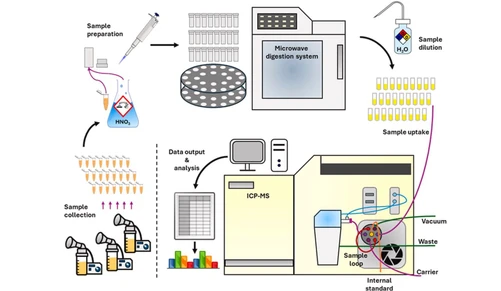
Chemosphere, Volume 374, April 2025, 144200: Graphical abstract
This study evaluates laser ablation inductively coupled plasma mass spectrometry (LA ICP-MS) as a minimally invasive method for analyzing trace elements in plant tissues. Compared to traditional acid digestion and ICP-MS, LA ICP-MS requires little sample preparation and reduces risks of contamination and loss. Jack pine needle samples were analyzed in various forms—intact, pelletized, and acid-digested—and compared using a NIST SRM 610 quartz standard and 43Ca internal standard.
Results showed that LA ICP-MS on intact samples accurately reflected bulk ICP-MS data for most elements, including key nutrients like P, Mg, and Zn. Pulverizing did not improve accuracy, and deviations were noted for elements like K, Ce, La, and Fe due to localization or volatility. LA ICP-MS significantly underreported volatile Pb levels compared to digested samples. Overall, LA ICP-MS proves effective for rapid, accurate, and largely non-destructive elemental analysis, especially for small or delicate plant samples.
The original article
Laser-ablation vs. bulk tissue ICP-MS for conifer tissue elemental analysis
Jasmine M. Williams, Sean C. Thomas
Chemosphere, Volume 374, April 2025, 144200
https://doi.org/10.1016/j.chemosphere.2025.144200
licensed under CC-BY 4.0
Selected sections from the article follow. Formats and hyperlinks were adapted from the original.
Laser ablation combined with ICP-MS is an alternative analysis technique that can directly measure intact plant components. In brief, a laser beam is fired at the plant surface which creates ablated material to be directly analyzed in the plasma torch of an attached ICP device (Su et al., 2012). LA ICP-MS allows for quantitative elemental analysis of a range of materials due to its high sensitivity (Pozebon et al., 2017). It also has capacity for the spatial analysis of elements within biological samples, and can be used to test small, whole tissue samples directly (Hoffmann et al., 2000). Moreover, LA ICP-MS may detect heavy metals and minerals in distinct plant parts with minimal sample preparation (Kaiser et al., 2009) and may fill a testing gap between destructive, bulk analysis and nano-scale techniques.
In spite of these advantages, application of LA ICP-MS to plants remains uncommon (Amais et al., 2021). Hoffmann et al. (2000) used leaf samples of Quercus robur to test application of LA ICP-MS for measuring the spatial distribution of element concentrations in leaves. Punshon et al. (2004) successfully applied LA ICP-MS to measure Ni and U residues on Andropogon elliottii leaf surfaces. Kaiser et al. (2009) reported on the feasibility of LA ICP-MS for measuring Pb, Mg, and Cu in leaves of Helianthus annuus L. Shi et al. (2009) measured patterns of Cu and Zn in roots of Cucumis sativus L. with LA ICP-MS data. These trials have all applied LA ICP-MS to intact samples of angiosperms. LA ICP-MS has also been used to measure mercury concentrations and for tissue localization in fungi (Debeljak et al., 2018; Kavčič et al., 2019). To our knowledge, no prior study has applied LA ICP-MS to measure elements in conifer needle samples. There are also no published comparisons of LA ICP-MS on both intact and ground plant samples, nor any direct comparisons to traditional acid-digestion ICP-MS.
External calibration is fundamental to ensuring accuracy of element quantification in LA ICP-MS, regardless of sample type (Pan et al., 2022). Matrix effects in LA ICP-MS analysis refer to a discrepancy between plasma loads introduced to the ICP-MS device and are caused by variations in sample surfaces ablated per laser pulse. These effects reduce precision of measurements for most sample types (Günther et al., 2000), and as such, accurate adjustment to a matrix-matched standard is imperative (Miliszkiewicz et al., 2015).
Elemental fractionation has been observed to some extent in all laser ablation applications (Günther et al., 2000); the use of certified reference materials with known concentrations for elements of interest ensures more accurate calibration and reduced error from both elemental fractionation and matrix effects (Su et al., 2012). Nevertheless, there is a deficit of laser ablation-compatible standards and appropriate reference materials (Pozebon et al., 2017), specifically for organic plant and soil samples (Hoffmann et al., 2000). Certified reference materials exist for needles of select pine species (e.g., SRM 1575a for Pinus taeda) but are not available as intact specimens - the form best suited for LA ICP-MS analysis as per the National Institute of Standards and Technology (NIST) (NIST, 2012; Pan et al., 2022). Analyses of conifer needles present unique challenges in comparison to other reference materials due to a distinct needle matrix and the location of elements within samples. To date, mass fractions of B, Ca, K, Fe and Mn from limited trials have been particularly divergent from other agricultural and plant Standard Reference Materials (Mackey et al., 2004).
Pairing the use of a known internal standard element in tandem with an external Standard Reference Material should enhance accuracy of LA ICP-MS measurements. Selection of an internal standard element with adequate and homogeneous distribution throughout given samples is crucial to ensure accurate and precise measures using laser ablation techniques (Limbeck et al., 2015). Most commonly, internal standardization of organic samples has been performed with 13C, however its high ionization potential and the risk of diffusion losses during the transfer from laser to ICP equipment reduces effectiveness of 13C calibration (Pan et al., 2022).
Here we test the application of LA ICP-MS for non-destructive element analysis of intact Pinus banksiana L. tissues and compare results to measures of pelletized, laser-ablated samples with those analyzed by conventional acid digestion followed by ICP-MS. Samples from a mature jack pine tree were used to conduct tissue elemental analyses with three distinct methods and calibration techniques. We tested the following hypotheses: 1) Laser-ablation ICP-MS analysis of both intact and homogenized samples will yield comparable element measurements to conventional acid-digestion ICP-MS analysis with the exception of known volatile elements (As, Cd, Sb, Pb), which we predict to have higher LA ICP-MS values given the reduced risk of volatilization losses; 2) Sample homogenization prior to LA ICP-MS will provide a closer match to conventional acid digestion combined with ICP-MS analysis for non-volatile elements.
2. Materials and methods
2.1. Sample preparation and referencing
One branch measuring approximately 1 m in length was harvested at a height of 1.5 m from a live P. banksiana tree, oven dried unwashed at 60 °C for 36 h, and all needles were subsequently removed and retained. Triplicate split-samples of dried needles were macerated in a Retsch cutting mill with internal 1 mm sieve (SM400 Cutting Mill with internal 1 mm sieve, Verder Scientific Companies, U.S.A.) then acid-digested with a mixture of hydrochloric and nitric acids at 95 °C for 2 h prior to dilution and elemental analysis with ICP-MS. Acid digestion ICP-MS analysis of needle tissue was conducted at Activation Laboratories Ltd. (Ancaster, Ontario).
2.4. LA ICP-MS analysis
LA ICP-MS analyses were accomplished with a ESL193 excimer-based laser ablation system (Elemental Scientific Lasers, U.S.A.) paired with an Agilent 7900 quadrupole mass spectrometer (Agilent Technologies Inc., U.S.A.); settings and parameters are detailed in Table 1. An initial set of 12 analyses were conducted on three intact tree needles (2–6 analyses/needle depending on sample surface uniformity). External calibration was conducted using a unique NIST610 with glass matrix; the NIST sample was ablated and analyzed across four distinct linear trajectories with two sweeps mapped prior to and following each intact needle sample analysis. Intact tree needle samples were kept on distinct slides, whereas all six pellets were positioned onto one glass slide without two-sided tape. Similarly, two NIST610 sweeps were run prior to and following each group of analyses on sample pellets (four NIST610 sweeps + three pellet trajectories per pellet sample).
3. Results
A linear model could accurately describe the relationship between LA ICP-MS measurements on both intact and homogenized, pelletized needle samples and the associated acid-digestion ICP-MS values (r2intact = 0.916, r2pellet = 0.932, Table S1). The crushing and pelletizing of needle samples prior to laser ablation resulted in more values with significant differences from associated acid digestion and ICP-MS measurements; however, this remained a minority of the total elements tested. LA ICP-MS elemental results from pellets and intact tissues remained within one standard deviation from one another for 24Mg (p = 0.6470), 31P (p = 0.3160), 52Cr (p = 0.3443), 66Zn (p = 0.143), 55Mn (p = 0.9989), 55Mo (p = 0.1388), and 47Ti (p = 0.0821).
3.1. Plant mineral nutrients
Considering both intact and pellet samples, the analyses conducted by laser ablation ICP-MS corresponded most closely to conventional acid-digestion and ICP-MS analysis for major plant nutrients measured (39K, 31P, 24Mg, 66Zn, 57Fe) with r2intact = 0.842, r2pellet = 0.768. Though measured values closely matched a direct 1:1 relationship in the case of 24Mg, 31P, and 66Zn (Fig. 1a–c), results for 39K (F(2,21) = 5.63, p = 0.011) and 57Fe (F(2,21) = 27.2, p = 1.48∗10−6) were significantly different amongst the three methods. Results for 39K from intact needle LA ICP-MS deviated most from other test methods, whereas pelletized sample LA ICP-MS results were within one SD from associated acid-digestion ICP-MS measurements (Fig. 1c). Conversely, LA ICP-MS analysis on intact needles yielded 57Fe values that closely matched those from conventional acid digestion ICP-MS, but values from pelletized sample LA ICP-MS were significantly higher (p = 0.00169) (Fig. 1c).
4. Discussion
Of the 25 elements measured through intact needle LA ICP-MS, only three deviated significantly from the corresponding results obtained by conventional grinding, acid digestion and ICP-MS analysis: specifically, 39K, 140Ce, and 208Pb. In contrast, LA ICP-MS conducted on pellets of crushed, homogenized, and compressed jack pine tissue yielded a higher number of measures with significant deviations from the acid digestion ICP-MS values (9/25, 36% of elements considered). These results suggest that LA ICP-MS conducted on intact conifer samples, rather than on ground, pelletized samples, may yield more comparable results to conventional acid digestion and ICP-MS. The strong agreement between intact sample LA ICP-MS and acid digestion ICP-MS also supports our hypothesis that the use of a NIST610 glass as an external, matrix-matched standard and 43Ca as a common element determined via EPMA is a suitable calibration technique when applied to intact Pinus banksiana L. needle samples.
LA ICP-MS results from pellet samples exhibited exclusively positive deviations from the associated acid digestion ICP-MS determined elemental values for all 25 elements, indicating that for pelletized sample, LA ICP-MS may yield a positive bias compared to both intact sample LA ICP-MS and acid digestion ICP-MS procedures. Jiménez et al. (2007) studied the effects of several parameters on precision of LA ICP-MS multi-element analysis of compost pellets and found that material grinding time and variable particle sizes within the pellet were primary factors of error, with material heterogeneity contributing most to inaccuracy for measures of 59Co, 111Cd, and 170Hg. Our results align with Jiménez et al.’s (2007) observations and suggest that the significant deviations we observed in pellet LA ICP-MS measures of 59Co and 111Cd concentrations may be due to heterogeneity of the ground needle material within each pressed pellet. Results thus suggest that pelletizing samples for LA ICP-MS analysis is counter-productive.
4.1. Plant mineral nutrients
Major plant nutrients (39K, 57Fe, 66Zn, 31P, 24Mg) were measured in the highest concentrations and yielded results with the lowest bias across all three analysis methods relative to other element groups considered. Nutrient composition of intact needles and pellets measured through LA ICP-MS also fit linear regression models with corresponding acid-digestion ICP-MS values. The relatively high concentration of nutrients in P. banksiana needle tissue likely contributed to reduced variability across repeated samples and analysis techniques. The consistency of measurements we observed across analysis methods for plant nutrients aligns with our hypothesis that deviations would be primarily found in elements prone to volatilization during grinding and acid digestion. However, an exception is potassium: although 39K measured on pellet samples closely matched the acid digestion ICP-MS results, 39K composition of intact needles from LA ICP-MS analysis was significantly lower. The concentration of many essential and non-essential elements differs in individual needle layers of gymnosperms (Giertych et al., 1997; Pongrac et al., 2018). Kötschau et al. (2013) applied LA ICP-MS in order to map the location of various elements within leaves of Helianthus annuus and reported that, unlike other major plant nutrients, 39K was enriched preferentially in leaf mesophyll layers, a finding also supported by the tissue-specific element profiles conducted on Pinus sylvestris L. samples by Pongrac et al. (2018), who described lowest 39K in the epidermal needle layer. Our analysis of intact P. banksiana needle samples through LA ICP-MS may have predominantly captured needle epidermis composition, whereas analysis of ground, homogenized samples measured through pellet LA ICP-MS and via acid digestion and ICP-MS likely captured an integrated leaf profile, possibly resulting in the negative LA ICP-MS deviation for 39K. Results from our preliminary study motivate additional follow-up assessments with larger sample sizes of both intact and ground, digested conifer needles in order to verify contrasts between 39K measurements.
Measured 57Fe was closely aligned between acid-digestion ICP-MS and intact needle LA ICP-MS analysis, but was significantly higher when measured through LA ICP-MS analysis conducted on the homogenized pellet samples. The localized concentration of 57Fe in pine needles may be affected by variations in chlorophyll content from needle tip to base (Giertych et al., 1997), and this could result in increased variability in measures from intact sample LA ICP-MS, however the alignment detected here between intact sample estimates and acid-digestion ICP-MS measures suggest that conducting laser sweeps across a needle length and averaging multiple laser ablation measures per needle reduced effects of within-sample heterogeneity. The detection of 57Fe from both acid-digestion ICP-MS and LA ICP-MS analysis may be imprecise for several reasons. 57Fe is the preferred isotope for measurement with LA ICP-MS analysis, however it remains subject to chemical interferences, for example from 40Ca16O1H, and this may lead to inconsistent measures particularly when paired with a NIST610 silicate standard that contains relatively low levels of Fe (Danyushevsky et al., 2011). Moreover, in conventional acid-digestion, solution-based ICP-MS, lighter metals such as Fe typically show lower precision (Gallo and Almiralli, 2009). Nonetheless, considering both the strong Fe recovery rate reported through conventional ICP-MS analysis (98.5%; Table S2) and the close alignment between estimates of 57Fe from acid digestion ICP-MS and intact needle LA ICP-MS methods, we can assume that pellet preparation produces inflated 57Fe estimates relative to the other testing and preparation techniques.
5. Conclusions
A procedure for applying LA ICP-MS to the accurate elemental analysis of intact Pinus banksiana L. needles has been proposed and compared to alternative procedures. Lack of appropriate type and form of standard reference materials for the use of LA ICP-MS on plant tissue samples has been a barrier to its more widespread application. Here we used an internal standard common element (43Ca) determined by electron probe microanalysis of gold-plated intact samples, and a conventional glass NIST610 pellet for external calibration. LA ICP-MS was also applied to the measurement of elemental composition in ground, pelletized pine needle samples with common element quantification achieved through XRF. Results from LA ICP-MS for both sample preparation techniques were compared to one another and also to third-party ICP-MS analysis measurements on crushed, dual-acid digested samples. Our results suggest application of LA ICP-MS on intact plant samples, referenced with NIST610 and an internal standard of 43Ca, is a viable tool for accurate, non-destructive analysis of pine tissue composition for most elements of interest – though problematic in the cases of 39K, 52Cr, 107Ag, 140Ce, and 208Pb. Use of LA ICP-MS on intact plant samples may prove particularly useful for analysis of individual plant components or on sample sizes too small for digestion techniques, as well as when measuring certain elements (such as 75As, 111Cd, and 121Sb) subject to volatilization losses during mechanical and chemical sample preparation.