Author
TU Wien
TU Wien
The TU Wien is Austria's largest research and educational institution in the field of technology and natural sciences. More than 4,000 scientists are researching "technology for people" in five main research areas at eight faculties. The content of the studies offered is derived from the excellent research. More than 26,000 students in 62 degree programmes benefit from this. As a driver of innovation, TU Wien strengthens the business location, facilitates cooperation and contributes to the prosperity of society.
Tags
Article
Scientific article
Plastics
LinkedIn Logo

Detecting nanoplastics – in fractions of a second

Tu, 7.5.2024
| Original article from: TU Wien / Dr. Florian Aigner
Tiny plastic particles are an environmental problem. They can even penetrate living cells. A method has now been developed at TU Wien to detect such particles quickly and with high sensitivity.
<ul>
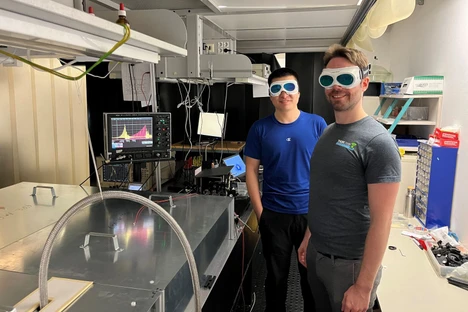
<li><strong>Photo:</strong> TU Wien: Detecting nanoplastics – in fractions of a second. Helmut Hörner, Sarah M. Skoff, Ambika Shorny, Fritz Steiner (from left).</li>
</ul>
  • Photo: TU Wien: Detecting nanoplastics – in fractions of a second. Helmut Hörner, Sarah M. Skoff, Ambika Shorny, Fritz Steiner (from left).

It is well known that microplastics are a problem: They are tiny, barely visible plastic particles that can harm the environment, for example, if they are eaten by animals. However, it has been difficult to assess the effect of even smaller particles, which can hardly be detected using conventional methods: Plastic particles with a diameter of less than one micrometer commonly referred to as "nanoplastics". Such tiny particles can even be absorbed into living cells.

TU Wien (Vienna) has now succeeded in developing a measurement method which can even detect individual nanoplastic particles – orders of magnitude faster than previous techniques. These results have now been published in the journal Scientific Reports. The new method now has the potential to become the basis for new measurement devices for environmental analysis.

Detecting molecules by wavelength

"We use a physical principle that has also often been used in chemical analysis, namely Raman scattering," explains Sarah Skoff, group leader of the "Solid State Quantum Optics and Nanophotonics" research group at TU Wien. In this process, molecules are illuminated with a laser beam, causing them to vibrate. Part of the energy of the laser light is thus converted into vibrational energy, while the rest of the energy is re-emitted in the form of light.

By measuring this light and comparing its energy with the laser light that was originally emitted, the vibrational energy of the molecule is determined – and because different molecules vibrate in different ways, it is possible to find out which molecule it is.

"Ordinary Raman spectroscopy, however, would not be suitable for detecting the smallest nanoplastics," says Sarah Skoff. "It would be far too insensitive and take far too long." The research team therefore had to search for physical effects that could significantly improve this technique.

The trick with the gold grid

To do this, they adapted a method that has already been used in a similar form to detect biomolecules. The sample is thereby put onto an extremely fine grid made of gold. The individual gold wires are only 40 nanometers thick and about 60 nanometers apart. "This metal grid acts like an antenna," says Sarah Skoff. "The laser light is amplified at certain points - so there is a much more intense interaction with the molecules there. There is also an interaction between the molecule and the electrons in the metal lattice, which ensures that the light signal from the molecules is additionally amplified."

In ordinary Raman spectroscopy, the light that is then emitted by the molecules is normally broken down into all its wavelengths to identify which molecule it is. However, the TU Wien team was able to show that the technique can also be simplified: "We know what the characteristic wavelengths of the nanoplastic particles are, and so we look very specifically for signals at precisely these wavelengths," Skoff explains. "We were able to show that this can improve the measurement speed by several orders of magnitude. Previously, you had to measure for ten seconds to get a single pixel of the image you were looking for – with us, it takes just a few milliseconds." Experiments with polystyrene (Styrofoam) showed that even at this very high speed, the nanoplastic particles can be reliably detected – even at extremely low concentrations. Unlike other methods, this technique even allows the detection of individual particles.

The basis for new measurement devices

The research team now wants to investigate the potential applications of the new technique in more detail - for example, how it can be used to detect nanoplastics in environmentally relevant and biological samples, such as blood. "In any case, we have now been able to show that the basic physical principle works," says Sarah Skoff. "In principle, this lays the foundation for the development of new measurement devices that could be used to examine samples directly in nature outside the laboratory in the future."

This research work was supported by the Austrian Research Promotion Agency (FFG, PhoQus2D) and the Austrian Science Fund (FWF, Quantoom).

TU Wien
LinkedIn Logo
 

Related content

Measurement of Fixed Carbon, Volatile Matter, and Ash of Biocoke

Applications
| 2026 | Shimadzu
Instrumentation
Thermal Analysis
Manufacturer
Shimadzu
Industries
Energy & Chemicals

Detection of Phenol Leakage into Wastewater Using TOC Measurement

Applications
| 2026 | Shimadzu
Instrumentation
TOC
Manufacturer
Shimadzu
Industries
Environmental

Routine Analysis of Rare Earth Elements in Basalt using ICP-MS

Applications
| 2026 | Agilent Technologies
Instrumentation
ICP/MS
Manufacturer
Agilent Technologies
Industries
Materials Testing

Analysis of rare earth elements in clay using XRF and XRD

Applications
| 2026 | Thermo Fisher Scientific
Instrumentation
XRD
Manufacturer
Thermo Fisher Scientific
Industries
Materials Testing

Measurement of TOC in Chloroisocyanuric Acid Used as Disinfectant

Applications
| 2026 | Shimadzu
Instrumentation
TOC
Manufacturer
Shimadzu
Industries
Pharma & Biopharma
 

Related articles

Ultra-short light pulses enable high-precision "artificial nose"
Article | Scientific article

Ultra-short light pulses enable high-precision "artificial nose"

A new spectroscopy method has been developed at TU Wien: Using a series of laser pusles, chemical analyses can be carried out much faster and more precisely than before.
TU Wien
tag
share
more
Atomic Nucleus Excited with Laser: A Breakthrough after Decades
Article | Video

Atomic Nucleus Excited with Laser: A Breakthrough after Decades

The "thorium transition", has now been excited for the first time with lasers. This paves the way for revolutionary high precision technologies, including nuclear clocks.
TU Wien
tag
share
more
TU Wien launches a research platform for 3D testing of bio-samples
Article | Science and research

TU Wien launches a research platform for 3D testing of bio-samples

The "LifeScope3D" research platform has been opened. It offers various new high-tech devices for bio-research at TU Wien, which are available to TU Wien scientists but also external institutions.
TU Wien
tag
share
more
Spin waves as the key to more sustainable AI: Ondřej Wojewoda makes a breakthrough in measurement using Brillouin spectroscopy of light
Article | Science and research

Spin waves as the key to more sustainable AI: Ondřej Wojewoda makes a breakthrough in measurement using Brillouin spectroscopy of light

The growing influence of AI brings with it huge energy demands, which in turn bring large-scale climate challenges. Ondřej Wojewoda from CEITEC BUT brings a revolutionary solution in his PhD thesis.
CEITEC
tag
share
more
 

Related content

Measurement of Fixed Carbon, Volatile Matter, and Ash of Biocoke

Applications
| 2026 | Shimadzu
Instrumentation
Thermal Analysis
Manufacturer
Shimadzu
Industries
Energy & Chemicals

Detection of Phenol Leakage into Wastewater Using TOC Measurement

Applications
| 2026 | Shimadzu
Instrumentation
TOC
Manufacturer
Shimadzu
Industries
Environmental

Routine Analysis of Rare Earth Elements in Basalt using ICP-MS

Applications
| 2026 | Agilent Technologies
Instrumentation
ICP/MS
Manufacturer
Agilent Technologies
Industries
Materials Testing

Analysis of rare earth elements in clay using XRF and XRD

Applications
| 2026 | Thermo Fisher Scientific
Instrumentation
XRD
Manufacturer
Thermo Fisher Scientific
Industries
Materials Testing

Measurement of TOC in Chloroisocyanuric Acid Used as Disinfectant

Applications
| 2026 | Shimadzu
Instrumentation
TOC
Manufacturer
Shimadzu
Industries
Pharma & Biopharma
 

Related articles

Ultra-short light pulses enable high-precision "artificial nose"
Article | Scientific article

Ultra-short light pulses enable high-precision "artificial nose"

A new spectroscopy method has been developed at TU Wien: Using a series of laser pusles, chemical analyses can be carried out much faster and more precisely than before.
TU Wien
tag
share
more
Atomic Nucleus Excited with Laser: A Breakthrough after Decades
Article | Video

Atomic Nucleus Excited with Laser: A Breakthrough after Decades

The "thorium transition", has now been excited for the first time with lasers. This paves the way for revolutionary high precision technologies, including nuclear clocks.
TU Wien
tag
share
more
TU Wien launches a research platform for 3D testing of bio-samples
Article | Science and research

TU Wien launches a research platform for 3D testing of bio-samples

The "LifeScope3D" research platform has been opened. It offers various new high-tech devices for bio-research at TU Wien, which are available to TU Wien scientists but also external institutions.
TU Wien
tag
share
more
Spin waves as the key to more sustainable AI: Ondřej Wojewoda makes a breakthrough in measurement using Brillouin spectroscopy of light
Article | Science and research

Spin waves as the key to more sustainable AI: Ondřej Wojewoda makes a breakthrough in measurement using Brillouin spectroscopy of light

The growing influence of AI brings with it huge energy demands, which in turn bring large-scale climate challenges. Ondřej Wojewoda from CEITEC BUT brings a revolutionary solution in his PhD thesis.
CEITEC
tag
share
more
 

Related content

Measurement of Fixed Carbon, Volatile Matter, and Ash of Biocoke

Applications
| 2026 | Shimadzu
Instrumentation
Thermal Analysis
Manufacturer
Shimadzu
Industries
Energy & Chemicals

Detection of Phenol Leakage into Wastewater Using TOC Measurement

Applications
| 2026 | Shimadzu
Instrumentation
TOC
Manufacturer
Shimadzu
Industries
Environmental

Routine Analysis of Rare Earth Elements in Basalt using ICP-MS

Applications
| 2026 | Agilent Technologies
Instrumentation
ICP/MS
Manufacturer
Agilent Technologies
Industries
Materials Testing

Analysis of rare earth elements in clay using XRF and XRD

Applications
| 2026 | Thermo Fisher Scientific
Instrumentation
XRD
Manufacturer
Thermo Fisher Scientific
Industries
Materials Testing

Measurement of TOC in Chloroisocyanuric Acid Used as Disinfectant

Applications
| 2026 | Shimadzu
Instrumentation
TOC
Manufacturer
Shimadzu
Industries
Pharma & Biopharma
 

Related articles

Ultra-short light pulses enable high-precision "artificial nose"
Article | Scientific article

Ultra-short light pulses enable high-precision "artificial nose"

A new spectroscopy method has been developed at TU Wien: Using a series of laser pusles, chemical analyses can be carried out much faster and more precisely than before.
TU Wien
tag
share
more
Atomic Nucleus Excited with Laser: A Breakthrough after Decades
Article | Video

Atomic Nucleus Excited with Laser: A Breakthrough after Decades

The "thorium transition", has now been excited for the first time with lasers. This paves the way for revolutionary high precision technologies, including nuclear clocks.
TU Wien
tag
share
more
TU Wien launches a research platform for 3D testing of bio-samples
Article | Science and research

TU Wien launches a research platform for 3D testing of bio-samples

The "LifeScope3D" research platform has been opened. It offers various new high-tech devices for bio-research at TU Wien, which are available to TU Wien scientists but also external institutions.
TU Wien
tag
share
more
Spin waves as the key to more sustainable AI: Ondřej Wojewoda makes a breakthrough in measurement using Brillouin spectroscopy of light
Article | Science and research

Spin waves as the key to more sustainable AI: Ondřej Wojewoda makes a breakthrough in measurement using Brillouin spectroscopy of light

The growing influence of AI brings with it huge energy demands, which in turn bring large-scale climate challenges. Ondřej Wojewoda from CEITEC BUT brings a revolutionary solution in his PhD thesis.
CEITEC
tag
share
more
 

Related content

Measurement of Fixed Carbon, Volatile Matter, and Ash of Biocoke

Applications
| 2026 | Shimadzu
Instrumentation
Thermal Analysis
Manufacturer
Shimadzu
Industries
Energy & Chemicals

Detection of Phenol Leakage into Wastewater Using TOC Measurement

Applications
| 2026 | Shimadzu
Instrumentation
TOC
Manufacturer
Shimadzu
Industries
Environmental

Routine Analysis of Rare Earth Elements in Basalt using ICP-MS

Applications
| 2026 | Agilent Technologies
Instrumentation
ICP/MS
Manufacturer
Agilent Technologies
Industries
Materials Testing

Analysis of rare earth elements in clay using XRF and XRD

Applications
| 2026 | Thermo Fisher Scientific
Instrumentation
XRD
Manufacturer
Thermo Fisher Scientific
Industries
Materials Testing

Measurement of TOC in Chloroisocyanuric Acid Used as Disinfectant

Applications
| 2026 | Shimadzu
Instrumentation
TOC
Manufacturer
Shimadzu
Industries
Pharma & Biopharma
 

Related articles

Ultra-short light pulses enable high-precision "artificial nose"
Article | Scientific article

Ultra-short light pulses enable high-precision "artificial nose"

A new spectroscopy method has been developed at TU Wien: Using a series of laser pusles, chemical analyses can be carried out much faster and more precisely than before.
TU Wien
tag
share
more
Atomic Nucleus Excited with Laser: A Breakthrough after Decades
Article | Video

Atomic Nucleus Excited with Laser: A Breakthrough after Decades

The "thorium transition", has now been excited for the first time with lasers. This paves the way for revolutionary high precision technologies, including nuclear clocks.
TU Wien
tag
share
more
TU Wien launches a research platform for 3D testing of bio-samples
Article | Science and research

TU Wien launches a research platform for 3D testing of bio-samples

The "LifeScope3D" research platform has been opened. It offers various new high-tech devices for bio-research at TU Wien, which are available to TU Wien scientists but also external institutions.
TU Wien
tag
share
more
Spin waves as the key to more sustainable AI: Ondřej Wojewoda makes a breakthrough in measurement using Brillouin spectroscopy of light
Article | Science and research

Spin waves as the key to more sustainable AI: Ondřej Wojewoda makes a breakthrough in measurement using Brillouin spectroscopy of light

The growing influence of AI brings with it huge energy demands, which in turn bring large-scale climate challenges. Ondřej Wojewoda from CEITEC BUT brings a revolutionary solution in his PhD thesis.
CEITEC
tag
share
more
Other projects
GCMS
LCMS
Follow us
FacebookLinkedInYouTube
More information
WebinarsAbout usContact usTerms of use
LabRulez s.r.o. All rights reserved. Content available under a CC BY-SA 4.0 Attribution-ShareAlike