Author
TU Wien
TU Wien
The TU Wien is Austria's largest research and educational institution in the field of technology and natural sciences. More than 4,000 scientists are researching "technology for people" in five main research areas at eight faculties. The content of the studies offered is derived from the excellent research. More than 26,000 students in 62 degree programmes benefit from this. As a driver of innovation, TU Wien strengthens the business location, facilitates cooperation and contributes to the prosperity of society.
Tags
Article
Scientific article
Science and research
LinkedIn Logo

Ultra-short light pulses enable high-precision "artificial nose"

We, 19.6.2024
| Original article from: TU Wien/Hongtao Hu and Vinzenz Stummer
A new spectroscopy method has been developed at TU Wien: Using a series of laser pusles, chemical analyses can be carried out much faster and more precisely than before.
<ul>
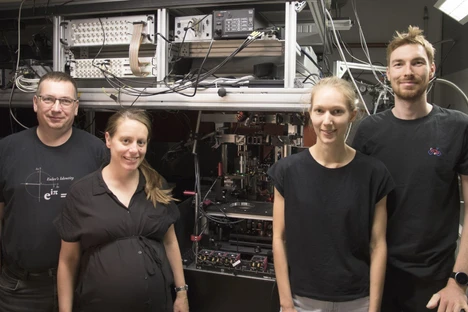
<li><strong>Photo:</strong> TU Wien: Ultra-short light pulses enable high-precision &quot;artificial nose&quot; - Hongtao Hu and Vinzenz Stummer.</li>
</ul>
  • Photo: TU Wien: Ultra-short light pulses enable high-precision "artificial nose" - Hongtao Hu and Vinzenz Stummer.

Whether you want to analyze environmental samples in nature or monitor a chemical experiment, you often need highly sensitive sensors that can "sniff out" even tiny traces of a certain gas with extreme accuracy. Variants of Raman spectroscopy are often used for this purpose: Different molecules react in very characteristic ways to light of different wavelengths. If you irradiate a sample with the appropriate light and measure exactly how the light is modified by the sample, you can find out whether the sample contains a certain gas or not.

However, scientists at TU Wien (Vienna) has now taken a significant step forward in this area: a new method has been developed to generate and precisely control suitable light for such experiments. This not only enables much greater accuracy than before, the method also works without moving parts and is therefore much faster than the best technologies to date. The method has now been published in the journal "Light: Science and Applications".

Stimulated Raman emission: wobbling atoms

The basis of the new technology is so-called "stimulated Raman emission" - a quantum physical process in which several photons are involved simultaneously. A sample is irradiated with light that consists of two slightly different wavelengths. A molecule in the sample can therefore be hit simultaneously by two photons that carry slightly different amounts of energy. It can then happen that the high-energy photon and the lower-energy photon suddenly become two lower-energy photons - the remaining energy difference leads to the molecule suddenly having a little more energy than before. The atoms of the molecule can be stimulated to wobble or rotate, for example.

This means that the number of higher-energy photons has decreased and the number of lower-energy photons has increased. This is precisely how you can tell that the molecule you are looking for was actually in the sample.

"Normally, however, this is a laborious process," explains Hongtao Hu from the Institute of Photonics at TU Wien, the first author of the current paper. "You have to carefully try out one wavelength after another - for example, by directing the light at a crystal and then slowly rotating the angle or changing the temperature of the crystal so that the sample is hit by many different wavelengths over time."

TU Wien: Ultra-short light pulses enable high-precision "artificial nose" - Hongtao Hu and Vinzenz Stummer.TU Wien: Ultra-short light pulses enable high-precision "artificial nose" - Hongtao Hu and Vinzenz Stummer.

Femtosecond laser pulses

At TU Wien, however, Prof. Andrius Baltuska's research group cooperated with Dr. Xinhua Xie from SwissFEL at Paul Scherrer Institute, Switzerland, and Prof. Alexei Zheltikov from the Department of physics and Astonomy at Texas A&M university, USA, to measure the Raman using a special light source. Andrius Baltuska's group had been working on this light source for years. Hongtao Hu and the co-authors have now been able to show through extensive computer simulations that it can achieve much higher precision than conventional methods. "We don't just produce one wavelength, but a series of ultra-short light pulses," explains Prof. Andrius Baltuska. "Each of these pulses has a duration in the femtosecond range."

These light pulse series do not have a specific wavelength - they are made up of many different wavelengths. The decisive factor is the phase of the light waves - i.e. the position of wave crests and troughs. "By changing the phase, we can shift all these wavelengths that make up the pulse a little at the same time," says Hongtao Hu. "You then get a Raman signal at very specific wavelengths, but not at others. Our method therefore allows us to examine a specific wave range in a very elegant way without having to adjust any moving parts. In principle, this allows us to differentiate between very different molecules."

Higher spectral resolution than ever before

Hongtao Hu was able to show: The longer the series of light pulses, the higher the precision: "You can therefore achieve a significantly higher spectral resolution with a series of many individual pulses than ever before," says Hongtao Hu. In principle, it is also possible to distinguish Raman transitions from each other that come from different molecules, whose signals looked almost exactly the same if the spectral resolution is not high enough. Possible applications for the new technology range from environmental analysis to quality assurance in the chemical industry and biological imaging.

TU Wien
LinkedIn Logo
 

Related content

Detection of Phenol Leakage into Wastewater Using TOC Measurement

Applications
| 2026 | Shimadzu
Instrumentation
TOC
Manufacturer
Shimadzu
Industries
Environmental

Routine Analysis of Rare Earth Elements in Basalt using ICP-MS

Applications
| 2026 | Agilent Technologies
Instrumentation
ICP/MS
Manufacturer
Agilent Technologies
Industries
Materials Testing

Analysis of rare earth elements in clay using XRF and XRD

Applications
| 2026 | Thermo Fisher Scientific
Instrumentation
XRD
Manufacturer
Thermo Fisher Scientific
Industries
Materials Testing

Measurement of TOC in Chloroisocyanuric Acid Used as Disinfectant

Applications
| 2026 | Shimadzu
Instrumentation
TOC
Manufacturer
Shimadzu
Industries
Pharma & Biopharma

High Precision Analysis of Major Components in Precious Metals by ICP-OES

Applications
| 2025 | Agilent Technologies
Instrumentation
ICP-OES
Manufacturer
Agilent Technologies
Industries
Materials Testing
 

Related articles

Detecting nanoplastics – in fractions of a second
Article | Scientific article

Detecting nanoplastics – in fractions of a second

Tiny plastic particles are an environmental problem. They can even penetrate living cells. A method has now been developed at TU Wien to detect such particles quickly and with high sensitivity.
TU Wien
tag
share
more
What waves know about their surroundings
Article | Scientific article

What waves know about their surroundings

A theory of information carried by waves has now been developed at TU Wien – with astonishing results that can be utilised for technical applications.
TU Wien
tag
share
more
Atomic Nucleus Excited with Laser: A Breakthrough after Decades
Article | Video

Atomic Nucleus Excited with Laser: A Breakthrough after Decades

The "thorium transition", has now been excited for the first time with lasers. This paves the way for revolutionary high precision technologies, including nuclear clocks.
TU Wien
tag
share
more
Spin waves as the key to more sustainable AI: Ondřej Wojewoda makes a breakthrough in measurement using Brillouin spectroscopy of light
Article | Science and research

Spin waves as the key to more sustainable AI: Ondřej Wojewoda makes a breakthrough in measurement using Brillouin spectroscopy of light

The growing influence of AI brings with it huge energy demands, which in turn bring large-scale climate challenges. Ondřej Wojewoda from CEITEC BUT brings a revolutionary solution in his PhD thesis.
CEITEC
tag
share
more
 

Related content

Detection of Phenol Leakage into Wastewater Using TOC Measurement

Applications
| 2026 | Shimadzu
Instrumentation
TOC
Manufacturer
Shimadzu
Industries
Environmental

Routine Analysis of Rare Earth Elements in Basalt using ICP-MS

Applications
| 2026 | Agilent Technologies
Instrumentation
ICP/MS
Manufacturer
Agilent Technologies
Industries
Materials Testing

Analysis of rare earth elements in clay using XRF and XRD

Applications
| 2026 | Thermo Fisher Scientific
Instrumentation
XRD
Manufacturer
Thermo Fisher Scientific
Industries
Materials Testing

Measurement of TOC in Chloroisocyanuric Acid Used as Disinfectant

Applications
| 2026 | Shimadzu
Instrumentation
TOC
Manufacturer
Shimadzu
Industries
Pharma & Biopharma

High Precision Analysis of Major Components in Precious Metals by ICP-OES

Applications
| 2025 | Agilent Technologies
Instrumentation
ICP-OES
Manufacturer
Agilent Technologies
Industries
Materials Testing
 

Related articles

Detecting nanoplastics – in fractions of a second
Article | Scientific article

Detecting nanoplastics – in fractions of a second

Tiny plastic particles are an environmental problem. They can even penetrate living cells. A method has now been developed at TU Wien to detect such particles quickly and with high sensitivity.
TU Wien
tag
share
more
What waves know about their surroundings
Article | Scientific article

What waves know about their surroundings

A theory of information carried by waves has now been developed at TU Wien – with astonishing results that can be utilised for technical applications.
TU Wien
tag
share
more
Atomic Nucleus Excited with Laser: A Breakthrough after Decades
Article | Video

Atomic Nucleus Excited with Laser: A Breakthrough after Decades

The "thorium transition", has now been excited for the first time with lasers. This paves the way for revolutionary high precision technologies, including nuclear clocks.
TU Wien
tag
share
more
Spin waves as the key to more sustainable AI: Ondřej Wojewoda makes a breakthrough in measurement using Brillouin spectroscopy of light
Article | Science and research

Spin waves as the key to more sustainable AI: Ondřej Wojewoda makes a breakthrough in measurement using Brillouin spectroscopy of light

The growing influence of AI brings with it huge energy demands, which in turn bring large-scale climate challenges. Ondřej Wojewoda from CEITEC BUT brings a revolutionary solution in his PhD thesis.
CEITEC
tag
share
more
 

Related content

Detection of Phenol Leakage into Wastewater Using TOC Measurement

Applications
| 2026 | Shimadzu
Instrumentation
TOC
Manufacturer
Shimadzu
Industries
Environmental

Routine Analysis of Rare Earth Elements in Basalt using ICP-MS

Applications
| 2026 | Agilent Technologies
Instrumentation
ICP/MS
Manufacturer
Agilent Technologies
Industries
Materials Testing

Analysis of rare earth elements in clay using XRF and XRD

Applications
| 2026 | Thermo Fisher Scientific
Instrumentation
XRD
Manufacturer
Thermo Fisher Scientific
Industries
Materials Testing

Measurement of TOC in Chloroisocyanuric Acid Used as Disinfectant

Applications
| 2026 | Shimadzu
Instrumentation
TOC
Manufacturer
Shimadzu
Industries
Pharma & Biopharma

High Precision Analysis of Major Components in Precious Metals by ICP-OES

Applications
| 2025 | Agilent Technologies
Instrumentation
ICP-OES
Manufacturer
Agilent Technologies
Industries
Materials Testing
 

Related articles

Detecting nanoplastics – in fractions of a second
Article | Scientific article

Detecting nanoplastics – in fractions of a second

Tiny plastic particles are an environmental problem. They can even penetrate living cells. A method has now been developed at TU Wien to detect such particles quickly and with high sensitivity.
TU Wien
tag
share
more
What waves know about their surroundings
Article | Scientific article

What waves know about their surroundings

A theory of information carried by waves has now been developed at TU Wien – with astonishing results that can be utilised for technical applications.
TU Wien
tag
share
more
Atomic Nucleus Excited with Laser: A Breakthrough after Decades
Article | Video

Atomic Nucleus Excited with Laser: A Breakthrough after Decades

The "thorium transition", has now been excited for the first time with lasers. This paves the way for revolutionary high precision technologies, including nuclear clocks.
TU Wien
tag
share
more
Spin waves as the key to more sustainable AI: Ondřej Wojewoda makes a breakthrough in measurement using Brillouin spectroscopy of light
Article | Science and research

Spin waves as the key to more sustainable AI: Ondřej Wojewoda makes a breakthrough in measurement using Brillouin spectroscopy of light

The growing influence of AI brings with it huge energy demands, which in turn bring large-scale climate challenges. Ondřej Wojewoda from CEITEC BUT brings a revolutionary solution in his PhD thesis.
CEITEC
tag
share
more
 

Related content

Detection of Phenol Leakage into Wastewater Using TOC Measurement

Applications
| 2026 | Shimadzu
Instrumentation
TOC
Manufacturer
Shimadzu
Industries
Environmental

Routine Analysis of Rare Earth Elements in Basalt using ICP-MS

Applications
| 2026 | Agilent Technologies
Instrumentation
ICP/MS
Manufacturer
Agilent Technologies
Industries
Materials Testing

Analysis of rare earth elements in clay using XRF and XRD

Applications
| 2026 | Thermo Fisher Scientific
Instrumentation
XRD
Manufacturer
Thermo Fisher Scientific
Industries
Materials Testing

Measurement of TOC in Chloroisocyanuric Acid Used as Disinfectant

Applications
| 2026 | Shimadzu
Instrumentation
TOC
Manufacturer
Shimadzu
Industries
Pharma & Biopharma

High Precision Analysis of Major Components in Precious Metals by ICP-OES

Applications
| 2025 | Agilent Technologies
Instrumentation
ICP-OES
Manufacturer
Agilent Technologies
Industries
Materials Testing
 

Related articles

Detecting nanoplastics – in fractions of a second
Article | Scientific article

Detecting nanoplastics – in fractions of a second

Tiny plastic particles are an environmental problem. They can even penetrate living cells. A method has now been developed at TU Wien to detect such particles quickly and with high sensitivity.
TU Wien
tag
share
more
What waves know about their surroundings
Article | Scientific article

What waves know about their surroundings

A theory of information carried by waves has now been developed at TU Wien – with astonishing results that can be utilised for technical applications.
TU Wien
tag
share
more
Atomic Nucleus Excited with Laser: A Breakthrough after Decades
Article | Video

Atomic Nucleus Excited with Laser: A Breakthrough after Decades

The "thorium transition", has now been excited for the first time with lasers. This paves the way for revolutionary high precision technologies, including nuclear clocks.
TU Wien
tag
share
more
Spin waves as the key to more sustainable AI: Ondřej Wojewoda makes a breakthrough in measurement using Brillouin spectroscopy of light
Article | Science and research

Spin waves as the key to more sustainable AI: Ondřej Wojewoda makes a breakthrough in measurement using Brillouin spectroscopy of light

The growing influence of AI brings with it huge energy demands, which in turn bring large-scale climate challenges. Ondřej Wojewoda from CEITEC BUT brings a revolutionary solution in his PhD thesis.
CEITEC
tag
share
more
Other projects
GCMS
LCMS
Follow us
FacebookLinkedInYouTube
More information
WebinarsAbout usContact usTerms of use
LabRulez s.r.o. All rights reserved. Content available under a CC BY-SA 4.0 Attribution-ShareAlike