The LECO 832 Series elemental determinators are engineered to deliver high productivity, analytical precision, and long-term reliability for the determination of carbon and sulfur in a wide range of organic and selected inorganic materials. By combining robust combustion technology with advanced infrared detection and the intuitive Cornerstone® touchscreen software platform, the 832 Series supports fast, accurate analysis while optimizing laboratory workflows.
Its compact yet rugged design minimizes bench space requirements while providing excellent usability and operational control. A high-efficiency combustion furnace, enhanced IR detector stability, and intelligent system control make the 832 Series a dependable solution for laboratories requiring consistent, high-quality carbon and sulfur results.
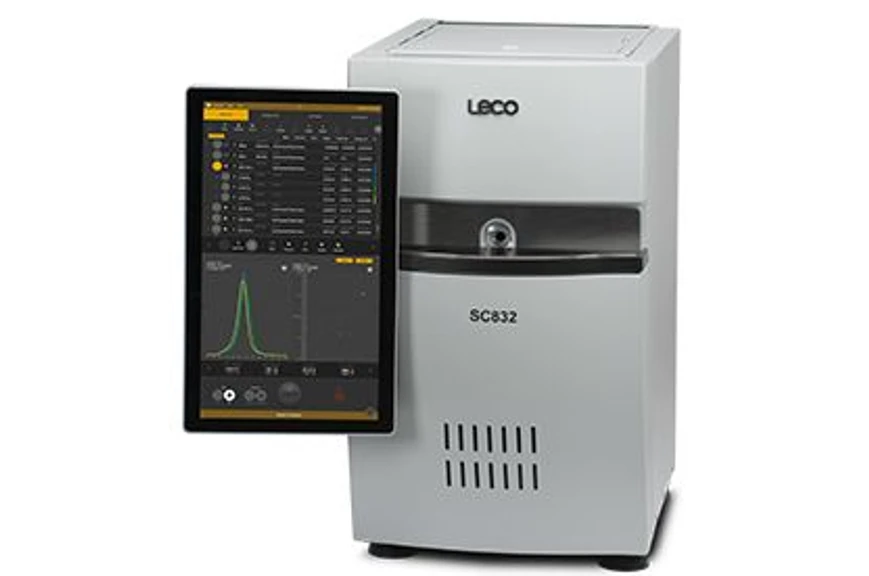 LECO 832 Series
Key Features and System Capabilities
Automated Sample Handling
An optional autoloader significantly improves laboratory efficiency by enabling unattended operation. The autoloader accommodates up to 100 samples and is built with a rugged mechanical design to ensure reliable long-term performance. Automated handling simplifies operator workflows while maintaining consistent, rapid analysis cycle times.
Enhanced Infrared Detection Performance
The 832 Series incorporates an improved infrared (IR) cell design that delivers increased signal stability and measurement precision. Independent, wide-range IR detectors are dedicated to carbon and sulfur, ensuring optimized sensitivity across a broad concentration range. Enhanced temperature control, electrical isolation, and updated circuitry further improve detector performance and reliability.
Dual-Range Sulfur Detection Option
For laboratories analyzing samples with widely varying sulfur concentrations, optional dual-range (DR) sulfur detection provides extended measurement flexibility. This configuration employs both short and long optical path length IR cells, allowing accurate quantification of both high- and low-level sulfur within a single system. The software automatically selects the appropriate detection path to ensure optimal results.
High-Efficiency Combustion Furnace
The furnace system is engineered for maximum combustion efficiency and durability. Intelligent temperature control allows operating temperatures of up to 1550 °C, ensuring complete oxidation of even refractory materials. The furnace design supports rapid heating, stable operation, and long service life.
Simplified Maintenance Access
Routine maintenance tasks are streamlined through easy access to key service areas. This design minimizes downtime and reduces the overall cost of ownership while supporting consistent analytical performance.
Application Areas
The LECO 832 Series is suitable for a wide range of industrial, environmental, and research applications, including:
- Coal and coke
- Combustion residues and biomass materials
- Catalyst materials
- Cement, hydrated lime, and building materials
- Soils, ores, ceramics, glass, and gypsum
- Fertilizers, feeds, and plant tissue
- Rubber, resins, and polymers
- Graphite
- Petroleum products and additives
Principle of Operation
The 832 Series is designed to determine carbon and sulfur content using high-temperature combustion followed by non-dispersive infrared (NDIR) detection. The technique is applicable to a wide variety of organic materials, such as coal, coke, and fuel oils, as well as selected inorganic materials including soils, cement, and limestone.
Analysis begins with the sample being weighed into a ceramic combustion boat and introduced into the furnace, typically regulated at 1350 °C under a pure oxygen atmosphere. During combustion, carbon is oxidized to carbon dioxide (CO₂), while sulfur-containing compounds are converted to sulfur dioxide (SO₂).
After an initial combustion period, additional oxygen is delivered directly above the sample via a ceramic lance to accelerate oxidation of refractory materials. Combustion gases pass through the inner and outer furnace tubes, extending their residence time in the high-temperature zone to ensure complete oxidation.
Upon exiting the furnace, gases flow through anhydrone drying tubes to remove moisture before entering the flow control system. The regulated gas stream is then directed through the NDIR detection cells for carbon and/or sulfur measurement.
NDIR detection is based on the selective absorption of infrared radiation by CO₂ and SO₂ at characteristic wavelengths. In dual-range sulfur models, both short and long path length IR cells are used to accommodate wide sulfur concentration ranges. The software automatically selects the appropriate cell for optimal quantification.
All calculations, data processing, and result storage are managed by the Cornerstone® software running on an external PC, with concentrations determined relative to calibration standards.
Available Models
- S832 – Sulfur Analyzer
- S832DR – Dual-Range Sulfur Analyzer
- S832HT – High-Temperature Dual-Range Sulfur Analyzer
- C832 – Carbon Analyzer
- SC832 – Carbon and Sulfur Analyzer
- SC832DR – Dual-Range Carbon and Sulfur Analyzer
- SC832HT – High-Temperature Dual-Range Carbon and Sulfur Analyzer