Easily perform wide-range carbon and sulfur analysis with the LECO CS844 Series. Designed for the determination of carbon and sulfur in primary steels, ores, finished metals, ceramics, and other inorganic materials, the CS844 uses proven combustion technology combined with advanced hardware and LECO’s Cornerstone® touch-screen software. The result is improved usability, higher productivity, and a lower cost per analysis for demanding metallurgical laboratories.
Available Models
The CS844 Series offers flexible configurations to match different analytical needs:
- CS844 – Carbon and Sulfur Analyzer
- C844 – Carbon Analyzer
- S844 – Sulfur Analyzer
- CS844ES – Carbon and Enhanced Sulfur Analyzer
- S844ES – Enhanced Sulfur Analyzer
Key Features and Benefits
The CS844 Series is engineered to maximize laboratory efficiency, uptime, and analytical performance:
Automation to maximize productivity
- 10- and 60-position shuttle loaders available
- Integrated robotic process loader option for extended unattended operation
Low-maintenance operation
- High-efficiency autocleaner and vacuum system minimizes routine maintenance
- Automatic combustion tube service and exchange system reduces downtime
Operator-focused design
- Ergonomic, boom-mounted touch-screen interface for comfortable and intuitive operation
- Cornerstone® software provides streamlined control and real-time diagnostics
Advanced infrared detection
- Improved IR cell design with dual-range detection
- Enhanced long-term stability and extended detector lifetime
Efficient furnace design
- High-efficiency induction furnace with low-maintenance construction
- Reduced need for accelerants and cleaning, lowering operating costs
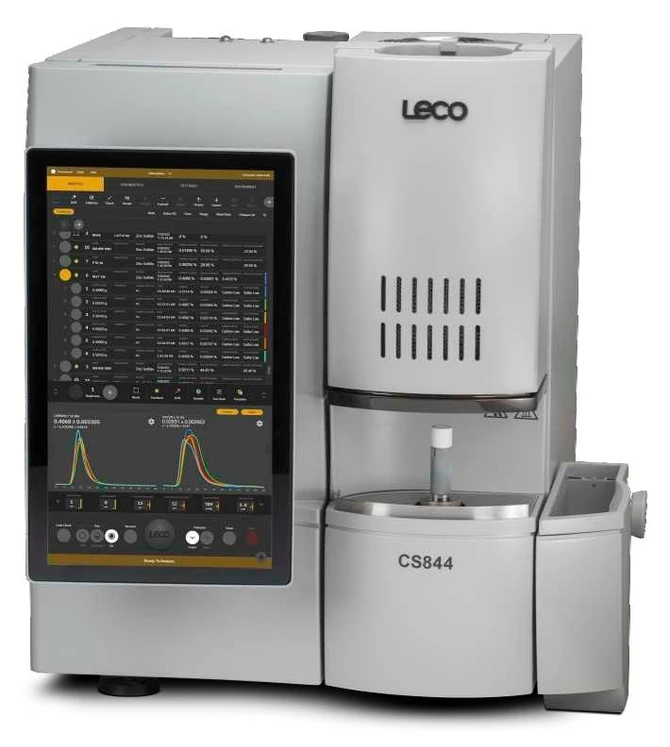 LECO 844 Series
Applications
The CS844 Series is ideally suited for the analysis of:
- Primary steels
- Ores and minerals
- Finished metals and alloys
- Ceramics
- Other inorganic materials
Theory of Operation
The CS844 Carbon/Sulfur system is designed for the wide-range determination of carbon and sulfur in metals, ores, ceramics, and other inorganic materials using combustion and infrared detection. The analyzer is controlled by custom Cornerstone® software optimized for touch-screen operation.
A pre-weighed sample, typically around 1 gram, is combusted in a stream of purified oxygen using RF induction heating. During combustion, carbon and sulfur in the sample are oxidized to carbon dioxide (CO₂) and sulfur dioxide (SO₂). The oxygen carrier gas transports the combustion gases through a heated dust filter and a drying reagent before entering the detection system.
Sulfur is measured first as SO₂ using non-dispersive infrared (NDIR) detection. The gas stream then passes through a heated catalyst, where carbon monoxide (CO) is converted to CO₂ and SO₂ is further oxidized to sulfur trioxide (SO₃), which is subsequently removed by a filter. Carbon is then detected as CO₂ using a second set of NDIR cells.
To ensure measurement stability, a pressure controller maintains constant pressure within the IR cells, minimizing the influence of ambient atmospheric pressure variations. An electronic flow sensor at the end of the flow path provides continuous diagnostic monitoring of carrier gas flow.
NDIR detection is based on the absorption of infrared energy by CO₂ and SO₂ at characteristic wavelengths. Because absorption depends on optical path length, both short and long path-length IR cells are used to cover high- and low-concentration ranges. The software automatically selects the appropriate detection path to ensure optimal measurement performance.
Sample concentrations are determined relative to calibration standards. To reduce the effects of instrument drift, reference measurements using pure carrier gas are performed prior to each analysis.