The GDS900 Glow Discharge Spectrometer delivers advanced, reliable technology for routine elemental determination in electrically conductive solid materials. Designed for high-performance industrial and laboratory environments, the GDS900 combines robust hardware with intuitive Cornerstone® software to simplify operation, reporting, and data handling while reducing overall analysis time.
Key Features
Glow Discharge Source Advantages
- Simple, linear calibrations compared to alternative excitation sources
- Controlled excitation occurring away from the sample surface
- Reduced consumption of reference materials
- Automatic source cleaning between analyses to save time and minimize matrix effects
- Improved analytical performance and reproducibility
Detection System Performance
- Full wavelength coverage from 160 to 460 nm
- High spectral resolution of 50 pm (0.050 nm) for resolving complex spectral features
- Stable, flexible detection platform based on CCD array technology
Optional CDP (Compositional Depth Profiling) Capability
- Enables depth-resolved elemental analysis of conductive solids
- Ideal for applications such as plating, galvanizing, cladding, and surface heat treatments
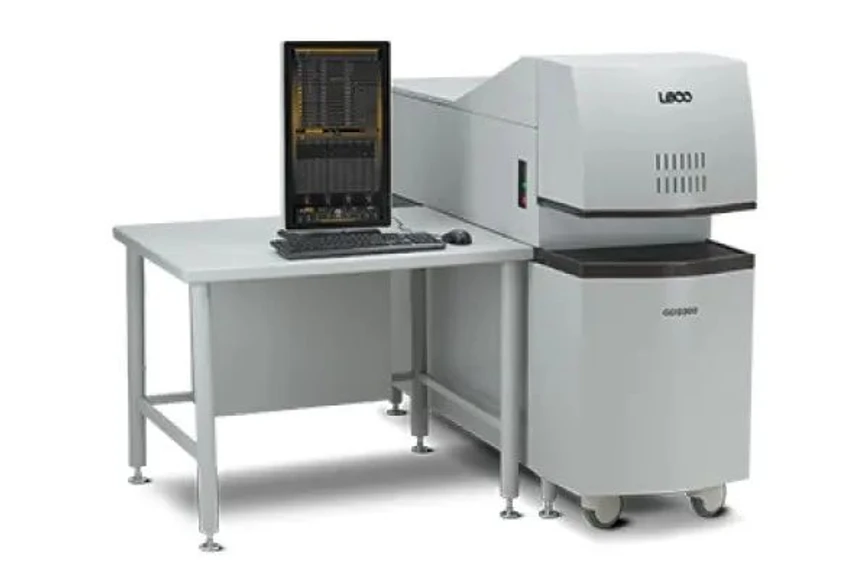 LECO: GDS900 Glow Discharge Atomic Emission Spectrometer
Applications
The GDS900 is optimized for bulk elemental analysis of conductive solid materials, including steel, cast iron, titanium, and other metals. When equipped with the CDP option, it also supports compositional depth profiling of treated surfaces such as galvanizing layers, plated coatings, claddings, and heat-treated materials.
Theory of Operation
Glow Discharge Spectrometry (GDS) is a direct analytical technique for determining the elemental composition of solid samples. A flat, prepared sample is mounted onto the glow discharge source, which is evacuated and then filled with argon gas. An electric field is applied between the sample, acting as the cathode, and the grounded lamp body, serving as the anode.
This setup generates a stable, self-sustained glow discharge plasma. Argon ions formed in the plasma are accelerated toward the sample surface, where they transfer kinetic energy to surface atoms through cathodic sputtering. These atoms are ejected into the plasma and become excited through collisions with energetic electrons or metastable argon atoms.
As the excited atoms return to lower energy states, they emit photons at characteristic wavelengths unique to each element. The emitted light is collected by a spectrometer whose optical system is continuously purged with argon to maintain transparency across the ultraviolet and visible range.
Photosensitive CCD detector arrays capture the full emission spectrum from 160 to 460 nm simultaneously. The resulting signals are digitized and processed to correct for dark current, normalize pixel response, extend dynamic range, and eliminate pixel artifacts. Since emitted photon intensity is proportional to elemental concentration, quantitative results are obtained through calibration with certified reference materials.
Models
GDS900DCBO
- DC lamp for electrically conductive samples
- Bulk elemental analysis
- Rotary vane pump
GDS900DCEXBO
- DC lamp for electrically conductive samples
- Bulk elemental analysis with extended wavelength range
- Rotary vane pump
GDS900DCQO
- DC lamp for electrically conductive samples
- Bulk elemental and CDP analysis
- Rotary vane pump
GDS900DCQEXO
- DC lamp for electrically conductive samples
- Bulk elemental and CDP analysis with extended wavelength range
- Rotary vane pump
Options
- Integrated desk or mobile workstation
- High-purity gas regulators
- Vacuum pump sound abatement enclosure