Invited Speakers at RAFA 2026 Symposium
RAFA: Invited Speakers at RAFA 2026 Symposium - Milena Stranska and Michael Rychlik
Scientific conferences are defined not only by the quality of the research presented but also by the expertise and vision of their invited speakers. RAFA 2026 brings together internationally recognized scientists from academia, industry, and regulatory organizations to address some of today's most pressing challenges in food analysis and food safety. Their lectures will explore cutting-edge analytical techniques, emerging contaminants, food authenticity, artificial intelligence, high-resolution mass spectrometry, allergen risk assessment, PFAS, microplastics, mycotoxins, and many other topics shaping the future of food analysis. This overview introduces the distinguished invited speakers and the scientific highlights they will present at RAFA 2026.
Registration
Registration Fees
- Regular registration (Until 30 September, 2026): € 855
- Late registration (From 1 October, 2026): € 955
- Student rate* (From 1 July, 2026): € 605
* The proof of student status (e.g. copy of a student identify card) is requested as an attachment of the registration form.
The regular registration fee will include:
- Attendance at all scientific sessions, workshops, seminars, vendor seminars and other satellite events
- Access to the poster and exhibition area
- Conference kit (name badge, conference bag, conference documents, certificate of participation, certificate of presentation on request)
- Final programme
- E-Book of Abstracts
- Coffee breaks
- Buffet luncheons
- Welcome drink
In the registration form you can register free of charge for the welcome drink and you can also order ticket(s) for the conference dinner (€ 85).
Please note that your registration is firm when your payment has been received.
Abstract submission
In order to submit an abstract, you must first register to attend RAFA 2026. After registration you will receive an access to the Member section where you can submit your abstract(s).
After successful submission of your abstract you will receive an automatic confirmation of receipt of submitted abstract via e-mail. If it will not be delivered within a few minutes after submission of your abstract please check at first your spam box-mail and then contact us at [email protected].
Important notice:
1 registered participant can submit no more than 2 abstracts.
To apply for a young scientist’s oral presentation, as an indication please respect the rule that you should be born in 1991 or later.
The text of the abstract should be limited to 3000 characters including spaces. Tables and pictures are not allowed.
Program
Invited Speakers
It takes a small step to fake food but a giant leap to authenticate
- Nicolai Zederkopff Ballin from Danish Veterinary, Food, Agriculture and Fisheries Agency, Glostrup, Denmark.
It takes a small step to fake food but a giant leap to authenticate”: Exploring unresolved issues in food authentication. Food authentication includes not just analytical chemistry, but also nomenclature, validation procedures and reporting of results. These aspects have attracted increasing focus, but setting limits in food authentication has been largely absent. It is therefore time to discuss how to set maximum tolerable levels to enable consistent and comparable results in food authentication.
Unravelling the mysteries of modified mycotoxins
- Franz Berthiller from BOKU University, Vienna, Austria
Modified mycotoxins are altered forms of mycotoxins, mainly formed by living plants on the field. They are not regulated, yet may contribute to toxicity. The presentations focuses on metabolites of fumonisin B1 and ochratoxin A, formed by maize plants.
From bitter to better: Fixing off-flavors in plant proteins
- Corinna Dawid from Leibniz Institute for Food Systems Biology at the Technical University of Munich, Freising, Germany
Uncovering the chemistry behind flavor: the presentation explores how Sensomics and NMR interaction studies reveal the complex interplay between aroma compounds, taste perception, and the polymer matrix in wine.
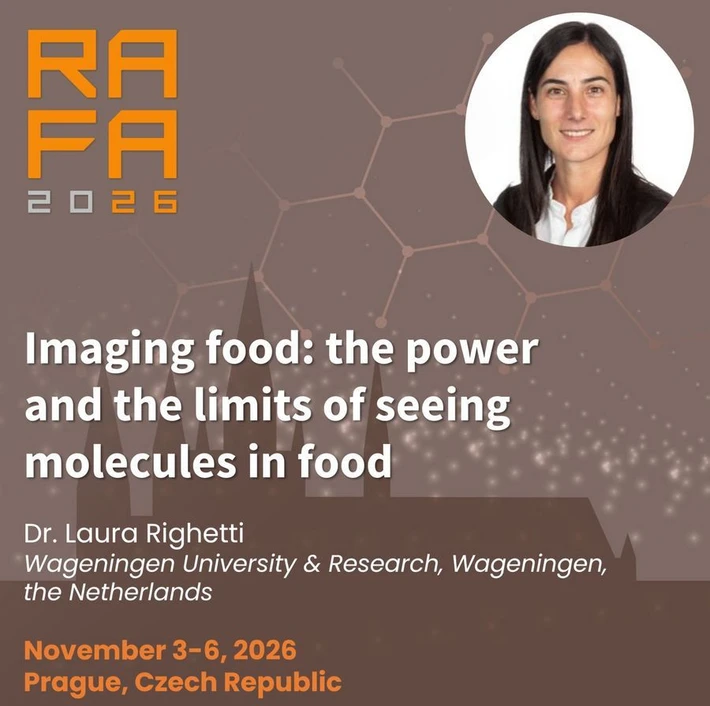
Imaging food: the power and the limits of seeing molecules in food
- Laura Righetti from Wageningen University & Research, Wageningen, the Netherlands
Imaging techniques enable ‘seeing’ molecules in food and elucidating mechanisms of accumulation and transformation, e.g. during processing. However, their application to food and contaminants remains limited. This talk discusses both instrumental constraints and future opportunities.
 RAFA: Laura Righetti
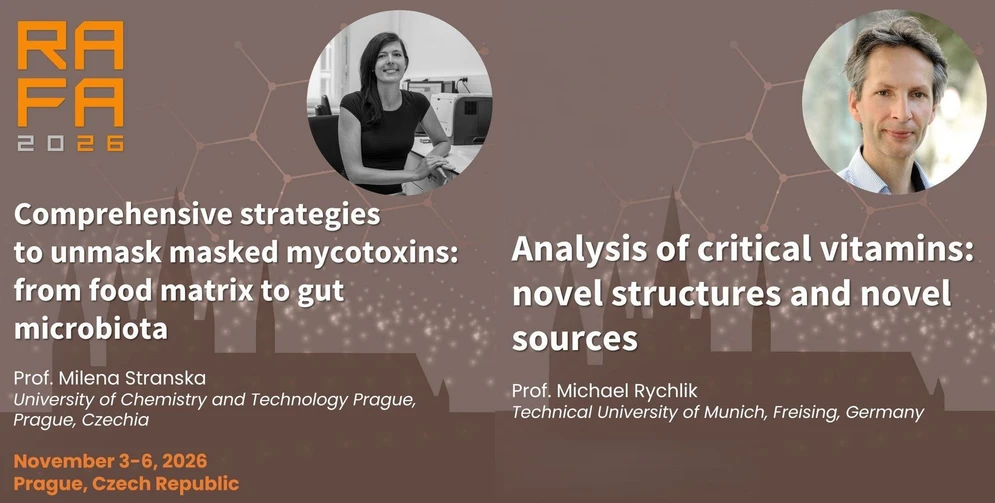
Analysis of critical vitamins: novel structures and novel sources
- Michael Rychlik Lab from Technical University of Munich, Freising, Germany
Growing population and dietary shifts lead to inadequate intake of folate, B6, and B12. The presentation introduces novel analytical methods (stable isotope dilution assays), identifies new sources, and assesses risks of certain dietary patterns.
Sample-to-solution approaches for natural toxin analysis at the point of need
- Gert Salentijn from Wageningen University & Research, Wageningen, the Netherlands
Taking analysis out of the lab is not trivial. Going beyond merely translating procedures from the lab to an out-of-lab setting, it requires a fundamentally different perspective on how we develop and deploy the tools to provide information at the point-of-need. In this, both the envisioned test, as well as the envisioned user are critical, and all the steps, from sample to solution, need to be considered.
EFSA’s rapid risk assessment of cereulide in infants
- Hans Steinkellner from European Food Safety Authority, Parma, Italy
The EU has established procedures for rapid risk assessment in urgent situations. EFSA’s assessment of cereulide in infants demonstrated its ability to provide robust scientific support within a short timeframe during a crisis.
Comprehensive strategies to unmask masked mycotoxins: from food matrix to gut microbiota
- Milena Stranska from University of Chemistry and Technology Prague, Prague, Czechia
The lecture will address non-extractable modified mycotoxins and their biological relevance. Bioaccessibility will be assessed using in vitro digestion models with diverse fecal microbiota (toddlers, children, adults) and bioavailability using Caco-2-based intestinal models. High-resolution mass spectrometry will reveal biotransformation pathways and cellular metabolism of free and modified mycotoxins.
Food allergen risk assessment: Past, present, future
- Ben Remington from Remington Consulting Group B.V., Utrecht, the Netherlands & University of Nebraska, USA
Food allergy and allergen management are global public health issues, and consumer protection depends on transparent and trustworthy labelling. While 30 years of scientific advances show that low level exposures, or reference doses, are unlikely to trigger reactions in most allergic individuals, harmonized and globally aligned regulations are still needed to promote consistent allergen risk assessment and labelling decisions. This presentation will discuss the landscape of allergen risk assessment, global policy developments, current research and future needs in the area.
Unmasking hidden adulteration in honey: Strategies for detecting and characterizing honeys produced from sugar-fed colonies
- Oscar Nuñez Burcio from University of Barcelona, Barcelona, Spain
From hive to jar, not all honey tells the same story. This presentation addresses hidden adulteration associated with sugar-fed bee colonies, highlighting implications for authenticity, production practices, and the need for a more precise characterization of honey to ensure consumer trust.
Analytical and toxicological methods for safety of food contact materials
- Erich Leitner from Graz University of Technology, Institute of Analytical Chemistry and Food Chemistry, Graz, Austria
Food packaging plays a critical role in protecting and preserving food throughout the supply chain. All packaging materials intended to come into contact with food must comply with strict EU safety rules. Due to increased complexity of packaging solutions, lowering legal limits and increasing numbers of target compounds, we also have to adapt the strategies used to verify and guarantee the safety of these materials.
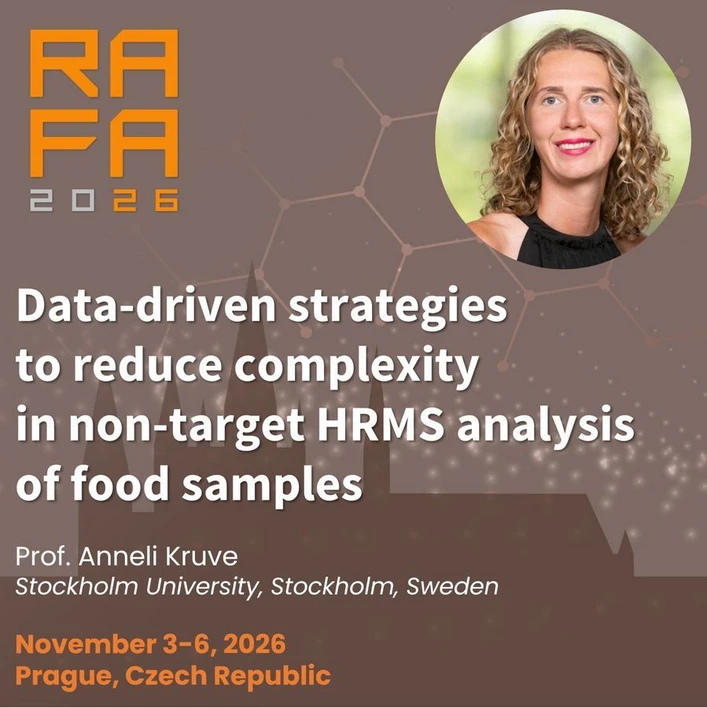
Data-driven strategies to reduce complexity in non-target HRMS analysis of food samples
- Anneli Kruve from Stockholm University, Stockholm, Sweden
LC/HRMS based non-target screening can detect hundreds to thousands of chemical features in complex food and environmental samples. Investigating all of these in detail is practically impossible, so which ones to focus on? Novel computational tools developed in computational mass spectrometry allow predicting the toxicity and concentration of the detected chemical features even if these have not yet been fully structurally elucidated. Combining these predictions enables us to focus on the chemical features possessing high risk.
 RAFA: Anneli Kruve
Role of AI in the identification of emerging food systems risks
- Ákos Bernard Jóźwiak from Syreon Research Institute, Budapest, Hungary
AI-assisted evidence synthesis – spanning curated scientific evidence, exposome data, and network analysis – is the backbone of next-generation emerging chemical food safety risk identification, enabling earlier signals and more resilient surveillance systems.
Challenges of microplastics analysis in the context of food safety
- Dorte Herzke from Norwegian Institute of Public Health, Oslo, Norway
Food and food packaging are major sources of micro- and nanoplastic exposure. Plastics used in processing, storage, and packaging can release particles through heat, abrasion, and degradation. Small particles below 2 µm may cross gut barriers and carry chemicals, highlighting the need for robust and sensitive measurement methods.
Never-ending analytical challenges in PFAS analysis of food
- Darina Dvořáková from University of Chemistry and Technology Prague, Prague, Czechia
Exploring and monitoring PFAS in food requires advanced strategies. Combining targeted, suspect, and non-target HRMS analysis, determination of total fluorine and sum parameters, and novel sensors provides new insights into PFAS occurrence and supports food safety monitoring.
An overview of the latest scientific knowledge on process contaminants in food for appropriate risk management measures
- Thierry Delatour from Nestlé Research, Lausanne, Switzerland.
Recent scientific findings related to acrylamide and furans formation, occurrence and analytical methods in food provide important insights for risk management.