Interlaboratory comparisons other than proficiency testing
Eurachem: Interlaboratory comparisons other than proficiency testing
The international standard ISO/IEC 17025 [1] clause 7.7.2 with regards to ensuring the validity of results, requires a laboratory to participate in proficiency testing (PT) and/or to participate in interlaboratory comparisons (ILCs) other than PT. However, no guidance as to what these other ILCs might be, or indeed how they might compare in relation to PT, is provided. This leaflet aims to outline other ILCs available, pointing out some of the limitations as compared to PT.
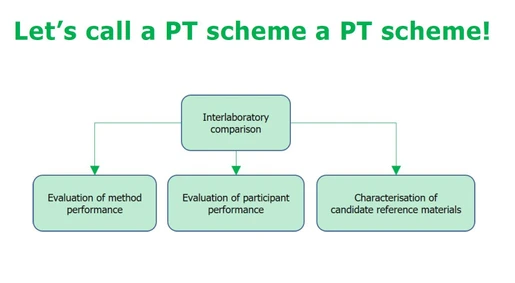
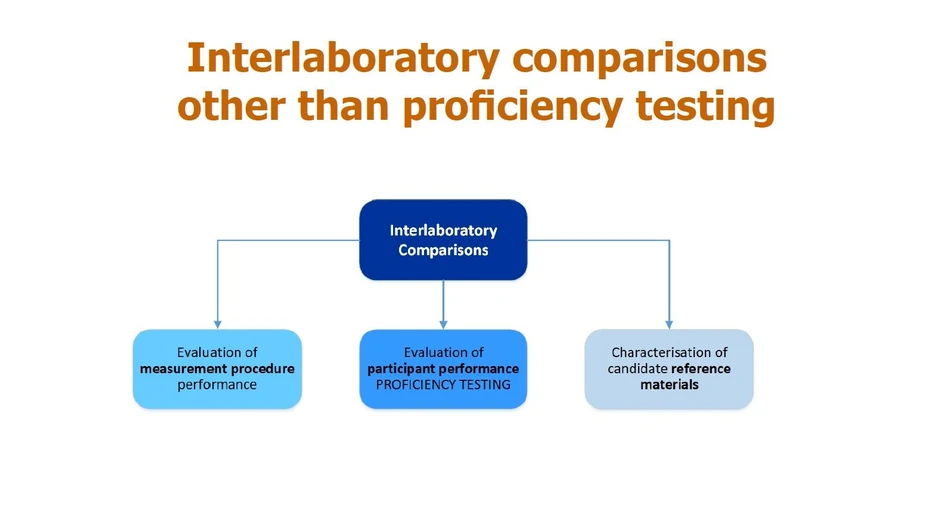
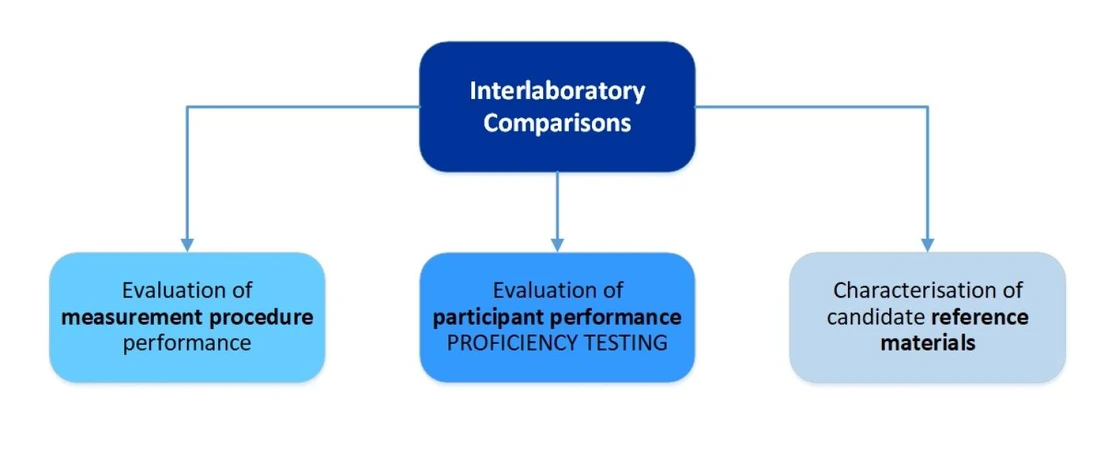
There are three major types of ILCs in which a group of laboratories analyses identical portions from a homogeneous, stable test sample, with each type being characterized by its intended purpose [2,3]:
 Eurachem: Interlaboratory comparisons other than proficiency testing
A key point is that PT is an ILC that is designed to specifically evaluate the performance of participants, providing them with an infrastructure to monitor and assess the validity of their results. This is not the key purpose of the two other ILCs, and thus depending on their intended purpose they have a number of limitations that laboratories need to be aware of when using them rather than PT. Only proficiency testing should have been conducted in full compliance to the competency standard ISO/IEC 17043 [4].
Evaluation of measurement procedure performance
These ILCs, are designed to assess how a particular measurement procedure performs and whether it is fit for its intended purpose. These ILCs are often referred to as a ‘method performance study’ or a ‘collaborative study’ [2]. Some limitations of using such ILCs for monitoring laboratory performance as an alternative to PT are:
- All participants use the same measurement procedure i.e. the measurement procedure that is being validated. Unless the measurement procedure is being routinely used by the participating laboratory such an ILC will not assess the routine performance of the laboratory using their own routine measurement procedure. Nor does it enable them to compare their performance with other laboratories using alternative measurement procedures.
- The measurement procedure is likely to be new, so participants may not have established stable procedures and quality control, so performance may not reflect routine use.
- The report from such an ILC would not provide information on the performance of the participant, if the statistical model used makes the assumption that all laboratories perform with equal variability.
- The design of the study may require the participants to assess multiple samples and/or to undertake multiple replicate analysis on the test materials. This may not be representative of the routine measurements or tests undertaken by the laboratory.
- The conclusion of the ILC might be that the measurement procedure being assessed is not valid.
 Eurachem: Interlaboratory comparisons other than proficiency testing
Characterisation of candidate reference materials
These are ILCs that assign a property value to a candidate reference material, usually with a stated measurement uncertainty. These are often referred to as a ‘material certification study’ [2]. Limitations of using such ILCs as an alternative to PT are:
- The analysis of the candidate reference material is likely to require additional care in exercising the routine measurement procedure, such as substantially more replication, and/or may require quite different reporting formats (e.g. all valid replicates instead of a mean result). Thus, such an ILC will not necessarily provide an evaluation of the performance of the laboratory based on the routine use of their measurement procedures.
- The report from such an ILC may include the results from the participating laboratories but would not provide information on the performance of each laboratory.
- Participating laboratories may be required to assess multiple samples and/or to undertake multiple replicate analysis on the candidate reference materials. Thus this may not be representative of the routine measurements or tests undertaken by the laboratory.
Other ILCs
Some other ILCs, whilst not being conducted in full compliance of the requirements of ISO/IEC 17043, may be designed to evaluate participant performance. These would include small ILCs as defined by EA‑2/21 [5] or split sample ILCs i.e. where a portion of a single sample is sent to two or three laboratories. Whilst these ILCs are specifically designed to evaluate participant performance, they may not provide a comprehensive comparison that a PT might provide. In such cases the laboratory needs to evaluate carefully the competence of the organization managing the ILC and the suitability of the service externally provided (ISO/IEC 17025 clause 6.6).
[1] ISO/IEC 17025:2017, General requirements for the competence of testing and calibration laboratories, ISO Geneva (2017).
[2] W. Horwitz, Nomenclature of interlaboratory studies (IUPAC Recommendations 1994), Pure & Appl. Chem. 66(9), 1903-1911.
[3] Eurachem leaflet “Let’s call a PT scheme a PT scheme!”. Available from www.eurachem.org.
[4] ISO/IEC 17043:2023, Conformity assessment — General requirements for the competence of proficiency testing providers, ISO Geneva (2023).
[5] EA-4/21 INF: 2018, Guidelines for the assessment of the appropriateness of small interlaboratory comparisons within the process of laboratory accreditation, European Accreditati