Author
CXI TUL
CXI TUL
The Institute for Nanomaterials, Advanced Technologies and Innovations of the Technical University of Liberec, also known as CXI TUL, was founded in 2009. Our mission is to support TUL's long-term vision of collaboration with industry and innovation.
Tags
Article
Science and research
LinkedIn Logo

Interview with Veronika Leová: From „Crazy Scientist“ to Professional Research
Fr, 5.6.2026
| Original article from: CXI TUL
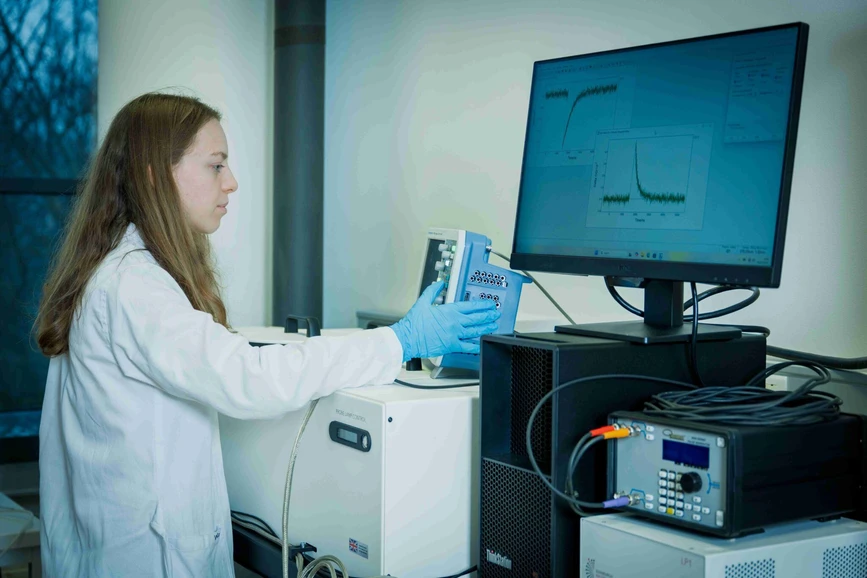
What does life in research really look like? Veronika Leová from CXI TUL shares her journey from curious student to scientist studying pharmaceutical pollutants in water.
<p><strong>CXI TUL: </strong>Interview with Veronika Leová: From „Crazy Scientist“ to Professional Research</p>

CXI TUL: Interview with Veronika Leová: From „Crazy Scientist“ to Professional Research

The life of a scientist isn’t just about wearing a white lab coat; it’s also about international internships, endless reading of articles, and searching for answers to questions no one has asked before. Veronika Leová initially had no idea what working in research entailed. Today, as a doctoral student at the CXI TUL institute in Liberec, she captures invisible radicals and seeks solutions to remove contaminants from water. How can you balance doctoral studies with playing in an orchestra, and why should every curious student try their hand at research?

How would you introduce yourself and your work to someone who has never heard of CXI TUL?

I am a doctoral student at the Faculty of Mechatronics and also work in the Department of Environmental Chemistry at the CXI TUL Institute, where we mainly focus on water treatment and monitoring, as well as removing pollution from the environment. Our institute uniquely combines mechanical engineering, software engineering, nanomaterials, and chemistry.

So, for example, do you also deal with removing residual pharmaceuticals from water?

Yes, that is one of the topics of the project I am currently in charge of. Pharmaceuticals in water are a major topic in science today.

If you had to explain the nature of your work to a layperson, what would that look like?

People always picture us in the lab, but a lot of time is spent working on the computer. We have to stay up to date on what research has already been done around the world. We then have to interpret the measured results and write scientific articles about them. The job also includes administrative tasks, ordering chemicals, and communicating with other scientists. I’ve also helped organize events and even given lectures. So a researcher’s job is very diverse.

Do you remember the moment when you first decided you wanted to pursue a career in research?

Even in high school, I was particularly interested in the natural sciences. When someone asked me what I wanted to be, I’d joke that I wanted to be a “crazy scientist,” even though I had no idea what working in science actually entailed. During my bachelor’s program, it was a bit of a rollercoaster, and I began to discover what working in science entailed, but by the time I started my master’s, I had already subconsciously decided that I would stay in research.

Was it a clear choice for you to go to CXI TUL, or did you have to choose?

I was studying at the University of Chemistry and Technology in Prague and was very hesitant about whether to stay there. But my husband and I moved to Liberec, and commuting would have been very difficult. I wanted to stay in academia, so I looked into opportunities at the Technical University, and Associate Professor Waclawek’s group interested me the most. So CXI TUL was the logical choice.
CXI TUL: Interview with Veronika Leová: From „Crazy Scientist“ to Professional ResearchCXI TUL: Interview with Veronika Leová: From „Crazy Scientist“ to Professional Research

What was the hardest part about starting your research work in Liberec?

The transition to a new topic. You have to learn everything all over again, and you don’t see tangible results for a long time. I felt unproductive when I was “just” reading articles and learning. It was hard to accept that this is a normal phase and that it takes time to fully get into the research.

Was there ever a moment when you weren’t sure whether to continue in science? What motivated you?

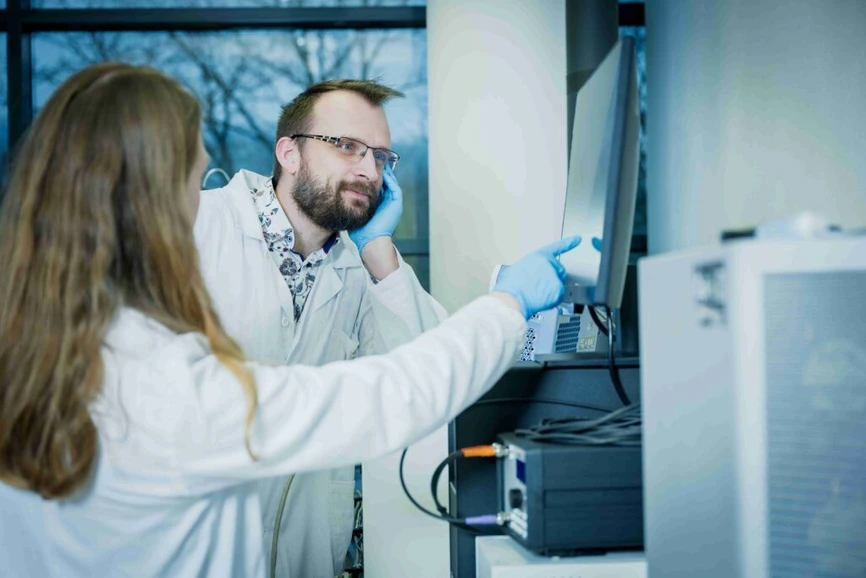
Yes, during those tough early days. When nothing is working out, you start to doubt yourself. Talking about it with colleagues or my advisor, Standa Waclawek, motivates me. At home, my husband supported me; he had been doing experimental chemistry for longer and explained to me that it’s common for experiments to fail. Sharing experiences with a friend who’s doing her PhD in Norway also helps.

What is the most interesting or “wow” moment in your research?

In science, just as in life, one should find joy in the little things. For example, we’re currently studying reactions that produce extremely reactive particles—radicals. They’re so fast that the human eye can’t detect them. But we have a new instrument that allows us to observe them. I don’t have much experience with it yet, so it’s quite challenging to set all the parameters correctly. That moment when a signal appears on the display that we weren’t even expecting—that’s the “wow” moment.

Can you recall a situation that pushed you the most, or a moment when, on the contrary, something went wrong?

Most things don’t work out, but I’ve learned that’s normal. It’s precisely failure that prompts us to investigate why it didn’t work. That leads to more questions we seek answers to, and that’s what moves us forward.

Is there such a thing as writer’s block in science? What do you do when you get stuck?

I used to get writer’s block occasionally at first, especially when experiments didn’t work out. The upside is that the work is varied. When I get stuck on a creative task, I do routine lab work or administrative tasks. I also jot down inspiration from colleagues and the literature—when I hit a dead end, I pull out that list and try a different direction.

Can science be balanced with a normal life, or do you have to sacrifice your hobbies?

Definitely. After work, I go running or play in an orchestra. These activities help me relax, and I’m refreshed for work the next day. You can devote all your time to science, but the question is, at what cost? Active rest is usually a necessity.

Does research at CXI TUL also take you out into the world?

There are plenty of opportunities, and as part of my doctoral studies, I even have a mandatory internship abroad. As part of the internship, I’ve already spent two weeks in Essen, Germany, and I’m probably heading to Vienna this fall.

Do you have any funny stories from abroad?

A funny experience abroad was our Czech-Polish project. At the first meeting, there were more Polish partners, so it was democratically decided that we would speak Polish. I had to pay close attention to understand the technical discussion.

What advice would you give to students considering a career in research?

I would advise them to think about whether they enjoy the work they do as part of their bachelor’s or master’s studies. After all, scientific work involves a combination of lab work, data analysis, writing, and research. If they’re unsure, I recommend trying an internship at a company, for example, so they have something to compare it to.

Why do you think students should give science a chance?

Compared to working in a company, you have a lot of freedom in science. You’re the master of your own time. It requires responsibility, but the flexibility is great. One day I don’t feel like writing, so I go to the lab. The next day, it’s the opposite. It’s the ideal mix of manual and creative work.

If I wanted to get started as a student at CXI TUL—what are the specific options?

The best way is to start by writing your bachelor’s or master’s thesis with us. We usually have openings and are happy to involve students in our current projects. Just don’t be afraid to reach out to a supervisor whose topic interests you.

CXI TUL
LinkedIn Logo
 

Related content

Agilent 9500 ICP‑QQQ with m‑Lens for Ultratrace Analysis of High‑Purity Reagents

Applications
| 2026 | Agilent Technologies
Instrumentation
ICP/MS, ICP/MS/MS
Manufacturer
Agilent Technologies
Industries
Semiconductor Analysis

Analysis of copper alloys with the ARL X900 XRF Spectrometer

Applications
| 2026 | Thermo Fisher Scientific
Instrumentation
X-ray
Manufacturer
Thermo Fisher Scientific
Industries
Materials Testing

Measurement of Fixed Carbon, Volatile Matter, and Ash of Biocoke

Applications
| 2026 | Shimadzu
Instrumentation
Thermal Analysis
Manufacturer
Shimadzu
Industries
Energy & Chemicals

Detection of Phenol Leakage into Wastewater Using TOC Measurement

Applications
| 2026 | Shimadzu
Instrumentation
TOC
Manufacturer
Shimadzu
Industries
Environmental

Routine Analysis of Rare Earth Elements in Basalt using ICP-MS

Applications
| 2026 | Agilent Technologies
Instrumentation
ICP/MS
Manufacturer
Agilent Technologies
Industries
Materials Testing
 

Related articles

Scientists should ask themself what impact science has on different people, says applicant for prestigious MSCA-FP funding
Article | Scientists

Scientists should ask themself what impact science has on different people, says applicant for prestigious MSCA-FP funding

Due to the success in Marie Sklodowska-Curie Postdoctoral Fellowship (MSCA-PF) William Morton from Robert Vácha's research group can fund his research at CEITEC MUNI.
CEITEC
tag
share
more
Who is Martin Pumera, one of the most cited scientists in the world?
Article | Scientists

Who is Martin Pumera, one of the most cited scientists in the world?

Published a remarkable 900 scientific papers. What is the journey of the most cited chemist Martin Pumera working in the Czech Republic?
CEITEC
tag
share
more
"It amuses me when people tell me they don't believe in nano," says Fatma Yalcinkaya
Article | Scientists

"It amuses me when people tell me they don't believe in nano," says Fatma Yalcinkaya

Fatma Yalcinkaya is a scientist whose name resonates both here and abroad. More than a decade ago, it was the nanoscale world that attracted her to the Technical University of Liberec from Turkey.
CXI TUL
tag
share
more
Martin Palušák goes from lab to longboard: science and adrenaline
Article | Scientists

Martin Palušák goes from lab to longboard: science and adrenaline

"I like the non-violence of the environmental chemistry field. We're trying to help society," says analytical chemist Martin Palušák from CXI TUL.
CXI TUL
tag
share
more
 

Related content

Agilent 9500 ICP‑QQQ with m‑Lens for Ultratrace Analysis of High‑Purity Reagents

Applications
| 2026 | Agilent Technologies
Instrumentation
ICP/MS, ICP/MS/MS
Manufacturer
Agilent Technologies
Industries
Semiconductor Analysis

Analysis of copper alloys with the ARL X900 XRF Spectrometer

Applications
| 2026 | Thermo Fisher Scientific
Instrumentation
X-ray
Manufacturer
Thermo Fisher Scientific
Industries
Materials Testing

Measurement of Fixed Carbon, Volatile Matter, and Ash of Biocoke

Applications
| 2026 | Shimadzu
Instrumentation
Thermal Analysis
Manufacturer
Shimadzu
Industries
Energy & Chemicals

Detection of Phenol Leakage into Wastewater Using TOC Measurement

Applications
| 2026 | Shimadzu
Instrumentation
TOC
Manufacturer
Shimadzu
Industries
Environmental

Routine Analysis of Rare Earth Elements in Basalt using ICP-MS

Applications
| 2026 | Agilent Technologies
Instrumentation
ICP/MS
Manufacturer
Agilent Technologies
Industries
Materials Testing
 

Related articles

Scientists should ask themself what impact science has on different people, says applicant for prestigious MSCA-FP funding
Article | Scientists

Scientists should ask themself what impact science has on different people, says applicant for prestigious MSCA-FP funding

Due to the success in Marie Sklodowska-Curie Postdoctoral Fellowship (MSCA-PF) William Morton from Robert Vácha's research group can fund his research at CEITEC MUNI.
CEITEC
tag
share
more
Who is Martin Pumera, one of the most cited scientists in the world?
Article | Scientists

Who is Martin Pumera, one of the most cited scientists in the world?

Published a remarkable 900 scientific papers. What is the journey of the most cited chemist Martin Pumera working in the Czech Republic?
CEITEC
tag
share
more
"It amuses me when people tell me they don't believe in nano," says Fatma Yalcinkaya
Article | Scientists

"It amuses me when people tell me they don't believe in nano," says Fatma Yalcinkaya

Fatma Yalcinkaya is a scientist whose name resonates both here and abroad. More than a decade ago, it was the nanoscale world that attracted her to the Technical University of Liberec from Turkey.
CXI TUL
tag
share
more
Martin Palušák goes from lab to longboard: science and adrenaline
Article | Scientists

Martin Palušák goes from lab to longboard: science and adrenaline

"I like the non-violence of the environmental chemistry field. We're trying to help society," says analytical chemist Martin Palušák from CXI TUL.
CXI TUL
tag
share
more
 

Related content

Agilent 9500 ICP‑QQQ with m‑Lens for Ultratrace Analysis of High‑Purity Reagents

Applications
| 2026 | Agilent Technologies
Instrumentation
ICP/MS, ICP/MS/MS
Manufacturer
Agilent Technologies
Industries
Semiconductor Analysis

Analysis of copper alloys with the ARL X900 XRF Spectrometer

Applications
| 2026 | Thermo Fisher Scientific
Instrumentation
X-ray
Manufacturer
Thermo Fisher Scientific
Industries
Materials Testing

Measurement of Fixed Carbon, Volatile Matter, and Ash of Biocoke

Applications
| 2026 | Shimadzu
Instrumentation
Thermal Analysis
Manufacturer
Shimadzu
Industries
Energy & Chemicals

Detection of Phenol Leakage into Wastewater Using TOC Measurement

Applications
| 2026 | Shimadzu
Instrumentation
TOC
Manufacturer
Shimadzu
Industries
Environmental

Routine Analysis of Rare Earth Elements in Basalt using ICP-MS

Applications
| 2026 | Agilent Technologies
Instrumentation
ICP/MS
Manufacturer
Agilent Technologies
Industries
Materials Testing
 

Related articles

Scientists should ask themself what impact science has on different people, says applicant for prestigious MSCA-FP funding
Article | Scientists

Scientists should ask themself what impact science has on different people, says applicant for prestigious MSCA-FP funding

Due to the success in Marie Sklodowska-Curie Postdoctoral Fellowship (MSCA-PF) William Morton from Robert Vácha's research group can fund his research at CEITEC MUNI.
CEITEC
tag
share
more
Who is Martin Pumera, one of the most cited scientists in the world?
Article | Scientists

Who is Martin Pumera, one of the most cited scientists in the world?

Published a remarkable 900 scientific papers. What is the journey of the most cited chemist Martin Pumera working in the Czech Republic?
CEITEC
tag
share
more
"It amuses me when people tell me they don't believe in nano," says Fatma Yalcinkaya
Article | Scientists

"It amuses me when people tell me they don't believe in nano," says Fatma Yalcinkaya

Fatma Yalcinkaya is a scientist whose name resonates both here and abroad. More than a decade ago, it was the nanoscale world that attracted her to the Technical University of Liberec from Turkey.
CXI TUL
tag
share
more
Martin Palušák goes from lab to longboard: science and adrenaline
Article | Scientists

Martin Palušák goes from lab to longboard: science and adrenaline

"I like the non-violence of the environmental chemistry field. We're trying to help society," says analytical chemist Martin Palušák from CXI TUL.
CXI TUL
tag
share
more
 

Related content

Agilent 9500 ICP‑QQQ with m‑Lens for Ultratrace Analysis of High‑Purity Reagents

Applications
| 2026 | Agilent Technologies
Instrumentation
ICP/MS, ICP/MS/MS
Manufacturer
Agilent Technologies
Industries
Semiconductor Analysis

Analysis of copper alloys with the ARL X900 XRF Spectrometer

Applications
| 2026 | Thermo Fisher Scientific
Instrumentation
X-ray
Manufacturer
Thermo Fisher Scientific
Industries
Materials Testing

Measurement of Fixed Carbon, Volatile Matter, and Ash of Biocoke

Applications
| 2026 | Shimadzu
Instrumentation
Thermal Analysis
Manufacturer
Shimadzu
Industries
Energy & Chemicals

Detection of Phenol Leakage into Wastewater Using TOC Measurement

Applications
| 2026 | Shimadzu
Instrumentation
TOC
Manufacturer
Shimadzu
Industries
Environmental

Routine Analysis of Rare Earth Elements in Basalt using ICP-MS

Applications
| 2026 | Agilent Technologies
Instrumentation
ICP/MS
Manufacturer
Agilent Technologies
Industries
Materials Testing
 

Related articles

Scientists should ask themself what impact science has on different people, says applicant for prestigious MSCA-FP funding
Article | Scientists

Scientists should ask themself what impact science has on different people, says applicant for prestigious MSCA-FP funding

Due to the success in Marie Sklodowska-Curie Postdoctoral Fellowship (MSCA-PF) William Morton from Robert Vácha's research group can fund his research at CEITEC MUNI.
CEITEC
tag
share
more
Who is Martin Pumera, one of the most cited scientists in the world?
Article | Scientists

Who is Martin Pumera, one of the most cited scientists in the world?

Published a remarkable 900 scientific papers. What is the journey of the most cited chemist Martin Pumera working in the Czech Republic?
CEITEC
tag
share
more
"It amuses me when people tell me they don't believe in nano," says Fatma Yalcinkaya
Article | Scientists

"It amuses me when people tell me they don't believe in nano," says Fatma Yalcinkaya

Fatma Yalcinkaya is a scientist whose name resonates both here and abroad. More than a decade ago, it was the nanoscale world that attracted her to the Technical University of Liberec from Turkey.
CXI TUL
tag
share
more
Martin Palušák goes from lab to longboard: science and adrenaline
Article | Scientists

Martin Palušák goes from lab to longboard: science and adrenaline

"I like the non-violence of the environmental chemistry field. We're trying to help society," says analytical chemist Martin Palušák from CXI TUL.
CXI TUL
tag
share
more
Other projects
GCMS
LCMS
Follow us
FacebookLinkedInYouTube
More information
WebinarsAbout usContact usTerms of use
LabRulez s.r.o. All rights reserved. Content available under a CC BY-SA 4.0 Attribution-ShareAlike