Pre- and post-analytical proficiency testing
Eurachem: Pre- and post-analytical proficiency testing
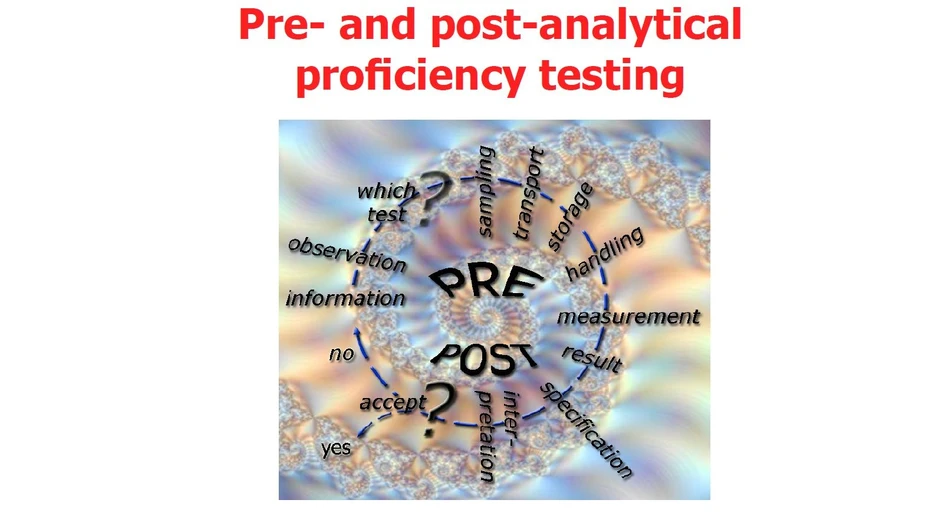
Routine chemical analysis typically involves several steps, e.g. selection of procedure, sampling, sample preparation, measurement, result calculation, uncertainty estimation, and reporting to customer. Based on the result, important decisions and actions are taken. The steps before and after the measurement are often referred to as “pre- and post-analytical”. There are many sources of uncertainty associated with this work, some of which can actually limit the overall quality.
Proficiency testing (PT) and external quality assessment (EQA) schemes are effective means of assessing the quality of routine analyses. However, if there are specific procedures, either before or after the measurement, which are applied to the routine samples, but not to the PT test sample, the result reflects only the quality of part of the measurement process. Pre- and post-analytical PT/ EQA schemes are already widely used in laboratory medicine. The standard ISO 15189, that underpins accreditation of medical laboratories, stresses that EQA schemes should “... have the effect of checking the entire process including pre- and post-examination procedures ...”
The examples in this leaflet illustrate the potential and importance of pre- and post-analytical PT/EQA. They are intended as an inspiration for the providers to further develop their external quality control activities.
Pre- and post-analytical PT/EQA – a means for harmonisation
By illustrating, e.g. lack of adherence to guidelines, or variation in sample preparation, or inconsistency in interpretation, pre- and post-analytical PT/EQA schemes pinpoint problems not apparent in other schemes. This may lead to improved harmonisation and changes to guidelines and standards.
Example 1: Interpreting clinical chemistry information
Patient background information together with analytical results can be used to check agreement of interpretational advice given by medical doctors. This type of scheme can, therefore, include both pre- and post-analytical aspects. The provider, e.g. through an expert group, ranks the quality of participants’ response and suggestions, and presents them in the report with comments.
Example 2: Sampling requests in microbiology
Using the scenario of food poisoning, pre- & post-analytical aspects of sampling requests in a microbiology scheme can be highlighted. The provider gives information about food type, symptoms, and incubation time with a simulated sample. Participants choose which organism(s) to test for. The associated laboratory work involves examination of samples, report on method(s) of choice and results. Participants could, e.g. be asked to specify which toxins or pathogens are likely to cause the food poisoning and state whether or not they will disseminate information, e.g. to hospitals or food suppliers. The feedback report would then show the results of each participant together with the comments of the provider.
Example 3: Toy testing
Faulty design, usage and chance play a role in injury and death incidents related to children’s toys. Toy safety is the practice of ensuring that toys are safe, usually through the application of set safety standards. The PT provider sources a toy, performs visual assessment of its homogeneity, and distributes the samples. Participants are requested to assess the toy against the European standard EN 71 and they have to decide which clauses of the standard apply. The clauses chosen define the test(s) to be carried out. The feedback report will contain a “model answer” including clauses, tests and labeling requirements (when applicable).
Example 4: Monitoring drinking water quality
A post-analytical application can be underpinned by legislation and national regulations (Directive 98/83/EC). Participants receive a synthetic drinking water sample with properties close to one or more limiting values. They are requested to deliver results, uncertainties and a “pass/fail” recommendation to the customer. The recommendations of the provider are listed in the feedback report for educational purposes. Information can be fed back also to regulators to serve, e.g. as basis for further discussions.
More information / further reading
Information about PT providers and schemes can be obtained from your national accreditation body, from the EPTIS website or from other national or international organisations.