

Plenary speakers at the 19th International Symposium on Hyphenated Techniques in Chromatography and Separation Technology (HTC-19)
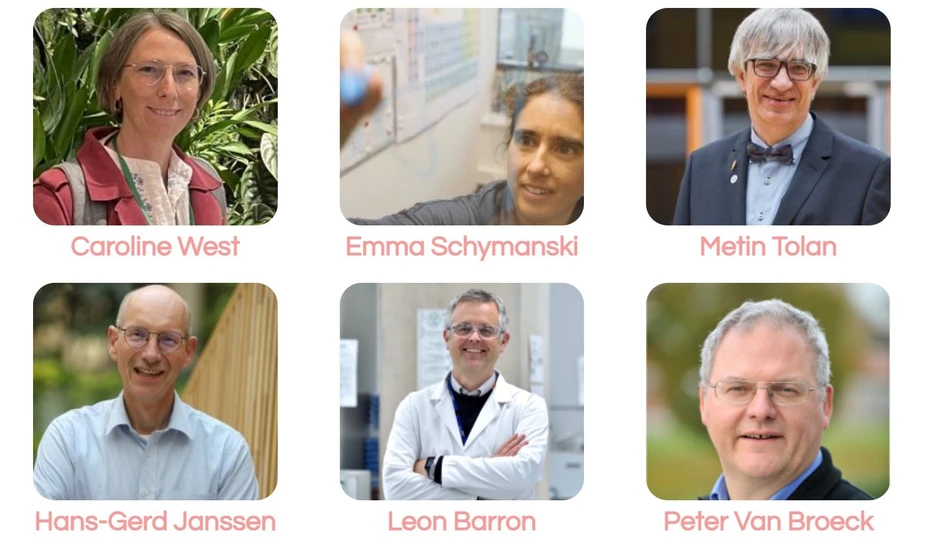
Plenary speakers at the 19th International Symposium on Hyphenated Techniques in Chromatography and Separation Technology (HTC-19)
It is our great pleasure to invite you to attend and contribute to the 19th International Symposium on Hyphenated Techniques in Chromatograph and Separation Technology (HTC-19), which will take place from May 26 to 29 in Leuven, Belgium.
The HTC symposium series started in 1990 and is the ideal meeting place for scientists and practitioners from academia and industry and vendors to discuss and gather new insights in emerging technologies, instrumentation, workflows, and applications. Organized under the auspices of the Vrije Universiteit Brussel (VUB), the Catholic University of Leuven (KU Leuven), Ghent University (UGhent), and the Separation Science Group of the Royal Society of Chemistry (RSC), HTC-19 is expected to gather over 300 participants.
Registration
Registration Fee
Regular (From 14 March 2026)
- Industry / Academic: € 775
- Student: € 425
Conference dinner / Tasting Event
- Participants: € 95 / € 50
- Accompanying persons: € 110 / € 60
Short courses (CE, GC and GCxGC, NANOLC-MS, 2D-LC)
- Academic: € 500
- Industry: € 500
- Students: € 350
Short course (AI MD Development)
- Academic: € 250
- Industry: € 250
- Students: € 125
Programme
Plenary Spekares
Under pressure: bringing supercritical fluids to multi-dimensional analysis systems
- Caroline West, Université d’Orléans, France
- Caroline West is a full professor in analytical chemistry at the University of Orleans, France, where she is teaching separation science. Her main scientific interests lie in fundamentals of chromatographic selectivity, both in the achiral and chiral modes, in SFC and LC. She is also applying these methods, with or without hyphenation to extraction methods and/or MS, to samples of pharmaceutical interest and natural products. She has authored about 120 papers in international peer‐reviewed journals and has presented about 120 lectures in conferences. In 2015, she received the “LC‐GC Emerging Leader in Chromatography” award. She was ranked several times among the most influential people in analytical chemistry by “The Analytical Scientist” magazine (“Top 40 under 40” 2014 & 2018, “The Power List” 2019, 2020 & 2021), received the Jubilee medal from the Chromatographic Society (2021) and JFK Huber Lecture award from the Austrian Society of Analytical Sciences (2025). She is also an advisory board member for several journals in separation science.
Open Science Cheminformatics Resources Supporting Hyphenated Non-target Screening Efforts
- Emma Schymanski, University of Luxembourg, Luxembourg
- Professor Emma Schymanski is head of the Environmental Cheminformatics (ECI) group, FNR ATTRACT Fellow and special advisor to the rector for Open Science and Research Data Management. She has a double degree in Chemistry/Environmental Engineering from UWA, Perth, completed her PhD at UFZ Leipzig and postdoc at Eawag, Switzerland. Her research combines cheminformatics and computational (high resolution) mass spectrometry approaches to elucidate the unknowns in complex samples, primarily with non-target screening, and relate these to environmental causes of disease. She is involved in many collaborative efforts, with >16,000 citations, >100 publications and a book. An advocate for FAIR and open science, she is involved in several European and worldwide activities to improve the exchange of data, information and ideas between scientists, including the NORMAN Suspect List Exchange, MassBank, MetFrag, PubChemLite for Exposomics, the PubChem PFAS Tree, patRoon, ShinyTPs and the Chemical Stripes.
The challenges of scale for meaningful environmental research
- Leon Barron, Imperial College London, United Kingdom
- Professor Leon Barron leads the Emerging Chemical Contaminants group at Imperial College London. His research aims to further our understanding of complex chemical exposures on environmental and public health. He gained his PhD in 2005 from Dublin City University and in 2009 moved to King’s College London as an academic in Forensic Science until 2020. He moved to Imperial in 2020 and was recently promoted to full professor of Analytical and Environmental Sciences in 2025. He has pioneered several (bio)analytical methodologies especially the development and integration novel passive sampling tools, liquid chromatography-mass spectrometry methods and predictive machine learning for contaminant identification, monitoring and risk assessment. He is a Fellow of the Royal Society of Chemistry and is the current Chair of its Separation Science Interest Group. His work has been recognised particularly for its large-scale applicability including in national and international monitoring campaigns in partnership with academia, government, industry and the general public.
Hyphenated methods in chromatography: Innovations realised and challenges remaining
- Hans-Gerd Janssen, Unilever, The Netherlands
- Prof. Hans-Gerd Janssen obtained his MSc and PhD degree in analytical chemistry from the Eindhoven University of Technology. After having worked at this university for another 8 years as an assistant/associate professor, he moved to Unilever R&D in 1999 and currently holds the position of science leader Food Compositional Analysis. From 2004 to 2019 he was a part-time professor at the University of Amsterdam at the chair ‘(bio-)macromolecular separations’. In 2019 he moved to Wageningen University where he now holds a part-time professor position in ‘recognition-based analytical chemistry’. Prof. Janssen has published more than 230 papers including six patents and seven book chapters. He is a member of the editorial advisory board of several scientific journals. He has been, or is, a member of the board of the Analytical Chemistry division of the Dutch Chemical Society and of the working group Separation Methods. He also is a member of the scientific or organizing committee of several symposia. Prof. Janssen was awarded the 2020 GC×GC scientific achievement award in recognition of his contribution to the field. In 2023 he was awarded the H.J. Dutton Award from the American Oil Chemist’s Society. In his research he focuses on the development of chromatographic methods and theories for the reliable, rapid and automated analysis of complex samples. Much of his work was on edible oils and fats, but also other food related samples including packaging materials and food processing got his attention. More recently his work focusses on food flavour analysis and understanding sensory perception from detailed chemical analysis.
Delicious Science: A Chemical Journey Through the Kitchen
- Peter Van Broeck, WM-Lightning B.V., Belgium
- Dr. Peter Van Broeck has more than 30 years of experience in analytical chemistry, process control, and technological innovation within the pharmaceutical and chemical industry. Since 2023, he has been Managing Director of WM-Lightning B.V., a consultancy firm specialized in innovation, interim management, and strategic support. He spent a significant part of his career at Johnson & Johnson, where he held leadership roles in Analytical Development and Chemical Process Control. As Scientific Director, he was end-to-end responsible for the analytical strategy within continuous manufacturing, the implementation of Process Analytical Technology (PAT), and the introduction of new analytical technologies. He developed extensive international academic and industry networks and represented the organization in various innovation programs and conferences. Earlier, Dr. Van Broeck led the Chemical Process Control Lab, where he drove the global adoption of PAT. At Amylum NV and BetzDearborn Inc., he focused on analytical method development, laboratory setup, and the introduction of advanced techniques such as HT-GPC, NIR and hyphenated GC and HPLC techniques. He also served as a Guest Professor at Hasselt University, teaching Industrial Chemistry to Business Engineering students. Beyond his scientific career, Dr. Van Broeck has a long-standing passion for wine, gastronomy, and the chemistry of flavor. Building on early academic and R&D experience in food analytics, he actively explores the intersection of taste, chemistry, and sensory experience, and is frequently invited as a speaker on topics such as food pairing and the science of brewing and winemaking.
Shaken, not stirred – James Bond in the spotlight of physics
- Metin Tolan, Faculty of Physics, TU Dortmund University, Germany
Main areas of research: Investigation of the interfacial behavior of so-called “soft matter” (polymers, liquids, biomaterials), phase diagrams and stability of proteins, use of synchrotron radiation for materials research in general and further development of investigation methods, more than 200 publications in refereed journals
Professional career: Since April 2025: Professor of Experimental Physics, Faculty of Physics, TU Dortmund University 2021–2025: President of Georg August University of Göttingen (on leave from TU Dortmund University) 2008–2020: Vice Rector for Research (3 years), for Studies (5 years), for Finance (4 years) at TU Dortmund University, permanent representative of the Rector 2003: Admitted as a full member of the North Rhine-Westphalian Academy of Sciences and Arts Since 2001: full professorship (C4) for experimental physics at TU Dortmund University. Chair of Experimental Physics I 1998 – 2001 Habilitation in experimental physics. Lecturer at Christian Albrechts University of Kiel 1994 – 1998: Research stays in the USA at Brookhaven National Laboratory (1994), Exxon Research Laboratories (1994), State University of New York at Stony Brook (1995 and 1998) and Argonne National Laboratory (1996 and 1997) 1990–1993: Research assistant, Institute for Experimental Physics, Christian Albrechts University of Kiel. Doctorate in physics (dissertation: “X-ray scattering on laterally structured surfaces – experiment and theory”) 1984–1989: Studied physics with a minor in mathematics, Christian Albrechts University of Kiel. Diploma in mathematical physics
Awards: 2024 Culture Prize of the Eduard Rhein Foundation 2018 Awarded the Badge of Honor of the German Physical Society 2017 Robert Wichard Pohl Prize of the German Physical Society for outstanding contributions to physics 2013 Communicator Prize of the DFG and the Stifterverband der Deutschen Wissenschaft 2010 Awarded the Silver Badge of Honor for special services to the DESY Research Center in Hamburg 2010 Professor of the Year elected by magazine “UNICUM Beruf” in the field of natural sciences and medicinePopular Books: 5 books published, among them “Shaken, not stirred! – James Bond in the Spotlight of Physics” Springer (2020) (in German: “Geschüttelt, nicht gerührt! – James Bond im Visier der Physik”, Piper 2008)


_s.webp)


_s.webp)


