Author
Eurachem
Eurachem
Eurachem is a European network promoting international traceability of chemical measurements and good analytical practice. It provides expert guidance, supports method validation, uncertainty evaluation, proficiency testing, and facilitates discussion on technical and policy issues in analytical quality.
Tags
Article
Science and research
LinkedIn Logo

Performance Assessment of Binary Output Examinations in Medical Laboratories

Tu, 31.3.2026
| Original article from: Eurachem
Learn how to assess clinical test performance using sensitivity, specificity, and confidence intervals, and how to define fitness-for-purpose criteria for reliable diagnostic decisions.
<p>Eurachem: Performance Assessment of Binary Output Examinations in Medical Laboratories</p>

Eurachem: Performance Assessment of Binary Output Examinations in Medical Laboratories

1 - What is fitness for purpose? 

The test meets the necessary performance criteria for a clinical binary examination to ensure it is suitable for making accurate and reliable clinical decisions in the intended patient population. Among others, performance criteria include clinical sensitivity and clinical specificity. 

2 - How to assess clinical performance? 

Assessing the clinical performance of a binary examination, stating results as 'positive' or 'negative,' involves calculating the examination's Clinical Sensitivity and Clinical Specificity. From the physician's point of view, clinical performance is evaluated by using predictive values, i.e., how likely is it that a positive or negative result corresponds to the presence or absence of the condition, which is also influenced by the prevalence of the condition in the population being tested. 

3 - What is Clinical Sensitivity? 

Clinical sensitivity (SS), also known as the True Positive Rate, measures the proportion of true positives correctly identified by the test. Data from a group of subjects who have been confirmed to have the disease or condition through diagnosis or a gold standard test (D1 in Table 1) are needed to calculate clinical sensitivity.
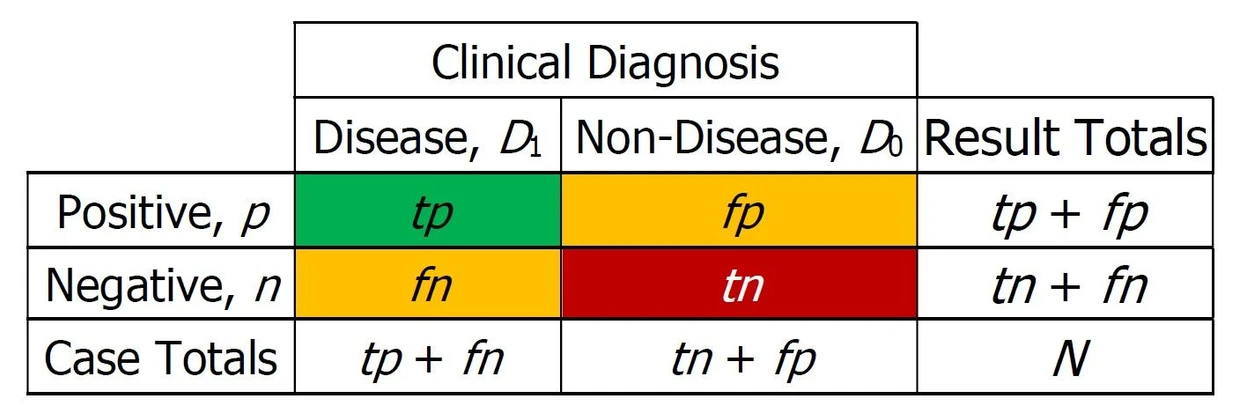
Eurachem: Table 1. 2x2 Contingency table for clinical diagnosis.Eurachem: Table 1. 2x2 Contingency table for clinical diagnosis.

The formula for clinical sensitivity is: 

SS = tp / (tp + fn), with: 

  • tp, True Positives are the cases where the test correctly identifies the presence of the disease. 
  • fn, False Negatives are the cases where the test incorrectly identifies the absence of the disease when it is actually present. 

Table 1 represents the components of clinical sensitivity and specificity. Figure 1 illustrates an example of the overlapping of the number of components. The symbol "∩" represents the intersection of groups. For example, D1∩n denotes the set of negative results obtained for known positive cases, i.e., false negatives.

4 - What is Clinical Specificity? 

Clinical Specificity (SP), also known as the True Negative Rate, measures the proportion of true negatives correctly identified by the test. Data from a group of subjects who have been confirmed not to have the disease or condition through a gold standard test (D0 in Table 1) are needed to calculate clinical specificity.

The formula for clinical specificity is: 

SP = tn / (tn + fp), where: 

  • tn, True Negatives are the cases where the test correctly identifies the absence of the disease. 
  • fp, False Positives are the cases where the test incorrectly identifies the presence of the disease when it is actually absent. 
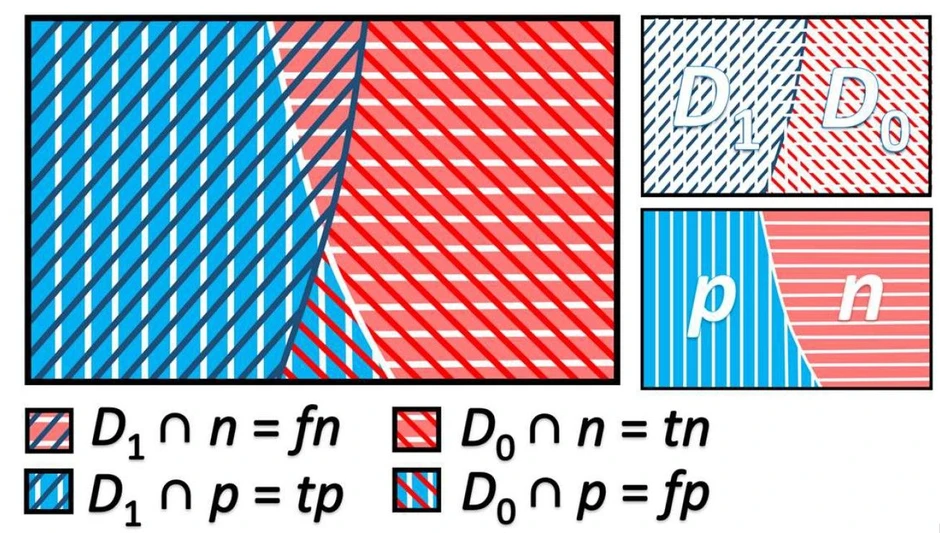
Eurachem: Figure 1. Graphical representation of an example of tp (D1∩p), tn (D0∩n), fn (D1∩n), and fp (D0∩p).Eurachem: Figure 1. Graphical representation of an example of tp (D1∩p), tn (D0∩n), fn (D1∩n), and fp (D0∩p).

5 - How to calculate the uncertainty of clinical sensitivity and specificity?

Calculating clinical sensitivity and specificity uncertainty involves statistical methods that estimate each parameter's confidence interval (CI). These intervals provide a range of values within which the true sensitivity or specificity is expected to lie with a certain level of confidence, typically 95 %. Please refer to the AQA:2021 for information about statistical models to compute the 95 % CI [1].

6 - How to define targets? 

Target minimum values for clinical sensitivity and specificity should be identified. These values may originate from regulations or criteria based on the intended use of the binary results. A target or minimum value for the lower limit of the 95 % CI for result rate, i.e., SS or SP, (LLSS.95 or LLSP.95) or the upper limit of the 95 % CI for result rate (HLSS.95 or HLSS.95) should also be defined according to the purpose of the analysis. The target or minimum value (LLSStg or LLSPtg) is particularly significant when the impact of false results is critical. For example, for blood components used in transfusions, the screening for infectious diseases should be performed with tests associated with an LLSS.95 close to 100 %. 

Figure 2 illustrates five different tests, each assessed for clinical sensitivity and its associated uncertainty. These cases reflect different levels of compliance with a target sensitivity of 0.5. Case 1 is non-compliant, Cases 2 to 4 are partially compliant, and Case 5 is compliant. From a simplified statistical power view, the laboratory should always take into account the minimum number of samples when defining its target. This number can be estimated by simulation. For example, for a clinical sensitivity of 90 % the evaluation will require a minimum of 10 samples. It should be emphasized that samples must be representative of the target population for a clinical power evaluation - for example, epidemiologically representative samples of the types and subtypes of a given virological agent are required.
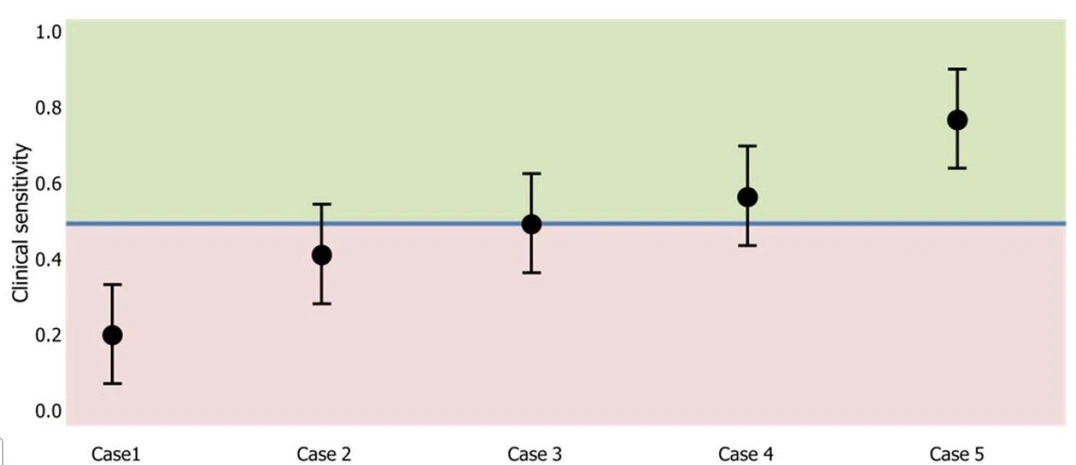
Eurachem: Figure 2. Compliance assessment with clinical sensitivity uncertainty using the lower 95% confidence interval limit for five performance assessment scenarios.Eurachem: Figure 2. Compliance assessment with clinical sensitivity uncertainty using the lower 95% confidence interval limit for five performance assessment scenarios.

Resources

[1] R. Bettencourt da Silva and S. L. R. Ellison (eds.) Eurachem/CITAC Guide: Assessment of performance and uncertainty in qualitative chemical analysis. (1st ed. 2021). 

Eurachem
LinkedIn Logo
 

Related content

Detection of Phenol Leakage into Wastewater Using TOC Measurement

Applications
| 2026 | Shimadzu
Instrumentation
TOC
Manufacturer
Shimadzu
Industries
Environmental

Routine Analysis of Rare Earth Elements in Basalt using ICP-MS

Applications
| 2026 | Agilent Technologies
Instrumentation
ICP/MS
Manufacturer
Agilent Technologies
Industries
Materials Testing

Analysis of rare earth elements in clay using XRF and XRD

Applications
| 2026 | Thermo Fisher Scientific
Instrumentation
XRD
Manufacturer
Thermo Fisher Scientific
Industries
Materials Testing

Measurement of TOC in Chloroisocyanuric Acid Used as Disinfectant

Applications
| 2026 | Shimadzu
Instrumentation
TOC
Manufacturer
Shimadzu
Industries
Pharma & Biopharma

High Precision Analysis of Major Components in Precious Metals by ICP-OES

Applications
| 2025 | Agilent Technologies
Instrumentation
ICP-OES
Manufacturer
Agilent Technologies
Industries
Materials Testing
 

Related articles

Amplification-Free Strategy for miRNA Quantification in Human Serum Using Single Particle ICP–MS and Gold Nanoparticles as Labels
Article | Scientific article

Amplification-Free Strategy for miRNA Quantification in Human Serum Using Single Particle ICP–MS and Gold Nanoparticles as Labels

In the article published in ACS Analytical Chemistry journal the researchers presented novel analytical strategy for detecting miRNA in human plasma without relying on nucleic acid amplification
LabRulez
tag
share
more
Blending Samples to Increase Accuracy and Precision of 1H NMR Urine Metabolomics
Article | Scientific article

Blending Samples to Increase Accuracy and Precision of 1H NMR Urine Metabolomics

In the article, the researchers showed that calculating 1H NMR the spectra of original samples from mixtures of urine samples using linear algebra reduces the shift problems.
LabRulez
tag
share
more
Digital Immunoassay for Biomarker Detection Based on Single-Particle Laser Ablation ICP MS
Scientific article | Science and research

Digital Immunoassay for Biomarker Detection Based on Single-Particle Laser Ablation ICP MS

A digital immunoassay using LA-SP-ICP-MS counts UCNP-labeled complexes with sub-pg/mL LODs, enabling detection of low-abundance biomarkers in clinical samples with high accuracy.
LabRulez
tag
share
more
Biochemometric 2D NMR-Based Heterocovariance Analysis: A Targeted Approach for Identifying Bioactive Compounds in Complex Mixtures
Scientific article | Science and research

Biochemometric 2D NMR-Based Heterocovariance Analysis: A Targeted Approach for Identifying Bioactive Compounds in Complex Mixtures

This study introduces a biochemometric 2D NMR heterocovariance approach to correlate spectral features with bioactivity, enabling targeted discovery of bioactive compounds in complex extracts.
LabRulez
tag
share
more
 

Related content

Detection of Phenol Leakage into Wastewater Using TOC Measurement

Applications
| 2026 | Shimadzu
Instrumentation
TOC
Manufacturer
Shimadzu
Industries
Environmental

Routine Analysis of Rare Earth Elements in Basalt using ICP-MS

Applications
| 2026 | Agilent Technologies
Instrumentation
ICP/MS
Manufacturer
Agilent Technologies
Industries
Materials Testing

Analysis of rare earth elements in clay using XRF and XRD

Applications
| 2026 | Thermo Fisher Scientific
Instrumentation
XRD
Manufacturer
Thermo Fisher Scientific
Industries
Materials Testing

Measurement of TOC in Chloroisocyanuric Acid Used as Disinfectant

Applications
| 2026 | Shimadzu
Instrumentation
TOC
Manufacturer
Shimadzu
Industries
Pharma & Biopharma

High Precision Analysis of Major Components in Precious Metals by ICP-OES

Applications
| 2025 | Agilent Technologies
Instrumentation
ICP-OES
Manufacturer
Agilent Technologies
Industries
Materials Testing
 

Related articles

Amplification-Free Strategy for miRNA Quantification in Human Serum Using Single Particle ICP–MS and Gold Nanoparticles as Labels
Article | Scientific article

Amplification-Free Strategy for miRNA Quantification in Human Serum Using Single Particle ICP–MS and Gold Nanoparticles as Labels

In the article published in ACS Analytical Chemistry journal the researchers presented novel analytical strategy for detecting miRNA in human plasma without relying on nucleic acid amplification
LabRulez
tag
share
more
Blending Samples to Increase Accuracy and Precision of 1H NMR Urine Metabolomics
Article | Scientific article

Blending Samples to Increase Accuracy and Precision of 1H NMR Urine Metabolomics

In the article, the researchers showed that calculating 1H NMR the spectra of original samples from mixtures of urine samples using linear algebra reduces the shift problems.
LabRulez
tag
share
more
Digital Immunoassay for Biomarker Detection Based on Single-Particle Laser Ablation ICP MS
Scientific article | Science and research

Digital Immunoassay for Biomarker Detection Based on Single-Particle Laser Ablation ICP MS

A digital immunoassay using LA-SP-ICP-MS counts UCNP-labeled complexes with sub-pg/mL LODs, enabling detection of low-abundance biomarkers in clinical samples with high accuracy.
LabRulez
tag
share
more
Biochemometric 2D NMR-Based Heterocovariance Analysis: A Targeted Approach for Identifying Bioactive Compounds in Complex Mixtures
Scientific article | Science and research

Biochemometric 2D NMR-Based Heterocovariance Analysis: A Targeted Approach for Identifying Bioactive Compounds in Complex Mixtures

This study introduces a biochemometric 2D NMR heterocovariance approach to correlate spectral features with bioactivity, enabling targeted discovery of bioactive compounds in complex extracts.
LabRulez
tag
share
more
 

Related content

Detection of Phenol Leakage into Wastewater Using TOC Measurement

Applications
| 2026 | Shimadzu
Instrumentation
TOC
Manufacturer
Shimadzu
Industries
Environmental

Routine Analysis of Rare Earth Elements in Basalt using ICP-MS

Applications
| 2026 | Agilent Technologies
Instrumentation
ICP/MS
Manufacturer
Agilent Technologies
Industries
Materials Testing

Analysis of rare earth elements in clay using XRF and XRD

Applications
| 2026 | Thermo Fisher Scientific
Instrumentation
XRD
Manufacturer
Thermo Fisher Scientific
Industries
Materials Testing

Measurement of TOC in Chloroisocyanuric Acid Used as Disinfectant

Applications
| 2026 | Shimadzu
Instrumentation
TOC
Manufacturer
Shimadzu
Industries
Pharma & Biopharma

High Precision Analysis of Major Components in Precious Metals by ICP-OES

Applications
| 2025 | Agilent Technologies
Instrumentation
ICP-OES
Manufacturer
Agilent Technologies
Industries
Materials Testing
 

Related articles

Amplification-Free Strategy for miRNA Quantification in Human Serum Using Single Particle ICP–MS and Gold Nanoparticles as Labels
Article | Scientific article

Amplification-Free Strategy for miRNA Quantification in Human Serum Using Single Particle ICP–MS and Gold Nanoparticles as Labels

In the article published in ACS Analytical Chemistry journal the researchers presented novel analytical strategy for detecting miRNA in human plasma without relying on nucleic acid amplification
LabRulez
tag
share
more
Blending Samples to Increase Accuracy and Precision of 1H NMR Urine Metabolomics
Article | Scientific article

Blending Samples to Increase Accuracy and Precision of 1H NMR Urine Metabolomics

In the article, the researchers showed that calculating 1H NMR the spectra of original samples from mixtures of urine samples using linear algebra reduces the shift problems.
LabRulez
tag
share
more
Digital Immunoassay for Biomarker Detection Based on Single-Particle Laser Ablation ICP MS
Scientific article | Science and research

Digital Immunoassay for Biomarker Detection Based on Single-Particle Laser Ablation ICP MS

A digital immunoassay using LA-SP-ICP-MS counts UCNP-labeled complexes with sub-pg/mL LODs, enabling detection of low-abundance biomarkers in clinical samples with high accuracy.
LabRulez
tag
share
more
Biochemometric 2D NMR-Based Heterocovariance Analysis: A Targeted Approach for Identifying Bioactive Compounds in Complex Mixtures
Scientific article | Science and research

Biochemometric 2D NMR-Based Heterocovariance Analysis: A Targeted Approach for Identifying Bioactive Compounds in Complex Mixtures

This study introduces a biochemometric 2D NMR heterocovariance approach to correlate spectral features with bioactivity, enabling targeted discovery of bioactive compounds in complex extracts.
LabRulez
tag
share
more
 

Related content

Detection of Phenol Leakage into Wastewater Using TOC Measurement

Applications
| 2026 | Shimadzu
Instrumentation
TOC
Manufacturer
Shimadzu
Industries
Environmental

Routine Analysis of Rare Earth Elements in Basalt using ICP-MS

Applications
| 2026 | Agilent Technologies
Instrumentation
ICP/MS
Manufacturer
Agilent Technologies
Industries
Materials Testing

Analysis of rare earth elements in clay using XRF and XRD

Applications
| 2026 | Thermo Fisher Scientific
Instrumentation
XRD
Manufacturer
Thermo Fisher Scientific
Industries
Materials Testing

Measurement of TOC in Chloroisocyanuric Acid Used as Disinfectant

Applications
| 2026 | Shimadzu
Instrumentation
TOC
Manufacturer
Shimadzu
Industries
Pharma & Biopharma

High Precision Analysis of Major Components in Precious Metals by ICP-OES

Applications
| 2025 | Agilent Technologies
Instrumentation
ICP-OES
Manufacturer
Agilent Technologies
Industries
Materials Testing
 

Related articles

Amplification-Free Strategy for miRNA Quantification in Human Serum Using Single Particle ICP–MS and Gold Nanoparticles as Labels
Article | Scientific article

Amplification-Free Strategy for miRNA Quantification in Human Serum Using Single Particle ICP–MS and Gold Nanoparticles as Labels

In the article published in ACS Analytical Chemistry journal the researchers presented novel analytical strategy for detecting miRNA in human plasma without relying on nucleic acid amplification
LabRulez
tag
share
more
Blending Samples to Increase Accuracy and Precision of 1H NMR Urine Metabolomics
Article | Scientific article

Blending Samples to Increase Accuracy and Precision of 1H NMR Urine Metabolomics

In the article, the researchers showed that calculating 1H NMR the spectra of original samples from mixtures of urine samples using linear algebra reduces the shift problems.
LabRulez
tag
share
more
Digital Immunoassay for Biomarker Detection Based on Single-Particle Laser Ablation ICP MS
Scientific article | Science and research

Digital Immunoassay for Biomarker Detection Based on Single-Particle Laser Ablation ICP MS

A digital immunoassay using LA-SP-ICP-MS counts UCNP-labeled complexes with sub-pg/mL LODs, enabling detection of low-abundance biomarkers in clinical samples with high accuracy.
LabRulez
tag
share
more
Biochemometric 2D NMR-Based Heterocovariance Analysis: A Targeted Approach for Identifying Bioactive Compounds in Complex Mixtures
Scientific article | Science and research

Biochemometric 2D NMR-Based Heterocovariance Analysis: A Targeted Approach for Identifying Bioactive Compounds in Complex Mixtures

This study introduces a biochemometric 2D NMR heterocovariance approach to correlate spectral features with bioactivity, enabling targeted discovery of bioactive compounds in complex extracts.
LabRulez
tag
share
more
Other projects
GCMS
LCMS
Follow us
FacebookLinkedInYouTube
More information
WebinarsAbout usContact usTerms of use
LabRulez s.r.o. All rights reserved. Content available under a CC BY-SA 4.0 Attribution-ShareAlike