News from LabRulezICPMS Library - Week 43, 2025
LabRulez: News from LabRulezICPMS Library - Week 43, 2025
Our Library never stops expanding. What are the most recent contributions to LabRulezICPMS Library in the week of 20th October 2025? Check out new documents from the field of spectroscopy/spectrometry and related techniques!
👉 SEARCH THE LARGEST REPOSITORY OF DOCUMENTS ABOUT SPECTROSCOPY/SPECTROMETRY RELATED TECHNIQUES
👉 Need info about different analytical techniques? Peek into LabRulezLCMS or LabRulezGCMS libraries.
This week we bring you application notes Agilent Technologies and Shimadzu and poster by Thermo Fisher Scientific!
1. Agilent Technologies: Optimizing Microplastic Characterization by LDIR: Automated versus Manual Workflows
- Application note
- Full PDF for download
The Agilent 8700 LDIR chemical imaging system with Agilent Clarity control software provides automated and manual workflows for the characterization of microplastics isolated from a wide range of matrices.
The Particle Analysis workflow is specially designed for routine testing, enabling fast, fully automated characterization of particles within a default size range of 20 to 500 µm. This range can be adjusted based on user methodology and analytical requirements. Once a region of interest has been defined on the substrate and a spectral library has been selected in the software, the 8700 LDIR automatically detects particles, acquires infrared (IR) spectra, matches the spectra against the library, and updates results in real time.
The manual analysis workflow allows users to adjust parameters, acquire spectra, and collect high-magnification images of particles as small as a few micrometers, providing greater flexibility for method development and research applications.
This technical overview evaluates the performance of both types of workflow using NIST-traceable polystyrene (PS) latex beads of 2, 5, and 10 µm diameter. Measurements were performed on both low-E slides and aluminum-coated (AI-coated) filters (0.8 µm pore size) to assess the influence of the substrate background on the minimum measurable particle size.
Results and discussion
Manual workflow
- 2 µm PS beads: High-magnification visible images were obtained for the 2 µm PS beads on the low-E slide by focusing on individual particles and using the ruler feature in the Clarity software to measure the length (Table 2). IR images were generated at 1,442 cm–1 with a pixel size resolution of 1 µm, resolving the 2 µm beads. Using the line profile feature and a reduced acquisition (sweep) speed, 20 spectra were acquired. The averaged spectrum (automatically obtained after data collection) was compared to reference spectra in the Microplastics Starter 2.1 library. The particle was correctly identified as polystyrene with a hit quality index (HQI) of 0.940. The 2 µm particles were successfully detected and identified on low-E slides only. Background interference from the 0.8 µm pores of the Al-coated filters prevented data collection from the 2 µm particles.
- 5 µm PS beads: High-magnification visible and IR images were successfully obtained for the 5 µm PS beads on both types of substrate. The spectra were collected in line profile mode using a faster data acquisition rate than for the smaller particles. The beads were accurately identified as PS with HQIs of 0.924 and 0.947 for the low-E slide and Al-filter, respectively (Table 2).
- 10 µm PS beads: The 10 µm PS beads were easily imaged and identified on both substrates with improved HQIs of 0.972 for the low-E slide and 0.968 for the Al-coated filter (Table 2).
Conclusion
The Agilent 8700 LDIR chemical imaging system is capable of analyzing microplastics as small as 2 µm on a low-E slide using a manual workflow and 5 µm and above using the automated Particle Analysis method. However, the automated workflow provided the most reliable identification and highest-confidence library matching results for particles ≥ 10 µm. Together, the two workflows offer complementary capabilities—automation for the rapid, routine analysis of larger particles and manual control for smaller particle characterization and research applications.
2. Shimadzu: Quantitative Analysis of Leaching of Heavy Metals in Soil Using ICP-MS
- Application note
- Full PDF for download
When soil is polluted by human activities such as industrial operations and waste disposal, harmful substances can be absorbed into the human body. This may have an adverse effect on health. In Japan, the Soil Contamination Countermeasures Act stipulates soil survey methods and appropriate management methodsto prevent adverse health effects.
The health risks due to soil contamination can be divided into two categories: those caused by leaching of harmful substances contained in soil into groundwater and ingestion of groundwater containing such harmful substances (ingestion from groundwater), and those caused by direct ingestion of harmful substances contained in soil through the mouth or skin (direct ingestion). Under the Soil Contamination Countermeasures Act, soil leaching standards are set to address the risk of ingestion from groundwater, and soil content standards are set to address the risk of direct ingestion. These standards are expected to become stricter in the future in line with other environmental regulations. Thus, it is important to select a highly sensitive analytical method in advance.
In this application, the results of analyzing the concentrations of heavy metals leached from five types of soil samples using ICPMS, which is currently recognized as the most sensitive method for elemental analysis in soil, will be introduced.
Instrument Configurations and Analysis Conditions
- Instrument: ICPMS-2050
- Nebulizer: Nebulizer DC04
Conclusion
Leaching analysis of heavy metals in soil was conducted using the ICPMS-2050. The measurement sensitivity of the system was sufficient to meet the soil leaching standard, and the spike recovery test showed that the influence of the matrix on this measurement was small. By adopting a unique mini-torch system, ICPMS-2050 can perform high-sensitivity and low-interference measurements at about 2/3 (about 11 L/min) of the argon gas flow rate of conventional ICP-MS. In addition, good results in a long-term stability test, where 50 samples were measured continuously, demonstrated its performance (high sensitivity, low interference) and cost savings, especially in the routine analysis of multiple samples.
3. Thermo Fisher Scientific: Hyphenation of a high-speed laser ablation system to Quadrupole Inductively Coupled Plasma Mass Spectrometry (ICP-MS) for imaging applications
- Poster
- Full PDF for download
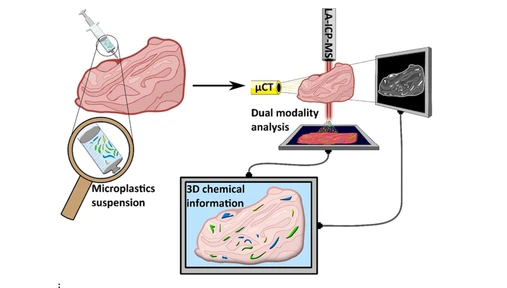
Laser Ablation (LA) coupled with ICP-MS is a well-established way to directly analyze solid samples. The main advantages of laser ablation include the ability to avoid lengthy and potentially contamination prone sample preparation protocols and the ability to obtain information about the spatial resolution of an analyte in a sample.
The interest in so-called mapping techniques has increased in recent years, calling for laser ablation systems to develop methods to improve sample transfer and therefore speed of mapping experiments. New laser-ablation systems dedicated to high-speed mapping are commercially available and can be easily coupled to quadrupole ICP-MS for such applications.
With the improvement in sample transfer and washout times from laser ablation systems, the time available to analyze discrete packets of sample from a laser pulse is drastically reduced. The limit for lateral resolution using a sequential ICP-MS, such as a quadrupole ICP-MS, is dependent on the dwell times chosen for each measured m/z channel. This has a direct impact on the signal-to-background ratio achievable for each m/z channel; therefore, a direct impact on the final image contrast for each mapped m/z channel.
Methods
An Elemental Scientific Lasers imageGEO193 Laser Ablation system fitted with a TwoVol3 Ablation chamber was directly coupled with a Thermo Scientific™ iCAP™ TQ ICP-MS using a compatible Dual Concentric Injector. Data was acquired using Thermo Scientific™ Qtegra™ Intelligent Scientific Data Solution™ (ISDS) Software and processed using Iolite™ Laser Ablation Data Reduction Software.
Results and Discussions
Washout Measurement and Optimization
For low-dispersion laser ablation set-ups, it is vitally important to assess the washout performance and peak shape of the laser pulses to determine the maximum scanning rate that can be used for a particular number of m/z channels without introducing blurring effects. To do this, a low repetition rate line was ablated on the sample surface and a matrix element was measured at 1 ms dwell time (44Ca as 44Ca.16O in this case).
Aliasing occurs, in essence, if the repetition rate and the cycle time of the laser ablation system and the ICP-MS system are not properly synchronized. This phenomenon causes periodicity in signal intensities that appear as bands in the final image. To combat this, the laser repetition rate and the sampling cycle frequency need to be matched so that an integer number of laser pulses fall within one quadrupole sweep.1
Pixelation blur is mainly a factor of the resolution at which the image is gathered, i.e., the laser spot size and the resulting pixel size. 2 To achieve high resolution (low blur), a small spot size must be used; however, this will directly decrease the signal-tobackground ratio (i.e., contrast) and increase the total experiment time. The amount of acceptable blurring must therefore be balanced with the desired contrast and experiment time.
Smearing, or motion blur, occurs when the transfer of material (washout) cannot keep up with the tracking of the laser across the sample surface (i.e., the scanning rate of the translation stages) and subsequent laser pulses are partially mixed. This is mitigated by adjusting the laser scanning time and repetition rates so that each laser pulse is fully resolved from each other when reaching the detector of the ICP-MS.
Contrast, as discussed briefly above, is a function of signal-tobackground ratio and can be adjusted by the amount of material ablated per shot (spot size and/or fluence) or the dwell time of each scanned m/z channel during the quadrupole sweep. Given a set of lasing conditions, optimizing the distribution of dwell times between all m/z channels scanned will achieve the best possible contrast for all analytes in one run.
Optimization of the Dwell Times was performed using the Precognition Add-On from Iolite Software available for ActiveView2 Laser Ablation Software. First, signal intensity data for all desired isotopes were acquired using a simple line scan across a section of the sample surface with high perceived variability. The data were loaded into the Precognition module, which then optimized the dwell times to improve the Signal-toNoise ratio (SNR) for each scanned isotope. There are two methods available:
- The Hutchinson Method: Dwell times are distributed such that the SNR is increased to above 3 for all isotopes.
- The Van Malderen Method: adjusts dwell times to improve SNR of isotopes whilst being constrained to the washout of the cell.
The Hutchinson method may result in cycle times much longer than the pulse width of the signal, so in this study the Van Malderen method was chosen. Resulting dwell times are summarized in Table 2.
Conclusions
Through careful optimization of laser ablation and ICP-MS parameters, it is possible to generate high quality multi-elemental images at a fast rate. The use of new low-dispersion laser ablation cells and aerosol transfer technology is not limited to simultaneous mass spectrometers and is also applicable to sequential scanning mass spectrometers such as Quadrupole ICP-MS.
The major limitation of coupling low-dispersion Laser Ablation systems to sequential mass spectrometers is the limited number of elements that can be scanned; however, this is offset by the sensitivity and the specificity of, especially, triple quadrupole ICPMS systems for the reduction of interferences on select analytes.
Most imaging experiments can be reduced to three or four analytes of interest, and in these cases LA-ICP-MS coupled to Triple Quadrupole ICP-MS using a low-dispersion, fast imaging setup can provide the analytical data quality required to answer challenging research questions.