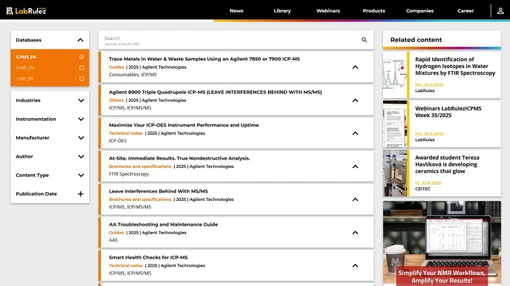
News from LabRulezICPMS Library - Week 29, 2025

LabRulez: News from LabRulezICPMS Library - Week 29, 2025
Our Library never stops expanding. What are the most recent contributions to LabRulezICPMS Library in the week of 14th July 2025? Check out new documents from the field of spectroscopy/spectrometry and related techniques!
👉 SEARCH THE LARGEST REPOSITORY OF DOCUMENTS ABOUT SPECTROSCOPY/SPECTROMETRY RELATED TECHNIQUES
👉 Need info about different analytical techniques? Peek into LabRulezLCMS or LabRulezGCMS libraries.
This week we bring you brochure by Anton Paar and application notes by Agilent Technologies and Shimadzu!
1. Anton Paar: Modular Circular Saccharimeters MCP 5300 | 5500 Sucromat
- Brochure
- Full PDF for download
The MCP Sucromat 5300 and 5500 from Anton Paar are high-precision circular saccharimeters designed specifically for the sugar industry. These instruments are widely used in sugar factories, quality control labs, and payment analysis due to their robust construction, modular expandability, and compliance with international standards such as ICUMSA, OIML, and the Australian K157.
Both models operate at the 589 nm sodium D-line wavelength, with an optional 880 nm LED light source for lead-free clarified or highly colored samples. The saccharimeters can be upgraded with features such as Peltier temperature control, Toolmaster™ (automatic wireless recognition of sample cells and quartz plates), and FillingCheck™, which uses a camera to ensure correct sample filling and traceability. These features enable precise and reproducible measurements, even under challenging conditions.
The devices are built on a solid aluminum optical bench for long-term stability and minimal optical distortion. With resolution down to 0.001 °OR and accuracy up to ±0.003 °OR, the MCP Sucromat models offer outstanding performance. They are ideal for both beet and cane sugar analysis, and can be combined with Anton Paar's Abbemat refractometers for full purity analysis, including °Z (Pol), °Brix, and % apparent purity.
Thanks to their modularity, durability, and automation capabilities, the MCP Sucromat series is a future-proof investment for sugar laboratories requiring fast, accurate, and traceable sugar content measurements, even in high-throughput environments like reception labs or integrated systems such as Betalyser.
2. Agilent Technologies: Revealing Colors of Concealers using the Cary 60 UV-Vis DRA
Coupled with an internal diffuse reflectance accessory, the Agilent Cary 60 UV-Vis quickly and accurately pinpoints color characteristics
- Application note
- Full PDF for download
Cosmetic products such as makeup, soaps, or lotions commonly require the addition of coloring agents to achieve a particular effect when applied or to improve their appearance on store shelves. Dyes and pigments are constantly being developed to improve product stability, boost color saturation, ensure consumer safety, and lower production costs. Quality control tests must be conducted on new raw materials to ensure color consistency throughout product lines. For each of these industrial needs, the analytical methodologies for characterizing these products must be robust. One of the key metrics for coloring agents is their response to UV-visible light. Cosmetics such as makeup can have complex interactions with light, including absorption, specular reflectance, and diffuse transmission and reflectance, which influence characteristics such as color, shine, and UV protection.
A powerful technique used to analyze these interactions is UV-Vis spectroscopy with an integrating sphere such as an internal UV-Vis DRA. The Cary 60 UV-Vis DRA is an attachment fitted inside the Agilent Cary 60 UV-Vis spectrophotometer (Figure 1) with a spherical cavity coated in diffuse reflective polytetrafluoroethylene or PTFE, entrance and exit ports for the UV-Vis beam, and its own detector (Figure 2).
If the sample is positioned at the entrance port, light that is diffusely transmitted through the sample can be collected with minimal loss compared to a traditional transmission measurement. Similarly, positioning the sample at the exit port allows the specular and diffusely reflected light to be measured by the integrating sphere. In this application note, diffuse reflectance of several differently colored, powdered concealers is measured to accurately determine their color coordinates using an Agilent Cary 60 UV-Vis spectrophotometer equipped with an internal DRA and the Agilent Cary WinUV Color software.
Conclusion
The Agilent Cary 60 UV-Vis spectrophotometer with DRA and the Agilent Cary WinUV Color software is a simple but powerful solution for analyzing the reflectance properties of cosmetics. The DRA is an ideal tool for measuring a range of cosmetic samples in both transmission and reflection modes, and alternative sample holders are available that allow liquids, powders, and gels to be measured. Data collection is fast and reliable, and the software allows the analysis of measurements with multiple illuminants and in many color coordinate systems by simply recalculating the data, making this combination well suited to color-based quality control and color-matching applications.
3. Shimadzu: Mapping Measurement of Paints and Pigments with Thermoelectrically Cooled MCT Detector
- Application note
- Full PDF for download
Automobiles are coated with multiple layers of paint, each with a specific purpose and composition. So paint fragments at the scene of a traffic accident can provide critical information for forensic investigations. Infrared microscopy can analyze fragments that retain this multi-layer structure to identify the component constituents in each paint layer, and this can be used to identify the specific model and year of manufacture of an automobile involvedin an accident.
Infrared microscopy is also used in scientific studies of valuable historical works of art to identify the pigment components and their distribution. This can reveal what techniques were used to create them, and it can assist in selecting the techniques and materials used to restore and conserve them.
The thermoelectrically cooled MCT (TEC MCT) detector is a new optional detector for infrared microscopes that can measure microscopic targets as small as 25 µm with high resolution and without requiring liquid nitrogen. But while AIMsight infrared microscope and the AIRsight infrared Raman microscope are equipped as standard with a T2SL detector, which can measure microscopic targets down to 10 µm, they require liquid nitrogen to do so. Due to the difficulty of procuring it and the dangers it can pose of frostbite and oxygen displacement, there is an increasing demand for analytical options that avoid using liquid nitrogen.
In this article, an infrared microscopy system (IRTracer-100, AIMsight) equipped with a TEC MCT detector was used for a mapping measurement of an automobile coating and organic pigments.
Conclusion
An infrared microscopy system equipped with a TEC MCT detector was used to perform mapping measurement of an automobile coating and organic pigments. The TEC MCT detector could perform mapping measurement over a wide target area with good sensitivity and without the need for liquid nitrogen. But for mapping measurement that requires a smaller aperture or if it needs to be quicker and use fewer scans, the T2SL detector, which requiresliquid nitrogen isrecommended.