Author
TU Wien
TU Wien
The TU Wien is Austria's largest research and educational institution in the field of technology and natural sciences. More than 4,000 scientists are researching "technology for people" in five main research areas at eight faculties. The content of the studies offered is derived from the excellent research. More than 26,000 students in 62 degree programmes benefit from this. As a driver of innovation, TU Wien strengthens the business location, facilitates cooperation and contributes to the prosperity of society.
Tags
Article
Video
Science and research
Scientific article
LinkedIn Logo

Nuclear Clocks and the Fundamental Constants of Nature
Mo, 29.7.2024
| Original article from: TU Wien
The long-sought thorium transition has been found. What can we do with it now? Very different areas of technology could benefit from this discovery.
Video placeholder
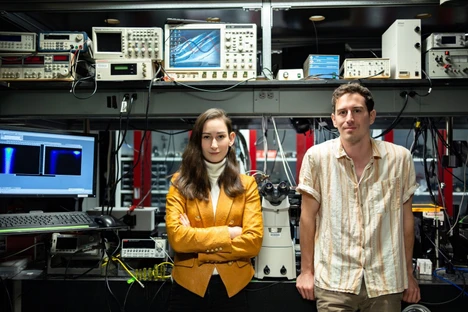
  • Photo: TU Wien: The nuclear clock: a spectacular application, made possible by the discovery of the thorium transition.
  • Viedo: ICFO People: USOQS Q-CLOCKS CC4C Workshop - Talk by Dr. Thorsten Schumm (TU Wien)

For the first time, thorium nuclei have now been successfully transferred from one state to another using a laser – but there has already been speculation for decades about the technical possibilities that would arise if this feat were one day possible. Expectations are high: probably the best-known idea is the nuclear clock, but precision measurements based on the thorium transition could open up new possibilities in completely different areas of research.

TU Wien: The nuclear clock: a spectacular application, made possible by the discovery of the thorium transition.TU Wien: The nuclear clock: a spectacular application, made possible by the discovery of the thorium transition.

Time measurement

The most accurate time measuring devices today are atomic clocks – they have even changed the definition of our units of time. Today, the second is defined as the length of time corresponding to a very specific number of oscillations of the light that must be shone on a caesium atom in order to switch its electrons from one state to another.

Similar to the pendulum of a pendulum clock, the light oscillation of the caesium atoms plays the role of the timer that provides the regular ticking for the most accurate time measurement possible. Today, atomic clocks are used, for example, for the coordination of satellites, they enable the high accuracy of GPS signals and they also play a role in telecommunications.

Instead of cesium atoms, however, thorium atomic nuclei can now also be used for keeping time. Only when the thorium nuclei are irradiated with a laser beam of exactly the right frequency do they change their state. If the laser changes its frequency slightly (e.g. due to external interference), this immediately results in a change of the response of the thorium nuclei. The combination of laser and thorium nuclei therefore makes it possible to keep the laser frequency extremely stable and ensures that the laser frequency does not drift away.

Because atomic nuclei are much smaller than atoms and much less sensitive to electromagnetic perturbations, atomic nuclei can achieve much higher precision than atoms when it comes to measuring time.

Everything gets better with better clocks

With better time measurement, other physical quantities can also be measured more accurately. This is a well-known phenomenon: in nautical navigation, for example, people have struggled for a long time with the problem that although it is easy to determine the latitude based on the position of the sun, an accurate clock is required to calculate the longitude correctly. Better time measurement often makes other measurements possible.

For example, Einstein's theory of relativity states that time does not pass in the same way everywhere: the flow of time depends on the gravitational field. In this way, an extremely precise clock could therefore be used to accurately measure the Earth's gravitational field – with many possible applications ranging from the search for mineral resources to research into plate tectonics and earthquake prediction.

Great hopes are also pinned on the possibility that new, better clocks could clarify previously unsolved fundamental questions of physics: If it is possible to measure the constants of nature much more accurately than before, then it would also be possible to test the theory that these natural constants may not be perfectly constant at all. Perhaps they change over time? Research into dark matter is also hoping to gain new insights through even more precise measurements.

It is not always possible to get closer to the fundamental laws of nature just by looking at the smallest particles in a particle accelerator or by looking at the most distant regions of space. Sometimes you just need greater precision – and this is where the newly discovered thorium transition and all its potential applications should help in the coming years and decades.

Back to the main article:

TU Wien
LinkedIn Logo
 

Related content

Detection of Phenol Leakage into Wastewater Using TOC Measurement

Applications
| 2026 | Shimadzu
Instrumentation
TOC
Manufacturer
Shimadzu
Industries
Environmental

Routine Analysis of Rare Earth Elements in Basalt using ICP-MS

Applications
| 2026 | Agilent Technologies
Instrumentation
ICP/MS
Manufacturer
Agilent Technologies
Industries
Materials Testing

Analysis of rare earth elements in clay using XRF and XRD

Applications
| 2026 | Thermo Fisher Scientific
Instrumentation
XRD
Manufacturer
Thermo Fisher Scientific
Industries
Materials Testing

Measurement of TOC in Chloroisocyanuric Acid Used as Disinfectant

Applications
| 2026 | Shimadzu
Instrumentation
TOC
Manufacturer
Shimadzu
Industries
Pharma & Biopharma

High Precision Analysis of Major Components in Precious Metals by ICP-OES

Applications
| 2025 | Agilent Technologies
Instrumentation
ICP-OES
Manufacturer
Agilent Technologies
Industries
Materials Testing
 

Related articles

Atomic Nucleus Excited with Laser: A Breakthrough after Decades
Article | Video

Atomic Nucleus Excited with Laser: A Breakthrough after Decades

The "thorium transition", has now been excited for the first time with lasers. This paves the way for revolutionary high precision technologies, including nuclear clocks.
TU Wien
tag
share
more
Study unlocks nanoscale secrets for designing next-generation solar cells
Article | Video

Study unlocks nanoscale secrets for designing next-generation solar cells

The work will help researchers tune surface properties of perovskites, a promising alternative and supplement to silicon, for more efficient photovoltaics.
Massachusetts Institute of Technology
tag
share
more
Exploring the quantum world is fascinating, says the scientist behind the development of a unique spectrometer
Article | Science and research

Exploring the quantum world is fascinating, says the scientist behind the development of a unique spectrometer

Oleksii Laguta left medicine for physics to study quantum systems. At CEITEC VUT, he’s developing the FRASCAN II spectrometer to make high-frequency ESR more accessible for research on qubits and proteins.
CEITEC
tag
share
more
Thomas Gouder: I want the project to continue. The surface research instrument is being relocated from Karlsruhe to Prague
Article | Science and research

Thomas Gouder: I want the project to continue. The surface research instrument is being relocated from Karlsruhe to Prague

A unique modular system for surface science, developed at JRC Karlsruhe by Thomas Gouder, is moving to Prague. Discover how it works, why it’s being transferred, and how it will support future research at FZU.
Czech Academy of Sciences
tag
share
more
 

Related content

Detection of Phenol Leakage into Wastewater Using TOC Measurement

Applications
| 2026 | Shimadzu
Instrumentation
TOC
Manufacturer
Shimadzu
Industries
Environmental

Routine Analysis of Rare Earth Elements in Basalt using ICP-MS

Applications
| 2026 | Agilent Technologies
Instrumentation
ICP/MS
Manufacturer
Agilent Technologies
Industries
Materials Testing

Analysis of rare earth elements in clay using XRF and XRD

Applications
| 2026 | Thermo Fisher Scientific
Instrumentation
XRD
Manufacturer
Thermo Fisher Scientific
Industries
Materials Testing

Measurement of TOC in Chloroisocyanuric Acid Used as Disinfectant

Applications
| 2026 | Shimadzu
Instrumentation
TOC
Manufacturer
Shimadzu
Industries
Pharma & Biopharma

High Precision Analysis of Major Components in Precious Metals by ICP-OES

Applications
| 2025 | Agilent Technologies
Instrumentation
ICP-OES
Manufacturer
Agilent Technologies
Industries
Materials Testing
 

Related articles

Atomic Nucleus Excited with Laser: A Breakthrough after Decades
Article | Video

Atomic Nucleus Excited with Laser: A Breakthrough after Decades

The "thorium transition", has now been excited for the first time with lasers. This paves the way for revolutionary high precision technologies, including nuclear clocks.
TU Wien
tag
share
more
Study unlocks nanoscale secrets for designing next-generation solar cells
Article | Video

Study unlocks nanoscale secrets for designing next-generation solar cells

The work will help researchers tune surface properties of perovskites, a promising alternative and supplement to silicon, for more efficient photovoltaics.
Massachusetts Institute of Technology
tag
share
more
Exploring the quantum world is fascinating, says the scientist behind the development of a unique spectrometer
Article | Science and research

Exploring the quantum world is fascinating, says the scientist behind the development of a unique spectrometer

Oleksii Laguta left medicine for physics to study quantum systems. At CEITEC VUT, he’s developing the FRASCAN II spectrometer to make high-frequency ESR more accessible for research on qubits and proteins.
CEITEC
tag
share
more
Thomas Gouder: I want the project to continue. The surface research instrument is being relocated from Karlsruhe to Prague
Article | Science and research

Thomas Gouder: I want the project to continue. The surface research instrument is being relocated from Karlsruhe to Prague

A unique modular system for surface science, developed at JRC Karlsruhe by Thomas Gouder, is moving to Prague. Discover how it works, why it’s being transferred, and how it will support future research at FZU.
Czech Academy of Sciences
tag
share
more
 

Related content

Detection of Phenol Leakage into Wastewater Using TOC Measurement

Applications
| 2026 | Shimadzu
Instrumentation
TOC
Manufacturer
Shimadzu
Industries
Environmental

Routine Analysis of Rare Earth Elements in Basalt using ICP-MS

Applications
| 2026 | Agilent Technologies
Instrumentation
ICP/MS
Manufacturer
Agilent Technologies
Industries
Materials Testing

Analysis of rare earth elements in clay using XRF and XRD

Applications
| 2026 | Thermo Fisher Scientific
Instrumentation
XRD
Manufacturer
Thermo Fisher Scientific
Industries
Materials Testing

Measurement of TOC in Chloroisocyanuric Acid Used as Disinfectant

Applications
| 2026 | Shimadzu
Instrumentation
TOC
Manufacturer
Shimadzu
Industries
Pharma & Biopharma

High Precision Analysis of Major Components in Precious Metals by ICP-OES

Applications
| 2025 | Agilent Technologies
Instrumentation
ICP-OES
Manufacturer
Agilent Technologies
Industries
Materials Testing
 

Related articles

Atomic Nucleus Excited with Laser: A Breakthrough after Decades
Article | Video

Atomic Nucleus Excited with Laser: A Breakthrough after Decades

The "thorium transition", has now been excited for the first time with lasers. This paves the way for revolutionary high precision technologies, including nuclear clocks.
TU Wien
tag
share
more
Study unlocks nanoscale secrets for designing next-generation solar cells
Article | Video

Study unlocks nanoscale secrets for designing next-generation solar cells

The work will help researchers tune surface properties of perovskites, a promising alternative and supplement to silicon, for more efficient photovoltaics.
Massachusetts Institute of Technology
tag
share
more
Exploring the quantum world is fascinating, says the scientist behind the development of a unique spectrometer
Article | Science and research

Exploring the quantum world is fascinating, says the scientist behind the development of a unique spectrometer

Oleksii Laguta left medicine for physics to study quantum systems. At CEITEC VUT, he’s developing the FRASCAN II spectrometer to make high-frequency ESR more accessible for research on qubits and proteins.
CEITEC
tag
share
more
Thomas Gouder: I want the project to continue. The surface research instrument is being relocated from Karlsruhe to Prague
Article | Science and research

Thomas Gouder: I want the project to continue. The surface research instrument is being relocated from Karlsruhe to Prague

A unique modular system for surface science, developed at JRC Karlsruhe by Thomas Gouder, is moving to Prague. Discover how it works, why it’s being transferred, and how it will support future research at FZU.
Czech Academy of Sciences
tag
share
more
 

Related content

Detection of Phenol Leakage into Wastewater Using TOC Measurement

Applications
| 2026 | Shimadzu
Instrumentation
TOC
Manufacturer
Shimadzu
Industries
Environmental

Routine Analysis of Rare Earth Elements in Basalt using ICP-MS

Applications
| 2026 | Agilent Technologies
Instrumentation
ICP/MS
Manufacturer
Agilent Technologies
Industries
Materials Testing

Analysis of rare earth elements in clay using XRF and XRD

Applications
| 2026 | Thermo Fisher Scientific
Instrumentation
XRD
Manufacturer
Thermo Fisher Scientific
Industries
Materials Testing

Measurement of TOC in Chloroisocyanuric Acid Used as Disinfectant

Applications
| 2026 | Shimadzu
Instrumentation
TOC
Manufacturer
Shimadzu
Industries
Pharma & Biopharma

High Precision Analysis of Major Components in Precious Metals by ICP-OES

Applications
| 2025 | Agilent Technologies
Instrumentation
ICP-OES
Manufacturer
Agilent Technologies
Industries
Materials Testing
 

Related articles

Atomic Nucleus Excited with Laser: A Breakthrough after Decades
Article | Video

Atomic Nucleus Excited with Laser: A Breakthrough after Decades

The "thorium transition", has now been excited for the first time with lasers. This paves the way for revolutionary high precision technologies, including nuclear clocks.
TU Wien
tag
share
more
Study unlocks nanoscale secrets for designing next-generation solar cells
Article | Video

Study unlocks nanoscale secrets for designing next-generation solar cells

The work will help researchers tune surface properties of perovskites, a promising alternative and supplement to silicon, for more efficient photovoltaics.
Massachusetts Institute of Technology
tag
share
more
Exploring the quantum world is fascinating, says the scientist behind the development of a unique spectrometer
Article | Science and research

Exploring the quantum world is fascinating, says the scientist behind the development of a unique spectrometer

Oleksii Laguta left medicine for physics to study quantum systems. At CEITEC VUT, he’s developing the FRASCAN II spectrometer to make high-frequency ESR more accessible for research on qubits and proteins.
CEITEC
tag
share
more
Thomas Gouder: I want the project to continue. The surface research instrument is being relocated from Karlsruhe to Prague
Article | Science and research

Thomas Gouder: I want the project to continue. The surface research instrument is being relocated from Karlsruhe to Prague

A unique modular system for surface science, developed at JRC Karlsruhe by Thomas Gouder, is moving to Prague. Discover how it works, why it’s being transferred, and how it will support future research at FZU.
Czech Academy of Sciences
tag
share
more
Other projects
GCMS
LCMS
Follow us
FacebookLinkedInYouTube
More information
WebinarsAbout usContact usTerms of use
LabRulez s.r.o. All rights reserved. Content available under a CC BY-SA 4.0 Attribution-ShareAlike